High-ROI Digital Marketing Strategy for Healthcare in 2026


This 2026 digital marketing strategy for healthcare guide shows how to drive ROI through integrated, data‑driven tactics across SEO, PPC, AI Search, content, and email.
Healthcare digital marketing is under pressure.
Costs are rising, sales cycles are lengthening, and compliance requirements are becoming more demanding. The average cost per lead has reached $401, while teams are expected to deliver more with less marketing budget.
At the same time, the behaviour of patients and healthcare professionals (HCP) is evolving. Search engines, social platforms, and AI tools are now key to how people research, evaluate, and choose healthcare providers and products.
To compete in 2026, brands need a healthcare digital marketing strategy that drives visibility, earns trust, and converts. We share the most effective strategies for healthcare marketing leaders focused on scaling patient acquisition, engaging professionals, and generating measurable ROI.
Why Every Healthcare Brand Needs Digital Marketing in 2026
Patients and HCPs Start Their Journey Online
From Google to TikTok to ChatGPT, patients and HCPs tend to start their long, and increasingly complex, journey online.
In 2019, Google’s previous VP of Health, David Feinberg, stated that around 7% of daily Google searches are health-related. While Google hasn’t published a more recent figure, search behaviour around healthcare continues to grow.
For example, Soliant Health reported that “Is bronchitis contagious?” was the most Googled health-related question in the U.S. in 2024, with 176,000 monthly searches. As of October 2025, that query now averages 201,000 U.S. monthly searches.
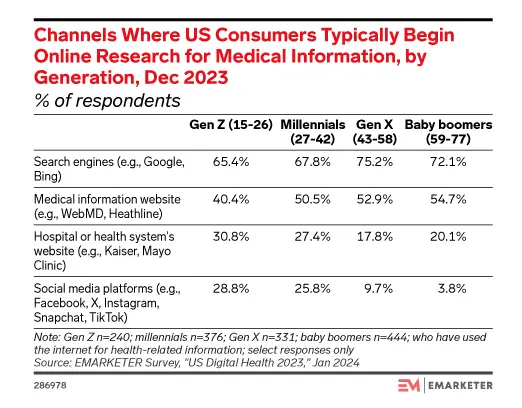
A 2023 study by eMarketer confirms that search engines remain the top choice across all generations for researching health information. Social platforms like TikTok and Facebook follow closely, especially among younger users, with 28% of Gen Z turning to social media for health advice.
However, by 2026, search habits will go beyond traditional platforms like social media or Google, thanks to AI Search.
A recent study found that one in six adults uses AI platforms at least once a month to find health information and advice. This rises to 25% of adults under the age of 30.
This means that your audience is searching online, whether on Google or ChatGPT, for information. If they’re looking for information, products, services, or clinics related to your healthcare business, you need to make sure that you’re part of that conversation.
Trust is Built Through Visibility and Credibility
Content marketing remains an integral way to capture visibility and connect with your target audience.
In fact, a study by McKinsey found 75% of consumers engage with health and wellness content (such as articles, videos, and podcasts) at least once a week. When looking for this content, 56% used Google and 43% turned to social media.
But trust is still a major barrier.
For example, although 60% of U.S. adults report watching health-related videos online, only 40% trust the information. With an estimated 30–40% of health-related posts on social media containing misinformation, consumers are becoming increasingly cautious about where they get their information.
This is actually an exciting opportunity for healthcare brands. People are still engaging with health content, but they’re becoming more selective. In fact, 77% of consumers say they prefer content that’s been reviewed by a clinician.
This highlights the importance of authority. Healthcare businesses that publish medically accurate, helpful content aligned with E-E-A-T best practices can stand out from the crowd. By providing high-quality, trustworthy information, they establish credibility, boost engagement, and build lasting patient loyalty.
Competition Demands Smarter Strategies
The healthcare industry is highly competitive across digital and offline channels, and here’s the data to back it up:
- The UK digital health market alone was valued at approximately $12.8 billion in 2024 and is projected to reach $37.6 billion by 2033, growing at a CAGR of around 12%, according to IMARC Group.
- In the UK, the healthcare digital marketing outsourcing market is expected to grow from $257 million in 2023 to $492.6 million by 2030, at a CAGR of approximately 9.7%, according to Grand View Research.
That level of growth brings two clear challenges:
- More competitors are entering the space.
- Increased investment in digital marketing across the board.
The bar is rising, but you can still outperform the competition with a smarter strategy that’s focused on the one thing that matters most: the customer experience.
In fact, a 2023 report from McKinsey found that healthcare providers who prioritised customer experience, including through improved digital marketing, saw up to a 20% increase in revenue and a 30% reduction in cost to serve.
That means with the right healthcare digital marketing strategy, you can:
- Stand out in a saturated market by building a brand that patients and HCPs trust and remember.
- Turn visibility into conversions by guiding users from search to enquiry with a seamless experience.
- Maximise ROI by investing in high-performing channels that drive revenue, not just traffic.
5 High-ROI Digital Marketing Strategies for Healthcare
AI Search Optimisation
AI Search is changing how patients and healthcare professionals discover, evaluate, and engage with information and brands.
It’s easy to understand why more patients and HCPs are using AI platforms like ChatGPT, Perplexity, or Google’s AI Mode when searching for health information or service recommendations. Unlike search engines, these platforms don’t just return links. They can understand longer, complex queries and return personalised, conversational answers instantly. This is the perfect recipe for anyone looking for healthcare advice.
For healthcare brands, this is a major shift and a significant opportunity in 2026.
If your brand is part of that answer, whether through content citations or direct mentions, you’re positioned to:
- Build brand awareness with patients and HCPs at the top of their buyer journey.
- Develop brand salience and trust through being directly recommended as the best option for their specific need.
- Capture direct traffic through branded searches on traditional search engines like Google.
- Increase your AI referral traffic and drive more conversions.
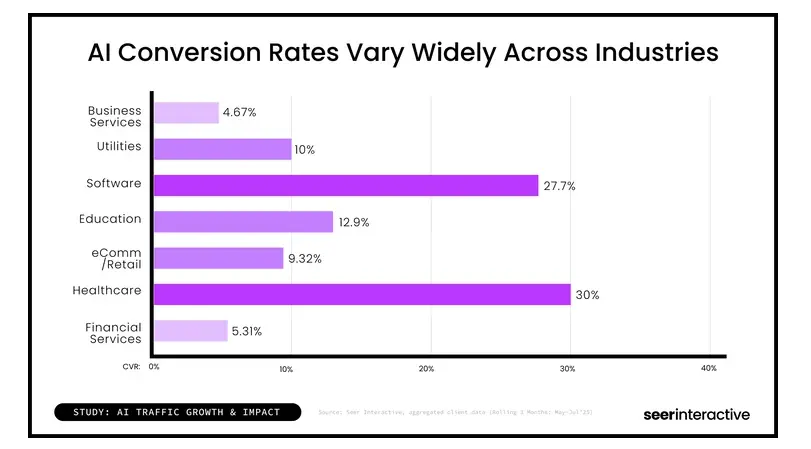
A recent study found that, out of all examined industries, healthcare had the highest conversion rate from AI traffic, at 30%. This shows the ROI potential of investing in AI visibility for healthcare brands.
To grab all these benefits, brands need a dedicated AI Search Optimisation strategy.
This isn’t SEO by another name. AI Search Optimisation is a new channel that focuses on optimising your content, services, products, and brand to be recommended or referenced in AI-generated answers.
To stay competitive in 2026 and beyond, your healthcare brand must implement these AI Search Optimisation tactics:
- Publish AI-friendly content. Write medically accurate, expert-led content using clean formatting, headings, and schema markup to make it scannable by AI.
- Get cited beyond your site. Earn digital PR placements, reviews, and brand mentions across third-party platforms. AI trusts what the wider web says about you.
- Audit AI visibility. Run test queries across ChatGPT, Perplexity, Gemini, and Google’s AI Overviews. Track how often your brand is mentioned and in what context.
- Monitor AI traffic and analyse brand sentiment. Use GA4 to track referral traffic from AI platforms, such as chat.openai.com and perplexity.ai. Use tools like Peec or Profound to track brand sentiment in AI answers.
- Optimise for prompts, not just keywords. Understand the natural language queries your audience uses and create content that directly answers them.
- Make technical performance flawless. AI agents are now performing tasks on a user’s behalf. If your site is slow, unclear, or broken, you’ll be skipped.
SEO
In 2026, your healthcare brand needs to be at the top of Google and Bing to bring in high-quality, organic traffic.
As we’ve shown, search engines are still a prominent platform in the patient and HCP online journey when researching symptoms, treatments, or local providers. Search Engine Optimisation (SEO) ensures your website appears in those critical moments.
What makes SEO especially valuable in healthcare is the intent behind the search. Someone looking for “private ENT clinic near me” or “how to refer a patient to a specialist clinic” isn’t just browsing; they’re actively seeking answers, services, or solutions. Ranking for those queries builds both visibility and trust.
Just look at Age Care Bathrooms, a mobility bathroom specialist. When they came to Exposure Ninja, they were averaging just 60 organic leads per month. We completely restructured their website, fixed critical SEO issues, and optimised content around high-intent local searches.
Within nine months:
- Organic leads surged past 300 per month.
- £215,000 in revenue was attributed directly to organic search.
- Ranking keywords increased by 77%, with priority terms like “mobility bathrooms” reaching the top of Google.
To experience this level of SEO ROI for your healthcare business in 2026, incorporate these tactics into your SEO strategy:
- Get technical SEO right. Ensure your site loads quickly, performs well on mobile, and is fully crawlable. Fix broken links, add schema markup, and maintain a clear site hierarchy.
- Target local and service-specific terms. Optimise your pages for high-intent keywords and use local SEO to drive footfall and phone calls.
- Fix keyword cannibalisation and consolidate content. Merge duplicate content, streamline page structure, and strengthen internal linking to boost rankings and simplify user journeys.
- Optimise for conversions. SEO brings the traffic, but Conversion Rate Optimisation (CRO) turns it into leads. Use strong CTAs, embed add-to-cart functionality, add trust signals, and always have clear next steps to convert organic visits into enquiries.
PPC
PPC (Pay-Per-Click) advertising is one of the most direct and effective ways for healthcare businesses to generate high-quality leads.
Unlike SEO, which builds momentum over time, Google Ads or Microsoft Ads offer immediate visibility by placing your services or products in front of patients or healthcare professionals at the exact moment they’re searching.
Healthcare also benefits from relatively higher click-through rates (CTRs) compared to other industries. According to WordStream, the average Google Ads CTR for health and medical is 3.27% — higher than benchmarks in legal, finance, or B2B. That makes PPC a high-performing channel for generating leads or driving sales.
And it’s not just about search. Meta Ads enable you to meet potential patients where they are already looking for information on social media. With refined targeting options by location, age, interest, and behaviours, you can deliver visually engaging campaigns that raise awareness, support retargeting, and drive leads.
Regain Hearing is a perfect example of how powerful PPC can be for healthcare brands. When they first partnered with Exposure Ninja, they were averaging minimal leads per month with a cost per acquisition (CPA) of £60. After we rebuilt their website for conversion and launched highly targeted Google Ads campaigns, their lead volume soared to 216 per month. We reduced their CPA to £21.73, achieving a 47% decrease in cost per lead.
These results were transformational for this private hearing clinic. According to Regain Hearing’s directors, “This growth enabled us to expand our business from a single premise operation to six locations in a relatively short period of time.”
That’s the kind of ROI that turns marketing from a cost centre into a growth engine.
To make PPC work as well for your healthcare business in 2026, include these tactics in your PPC strategy:
- Use AI-powered automation, but don’t run on autopilot. Let AI manage bidding, targeting, and creative delivery while you steer strategy and messaging.
- Go multichannel. Reach patients and HCPs across Google, Meta, and Microsoft Ads to stay visible throughout their journey.
- Prioritise visual ads. Invest in video, testimonials, and UGC to capture attention and establish trust, particularly on social media platforms.
- Build conversion-ready landing pages for every service or product, featuring strong CTAs, mobile-first layouts, and credibility signals such as reviews or accreditations.
- Connect your first-party data to Google Ads and Meta to personalise ads, retarget previous visitors, and improve overall performance.
Content Marketing
It’s not just patients who expect informative, accurate content; healthcare professionals do too. But their needs and preferences are evolving fast.
According to the 2024 Healthcare Marketers Trend Report, a growing number of clinicians now prefer to receive treatment and product information through digital channels, such as email, webinars, and on-demand video. This reflects a generational shift. Younger, digitally fluent HCPs want content they can access at their convenience and that delivers real value.
But many brands still miss the mark.
A global study found that 62% of physicians feel overwhelmed by the volume of content they receive from pharma companies, not because it’s too frequent, but because it’s too promotional. What they want is timely, relevant, educational material that helps them do their jobs better, not just sell a product.
This disconnect is a huge opportunity for healthcare marketers.
In 2026, content will still be one of the most cost-effective ways for healthcare brands to build visibility, trust, and conversion-ready traffic. But visibility alone isn’t enough. To see real ROI, your content needs to educate, connect, and convert.
To make your content marketing strategy perform in 2026, focus on these tactics:
- Answer real patient questions. Use patient feedback and your sales team’s insights to identify the questions your audience is actually asking. Then create content that answers them comprehensively.
- Prioritise education over promotion. Patients and HCPs alike are increasingly selective. Write content that informs, empowers, and supports decision-making, not just content that pushes products or services.
- Build around E-E-A-T. Every piece of content should demonstrate Experience, Expertise, Authoritativeness, and Trustworthiness. That means medically reviewed articles, expert quotes, case studies, and transparent sourcing.
- Use multiple formats. Create blog posts, videos, infographics, downloadable guides, webinars, and case studies to reach different audience segments.
- Demonstrate expertise through thought leadership. Go beyond generic health topics. Share expert commentary, highlight original research, and address emerging challenges in your sector to position your brand as a leader.
- Optimise content for conversions. Use clear CTAs, patient-friendly language, and mobile-first design to guide visitors toward action. Connect your content to service pages, booking forms, or lead magnets to capture high-intent traffic.
Email Marketing
Email marketing will continue to be one of the highest-ROI digital channels for healthcare brands in 2026.
We’ve seen this first-hand with our email campaign for Age Care Bathrooms. After we introduced segmented sign-up forms, automated nurture workflows, and weekly value-packed newsletters, their email list became a consistent revenue engine. Over a single campaign, we generated:
- 529 qualified leads.
- 775% increase in HubSpot-recorded leads.
- 127% increase in email-driven revenue.
But this isn’t just a one-off.
Email marketing consistently outperforms other channels in healthcare. According to MailerLite, the average open rate for emails related to medical, dental, and healthcare is 44.60%. The CTR also stands at a strong 3% on average for healthcare services. In a sector where trust, clarity, and education drive conversions, email provides a direct and reliable means of communication with your audience.
It’s also a powerful tool to support other goals, like building review volume. A recent survey showed that 86% of patients will check reviews before making a decision, but only 57% leave reviews themselves.
Encouraging reviews in post-service emails or appointment follow-ups is one of the most effective ways to generate more patient feedback, which builds credibility and improves performance across platforms like Google or Trustpilot.
Drive better results from your email marketing strategy in 2026 with these proven tactics:
- Segment by intent. Use your lead capture forms and CRM to determine whether someone is seeking information, planning ahead, or ready to convert, and tailor your content accordingly.
- Automate your nurture sequences. Don’t rely on manual follow-ups. Build email journeys triggered by brochure downloads, PPC traffic, or newsletter sign-ups to keep leads warm.
- Send value-packed newsletters. Stay top-of-mind with helpful content that informs and educates. Weekly or bi-weekly sends are ideal for maintaining engagement during longer sales cycles.
- Track email-attributed leads and revenue. Set up tracking in GA4 and your CRM to prove ROI and double down on what’s working.
Best Digital Marketing Strategy for Healthcare
The best-performing healthcare digital marketing strategy in 2026 isn’t built around a single channel. It’s having one integrated digital marketing strategy. When SEO, PPC, content marketing, email, and AI Search Optimisation work together, you get compounding performance that consistently delivers ROI.
Each channel supports the others:
- SEO builds long-term visibility and trust through expert-led content and strong technical foundations.
- PPC captures immediate demand, especially for urgent or high-intent searches.
- Content marketing educates and positions your brand as the trusted authority patients and professionals want to hear from.
- Email marketing keeps your brand top-of-mind during longer buying cycles and nurtures leads toward conversion.
- AI Search Optimisation ensures your brand shows up in the platforms shaping modern search behaviour.
When aligned, these channels amplify each other. Blog posts support SEO, fuel email nurture campaigns, and get cited in AI answers. PPC landing pages built for conversion benefit from high-quality, trust-building content. Email sequences re-engage traffic from ads. AI tools pull from all of it — but only if you’ve structured your digital presence correctly.
Just watch our healthcare marketing masterclass to see how an integrated strategy delivered award-winning results:
FAQs
What makes digital marketing different for healthcare businesses?
Digital marketing for healthcare is uniquely complex due to strict regulations, extended decision-making cycles, and the deeply personal nature of health-related choices. Patients and healthcare professionals aren’t just choosing a service; they’re placing their trust in your brand to impact lives and reputations. This demands a strategy that prioritises credibility, empathy, and long-term trust over short-term wins.
How can healthcare brands prepare for AI Search in 2026?
To prepare for AI Search in 2026, healthcare brands need to optimise not just for keywords, but for prompts and natural-language questions patients and HCPs are asking in tools like ChatGPT, Perplexity, and Google’s AI Mode. This means creating medically accurate, AI-readable content, earning third-party citations, and monitoring how your brand is referenced across AI platforms. With healthcare seeing the highest conversion rate from AI traffic at 30%, the opportunity for visibility, trust, and ROI is significant.
What is the most cost-effective digital marketing strategy for healthcare?
The most cost-effective digital marketing strategy for healthcare is an integrated approach that combines content-led SEO, email marketing, PPC, and AI Search Optimisation. Together, these channels establish long-term visibility, nurture trust, and drive traffic.
What KPIs should healthcare businesses track in digital marketing?
The most important KPI for healthcare marketing is conversion rate: how effectively your digital efforts turn visitors into leads or sales. It directly reflects the ROI of your strategy, whether you’re running PPC, email, or SEO. By optimising every touchpoint for conversions, you improve performance across channels and drive measurable business growth.
*Disclosure: This page contains referral links. If you purchase through these links, we may receive a commission at no additional cost to you.