How to Create Content That Ranks in Google’s AI Mode (With Examples)


Become the go-to source Google’s AI Mode trusts and cites. This guide breaks down how to create content for AI Mode by building authority, showcasing real expertise, structuring for easy extraction, and covering the subtopics AI and users are actively searching for.
Google has rolled out a powerful new addition to its evolving search experience: AI Mode.
AI Mode lets users ask longer, more detailed questions than traditional search. It takes the original query, breaks it down into multiple related searches behind the scenes, and then uses generative AI to create a conversational response. That response is built using content pulled from websites and includes links to those sources.
This is where the opportunity lies.
When your content is expertly written, well-structured, and aligned with what users are really asking, it can be selected and cited in Google’s AI-generated answers. That’s what we mean by getting your content to rank in AI Mode — your content being chosen by AI Mode to answer real search queries, with your brand featured and linked within the result.
And while most businesses are still playing catch-up, a few are already earning top visibility in AI Mode by rethinking how they write, structure, and optimise content.
We’ll show you how to create content that ranks in Google’s AI Mode so your business can lead, not follow.
Quick Recap on Google’s AI Mode
Google launched AI Mode in the U.S. in May 2025 as a new way to search using generative AI. Instead of listing ten blue links, it provides a full, conversational answer built by Google’s Gemini 2.5 model. This answer is built by scanning multiple web pages and summarising the most relevant information into an AI-generated answer.
This is changing how people research and make decisions. A user can now ask a broad, multi-part question and get a summarised response with advice, comparisons, map packs, and product suggestions all in one search.
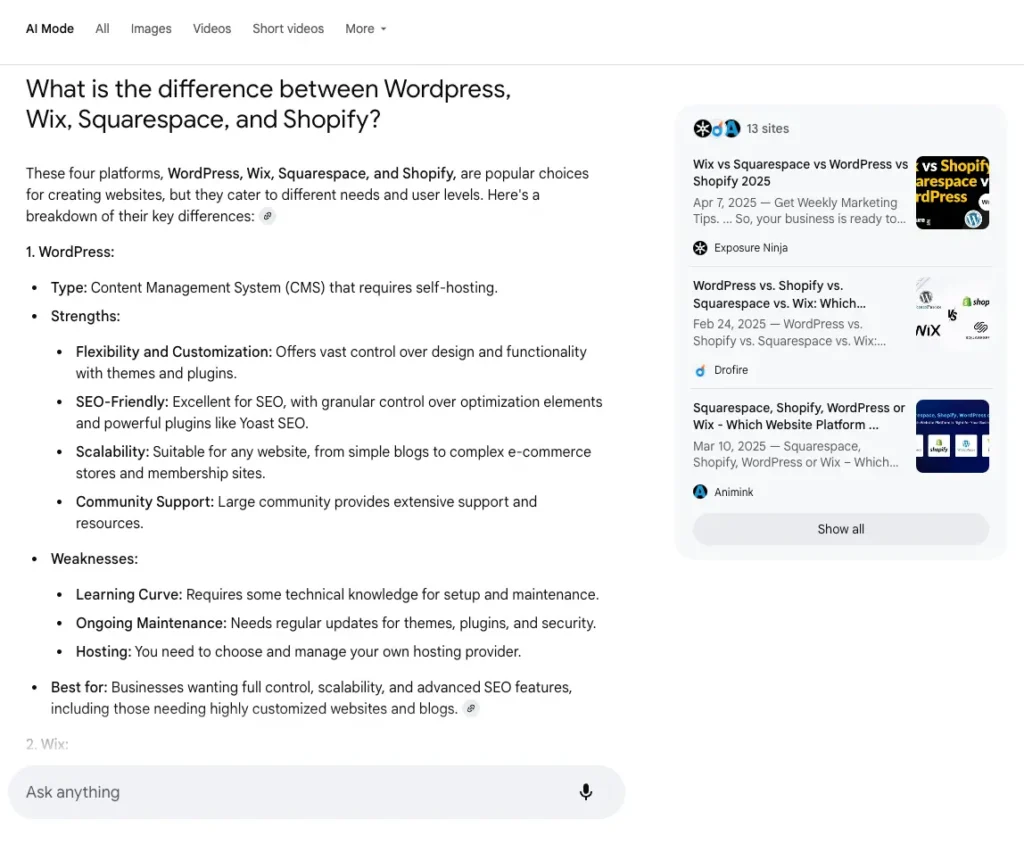
Here’s what this looks like in action for the query “What is the difference between WordPress, Wix, Squarespace, and Shopify?” There is a brief overview, followed by a detailed, bullet-point comparison with embedded links to sources. It also cites its sources in a sidebar, including our blog on Wix vs Squarespace vs WordPress vs Shopify.
AI Mode isn’t yet integrated into the main search results like AI Overviews, but it’s moving in that direction. Google has a clear track record of rolling experimental features into the core experience over time. That’s why it’s crucial to start preparing your content for AI Mode now — before it becomes the default way people interact with search.
How to Create AI-Mode-Ready Content
1. Build Strong Topical Authority
Topical authority is how well your website demonstrates expertise and trustworthiness on a specific subject. It’s not just about ranking for a few keywords — it’s about becoming the go-to source for information on that topic.
This matters because Google’s AI Mode favours comprehensive, expert-led sources. When a user submits a query, the AI breaks it into multiple sub-questions and looks for websites that can fully address the topic. Content that’s narrow, shallow, or disconnected from related topics is unlikely to be cited, no matter how well-optimised it is.
To build strong topical authority, focus on two key content marketing strategies:
1. Develop a Comprehensive Content Strategy
The foundation of topical authority is strategic content planning. That begins with identifying the key topic your business wants to be known for and then mapping out every related subtopic and question your audience might ask along their journey.
At the centre of this strategy is a pillar page: a comprehensive overview of the main topic. This page acts as a hub, linking to a series of supporting articles that explore each subtopic in greater depth. These might include how-to guides, side-by-side comparisons, step-by-step tutorials, common pitfalls, and practical tools. This structure signals to AI systems that your site offers complete, trustworthy coverage of the subject.
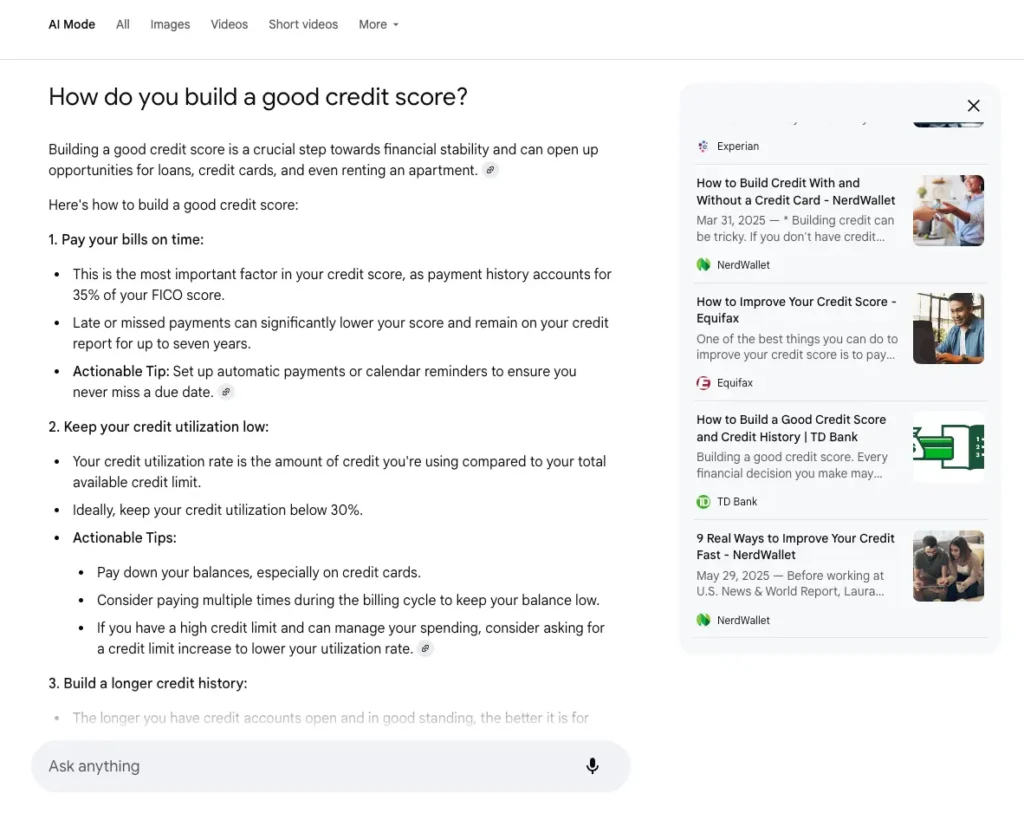
Take NerdWallet, for example. In the finance space, they’ve established themselves as a leading topical authority on credit cards and personal finance. Their credit card resources cover every angle of this topic, from credit-building strategies to product comparisons, FAQs, and decision-making guides. That depth is exactly why, when asked in AI Mode, “How do you build a good credit score?”, they’re not cited once, but twice:
By creating content that mirrors how people search and think about a topic, you position your brand as the most complete and credible answer. And that’s precisely the kind of content AI Mode is designed to prioritise.
2. Earn High-Quality Brand Mentions Through Digital PR
Topical authority isn’t just about on-site content. Google’s AI also considers how often and where your brand is referenced elsewhere online.
When your brand is cited by trusted publications, mentioned in relevant podcasts, featured in roundups, or quoted in industry articles, it strengthens your credibility. These brand signals help position your business as a recognised authority, increasing your chances of being selected in AI Mode responses.
To increase your brand mentions:
- Pitch expert quotes or original insights to journalists and bloggers covering your industry.
- Create data-led content (like reports, surveys, or unique insights) that’s highly shareable and easy to cite.
- Reach out to podcast hosts, webinar organisers, and conference panels to share your expertise on specific topics.
- Use digital PR tools like Qwoted to identify media opportunities.
Together, these approaches build the credibility and coverage needed to position your brand as the preferred source in traditional search and AI Mode.
2. Think Beyond Search Volume and Rankings
Traditional Search Engine Optimisation (SEO) content has long focused on two key metrics: keyword search volume and where your content ranks in Google’s results. The goal was relatively simple — find keywords that get searched often enough (but aren’t too competitive) and optimise your content to hit page one of Google.
But AI Mode plays by different rules. It doesn’t just scan for keywords or reward top-ranking pages. It looks for content that directly and completely answers the user’s question.
Take this example. When asked, “Do you need a credit card to build a credit score?”, AI Mode responds with a helpful summary of alternative methods, then cites sources like NerdWallet, Chase Bank, CNBC, Experian and Yahoo Finance.
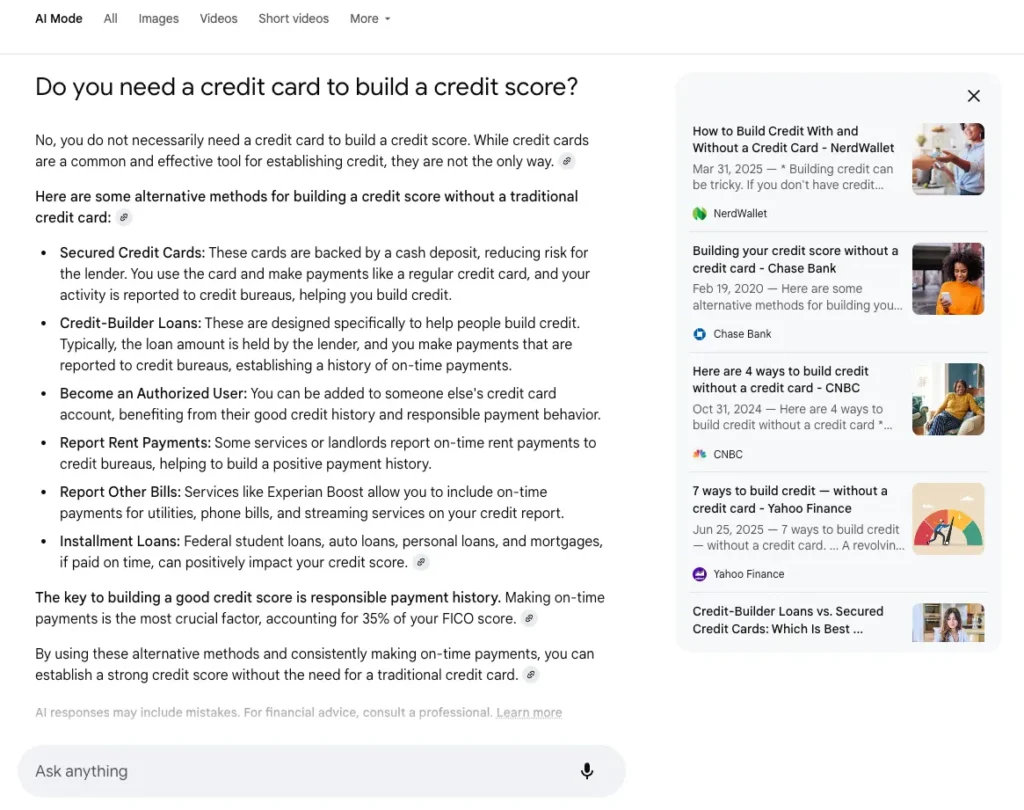
If you look at Google’s standard search results, all these brands appear on page one, except Yahoo Finance. In Semrush, their article isn’t even ranking for any relevant keywords. But AI Mode still features it.
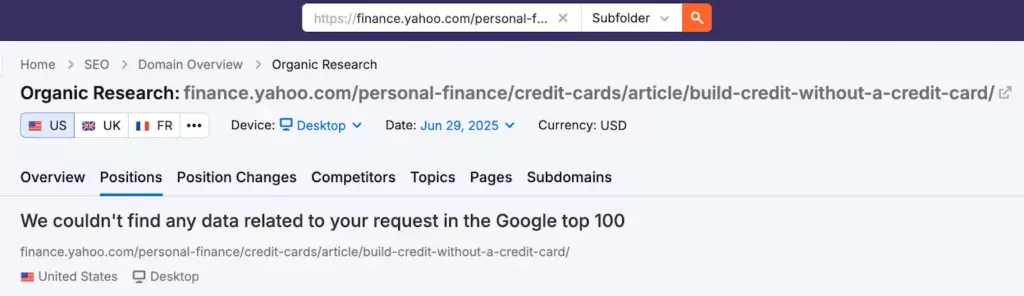
This shows us something important: AI Mode isn’t just pulling from the top-ranking content. It’s selecting pages that clearly answer the question, even if they’re not visible in traditional search.
To perform well in AI Mode, you need to focus less on volume and more on intent. Ask yourself: What is the user really trying to learn or solve? Then build content that delivers that answer — directly, clearly, and in full, because that’s what the AI is looking for.
Ranking on Google through traditional SEO isn’t enough to get visibility in this new era of AI Search, whether that’s in AI Overviews or AI Mode or other tools like ChatGPT, Perplexity, and Claude.
 Tim Cameron-Kitchen
Founder
Tim Cameron-Kitchen
Founder
3. Demonstrate Value with Firsthand Experience
Google has published clear guidance on how to create content that performs well in its AI-driven search experiences. Top of the list is creating “unique, valuable content for people.”
This lines up with its long-standing content quality framework: Experience, Expertise, Authoritativeness, and Trustworthiness (E-E-A-T). These guidelines are central to how content is evaluated in traditional search, and they’re just as relevant in AI Mode.
But here’s the difference: in AI Mode, firsthand experience plays a bigger role.
Firsthand experience is about showing that you’ve personally done or directly observed what you’re writing about. It’s the type of content that adds depth, context, and human insight that AI-generated summaries can’t replicate.
Let’s look at an example. In response to the query, “I’m looking for a no foreign transaction fees card for my upcoming holiday,” AI Mode includes an article from The Points Guy.
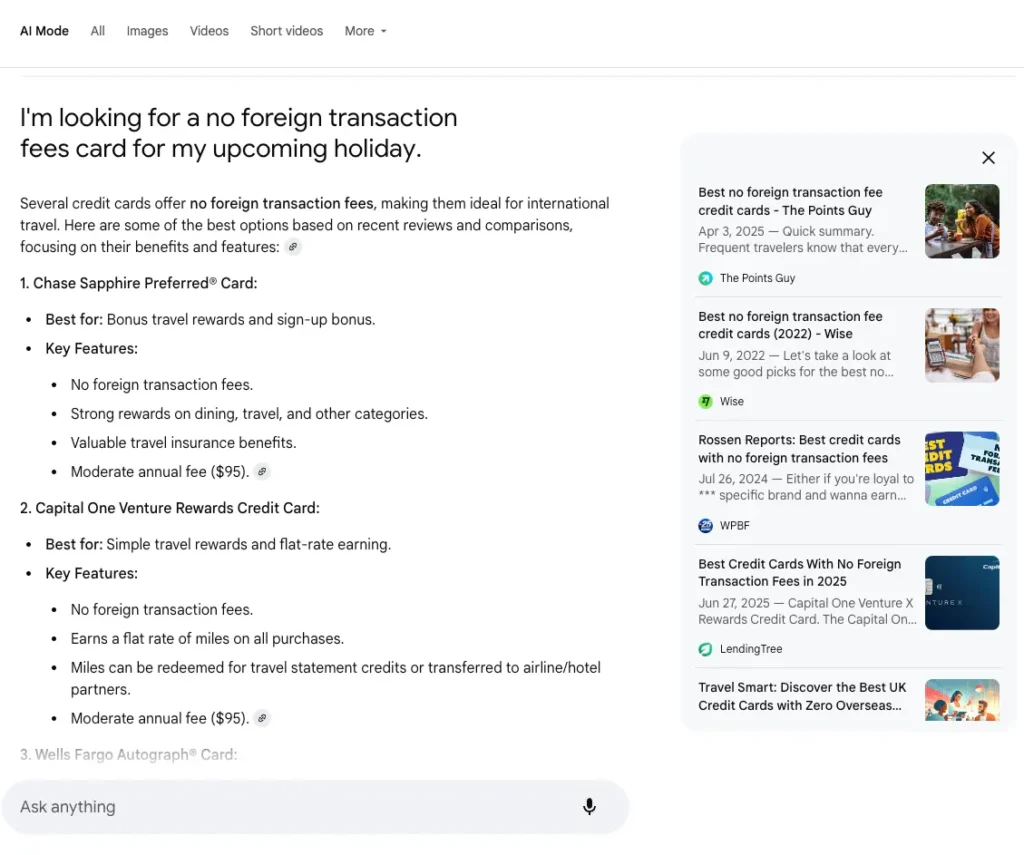
The post includes personal commentary from the author, who explains how they used a specific card during a recent trip to Turks and Caicos. They list what they purchased, the fees they avoided, and the perks they used.

It’s this kind of practical, lived experience that makes content stand out in AI Mode because it delivers unique, valuable content for people, not just for search engines or AI systems.
Here are some ways you can demonstrate firsthand experience in your content:
- Share real use cases, experiments, or client outcomes.
- Add expert insights from your team based on actual work.
- Include photos, screenshots, or video clips showing processes in action.
- Use your own data, surveys, or internal benchmarks to back up insights.
- Write in the first person when relevant to signal personal perspective.
- Use clearly labelled author sections to highlight expertise and reinforce credibility.
If AI Mode is going to cite your content, there has to be a reason. Generic, thin, or obviously AI-generated content won’t make the cut. To earn a place in AI Mode’s responses, your content needs to offer something it can’t produce itself: originality, real depth, or firsthand expertise.
Tim Cameron-Kitchen
Founder
4. Format for Easy AI Extraction
Google’s AI Mode is looking for content that’s easy to scan, summarise, and repurpose into clear answers. If your page structure helps the AI understand and extract key insights quickly, your chances of being cited go way up.
This isn’t just about helping AI Mode extract information. Humans prefer clarity, short paragraphs, clear headings, and straightforward answers, too.
Here’s how to format for easy AI extraction (and human scanning):
- Lead with the answer. Open with a 1 – 2 sentence summary that directly answers the query.
- Use short paragraphs. Keep blocks of text to 2 -3 sentences max to improve scannability.
- Apply clear headings. Use a relevant H1 and structure content with descriptive H2s and H3s that mirror user queries.
- Use bullet points and tables. Break down steps, pros and cons, comparisons, or stats into digestible formats.
- Implement structured data. Use schema markup to help Google’s AI understand the page’s purpose.
- Write semantically rich content. Include synonyms, related terms, and natural language that reflects how users ask questions.
AI Mode is built to reward content that’s logically presented and easy to parse (understand). If your content feels like a well-organised, expert answer, it’s far more likely to be featured.
5. Go Deeper Into Subtopics
In traditional search, users are accustomed to entering short, keyword-focused queries, like “buying a house vs renting.” But in AI Mode, users can now ask much more specific, complex questions like, “Is it better for a couple to buy a house or rent in their early thirties if they plan to move countries in five years?”
To handle this complexity, AI Mode uses a “query fan-out” technique. It breaks down the original question into multiple smaller subqueries and runs each as a separate search. It then pieces together a response using content that best addresses those subtopics.
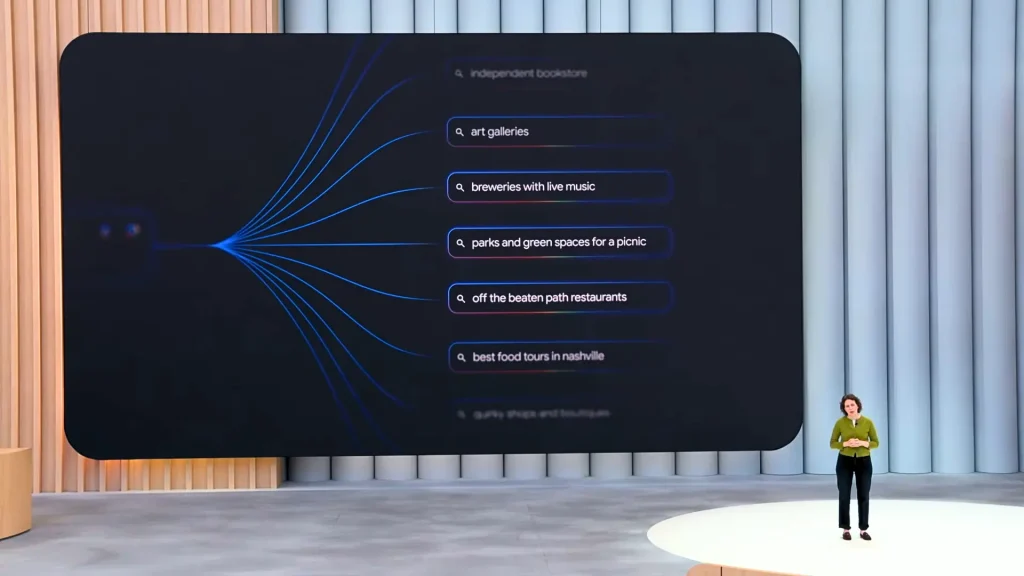
If your content only answers the headline question, it might get cited once. But when your content also addresses the subtopics AI Mode is exploring in the background, it becomes useful for more than one part of the AI’s search process. This increases your chances of being cited multiple times in a single response.
More importantly, it also helps your content show up across similar user queries that are phrased differently but looking for the same type of information. That’s how you scale your visibility in AI Mode.
6. Have a Great Page Experience
Like with traditional search, Google’s AI Mode prioritises citing sources that provide a great page experience. After all, when someone clicks through from an AI-generated answer, Google wants to send them to a page that’s fast, clear, and genuinely helpful.
To maximise your chances of being cited and to keep users engaged when they arrive, optimise these key areas:
- Mobile-First Design: Make sure your layout is fully responsive, with easy-to-read text, clickable elements, and no awkward formatting on smaller screens.
- Fast Load Times: Reduce page load time by compressing images, minimising JavaScript, leveraging browser caching, and using a reliable host.
- Clean Formatting: Avoid intrusive elements like pop-ups, autoplay videos, and excessive ads. Use white space, clear headings, and logical content blocks that make it easy to find and absorb the main message.
- Visual Hierarchy: Display your key content above the fold. Use bold headlines, concise subheadings, and visual cues like icons or callouts to help users and AI models identify essential information quickly.
- Accessibility and Readability: Use legible font sizes and contrasting colours. Ensure text is easy to scan using bullet points, numbered steps, and highlighted quotes or stats. Include alt text on images and clear labels for links and buttons.
7. Go Beyond Text with Visual and Video Content
AI Mode isn’t limited to parsing paragraphs — it’s increasingly capable of interpreting images, video, and audio embedded within web pages. If your content includes these richer media formats, you’re giving Google’s AI Mode more context, more engagement signals, and more reasons to elevate your page above others.
Google is already pulling YouTube videos into AI Mode answers. This makes your YouTube content a powerful visibility asset not just on YouTube itself but also directly within AI-powered search results.
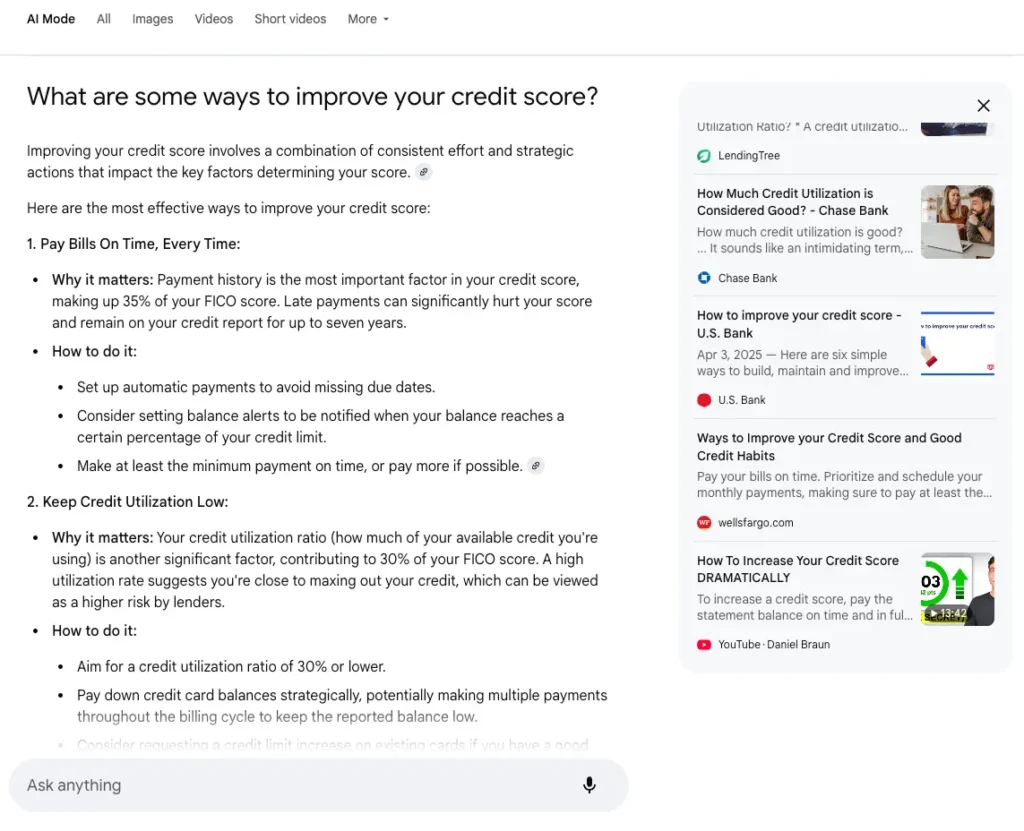
If you’re producing video content, embed it into relevant blog posts. It gives your content more depth, keeps users engaged for longer, and increases your chances of being cited by AI Mode. The transcript, description, and visual content all serve as additional data points the AI can draw from to support and enrich its answers.
Why These Articles Were Cited in AI Mode
At Exposure Ninja, we’ve been ahead of the curve when it comes to AI Mode. We’ve analysed hundreds of AI Mode responses, tracked what gets cited (and what doesn’t), and translated that into an AI Mode Checklist. This checklist guides everything we do to help our clients win visibility in AI Mode.
One of these clients is Golf Course Lawn Store. Their blog on the benefits of liquid kelp for lawns ranks in various related queries in AI Mode. Not only that, for the query “Why should I use liquid kelp on my lawn?” it’s referenced twice to back up the AI-generated answer:
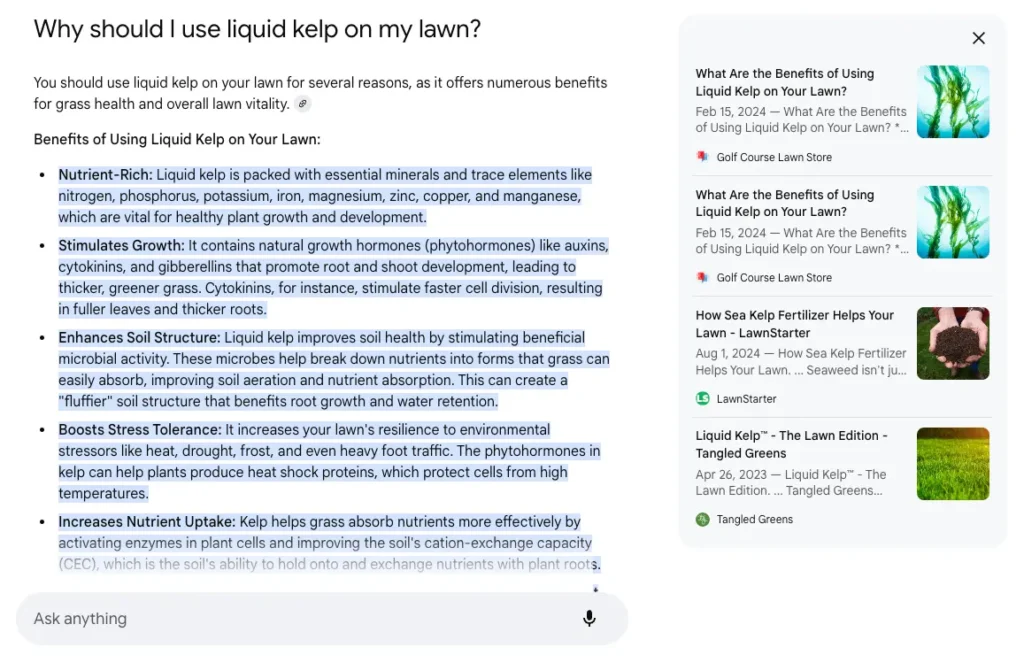
This article is AI Mode–ready for a few reasons, including:
- The content is clear and well-structured with benefit-focused subheadings, concise paragraphs, and easy-to-scan bullet lists.
- It covers the topic of liquid kelp in depth, including everything from explaining what it is to application steps to how to combine it with other lawn care products.
- The content shows firsthand experience by not only recommending a product but also incorporating a video tutorial on how to apply it best.
- It includes an author section that shows the content is written by a known expert on the topic, Ron Henry, adding further credibility to the information.
Another of our clients, DSLD Mortgage, is also seeing content success in AI Mode. For example, their comprehensive guide on calculating mortgage payments features in AI Mode for the target term “How to calculate a mortgage payment.” Like with Golf Course Lawn Store, the article is cited multiple times throughout the AI-generated response.
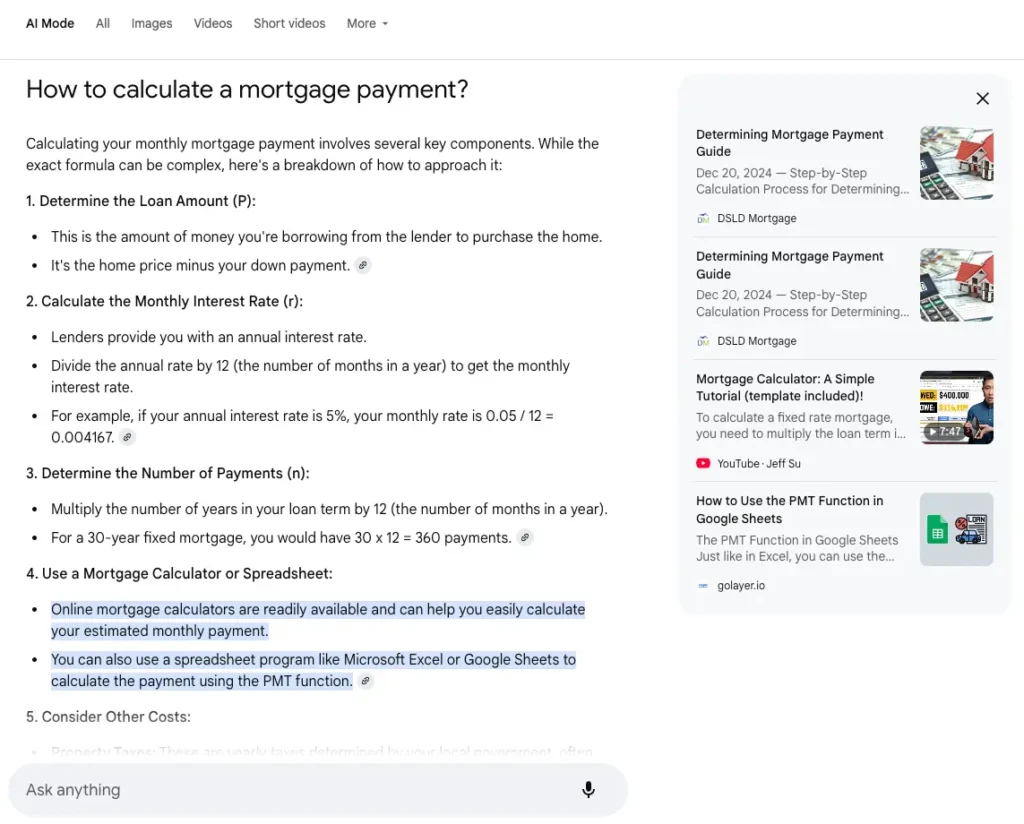
This mirrors what we observed with Golf Course Lawn Store: strong content structure, thorough topic coverage, a credible author, and helpful visuals all contribute to its visibility. However, DSLD Mortgage’s guide has one standout feature: an inline mortgage affordability calculator.
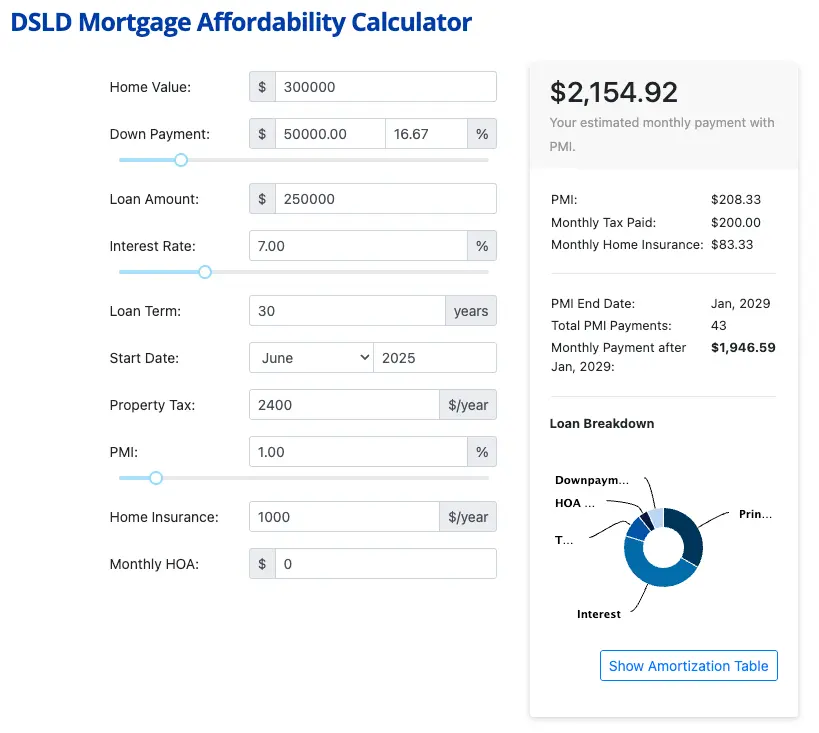
By adding an interactive tool, DSLD Mortgage strengthens its content from multiple angles: user experience, informational depth, and AI accessibility. That’s why the guide performs so well in AI Mode — and why tools like calculators can seriously boost your visibility.
How to Reverse‑Engineer AI Mode Topic Coverage
To be featured in AI Mode, your content needs to do more than just answer the initial query. It must anticipate and cover the broader set of related questions that it will search in the background before generating an answer.
The challenge is that Google doesn’t show you which background searches were performed to generate the AI answer. But there is a workaround:
- Go to Gemini 2.5 Pro.
- Enter your target search query.
- Click “Show thinking.”
- Gemini will display a list of follow-up questions that it used to shape the answer.
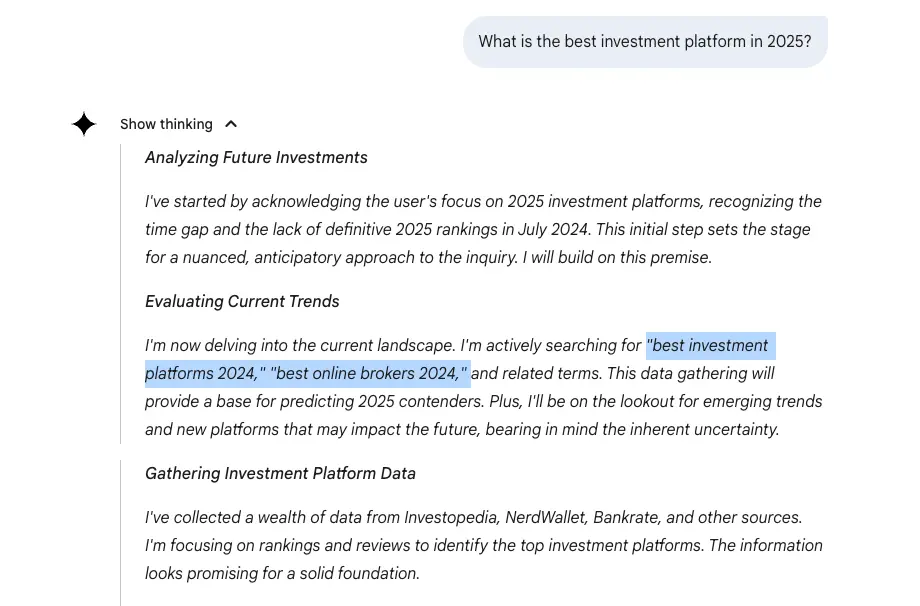
These insights can help you understand which subtopics or supporting queries the AI considers relevant.
But be cautious. Some of the listed questions may be hallucinations. You also can’t control user phrasing, which can vary widely, so you might not capture every related search query.
What you can do is create content that covers the topic comprehensively. Focus on the user journey and consider:
- What related questions are they likely to ask before reading your article?
- What supporting details, comparisons, or use cases might they need?
- What potential objections or follow-up problems might they have after reading your content?
By anticipating these subqueries and weaving them into your content, you:
- Increase your chances of being cited across multiple AI Mode queries.
- Strengthen your topical authority in the eyes of AI systems.
- Deliver a better user experience that supports real decision-making.
Is Your Content AI-Mode Ready?
Creating AI Mode–ready content means going beyond great SEO and towards becoming the authoritative source that AI Mode (and other AI platforms) cite across queries.
Here’s a quick self‑audit checklist to review your content:
- Are you building web-wide topical authority with your content plan and digital PR?
- Are you focusing on real questions guided by user intent over keyword search volumes?
- Does it demonstrate firsthand experience with case studies, quotes, data, or screenshots?
- Is it structured for AI extraction with clear headings, lists, and short paragraphs?
- Do you cover related subtopics and FAQs to broaden your AI Mode visibility?
- Is your page fast, mobile-friendly, and providing a great user experience?
- Do you have images, videos, or charts to support your text?
If you can tick all those points, your content is set to perform in AI Mode.
That said, success in AI Mode is just one piece of the puzzle. A complete AI Search Optimisation strategy also includes ranking in AI Overviews, ChatGPT, Perplexity, and other AI platforms.
If that’s starting to feel like a lot, we can help with our AI Search Optimisation service. We’ll create a tailored AI Search Strategy to drive maximum AI visibility for your brand, content, and products or services. Request a callback, and we’ll walk you through how to make it happen.
FAQs
Is writing content for traditional search engines the same as AI Mode?
Not quite. Traditional SEO prioritises keywords, backlinks, and rankings, while AI Mode is all about structure, clarity, and depth. It rewards content that’s easy to summarise, rich in useful detail, and clearly answers real user questions.
How should I structure my content for Google’s AI Mode?
To structure content for Google’s AI Mode, start with a direct answer in the first 1 – 2 sentences. Use short paragraphs, clear H2s and H3s, bullet points, and tables to make key information easy to extract. Add structured data and write with semantic depth to help AI understand context and relevance.
Does AI Mode prefer short‑form or long‑form content?
AI Mode doesn’t prioritise content by length; it prioritises completeness. Whether short or long, your content needs to answer the main question and its related subtopics clearly and thoroughly.
Should I still include keywords in content written for AI Mode?
Yes, keywords still matter because you still need to have a strong SEO foundation. But for AI Mode, how you use them matters more. Focus on writing naturally and covering the full context of a topic rather than forcing exact keyword matches. AI Mode recognises patterns, synonyms, and related terms to assess topic relevance.
Can AI Mode cite a blog even if it’s not ranking well in traditional search engines?
Definitely. If your content is clear, structured, useful, and formatted well, AI Mode can pick it even if you’re not on page one in traditional search.
How can AI Mode cite a blog even if it’s not ranking well in traditional search engines?
AI Mode doesn’t rely solely on search rankings. It looks for content that answers the question clearly, thoroughly, and with a structure that it can extract. That means even lower-ranking pages can be cited if they offer high-quality, well-formatted, user-focused information.