8-Step AI Mode Checklist to Rank in Google’s AI Search


Google's AI Mode is reshaping how your audience finds you online. While most businesses are still playing catch-up, use our Google AI Mode checklist to get ahead in this new search landscape.
Google changed the rules of search (again) in May 2025 by officially launching AI Mode in the U.S. during its I/O 2025 keynote.
Described by CEO Sundar Pichai as a “total reimagining of Search,” AI Mode replaces the familiar list of ten blue links in favour of a fully AI-generated answer built from multiple background searches and Gemini 2.5’s capabilities. The result is an experience that feels more like a conversation than using a traditional search engine.
While AI Overviews supplement existing search engine result pages (SERPs), AI Mode replaces them entirely by building custom responses from scratch and citing content. For brands, it’s no longer about fighting for position one; it’s about being featured in the AI answer.
The businesses currently winning in Google’s AI Mode aren’t just optimising for keywords anymore. They’re building comprehensive topic authority, demonstrating real expertise, and making their content easy for AI to understand and extract. We should know because we’re helping our clients do just that.
We’re ready to share our 8-step Google AI Mode checklist, which you can start implementing today, based on what we know so far.
Google AI Mode Checklist: Key Takeaways
- Define two to three specific concepts you want AI to associate with your brand and use them consistently across your entire digital presence.
- Audit your brand’s appearance in AI Mode by searching your name and services to see what’s being said and what you’re missing.
- Maintain semantic consistency across every owned platform so AI recognises and reinforces your positioning.
- Expand your content to include related subtopics that AI Mode might surface through its query fan-out process.
- Structure content using schema and clear HTML tags so AI can read and reuse it confidently.
- Demonstrate first-hand experience through expert authorship, real examples, and regularly updated content.
- Make your content easy for AI to quote by using summaries, concise paragraphs, FAQs, and clearly labelled answers.
- Earn trusted third-party mentions through digital PR to increase your brand’s authority and visibility in AI-generated answers.
1. Define Your Core Concepts
To rank in Google’s AI Mode, the AI first needs to recognise and understand your brand.
The starting point is defining a small set of core concepts. These are short, specific phrases that capture what your business offers, who it’s for, or how it’s different.
Think: “affordable skincare,” or “no-code website builder.” These aren’t just keywords. They’re positioning statements that help AI systems categorise your brand and surface it in relevant conversations.
This is necessary because AI Mode uses Gemini 2.5, a large language model (LLM) that doesn’t just scan current search results. It also pulls from its own training data and internal map of how words and ideas are connected.
Tim Cameron-Kitchen, Founder of Exposure Ninja, explains: “Google’s AI Mode and tools like ChatGPT are prediction engines. They’re trained on huge volumes of data, and as they process that information, they learn how different concepts and phrases are connected. The more often two ideas appear together, the stronger the link between them.”
Your job is to decide what your brand should be known for, then create strong, consistent associations between your brand name and those core concepts across the web. That’s how you help AI Mode and other AI platforms create that strong link.
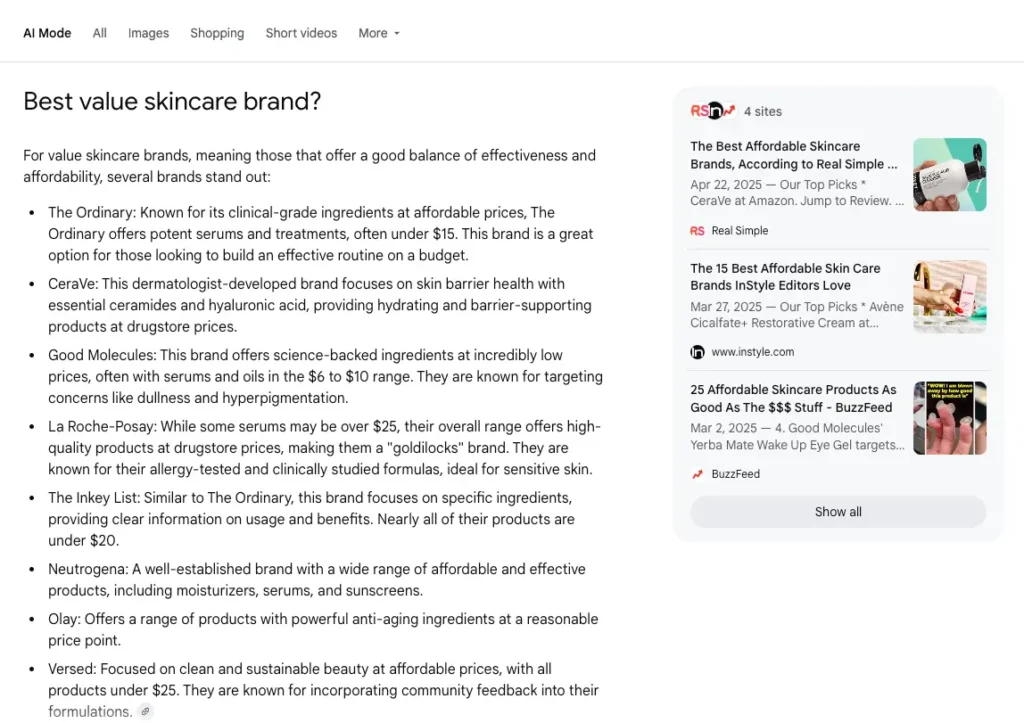
Let’s look at The Ordinary as an example. Their core concepts are “affordable skincare” and science-backed skincare,” and their messaging around these concepts has been consistent across the web. Now when you ask Google AI Mode for “best value skincare options”, it recommends The Ordinary, and even compares other brands to them!
To do the same for your brand, you must be crystal clear on your core concepts. To find your core concepts, you can take two approaches:
- Link to a Type of Audience: You can align your brand with a specific audience segment. For example, an insurance brand for mothers, like Polly. The more clearly you define the audience you serve, the easier it is for AI to place you in relevant conversations.
- Focus on Your Positioning: Alternatively, anchor your brand to a unique value or trait. You might want to own a brand positioning like “best budget CRM” or “fastest no-code website builder.” The goal is to consistently link that positioning with your brand so that AI tools like Gemini absorb the association.
Figuring this out is essential, but it’s not always easy. That’s where our Branding and Positioning Accelerator comes in. We speak directly with your customers to uncover what they really associate with your brand, then use those insights to build a clear, consistent messaging framework — one that AI tools like Gemini can recognise, remember, and recommend.
2. Audit How You Appear in AI Mode
To know where you need to make improvements, you need to know how you currently show up in Google’s AI Mode.
Start by searching for your brand name, core services, and key areas of expertise in AI Mode. Are you mentioned? What’s being said? Is the description accurate? Is it positive?
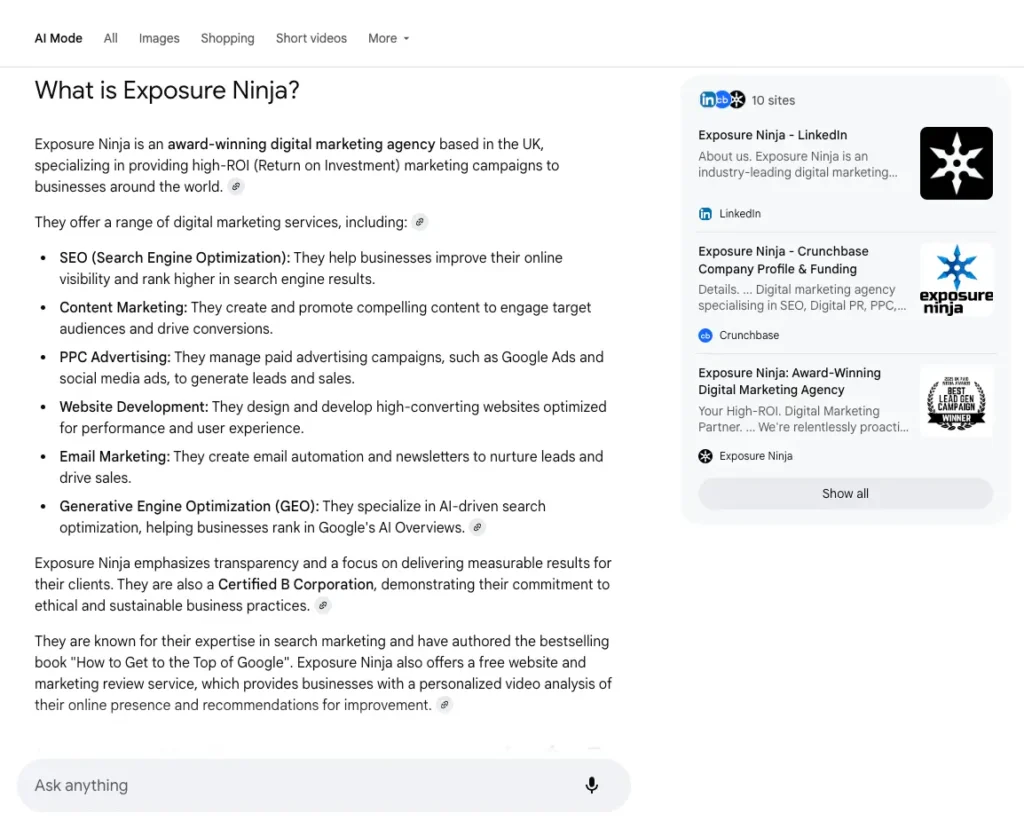
When we searched “What is Exposure Ninja,” we were happy to see a strong, accurate description and the right associations with our core digital marketing services.
But when we tried “award-winning SEO agencies in the UK,” we didn’t appear — despite having multiple awards over the years for our SEO campaigns. That tells us Google’s AI Mode hasn’t yet made the connection between Exposure Ninja and that phrase. So now we’re working on bridging that gap.

This audit can help if you’re unsure of your core concepts. It shows you what AI already associates with your brand, which may be different from what you want to be known for. Use it to validate your current messaging or identify areas where your positioning needs a reset.
Make sure to audit your competitors. What terms are they owning in AI Mode? Are they showing up for categories you should be competing in? How are they structuring their content? Often, you’ll spot missed opportunities and content gaps you didn’t know existed.
Remember, Google’s AI Mode is still evolving, which means your visibility can shift. Make auditing a monthly habit to stay ahead and ensure your brand is still showing up where it matters.
3. Build Semantic Consistency Across Channels
Google’s AI Mode isn’t just reading your website. It’s scanning your entire digital footprint — LinkedIn, Facebook, directory listings, guest articles, podcast transcripts, and from July 2025, even your public Instagram posts. Every word in those channels shapes how AI Mode understands and represents your brand.
That’s why semantic consistency is so critical. You’re training Google’s AI to recognise who you are and what you do by clearly, confidently, and intentionally repeating the same core concepts across every channel.
This doesn’t mean copy-and-pasting boilerplate text but reinforcing the same themes, terminology, and value props in a way to fit the channel.
Look at Monzo. Their website leads with “Banking never felt like this.” On LinkedIn, it’s “Corporate content never felt like Monzo.” On Instagram, “Money never felt like Monzo.” They’ve adapted the message to the context, but the core idea is crystal clear and unmistakably theirs.
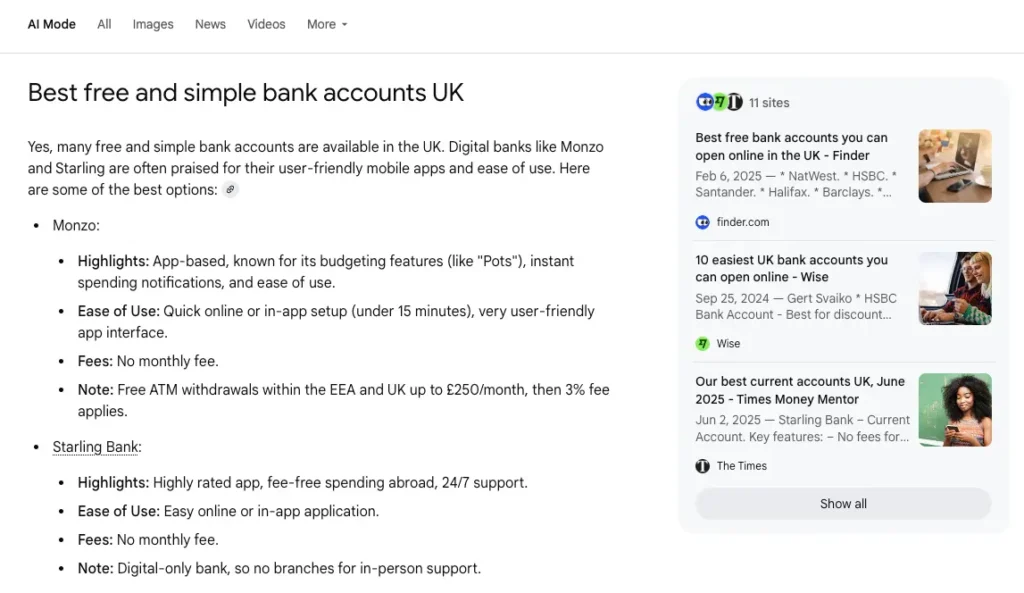
That’s one of the reasons why, when you search for “free and simple bank accounts,” Monzo is positioned number one in AI Mode:
Consistency doesn’t mean boring. It means being clear, recognisable, and unforgettable to an AI (and your target audience). Here’s how you do it:
- Choose two to three core concepts you want associated with your brand and use them everywhere: on your homepage, social bios, product pages, and press coverage.
- Audit your current messaging across all platforms. Are you using different terms to describe the same service? Unify the language.
- Create a messaging guide for your team (and freelancers) to ensure consistency in terminology, tone, and key phrases consistent across content.
- Say the same thing in different ways, using the same language pillars tailored to the platform’s tone and audience.
4. Match Query Fan-Out Topics
Query fan-out is a technique used by AI search tools, like Google’s AI Mode, where a single user query triggers multiple background searches instead of just one. Instead of answering your question with one source or summary, the AI spreads the query out into related subtopics to build a richer, more complete response.
Let’s say you run an insurance company. If a user asks, “What’s the best insurance for first-time drivers?” AI Mode might break that into sub-queries like:
- “Best-value car insurance for young drivers.”
- “Which providers offer first-time driver discounts?”
- “Highly-rated insurance providers for drivers with low credit scores.”
This means it’s no longer enough to rank for one main keyword or create one pillar page. If your site only answers the first question, you miss the chance to appear in the broader response. But if you’ve created content around all these angles, your brand starts to dominate the full answer space.
If you want to show up in AI Mode, you need to own the topic, not just the term. That means anticipating the surrounding queries the AI will explore — and answering them better than anyone else.
But here’s the catch: we can’t see the “thinking” behind the responses AI Mode provides. This means you can’t type in a relevant question to your target audience, see all the related searches in AI Mode, and build a comprehensive content piece to dominate this conversation.
There are a few ways around this:
- Use Gemini 2.5 to reverse-engineer likely fan-out questions. Gemini often reveals the related queries it runs.
- Check Google’s “People also ask” or use AlsoAsked to find similar questions to cover.
- Check competitors’ pages in AI Mode to see what subtopics they’re hitting.
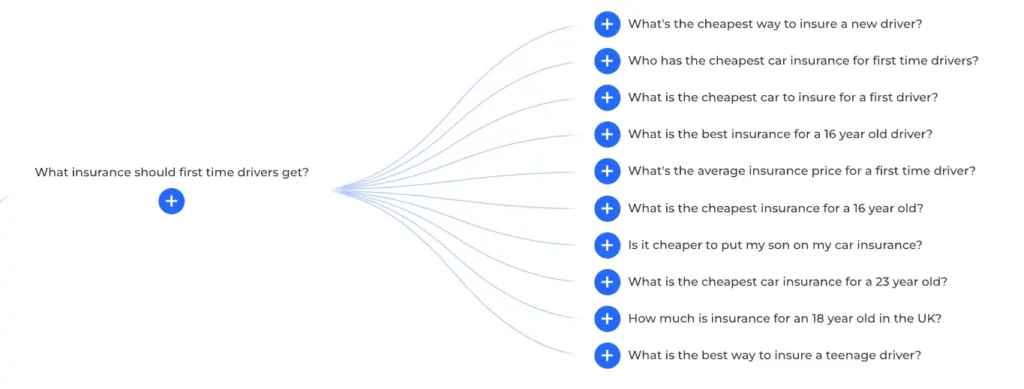
Mastering fan-out coverage means your brand doesn’t just answer a question — it becomes the go-to authority for everything around it.
5. Optimise Content Structure for AI
AI Mode isn’t just reading your content — it’s parsing, segmenting, and interpreting it in a very technical way. To give your pages the best chance of being surfaced or cited, you need to optimise the underlying structure so AI can understand and extract your content accurately.
Use Schema Markup
Schema Markup is a type of HTML markup that helps search engines and AI Mode identify the specific parts of your content — whether it’s a product review, a recipe, an FAQ, or a service description.
By implementing structured data with Schema.org markup, you give Google’s AI Mode clearer signals about the type of content you’re offering. For example:
- Use FAQPage schema for your FAQs.
- Use Article, BlogPosting, or HowTo schema for content pieces.
- Use Product and Review schema for eCommerce pages.
This helps AI Mode feature your content more accurately in summaries or overviews, especially when users ask for comparisons, how-tos, or lists.
Nail Your HTML Structure
AI Mode, like most AI search systems, relies on HTML tags to break down and understand the hierarchy of your page.
Here’s what to focus on:
- Headings (H1, H2, H3): Use a single H1 per page and break your content into clear H2 and H3 subheadings that answer the subtopics you identified in the query fan-out. This helps AI Mode identify sections and context quickly.
- Lists and Tables: Bullet points, numbered lists, and tables are more easily parsed by AI and more likely to be featured as extractable snippets.
- Bold Key Phrases: Highlighting core terms or takeaways with bold tags can help AI spot important concepts for extraction.
Think of it like this: if your content is well-organised and machine-readable, AI can quote, summarise, and recommend it more confidently.
6. Demonstrate First-Hand Experience
Google’s AI Mode heavily weights content that demonstrates genuine, first-hand expertise. Generic advice regurgitated from other sources won’t cut it in this new landscape.
This aligns with Google’s E-E-A-T framework: Experience, Expertise, Authoritativeness, and Trustworthiness. Of these, Experience has become a key differentiator in AI-generated results. AI Mode looks for evidence that the author has directly used the product, applied the strategy, or tested the advice.
There are so many ways you can showcase valuable, first-hand experience:
- Author credentials that show hands-on experience with the topic.
- Expert quotes from internal specialists, not just generic commentary.
- Case studies with clear actions and outcomes.
- Visual proof like screenshots, data visuals, or process videos.
- Updated timestamps, especially for fast-evolving topics.
Here’s what this looks like in action. When we asked, “What are the top SEO trends in 2025?” in AI Mode, our SEO trends article was referenced.
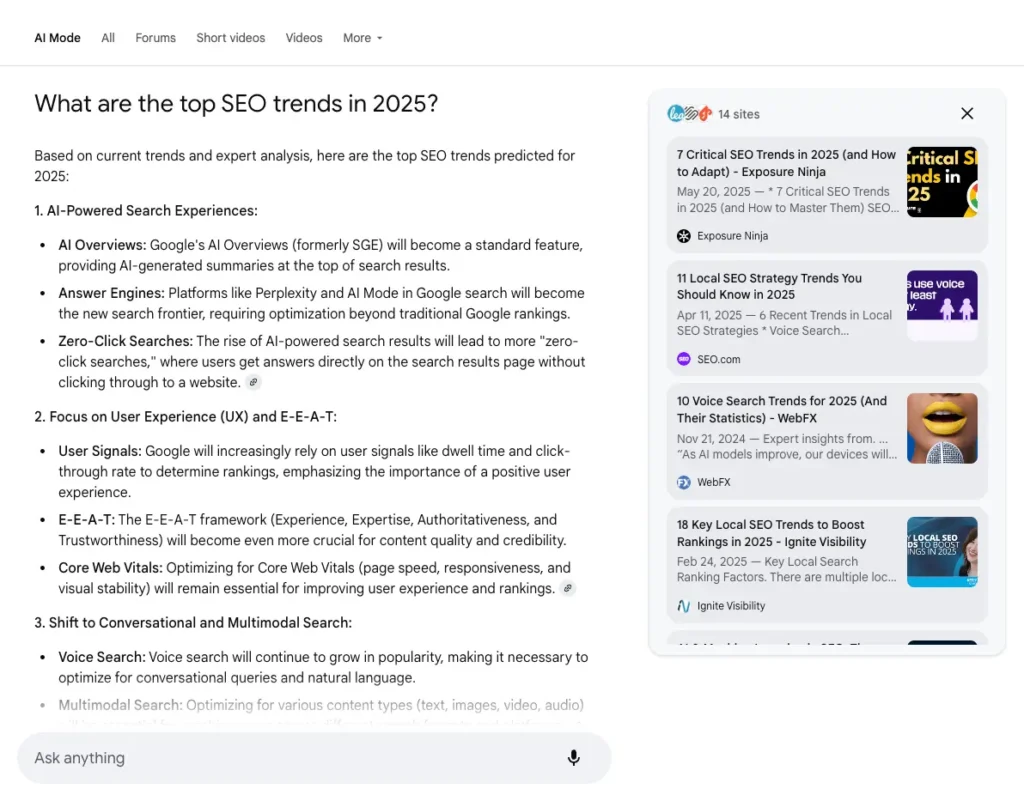
This is because it includes some key aspects that signal a trustworthy, authoritative experience, such as:
- It’s expert-reviewed by our Head of SEO, Andrew Tuxford.
- It includes fresh data, and we regularly update our insights.
- It features specialist quotes from across our team.
- It’s backed by client case studies, visual proof, and measurable outcomes that show our experience in the subject matter.
- It’s structured for easy parsing and extraction.
Our goal was to create a detailed, genuinely useful resource on a topic our audience cares about — grounded in real-world experience and presented clearly. As a result, not only did it deliver value to readers, but it also earned us a spot in Google’s AI Mode.
7. Make Your Content Easily Extractable
To get quoted or featured in AI Mode, your content needs to be easily extractable — which means Google’s AI can quickly understand, lift, and repurpose parts of your content without confusion.
AI Mode builds its answers by pulling from web pages that are clear, scannable, and structured. If your content is dense, disorganised, or buried in waffle, it’s far less likely to be used.
Here’s how to make your content AI-friendly:
- Include a short overview, key takeaways section, or TL;DR at the top that clearly outlines what the page covers. These serve as easily extractable snippets that AI systems can use in their responses. They also provide value to readers who want to quickly scan your content.
- Write in short, concise paragraphs. Long walls of text that are difficult for AI (and humans) to understand.
- Answer question headers immediately. Providing a clear, direct answer right after the heading increases your chances of being featured in AI-generated summaries.
- Add FAQ sections to your content and product or service pages. Questions and answers provide natural extraction points for AI systems and help you capture long-tail search queries.
- Include videos and images. These elements provide extra context and help reinforce key points in ways AI can easily interpret and quote.
8. Strengthen Brand Mentions Through Digital PR
The final and most influential step in your AI Mode checklist is strengthening your presence across the wider web through Digital PR.
AI tools like Google’s AI Mode, ChatGPT, Gemini, and Perplexity don’t just rely on your website or owned channels. They often prioritise what third-party sources say about you, pulling from platforms like Reddit, Quora, YouTube, news outlets, review sites, and trusted publishers. These tools synthesise what you say and what others say to form a picture of your brand’s authority and relevance.
“We’re seeing brand mentions and sentiment across the web becoming one of the biggest drivers of AI Search visibility,” says Tim Cameron-Kitchen. “That means businesses need to be crystal clear about what they want to be known for and ensure that message shows up consistently in reviews, articles, and forums. You’re not just convincing a customer anymore; you’re convincing an AI model doing the research on their behalf. And in the future, potentially making the purchase too.”
Our own client analysis backs this up. When we reviewed which brands were most frequently recommended by AI tools, a consistent pattern emerged: the businesses with the highest volume of brand mentions across third-party sites saw the strongest visibility in AI-generated answers like AI Mode.
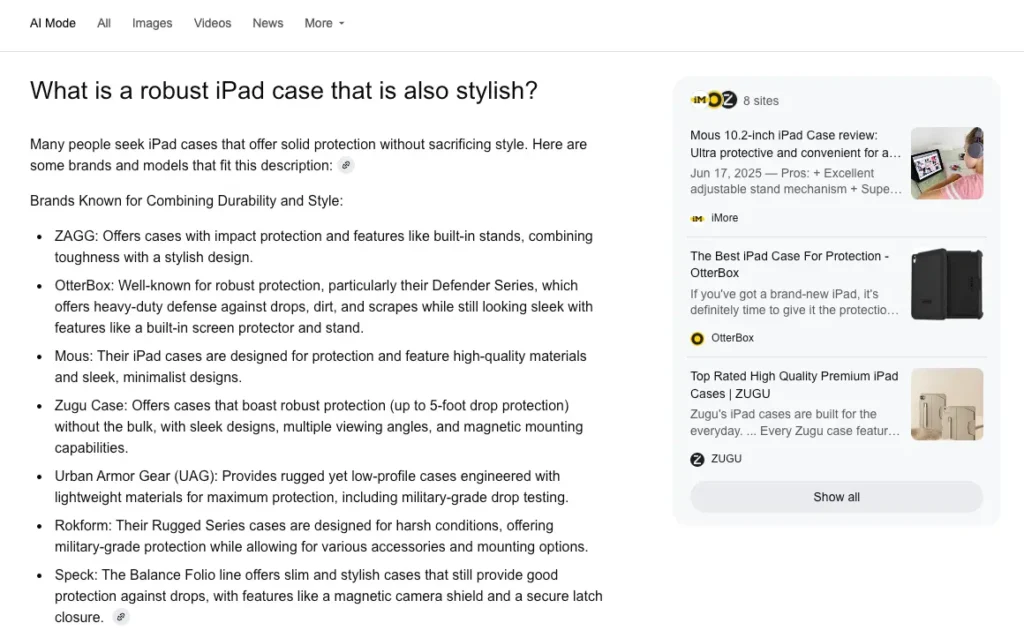
“ZUGU is a great example,” says Tim Cameron-Kitchen. “We’ve worked on optimising their site, sure. But what pushed them to the top of AI platforms like Perplexity and Google’s AI Mode recommendations was consistent mentions across various sites like Wired, ZDNet, and Reddit. The AI saw consistent sentiment and echoed it.”
A recent study by Ahrefs confirms this. When looking at what factors correspond with higher brand visibility in Google’s AI Overviews, they found branded web mentions to be the top factor.
But here’s the reality: building this kind of digital PR momentum takes time. “It doesn’t happen overnight,” says Tim Cameron-Kitchen. “It takes months and sometimes years of consistently getting your message out. But the return is massive by being cited by AI when customers are ready to make decisions.”
Here’s what you can do now:
- Create PR hooks around your core concepts and pitch them to industry journalists and publications.
- Submit expert commentary via platforms like Qwoted.
- Engage in high-authority forums and niche communities with thoughtful, value-driven contributions.
- Repurpose client wins, unique insights, or product research into publishable stories.
- Monitor your mentions to track sentiment and identify gaps.
Ready to Feature in AI Search?
Google’s AI Mode is reshaping how people discover brands and influencing buying decisions.
If you want your business to show up in these AI-powered results, you need more than just good SEO. You need an AI Search Optimisation strategy that connects your brand to the right concepts across the right channels in a way that AI tools can recognise and trust.
At Exposure Ninja, we help businesses do exactly that with our AI Search Optimisation. From defining your brand positioning and optimising your content to executing digital PR campaigns, we build the foundations that get you featured in AI Search and keep you there. Request a callback to see where we can take your AI visibility to the next level.
To better understand how AI Mode works and what you need to do to win, watch:
FAQs
What counts as a core concept for AI Mode?
A core concept is a specific phrase or positioning you want AI to associate with your brand, like “affordable skincare” or “best budget CRM.” These should reflect what you offer, who you serve, or how you’re different. They need to be used consistently across your website, content, and digital footprint to build strong semantic links.
How often should I audit my brand’s appearance in AI Mode?
Google’s AI Mode is evolving, so set aside time each month to check your brand’s AI Mode appearances and track any shifts in how you’re being presented or positioned.
Does semantic consistency include social media captions and ads?
Yes! AI Mode considers your entire digital footprint, including LinkedIn posts, TikToks, Facebook posts, and (soon) Instagram posts. If your messaging isn’t consistent across these channels, it weakens the signal AI receives about what your brand is known for. Use the same language and positioning in every channel, adapting the tone without changing the message.
How can I find query fan-out subtopics my page should cover?
Start by running your target queries in Gemini 2.5 and clicking “Show thinking” to view the background searches it performs — this strongly indicates how AI Mode breaks down topics. Supplement this with Google’s “People Also Ask” or AlsoAsked to uncover commonly linked subtopics and related questions. You can also analyse top-performing pages in your niche; they often already cover a wide range of fan-out topics that you can expand on, refine, or improve.