How To Rank in Google’s AI Mode (with Examples)

Picture this: you’re a marketing leader who’s mastered the art of SEO. Your pages rank beautifully, organic traffic is flowing, and then — boom — Google releases AI Mode, and everything you thought you knew about search gets turned on its head.
Sound familiar? You’re not alone.
In May, Google unleashed AI Mode across the globe, fundamentally reshaping how users interact with search. Instead of the familiar list of blue links, searchers now get direct answers powered by Google’s Gemini AI — think ChatGPT meets Google Search, but with the power to make or break your digital visibility.
Here’s what makes this particularly urgent for marketing leaders: if Google follows its typical pattern of rolling test features into main search (and they always do), AI Mode isn’t just the future — it’s your immediate reality. The brands that crack this code now will dominate tomorrow’s search landscape.
The million-pound question? How do you get an AI to recommend your products and services over your competitors?
We’ve been testing, tweaking, and perfecting AI Mode strategies for our clients since March. What we’ve discovered will challenge everything you think you know about search visibility — and show you exactly how to turn this seismic shift into your competitive advantage.
Executive Summary
Google’s AI Mode represents the most significant change to search in 20 years. It replaces traditional search results with AI-generated answers that fundamentally alter how brands achieve visibility online.
Unlike traditional SEO, ranking in AI Mode requires three critical strategies:
- Brand positioning through mentions: The number of branded mentions across the web is the strongest predictor of AI Mode visibility — more important than backlinks or domain authority
- Experience-rich content: Generic, AI-generated content is worthless; only in-depth, expert-driven content with first-hand experience gets referenced
- Topic cluster coverage: AI Mode breaks complex queries into multiple searches, requiring comprehensive content coverage across related subtopics
Early adopters are already seeing dramatic results. Zugu Case dominates “best iPad Air case” searches through strategic PR placement. The Golf Course Lawn Store ranks for specialised fertiliser queries through expert-authored content.
The window for competitive advantage is closing rapidly. Marketing leaders who act now — before AI Mode becomes the default search experience — will establish market positions that become increasingly difficult for competitors to challenge.
What Is Google’s AI Mode?
Imagine conducting a Google search and receiving a comprehensive answer, not a list of links to click through. That’s AI Mode in a nutshell.
If you’re familiar with AI Overviews (those AI-generated summaries at the top of some searches), picture that, but with virtually no other web results visible. You get:
- A detailed, conversational answer to your query
- Limited links embedded within the response
- A handful of source websites listed on the right (desktop only)
- An uncluttered experience that prioritises answers over options
The experience feels more like consulting ChatGPT than using traditional Google — and that’s precisely the point. Google is racing to defend its search dominance against AI competitors, and AI Mode is their answer.
But here’s what should grab your attention as a marketing leader: this isn’t just another search feature. It’s a fundamental reimagining of how people find and choose products and services online.
Why AI Mode Requires a Different Approach Than Traditional SEO
Let me be blunt: anyone telling you that ranking in AI Mode is “just SEO” either doesn’t understand AI Mode or is trying to sell you outdated services.
Traditional SEO operates on a beautifully simple principle: optimise for ranking factors, climb the results. It’s binary, predictable, and — dare I say it — comfortable.
AI Mode? It’s an entirely different beast.
Here’s why:
The AI Layer Changes Everything
When you search in AI Mode, Google’s Gemini large language model doesn’t just retrieve information — it synthesises it. The AI:
- Runs multiple background searches
- Analyses and cross-references information
- Applies its trained understanding of concepts and relationships
- Generates a unique response
This means two searches for similar terms might reference completely different sources, depending on how the AI interprets the query and what it deems most relevant.
%E2%80%9CThe cat is out of the bag. Google is not going to go back to 10 blue links and the old world of simple SEO.”
 Tim Cameron-Kitchen
Founder
Tim Cameron-Kitchen
Founder
The Death of Generic Content
Remember when HubSpot would publish articles about email signature generators, barely related to their CRM product? That strategy is dead.
Why? Because AI can generate that generic information itself. It doesn’t need to send users to your website for basic, factual content that lacks unique insight or experience.
This shift fundamentally changes content strategy. You can no longer win by being comprehensive — you must be irreplaceable.
The Brand Mentions Factor: Your Most Powerful Lever
Here’s the insight that’s worth the price of admission: brand mentions across the web are the single strongest predictor of AI Mode visibility.
Fresh data from Ahrefs confirms what we’ve been seeing in practice. The factors most correlated with appearing in AI-generated results are:
- Branded web mentions (by far the strongest correlation)
- Branded anchor text in links
- Branded search volume
Notice what’s not on that list? Traditional SEO metrics like Domain Authority or Page Speed.
Understanding the AI’s “Brain”
To grasp why this matters, you need to understand how large language models work. Here’s a simple example:
Type “Have a break, have a…” into ChatGPT, and it instantly completes: “KitKat.”
The AI didn’t search for this answer. Through training on billions of web pages, it learned that these concepts — “have a break” and “KitKat” — appear together so frequently that they’ve become neurally linked in its model.
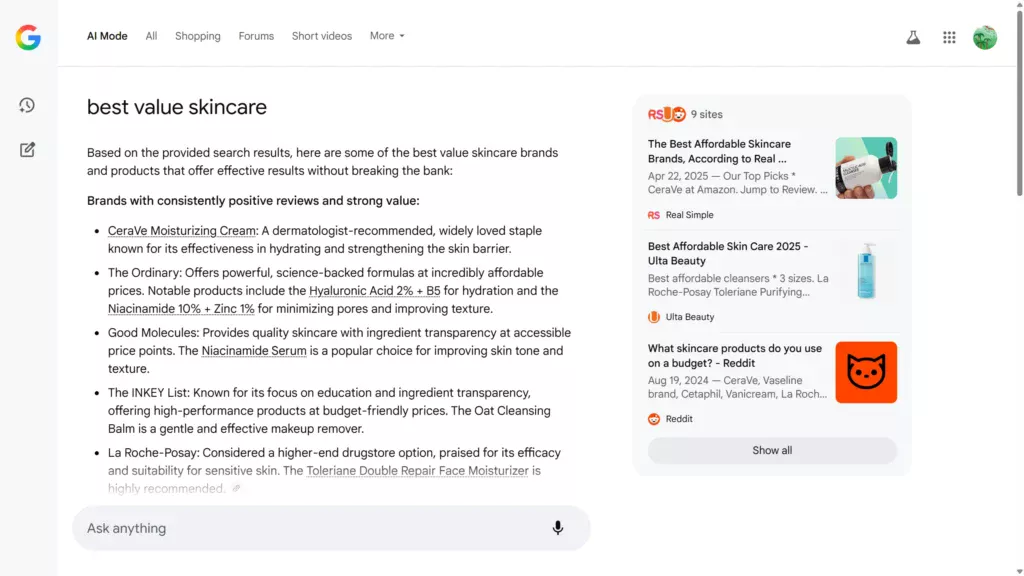
This is the principle behind AI Mode recommendations. When someone searches for “best value skincare brands,” the AI recommends The Ordinary not because it ran a fresh analysis, but because across millions of web pages, “best value skincare” and “The Ordinary” are consistently mentioned together.
The Positioning Imperative
This creates an urgent challenge for marketing leaders: What concepts do you want your brand to be inextricably linked with?
You have two positioning strategies:
- Audience positioning: “Insurance for young women drivers“
- Market positioning: “Lowest cost,” “highest specification,” “celebrity choice“
Many brands haven’t clearly defined this. If you don’t know what you want to be known for, neither will the AI.
Making It Happen: The Zugu Case Study
Our client Zugu makes premium iPad cases. Search “best iPad Air case” in AI Mode, and here’s what appears:
“Overall best is Zugu’s iPad Air case, highly rated for its multiple stand configurations…”
This didn’t happen by accident. Through strategic digital PR, we’ve ensured Zugu appears in high-authority reviews and recommendations across the web. The AI sees this consistent pattern — “best iPad case” + “Zugu” — and makes the connection.
Yes, this level of digital PR requires significant investment. But when AI Mode becomes the default search experience, being the AI’s go-to recommendation becomes priceless.
Creating Content That AI Tools Actually Want to Reference
Generic content is dead. Long live experience-driven expertise.
AI tools can generate unlimited generic content instantly. What they can’t create — and desperately need to reference — is content with genuine, first-hand experience.
Golf Course Lawn Example
Search “what kelp lawn fertilizer should I use?” in AI Mode, and you’ll find our client Ron from Golf Course Lawn featured prominently.
Why? Let’s dissect what makes his content AI-mode gold:
- Genuine expertise: Ron holds a certificate in sports turfgrass management from the University of Georgia
- First-hand experience: The article includes specific product recommendations based on actual use
- Rich media: Embedded videos show Ron demonstrating techniques on real lawns
- Actionable specifics: Detailed application rates, timing, and troubleshooting tips
- Commercial integration: Shopping options embedded naturally within expert advice
This isn’t content an AI could generate. It’s irreplaceable human expertise — exactly what AI tools need to reference for credibility.
The New Content Framework
Based on our testing, here’s what works:
1. Deep expertise over broad coverage
- One exceptional article beats ten generic pieces
- Focus on what only you can write
- Include specific examples, case studies, and failures
2. Middle and bottom-funnel focus
- Comparisons between specific solutions
- Implementation case studies
- Troubleshooting guides for actual users
- ROI calculations with real data
3. Multi-format authority signals
- Author bios that establish credibility
- Video demonstrations
- Data visualisations
- Interactive tools or calculators
The bar has been raised. Meet it, or become invisible.
%E2%80%9CThe days of generic, very top-level, dare I say it, AI-generated, could-be-written-by-anyone content for very top of the funnel, very informational searches, those days are long gone.”
Tim Cameron-Kitchen
Founder
The Query Fan-Out Technique: How AI Mode Searches Work
Here’s where AI Mode gets genuinely clever — and where smart marketers find opportunity.
When someone enters a complex query, AI Mode doesn’t run one search. It runs several, breaking down the query into components. Google calls this “query fan-out.”
Real Example: Nashville Weekend Plans
User searches: “Things to do in Nashville this weekend with friends. We’re big foodies who like music, but also more chill vibes and exploring off the beaten path.”
AI Mode breaks this into multiple searches:
- “Nashville art galleries off beaten path“
- “Breweries with live music Nashville“
- “Best food tours Nashville“
- “Chill music venues Nashville“
- “Hidden restaurants Nashville“
It then synthesises results from all these searches into one comprehensive answer.
The Topic Cluster Imperative
This changes everything about content strategy. You can’t just target “Nashville tourist guide” anymore. You need content addressing every potential sub-query.
Smart approach:
- Map the query landscape: What are all the ways someone might search for your solution?
- Create topic clusters: Develop in-depth content for each angle
- Interlink strategically: Help AI understand the relationships
- Monitor and expand: Track which angles gain traction
The Dale Hack
Want to see what queries AI Mode might run? Exposure Ninja’s Head of Marketing, Dale Davies (that’s me), discovered that running the same search in Google’s Gemini tool often reveals the underlying queries. Not perfect, but it’s a valuable starting point for content planning.
Real-World Success Stories
Theory is valuable. Results are everything. Here’s what’s working:
Zugu Case: Dominating Premium iPad Accessories
- Challenge: Compete against established accessories brands
- Strategy: Secured placements in high-authority review sites like ZDNet
- Result: AI Mode recommends Zugu as “overall best” for iPad Air cases
- Key insight: Third-party validation trumps self-promotion
The Golf Course Lawn Store: Niche Authority
- Challenge: Stand out in the crowded lawn care market
- Strategy: Created expert-driven content with genuine field experience
- Result: Featured prominently for specific fertiliser queries
- Key insight: Specificity and expertise beat generalisation
The Ordinary: Value Positioning
- Achievement: Consistently recommended for “best value skincare“
- Why it works: Years of consistent positioning as affordable quality
- Key insight: Long-term positioning strategy pays compound dividends
Next Steps
The clock is ticking. While this might feel overwhelming, remember: your competitors are likely more overwhelmed — or blissfully unaware. This is your opportunity.
Immediate Actions (This Week):
- Define your position: What concept should your brand own? Be specific.
- Audit your mentions: Use tools like Semrush’s AI sentiment analysis to understand current perceptions
- Identify content gaps: What expertise do you have that AI can’t replicate?
Short-term Strategy (Next 30 Days):
- Launch a digital PR campaign: Focus on getting featured in high-authority lists and reviews
- Create one exceptional piece: Better to publish one outstanding expert article than ten generic posts
- Map your topic clusters: Identify all the sub-queries around your main offerings
Long-term Positioning (Next Quarter):
- Build systematic PR: Make high-authority mentions a consistent part of your marketing
- Develop expert content programmes: Create processes to capture and share internal expertise
- Monitor and optimise: Track AI Mode performance and adjust strategies accordingly
Expected Outcomes:
Brands that execute this strategy can expect:
- Increased visibility in AI-powered search results within 60–90 days
- Higher-quality traffic from users getting strong recommendations
- Competitive moat that becomes stronger over time
- Future-proofed marketing as search evolves
Resources Mentioned
- Ahrefs’ AI Overviews study: Latest data on brand mention correlations
- Semrush AI Toolkit*: For sentiment analysis and AI visibility tracking
- Google Gemini tool: To research potential query fan-out patterns
In Conclusion
AI Mode isn’t just another Google update to weather — it’s a fundamental shift in how people discover and choose products and services online.
The playbook has changed. Traditional SEO, while still valuable, is no longer sufficient. Success requires a three-pronged approach: strategic brand positioning through mentions, irreplaceable expert content, and comprehensive topic coverage.
Yes, it’s more complex than traditional SEO. Yes, it requires investment in digital PR and expert content creation. But here’s the thing: the brands that figure this out now, while AI Mode is still rolling out, will establish positions that become exponentially harder for competitors to challenge.
The question isn’t whether AI-powered search will dominate — it’s whether you’ll be ready when it does.
Your competitors are either overwhelmed or oblivious. Which means right now, while they’re still figuring out what AI Mode even is, you have a window to establish your brand as the AI’s go-to recommendation in your space.
That window won’t stay open long.
Watch This Next
AI Mode is just one of the many new industry-changing product releases announced at Google I/O 2025.
Exposure Ninja’s Charlie Marchant (CEO) and Dale Davies (Head of Marketing) released an episode of our search marketing news podcast, The Dojo, that covers all of the biggest changes from the event. You can watch the podcast below or find the audio version via the podcast show notes: How Google Changed the Future of SEO at Google I/O 2025
*Disclaimer: Exposure Ninja may get a commission through the marked links above, at no cost to you