What Is Google Gemini in 2026? A Complete Marketer’s Guide

2026 Update — This guide has been rewritten to reflect the current Gemini model lineup, Google’s AI Overviews and AI Mode, and current pricing. Gemini launched in December 2023 and has been rebuilt several times since; see “Google Gemini Models Explained” below for what’s actually live today.
Google Gemini now underpins Google Search, Google Workspace, AI Overviews, and AI Mode. This guide explains what it is, what it can do today, and what that means for marketers.
Key Google Gemini Insights for Marketers
In a rush? Here are the most important things marketers should know about Google Gemini. If you want to learn more about any of these areas, then keep reading.
What Is Google Gemini? (The 2026 Definition)
Gemini is Google’s family of AI models. It powers Google Search’s AI Overviews and AI Mode, Google Workspace (Gmail, Docs, Sheets, Drive, Calendar), the standalone Gemini app, and Google’s developer APIs.
What Are the Main Features of Google Gemini?
Gemini is multimodal, meaning it can process images, video, audio, and code alongside text. It has a long context window (up to 1 million tokens on current models), strong agentic/planning capabilities, and deep integration across Google’s own products.
When Did Google Gemini Launch? (A Timeline of Key Releases)
Gemini launched in December 2023, initially powering Google Bard. Google rebranded Bard to Gemini in February 2024. Since then, Gemini has gone through several major generations — 1.0, 1.5, 2.0 Flash (January 2025), 2.5 Pro (March 2025), and the current 3.x family (from late 2025 onward), alongside the May 2025 launch of AI Mode in Search and the ongoing rollout of AI Overviews.
What Is Google Gemini? (In Depth)
Essentially, the task here is to explain the workings of a new type of brain that even the inventors (who happen to include some of the most intelligent humans alive) don’t truly understand.
But we’ve done a pretty darn good job of making information about Gemini accessible to marketers.
We’ve found some ways to explain it that make it slightly less confusing. There’s going to be a lot of jargon here, which we try to avoid, but some topics need it. There will be explanations for every acronym and jargon-y word.
If you’re new to AI, check out our guide, which includes a handy list of common AI terms.
Google Gemini is Google’s collection of large language models (LLMs), which power its AI tools — much like how ChatGPT is powered by OpenAI’s GPT models.
If you’re new to large language models, essentially, they’re super-smart computer programs that are really good with words and know a lot of things.
When we say “large,” we mean that this program has learned from many books, websites and other things people have written.
The most popular AI tools right now are generative AI chatbots. You can ask them questions, and they will try to give you answers. They can also write stories, offer advice or chat with you about all sorts of topics. Because of this, tools that use LLMs are great assets for marketers.
The screenshot below shows Bard, Google’s generative AI chatbot.
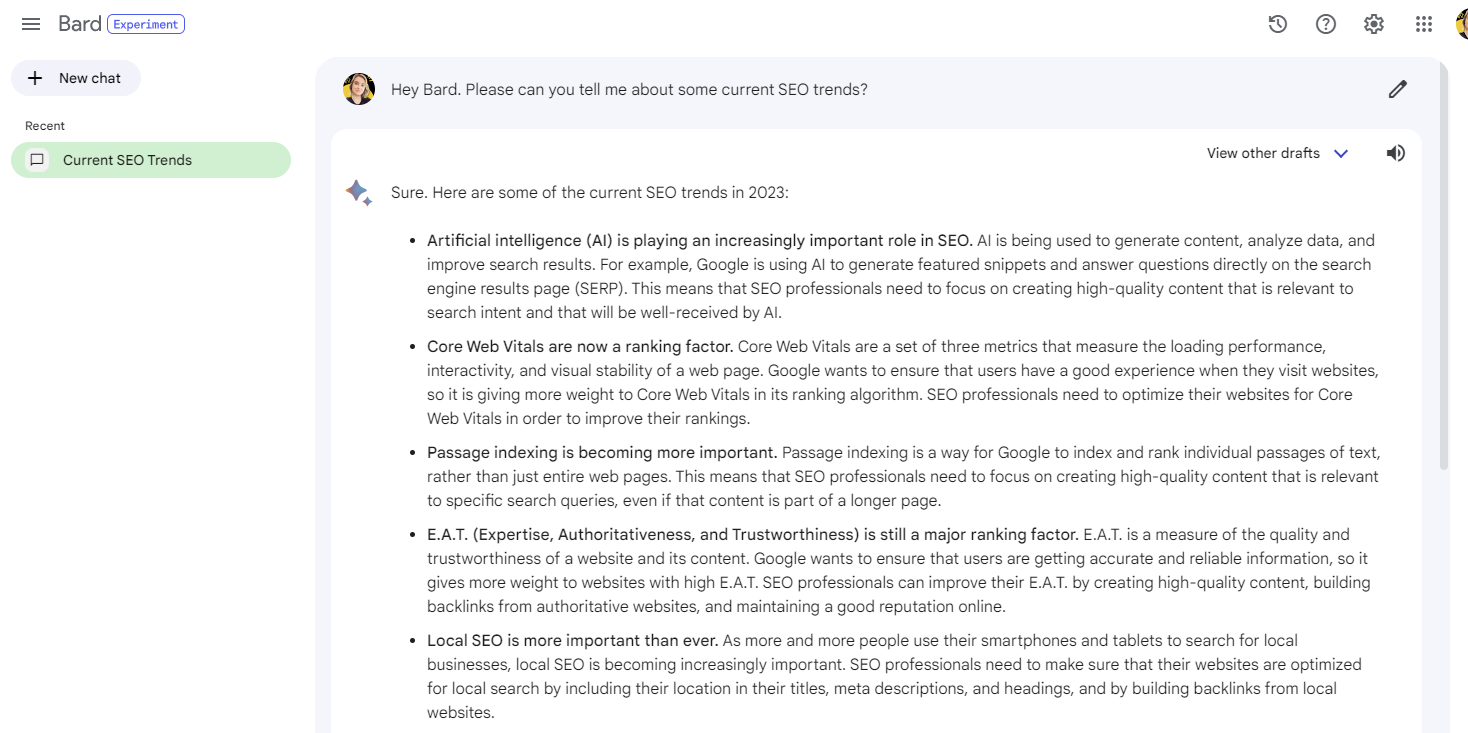
So what makes Google Gemini different from the LLMs that power tools like ChatGPT and Microsoft Copilot?
Starting with Bard. It won’t replace Bard, as it’s not a competitor. It’ll be one of the things that powers Bard, meaning Bard will be able to give better answers to users. The same goes for Google’s Search Generative Experience (SGE).
Gemini used to power the standalone Bard chatbot before Bard was rebranded to Gemini in February 2024. Today, Gemini directly powers the Gemini app, Google’s AI Overviews, and AI Mode in Search — there’s no separate “Bard” product to compare it to any more.
It stands out from OpenAI’s GPT models (which power ChatGPT) because of how deeply it’s integrated into Google’s own ecosystem — Search, Workspace, Android, and more.
Google’s stated aim for Gemini was for it to be “multimodal, highly efficient at tool and API integrations and built to enable future innovations, like memory and planning” — and the current 3.x model family delivers on that: full multimodal input and output, agentic tool use, and long-context memory.
It does this by processing data taken across services, including Google Search, YouTube, Google Books, and Google Scholar.
“That’s great,” we hear you say. “But what does that actually mean? What can it do? How has it impacted SEO? And how does it impact marketers today?”
What Can Google Gemini Do in 2026? (Current Capabilities)
There’s a lot that Google Gemini can do to help marketers by improving Google’s AI tools and search.
But the way Google has explained this isn’t ideal.
Using words like “multimodal” isn’t super accessible to most marketers, so let’s break this down for you.
Multimodal Understanding (Text, Images, Audio, Video, and Code)
Multimodal, in very simple terms, means that Gemini can “see” a bunch of different stuff.
If you show it text, it can understand it. If you show it an image, it can understand it. If you show it a video, it can understand that, too.
Thanks to Google images and YouTube (also owned by Google), the tech giant has a huge pool of data to use to train Gemini.
This is what makes it multimodal. If Gemini could only process text, then it wouldn’t be multimodal.
Not only can it understand text, images, and video; it can now also generate images, text, and video directly (via Gemini Omni Flash and Veo, Google’s video generation model).
There are two distinct ways that this can help marketers.
The first is helping with content generation.
This allows for natural, multi-turn conversations directly within the Gemini app or AI Mode.
Current Gemini models support long-context memory and agentic planning, so it can now hold onto much more context across a conversation and help plan multi-step tasks.
Lots of existing AI tools can help you generate text, images, or video, but it’s not often that one AI tool will do all of these. Then you have issues with the quality.
So, instead of getting the AI to create the work for you, you could work collaboratively with them, using them as an assistant. (which is how you should be using AI tools now, rather than just taking what they say word for word).
With Gemini, you can create a design for a landing page, for example, and get feedback from the AI on how well-optimised it is for conversions.
- It might suggest that you adjust the padding on the page or move the CTA to a more optimal position based on its research of other landing pages.
- You could even ask it to watch a promotional video you’ve created and get feedback on how strong your hook, pacing and graphics are.
ChatGPT offers similar multimodal feedback capabilities today.
The downside of this is that now it will be easier than ever for your competitors to produce higher-quality marketing. Perhaps right now, you have the competitive edge because you have the most user-friendly design, but in the future, it will be more difficult to stand out.
These tools are now widely available and being used at scale — these are some of the ways the multimodal side of Gemini is impacting marketers today.
The other area it will impact is SEO.
Since it powers AI Overviews and AI Mode, it uses its ability to “look” at images and video to influence the generated responses it gives searchers.

It may be able to find the perfect image someone is searching for or find a video about the weird thing they’re describing.
Gemini-powered systems now factor into how Google assesses page quality and relevance for ranking and for AI Overviews/AI Mode citation.
The AI-generated results in AI Overviews and AI Mode are now a standard part of the Google search experience for billions of monthly users (see “Google Gemini in AI Overviews” below).
This has reduced the number of website visits in a typical user’s search journey. Independent industry tracking generally shows fewer clicks through to websites for queries that trigger an AI Overview or AI Mode response, though the exact click-through impact varies significantly by query type and industry (VERIFY current click-through-rate benchmarks before publishing a specific figure).

You might be thinking that this means creating informational content for your website will be pointless, but we disagree.
Gemini needs to get the information that appears in AI Overviews and AI Mode from somewhere. If it’s taking that information from your website, it’s more likely to cite you as a source.
But the decrease in traffic still means that you’ll want to use other content sources to boost your traffic.
This includes running digital PR campaigns and improving your social media presence.
Social media doesn’t just mean the likes of Instagram and Twitter — it also includes places like YouTube or industry-focused forums.
PPC remains another way to maintain visibility and traffic alongside AI Overviews and AI Mode — Google continues to test and roll out ad formats within these AI-generated search experiences.
Exposure Ninja’s AI-forward founder, Tim Cameron-Kitchen, shares his thoughts on how Google Gemini will change SEO in this guide.
Gemini’s other capabilities have matured significantly since launch.
Gemini integrates with tools and APIs across Google’s existing platforms, including Google Workspace (Gmail, Docs, Sheets, Drive, Calendar), YouTube, and Maps.
The LLM will also come in a number of different models or sizes, which means it will have more flexible uses.
If you only have a model that’s virtually the size of an elephant, but your project is the size of a thimble, you’ll have trouble fitting the elephant-sized LLM into it.
That’s a pretty chaotic metaphor, but it just means that projects that don’t need to use the biggest version of Gemini won’t be weighed down by it. They can use “lighter” models that do what they need.
Google Gemini Models Explained: Flash, Pro, and Ultra in 2026
As of 2026, Gemini comes in several models, each built for a different use case:
- Gemini 3.5 Flash — the fast, efficient default model, including in the free tier since May 2026
- Gemini 3.1 Pro — the strongest reasoning model, available on the Google AI Pro plan, with a 1 million token context window
- Gemini 3.1 Flash-Lite — a lower-cost, high-speed model built for high-volume tasks like classification and routing
- Gemini 3 Deep Think and Gemini Omni Flash — specialist models for advanced reasoning and multimodal image/video generation respectively
For most marketing use cases — drafting, brainstorming, and quick analysis — Flash is fast and more than capable. For complex, multi-step research or strategy work, Pro is worth the upgrade. You don’t need to choose manually every time: Gemini’s apps route simpler requests to Flash and harder ones to Pro automatically in many contexts.
How to Access Google Gemini in 2026 (Free vs Paid Plans)
Google Gemini is built into the Gemini app, Google Search (via AI Overviews and AI Mode), and Google Workspace. You don’t need a separate sign-up to encounter it — most people are already using it every time they search on Google or open Gmail.
For the standalone Gemini app and deeper features, Google now offers tiered plans: a free tier, Google AI Plus (£/$7.99 a month), Google AI Pro (£/$19.99 a month), and Google AI Ultra (£/$99.99–£/$199.99 a month depending on tier). Pricing correct as of the May 2026 Google I/O restructure — verify current prices before publishing, as these change periodically.
Is Google Gemini Free? (Free Tier vs Advanced Plans)
Most marketers can use Gemini for free — it powers Google’s free AI Overviews and AI Mode in Search, and the free tier of the Gemini app now includes Gemini 3.5 Flash. Paid plans (Google AI Plus, Pro, and Ultra) unlock higher usage limits, the strongest reasoning model (Gemini 3.1 Pro), more storage, and extra features like Deep Research reports. Developers building on the Gemini API pay per token rather than a flat subscription.
Google Gemini vs ChatGPT in 2026: Which Should Marketers Use?
One of the questions marketers ask most often is this — is Google Gemini better than ChatGPT?
This is sort of a trick question, as Gemini and ChatGPT aren’t the same thing.
The fairer question is: how does Gemini’s current model family compare with OpenAI’s current GPT models?
The honest answer is that both are genuinely strong, and the best choice depends on your use case rather than one being straightforwardly “better.”
Gemini’s biggest practical advantage for marketers is its integration into tools you’re probably already using — Google Search, Gmail, Docs, Sheets, and Drive — plus its long context window. ChatGPT’s advantage remains its huge plugin/GPT ecosystem and, for many users, a longer track record with conversational quality.
OpenAI paved the way for the current generation of generative AI and has pushed Google to speed up its own AI product development.
Competition is healthy, and it will be interesting to see what OpenAI will do next with ChatGPT.
How Google Gemini Affects SEO and AI Search in 2026
Gemini is now the model powering two of the biggest changes to Google Search in years: AI Overviews and AI Mode. Both change how — and whether — users click through to a website after searching.
For marketers, the practical implications are similar to those for any generative-engine optimisation (GEO) work: structure content clearly, answer the specific question a searcher is likely to ask, back up claims with citable sources, and make sure your site is technically crawlable and fast. Content that gets cited inside an AI Overview or AI Mode answer can still drive brand visibility and qualified traffic, even where total click volume falls for a given query.
Google Gemini in AI Overviews: What Marketers Need to Know
AI Overviews — the AI-generated summaries that appear above traditional search results — are powered by Gemini and reached 2.5 billion monthly active users, according to Google at I/O 2026.
AI Mode, a separate, fully conversational search experience for complex, multi-step queries, launched in May 2025 and passed 1 billion monthly active users roughly a year later. Unlike AI Overviews, AI Mode retains context across a back-and-forth conversation rather than delivering a single static summary.
Both features draw directly on Gemini’s models, and both are reshaping how much organic traffic reaches individual websites from search. Our guide on how to rank in Google’s AI Overviews covers the specific optimisation steps in more depth.
Google Gemini for Marketers: The Takeaways
Google Gemini AI is a complicated topic. But it’s important that you understand what it is, at least a little bit, so that you can prepare for how it will impact your marketing.
- Gemini powers AI Overviews and AI Mode, meaning more people stay within Google’s search results rather than visiting websites. This sounds bad — most websites get less overall traffic — but the traffic that does come through tends to be more qualified.
- Gemini powers the Gemini app directly (Bard no longer exists as a separate product), which remains a handy brainstorming tool for marketers.
- In the future, it’s possible that AI tools using Gemini will be able to offer feedback on design and video work.
- Gemini launched in December 2023 and now underpins AI Overviews, AI Mode, Google Workspace, and the standalone Gemini app across three major model generations.
What to Read Next
- Learn more about the impact Gemini will have on marketers
- Get up to speed on the future of AI marketing.
What to Watch Next
- AI Tools Most Marketing and Sales Teams (Probably) Aren’t Using Yet
- 2023 Marketing Changes RANKED
- SGE: The Future of Google Search (How it Works and SEO Impact).
What to Listen to Next
- Google Gemini – The Biggest SEO Disruption in 25 Years
- Google’s AI Search FINALLY Has Links (Maybe?)
- Google’s SECRET SEO Guide (and How to Use It).
Google Gemini FAQs for Marketers
Is Google Gemini free to use?
Yes, with rate limits — Gemini powers Google’s free AI Overviews and AI Mode in Search, and the free tier of the standalone Gemini app now runs on Gemini 3.5 Flash. Paid plans (Google AI Plus, Pro, and Ultra) unlock higher limits and the stronger Gemini 3.1 Pro model.
What replaced Google Bard?
Google Gemini. Google rebranded Bard to Gemini in February 2024, and Bard no longer exists as a separate product.
How does Google Gemini affect SEO?
Gemini powers AI Overviews and AI Mode, the two biggest changes to Google Search in recent years. Both can reduce click-through to websites for a given query while still offering visibility if your content is cited as a source, making clear structure and citable, well-sourced content more important than ever.
Is Gemini better than ChatGPT for marketing?
It depends on the use case. Gemini’s main advantage is deep integration with Google Search, Workspace, Gmail, Docs, and Sheets, plus a long context window. ChatGPT’s advantage remains its broader plugin ecosystem and a longer track record for many conversational use cases. Many marketers use both.
What is the difference between Gemini Flash and Gemini Pro?
Flash is Google’s fast, efficient default model, suited to most everyday marketing tasks like drafting and quick analysis. Pro is the stronger reasoning model, better suited to complex, multi-step research or strategy work, and is available on the Google AI Pro plan.
How can I use Google Gemini for marketing?
You can use Gemini directly through the Gemini app for brainstorming, drafting, and research, through Google Workspace for content and data tasks, and indirectly by optimising your content to be cited well within AI Overviews and AI Mode search results.