The Marketing Metrics That Actually Matter in 2026


We break down the website metrics that truly matter in 2026 and how marketing leaders can use them to connect digital activity to leads, revenue, and AI Search visibility.
Access to digital marketing data isn’t the problem. Most teams already have more dashboards, reports, and platform insights than they know what to do with.
The real challenge is knowing which metrics actually matter. As every platform adds more charts, numbers, and insights, it’s becoming harder for marketing leaders to separate meaningful performance signals from noise.
At the same time, your role goes beyond reporting activity. You’re expected to set the strategic direction for digital marketing, prove ROI, and identify where the next stage of growth will come from. That requires focusing on metrics that connect marketing activity directly to outcomes like visibility, traffic, leads, and revenue.
We break down the digital marketing metrics worth tracking and a few worth ignoring in 2026.
How to Choose Valuable Marketing Metrics
The most valuable website metrics depend on your specific goals. There are dozens of metrics available in analytics platforms, but not all of them will be meaningful for your business.
As Andrew Tuxford, Head of Search Engine Optimisation (SEO) and AI Search, explains: “The most important website metrics depend on what you’re trying to achieve. There are lots of metrics you could track, but depending on your goals, you may use some of them, all of them, or different metrics altogether.”
To get the most valuable metrics to track for your website, start by setting the goals. Define what success looks like for your digital marketing strategy, then work backwards to identify the metrics that show whether you’re moving towards that goal.
For most businesses, the ultimate aim is to increase leads or revenue. But measuring that outcome alone rarely tells the full story. To understand performance properly, you need supporting metrics that explain how you’re getting there.
Andrew Tuxford explains: “For example, sessions are a pretty standard website metric, and most websites will target it. But sessions alone don’t tell you if you are performing well. Increasing the number of people going to your website doesn’t help unless those people are also interested in your offering.”
He uses a simple analogy to illustrate the point: “It’s a bit like if you owned a butcher’s shop, no amount of extra people through the door will grow your business if all those extra people are vegetarians. So you’ll want to pair sessions with conversions to make sure those increased visits are also driving increased sales or leads.”
Main takeaways for busy CMOs:
- Start with your goal. Decide what success looks like for your business before choosing metrics.
- Focus on outcomes first. Leads, sales, or revenue should be your primary indicators of success. Use supporting metrics for context. Metrics such as sessions, rankings, and engagement help explain why performance is changing.
- Pair metrics together. Traffic without conversions rarely creates growth.
First decide what you’re trying to achieve. From there, you can identify the pieces of information that tell you whether you’re achieving it, which become your metrics. For most websites, the goal is more leads or sales, so your primary metrics will be conversions or revenue. Then you track additional metrics to understand the levers that influence those outcomes. Start with the goal and work backwards.
 Andrew Tuxford
Head of SEO
Andrew Tuxford
Head of SEO
Marketing Metrics for Lead Generation Businesses
For businesses where the sale happens off the website, the key is identifying the last trackable action a visitor takes on your site before entering the sales process.
Tim Cameron-Kitchen, Founder of Exposure Ninja, uses Westminster Wealth Management as a clear example. A visitor lands on the site, books a free initial consultation, speaks with an adviser, and eventually becomes a client. The consultation booking is the last action that happens on the website. That becomes the conversion event to track.
Tim Cameron-Kitchen adds, “Of course, with a lead generation business, it’s great to track conversions, but you’re also going to want to track the performance of different traffic channels leading up to those conversions.”
These are the supporting metrics you can layer in:
- Key Events: Form submissions, demo bookings, quote requests, or consultation calls, depending on your business model.
- Key Event Rate: The percentage of sessions that result in one of those key actions. This tells you how efficiently your site converts traffic into leads, not just how much traffic it receives.
- Sessions by Channel: Which traffic sources are actually producing leads, not just visits.
- Funnel Attrition: Where visitors drop out before completing a lead action. This is where you find the friction.
Elite Renewables shows exactly why tracking channel performance alongside conversions matters. When the team acquired the business in March 2025, the site was generating around 276 visitors per month. After a full website rebuild in July, organic traffic grew from 215 to over 1,300 visitors a month, with paid media cross-network campaigns running alongside.
The two channels told very different stories:
- Cross-network traffic generated nearly 7,500 sessions at a 0.64% conversion rate.
- Organic brought fewer than 2,000 sessions, but converted at 4.37%.
The instinct might be to deprioritise paid. But as Tim Cameron-Kitchen explains: “The cross-network traffic is so cheap that we will take these numbers all day long.”
Cost per lead matters as much as conversion rate; as this was a judgement call that’s only possible when you’re tracking both together.
Google Analytics 4 (GA4) only shows you what happens on the website. To understand whether those leads are actually turning into revenue, you need your CRM data too.
The metrics worth pulling from your CRM, like HubSpot, include:
- Lead to Opportunity Rate: How often website enquiries become sales-qualified opportunities.
- Conversion to Customer Rate: How often those opportunities close.
- Revenue per Lead: Total revenue divided by total leads generated.
- Lead Quality by Channel: Which traffic sources produce leads that actually buy.
This data is what connects marketing spend to commercial outcomes. Without it, you’re optimising for enquiry volume, not revenue.
Marketing Metrics for eCommerce Businesses
For eCommerce and transactional websites, the conversion point is clear: the sale. But that doesn’t mean the analysis is simple.
Tim Cameron-Kitchen shares an example: “Let’s look at a larger business example, and imagine that you’re on the marketing team at Holland & Barrett. Now, obviously, if you’re on the SEO team at Holland & Barrett, you wouldn’t just be looking at your keyword rankings and celebrating. You’d also want to see the traffic coming through to the website and the sales, the conversions, the revenue generated by that organic traffic.”
The core metrics to track:
- Revenue: The ultimate measure of whether your marketing is working.
- Conversion Rate: The percentage of sessions that end in a purchase.
- Average Order Value: Less meaningful on its own, but powerful when compared across acquisition channels to understand where your highest-value customers are coming from.
- Funnel Attrition: At a minimum, track the checkout journey from product page to purchase. GA4’s purchase journey report lets you split this by channel and device, which is where the real insights are. Paid traffic and organic traffic often behave very differently at each stage of that funnel.
Tim Cameron-Kitchen flags an important nuance here: “We’ve got to be really careful with organic traffic and conversion rate because sometimes when you build the content site on a website, you can drive a lot more organic traffic to that website, but you can actually see your conversion rate drop because a lot of that traffic is informational.
That doesn’t mean it’s bad traffic. If that traffic generates any conversions at all, then it’s a win. This just illustrates the danger of relying too heavily on setting one metric as your KPI. If you wanted to conversion rate max organic traffic, you would cut out all informational pages on your website and probably just drive people through to your homepage and your product pages, which wouldn’t make any sense.”
SEO Metrics Worth Tracking
The performance of your SEO strategy comes down to three things working together: rankings, traffic, and conversions.
- Rankings tell you whether your site is visible.
- Traffic tells you whether that visibility is translating into visitors.
- Conversions tell you whether those visitors are doing something that matters to the business.
Tim Cameron-Kitchen runs through L&C Mortgages as an example in Semrush One*. In L&C’s case, their total keyword count had grown significantly since 2020, but their positions one to three rankings only increased from 732 keywords to 959 over several years. That’s why their organic traffic had stayed relatively flat despite the broader growth in visibility. More keywords ranking doesn’t mean much if they’re sitting on page two.
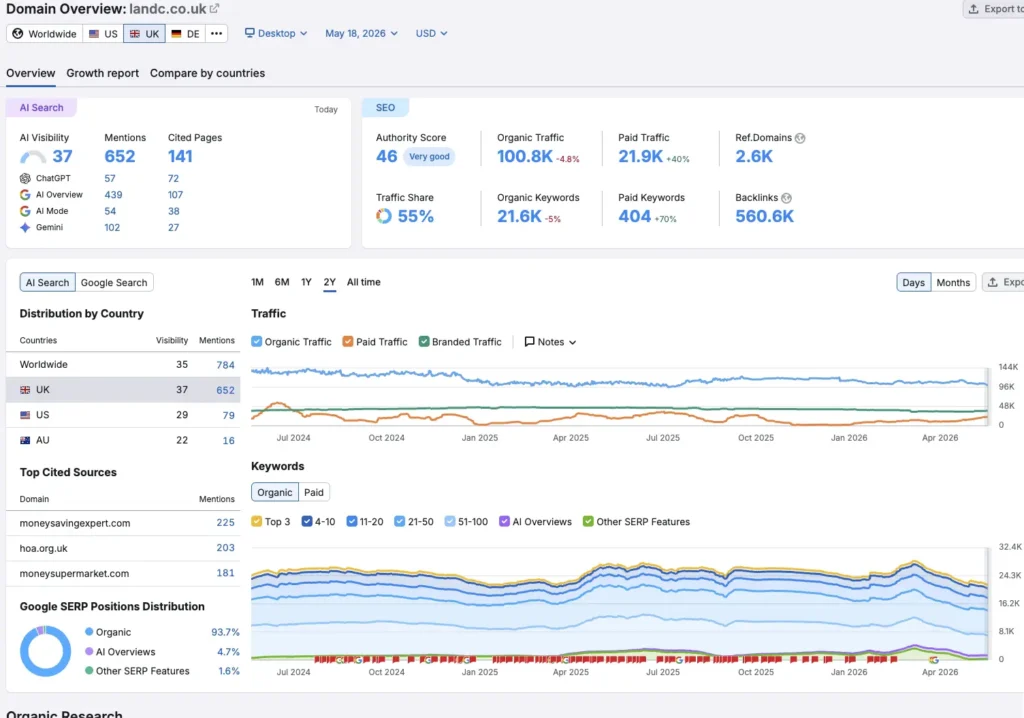
Andrew Tuxford adds, “Tracking rankings, traffic, and conversions are required together because the interplay among them helps to understand how the work being done ultimately influences the business performance. For example, if your rankings are going up but your traffic isn’t, you’re improving the wrong keywords. If traffic is going up but conversions aren’t, it’s either the wrong type of traffic or there’s a sales blocker on site.”
Also pay attention to the split between branded and unbranded traffic. A rise in branded search can be an early signal that your AI Search visibility is improving, even before you can attribute it precisely.
The important thing with these sorts of metrics for SEO is that rankings aren’t the ultimate goal. They’re a leading indicator. Rankings should bring traffic, which should bring conversions, and it’s really important that we stay anchored on the true goal of all of this, which is those conversions.
 Tim Cameron-Kitchen
Founder
Tim Cameron-Kitchen
Founder
New AI Search Metrics to Track
AI Search has introduced new marketing metrics to track.
There are two distinct areas to measure how your AI Search Optimisation is performing: Google’s AI Overviews and appearances in standalone Large Language Models (LLMs) like ChatGPT, Perplexity, and Gemini.
AI Overviews
AI Overviews appear directly in Google’s search results and can be tracked through most modern rank-tracking tools, including Semrush One. Unlike traditional rankings, ranking in an AI Overview is binary: you’re either in, or you’re not.
Track two metrics together to get the real picture:
- Total AI Overviews your site appears in.
- Percentage of available AI Overviews your site appears in.
As Andrew Tuxford explains, “Google regularly changes the number of AI Overviews available. If your total number increases without looking at the percentage as well, you don’t know whether that’s because Google has added more AI Overviews to search results or because your performance within them has improved.”
LLM Visibility
Tracking visibility in AI platforms is more complex than traditional search. Unlike search engines, most AI platforms do not publish data on how often brands appear in responses or where their information comes from.
A number of AI Search tools have emerged to estimate LLM visibility, including platforms such as Profound, Peec AI, and Semrush’s AI Visibility Toolkit. These tools track a similar set of signals that help indicate how visible your brand is within AI-generated responses. These include:
- Brand Mentions: How often your brand or website is referenced in an AI-generated response. A mention does not necessarily include a link, but it shows that the model recognises your brand as a source of information.
- Citations: How often an AI platform links directly to your website when generating an answer. Citations are particularly valuable because they create a clear path for users to visit your site.
- Brand Sentiment: The context in which your brand is mentioned. Sentiment analysis indicates whether the model presents your brand positively, negatively, or neutrally within responses.
Alongside these platform-level signals, it is also important to monitor real traffic and outcomes from your AI Search Optimisation strategy. This includes:
- AI referral traffic from platforms such as ChatGPT or AI Mode.
- Conversions from AI traffic, such as leads, sign-ups, or purchases.
These metrics help connect AI visibility to real business impact.
One important nuance: AI visibility doesn’t always produce a direct click. Often it produces branded organic traffic: someone gets an answer from ChatGPT and then Googles your brand name. That traffic shows up in your organic channel, not attributed to AI. Tim Cameron-Kitchen’s advice is to mentally attribute a portion of rising branded traffic to AI Search performance, even when you can’t precisely track the path.
That said, direct AI referral traffic is growing fast. According to HubSpot’s State of Marketing report, 49% of marketers say their web search traffic has dropped as a result of AI Search, but 58% say AI Search traffic converts at a significantly higher rate than regular organic traffic. Lower volume, higher intent. That makes tracking it closely worth the effort.
Exposure Ninja is a proud Semrush partner: try Semrush One free for 14 days and get access to both traditional SEO and AI Search metrics in one place.*
Website Metrics to Forget in 2026
The marketing metrics to forget in 2026 are the ones that don’t reflect real business performance or help you make better decisions.
As Andrew Tuxford explains: “Useful metrics are the pieces of data that accurately reflect your business performance and help you make the decisions you need to make as a business.”
In many dashboards, metrics such as sessions, impressions, or rankings are reported separately. These numbers can show activity, but they do not necessarily show whether marketing is driving leads, sales, or revenue.
To decide if a metric is worth tracking, Andrew Tuxford recommends that you ask two simple questions:
- Do I clearly understand what this metric measures and what it tells me about my business?
- Does this information help me make a decision?
If the answer to the first question is no, the metric needs a better definition. If the answer to the second is no, it probably does not belong on your dashboard.
For marketing leaders, the goal is to build a focused set of metrics that clearly connect marketing activity to business outcomes. Removing metrics that do not support that goal helps keep reporting simple, meaningful, and actionable.
Tools for Tracking Marketing Metrics in 2026
The right tools depend on what you’re measuring, but these three categories cover the essentials:
- Analytics: GA4 remains the go-to for on-site performance. Adobe Analytics is a solid alternative for larger enterprise setups.
- Rank Tracking: Semrush, SE Ranking, and Ahrefs all give you visibility over keyword rankings, including AI Overviews. Your choice often comes down to budget and the depth of data you need.
- LLM Tracking: Profound, Peec AI, and Semrush One are our top AI Search visibility tracking tools.
Turn Marketing Metrics into Measurable Marketing Growth
The businesses that will win in 2026 aren’t the ones with the most data. They’re the ones who’ve taken the time to decide what good looks like and built their reporting around that.
If you’re not sure whether your current website metrics are giving you the right picture or if you want a second opinion on where your biggest growth opportunities are, request a marketing review from Exposure Ninja. We’ll take a look at what’s working, what’s not, and where to focus next.
FAQs
What are the top 3 website performance metrics to monitor?
The three most important website performance metrics are traffic (sessions), conversion rate, and revenue or leads. Traffic shows whether your marketing is bringing people to your site, while conversion rate shows how effectively your site turns those visitors into customers or enquiries. Revenue or leads confirm whether that activity is actually driving business growth.
Are website traffic metrics still important?
Yes, but only when paired with related website metrics. Traffic growth is a positive signal, but sessions alone can’t tell you whether your site is actually performing. Always pair traffic metrics with conversion rate or key events to understand whether increased visits are translating into real business value.
What metrics show whether a website is generating revenue?
The clearest revenue indicators are total revenue, conversion rate, and average order value. Revenue tells you the outcome; conversion rate shows you how efficiently your site turns visitors into customers; and average order value helps you understand the quality of those customers. Funnel attrition data provides further clarity by showing exactly where potential customers drop off before converting.
How often should you review marketing metrics?
Most marketing leaders benefit from a weekly pulse check on key conversion and traffic metrics, with a deeper monthly review that includes SEO rankings, funnel performance, and channel breakdowns. Quarterly reviews are the right moment to reassess whether your metrics still align with your business goals.
Which tools are best for tracking website performance?
Google Analytics 4 (GA4) is the standard for on-site behaviour and conversion tracking. For SEO and AI Overview visibility, Semrush One, Ahrefs, and SE Ranking are all strong options, depending on your budget and requirements. For LLM visibility tracking, Profound, Peec AI, and Semrush are great options.
What metrics should marketing leaders report to executives?
Executive reporting should focus on the metrics that connect marketing activity to business outcomes: revenue or leads generated, conversion rate, cost per acquisition by channel, and visibility.
*Some links in this article are affiliate links that Exposure Ninja receives a fee for promoting (these links are not sponsored). Exposure Ninja only promotes services we already use within our marketing stack.