
SEO for Law Firms: The Complete Guide

Law firm SEO comes down to getting the fundamentals right in the right order: solid technical foundations, well-structured practice-area and location pages, expert content, local visibility, trust signals, and a site that turns visitors into enquiries.
The short version: Law firm SEO comes down to getting the fundamentals right in the right order: solid technical foundations, well-structured practice-area and location pages, expert content, local visibility, trust signals, and a site that turns visitors into enquiries. Get those working together and your cost per case falls while your visibility compounds. This guide walks the whole process, then hands you a 90-day plan to start.
Every law firm wants the same thing from its website: more of the right enquiries, at a lower cost than paid ads. SEO is how you get there. Done properly, it puts your firm in front of people at the exact moment they’re looking for legal help, and keeps doing it long after the work is done.
This is the complete, practical guide to SEO for law firms, whether you’re a high-street solicitor, a specialist chambers, or a US attorney competing in a crowded market. We’ll cover what law firm SEO involves, the full process in the order we’d run it, a real client result, and a 90-day action plan you can start this week.
What is law firm SEO?
Law firm SEO is the work of improving your firm’s visibility in search results so potential clients find you when they look for legal help. It spans your website’s content, its technical health, your local presence, your reputation, and how AI engines describe your firm.
Search has split into two arenas: traditional Google results and AI answers (AI Overviews and tools like ChatGPT). This guide focuses on the practical foundations that win in both. For a deeper look at the AI side specifically, see our guide on how law firms rank on Google and AI Search.
Why SEO matters for law firms
Legal clicks are expensive, organic compounds
Legal keywords are among the most expensive in all of paid search, because a single case can be worth so much. With ads, you pay for that visibility on every click, forever. SEO front-loads the effort instead: the investment is heaviest early, then your cost per enquiry falls as your pages gain authority and keep working month after month. It’s the difference between renting visibility and owning it.
You can beat bigger firms on relevance
Search rewards the most relevant, most useful result, not the biggest ad budget. A focused firm that targets the right practice areas and locations, answers client questions better than anyone else, and earns real local trust can out-rank national firms for the searches that matter to it. That’s the opportunity SEO gives smaller and mid-sized firms.
Before you start: map your practice areas and keywords
Good law firm SEO starts on paper, not in a CMS. List every practice area you want more of, and every location you serve. For each, note how clients actually search: ‘divorce solicitor Leeds’, ‘personal injury claim time limit’, ‘commercial lease dispute’. You’ll see three types of query: commercial (ready to hire), informational (researching), and local (looking nearby).
Map each priority term to a single page, so nothing competes with itself, and separate your money pages (practice-area and location pages that win enquiries) from your supporting content (guides and FAQs that build authority and feed internal links).
Here’s what that mapping looks like in practice:
| Practice area / location | Example search | Query type | Target page |
|---|---|---|---|
| Personal injury, Manchester | personal injury solicitor Manchester | Local / commercial | Practice-area + location page |
| Divorce, national | how long does divorce take in the UK | Informational | Blog guide linking to family law page |
| Commercial property | commercial lease dispute solicitor | Commercial | Practice-area page |
Build that out across every service and location and you have a page-by-page plan for the year.
The complete law firm SEO process
Here’s the process in the order we’d run it. Each step builds on the one before.
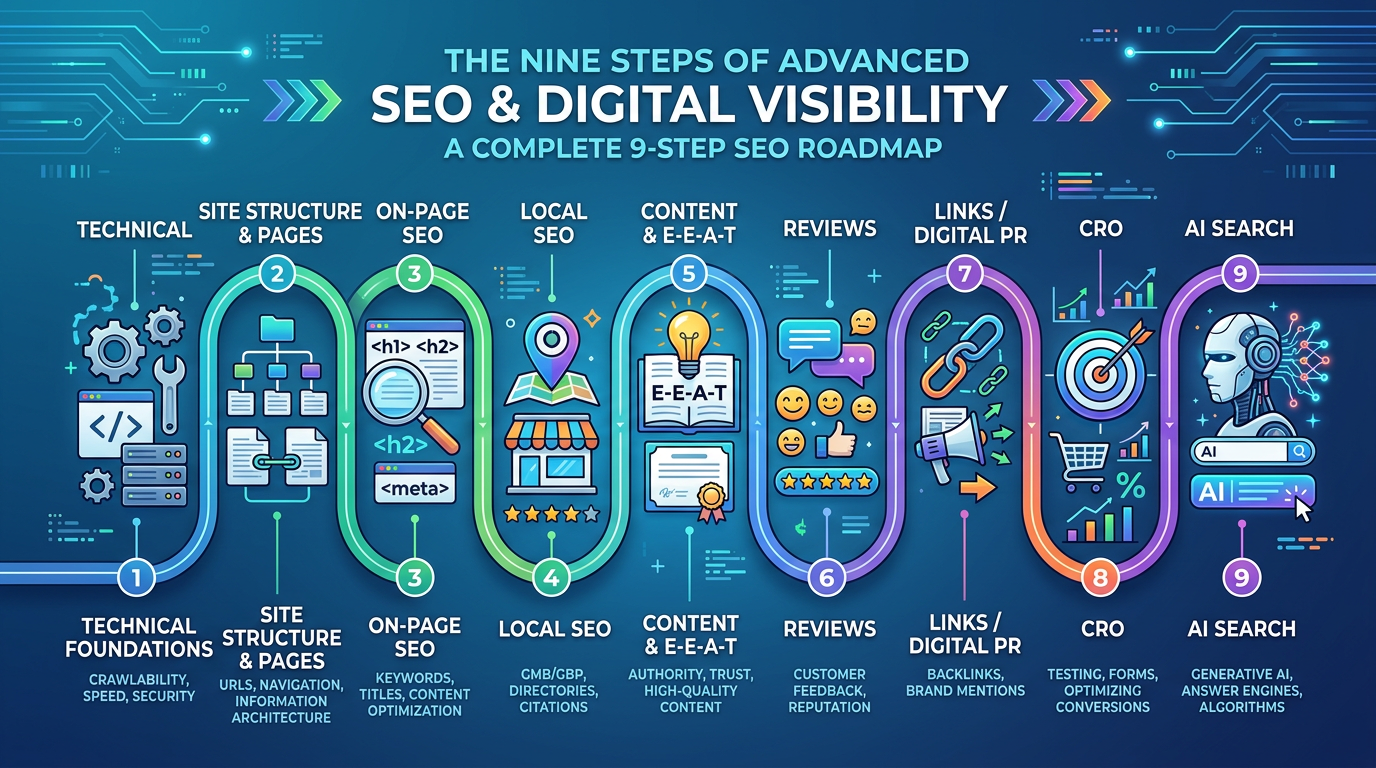
1. Technical foundations
If search engines and AI crawlers can’t reach, read and understand your site, nothing else matters. Get the basics right first: fast load times, a mobile-first build, a logical structure, HTTPS, a clean XML sitemap, and no crawl or indexing errors. Add structured data (schema such as LegalService, Attorney and FAQ) so machines know exactly what each page is. A quarterly technical SEO check keeps small issues from quietly stacking up into lost rankings.
2. Site structure, practice-area and location pages
Give every service and every location its own developed page. A single ‘Our Services’ page won’t rank for much. A firm covering three practice areas across two cities needs a clear structure of dedicated pages, each going deep on that specific service and speaking to that client’s specific worry. This is where most firms leave enquiries on the table. A firm handling both personal injury and family law across two cities needs separate, in-depth pages for each service in each location, not one page trying to do everything at once.
3. On-page optimisation
For each page, get the fundamentals right: a clear, keyword-led page title and meta description, one focused H1, logical subheadings, genuinely useful copy that answers the client’s question, and internal links to related pages. Write for the client first and the search engine second. The two goals agree more often than not. Take care not to spin up near-identical pages for different locations, as thin, duplicated copy helps no one and can hold your rankings back.
4. Local SEO and your Google Business Profile
Most legal searches are local, and much of local SEO is won in the map pack before anyone reaches the main results. Claim and fully optimise your Google Business Profile, pick the right categories, and keep your name, address and phone number identical everywhere online. Add listings in reputable legal directories, and build a steady flow of genuine reviews. For the firm in our case study, this was the single biggest early win: top-three map pack positions in two separate cities. Aim to earn reviews steadily rather than in bursts, reply to every one, and keep your profile active with posts and current opening information.
5. Content and E-E-A-T
Because legal advice affects people’s finances, freedom and wellbeing, Google treats it as a ‘Your Money or Your Life’ topic and holds it to a higher standard through E-E-A-T (Experience, Expertise, Authoritativeness and Trustworthiness). Publish content that answers real client questions, written or reviewed by named, credentialed people at your firm. This is what earns rankings, trust, and AI citations at the same time. Think practice-area explainers, answers to the questions clients ask in a first call, and plain-English guides to the processes they’re anxious about.
6. Reviews and reputation
Reviews influence clients, rankings and AI answers alike. Build a simple, ethical process to ask satisfied clients for reviews at the right moment, and never incentivise or fabricate them. For our case-study firm, an ethical review programme doubled one location’s review count, all genuine.
7. Link building and digital PR
Links from respected websites tell Google your firm is credible. For law firms, the best come from legal press, bar and association listings, journalists after expert comment, and real local partnerships. Digital PR earns these at scale by turning your firm’s expertise into stories and data journalists want to cover. Steer well clear of cheap or bought links, which risk a penalty and the reputational damage that follows.
8. Converting visitors into enquiries (CRO)
Rankings only pay when visitors become enquiries. Make it effortless to get in touch: clear calls to action, short enquiry forms, click-to-call on mobile, and visible trust signals like reviews and accreditations. A conversion rate optimisation audit for our case-study client lifted blog conversions by 144%, turning readers into calls without any extra traffic.
9. AI Search (GEO): the short version
A growing share of clients now read an AI Overview or ask an AI assistant to recommend a firm. The good news: the foundations above are most of the battle. Clear, question-led content, structured data, consistent details and genuine authority are exactly what AI engines reward. For the full playbook, including how AI decides which firms to name, see our dedicated guide on how law firms rank on Google and AI Search.
How SEO fits with the rest of your marketing
SEO doesn’t work in isolation. Most firms get the best return by pairing it with paid ads early on and feeding both from the same content and reputation.
| Factor | SEO | PPC (paid ads) |
|---|---|---|
| Time to results | Builds over months | Immediate |
| Cost over time | Falls as authority grows | Fixed cost, every click |
| Sustainability | Holds with ongoing work | Stops when spend stops |
| Best for | Long-term, compounding enquiries | Fast visibility, testing demand |
The practical play: run PPC for immediate enquiries while your SEO builds, then lean more on organic and AI Search as they take over the heavy lifting. Referrals and reputation feed both, because a firm people already trust is one search engines and AI trust too.
Case study: 727% more leads for a personal injury firm
The results:
- +727% growth in monthly leads
- +299% increase in monthly organic sessions
- +144% increase in blog conversions
A US personal injury firm came to us competing against much larger, better-funded firms, with a dated website and very little organic traffic. We ran the process above: rebuilt the site for speed and conversion, led with local SEO in one city then expanded to a second, published content around the exact questions clients ask, generated reviews ethically, and future-proofed for AI Search. The firm grew from 357 leads a year to nearly 3,000, and its director reported roughly a 50% increase in calls.
“If you have a business that relies on your website to bring in business, don’t waste your time and money on any other company. From my experience, I have gained approximately a 50% increase in calls.” — Director, personal injury law firm
Every figure here is real and taken from our own case study.
How to measure law firm SEO success
Track the numbers that reflect business, not vanity. The ones that matter most are enquiries and cost per lead or per signed case, measured with call tracking and form attribution. Watch organic sessions and keyword visibility to see momentum building, and your map pack positions for core local terms. Add AI visibility, how often your firm appears in AI answers, as an emerging measure. And stay honest about GA4 attribution: not every enquiry traces cleanly to one source. Set a baseline before you start and review monthly, so you can see the trend rather than reacting to any single week.
How much does law firm SEO cost?
There’s no single price. It depends on how competitive your market is, whether you’re targeting local or national terms, and how many practice areas and locations you cover. Most firms work on a monthly retainer, typically from a few hundred pounds a month for a focused local campaign to several thousand for competitive, multi-location work.
The number that matters isn’t the retainer, it’s the cost per client you sign. A campaign that costs more but wins higher-value cases at a lower cost per client is the better investment. Cost is driven mainly by how competitive your market is, how much content and technical work is needed, and how aggressive your link building has to be to compete. Be cautious of anyone who quotes before understanding your market, or who promises a specific ranking. No one credible can.
Should you do SEO in-house or hire a legal SEO agency?
You can run law firm SEO in-house if you have the time, the skills and the tools. The catch is that SEO is broad and fast-moving, and law is one of its most competitive niches, so progress can be slow without dedicated expertise.
A specialist legal SEO agency brings experience across many firms, the tools to move quickly, and a team that already understands legal compliance. If you’re choosing one, look for straight talk about what they’ll do, reporting built around leads and cases rather than vanity metrics, real sector experience, and no promises of guaranteed results. Ask to see law firm results, and ask how they handle compliance.
Your 90-day law firm SEO action plan
You don’t need to do everything at once. Here’s a sensible order.
This week
Claim and optimise your Google Business Profile, check your site loads fast on mobile, and list your practice areas and locations. Set up call tracking and make sure enquiry forms work. Pick your three highest-value practice-area or location pages to improve first.
Next 30 days
Fix the technical issues holding you back, rewrite those three priority pages properly, and get consistent name, address and phone details across your key directory listings. Launch a simple, ethical review request process.
Next 90 days
Build out the rest of your practice-area and location pages, start a content plan around real client questions, begin earning links through digital PR, and review your conversion paths. Check your progress against enquiries and cost per lead, not just rankings, and plan the next quarter.
Common law firm SEO mistakes
- Thin, generic practice-area pages that could describe any firm
- Leaving your Google Business Profile unclaimed or half-finished
- Covering several locations with one page instead of dedicated pages
- Publishing content with no named author or credentials behind it
- Measuring rankings and traffic instead of enquiries and cases
- Ignoring AI Search until competitors have claimed the answers
- Chasing cheap links that put your rankings at risk
Law firm SEO and compliance (UK and US)
Great legal marketing is also compliant marketing. In the UK, the SRA Code of Conduct requires your publicity to be accurate and not misleading, the SRA Transparency Rules require clear price and service information for certain work, and the ASA’s CAP Code requires every claim to be legal, decent, honest, truthful and substantiated. In the US, state bar rules and the ABA Model Rules prohibit false or misleading claims, with particular care around testimonials and comparisons. Avoid absolutes like ‘best’ or ‘guaranteed’, keep evidence for what you claim, and route regulated content for a compliance check before it goes live.
This is general guidance, not legal advice. Always confirm the current rules with your regulator or compliance team.
Law firm SEO FAQs
Can I do SEO for my law firm myself?
Yes, especially the foundations: claiming your Google Business Profile, fixing obvious technical issues, and improving your core pages. The harder, ongoing work (content at scale, link building, competitive practice areas) is where most firms bring in specialist SEO help to move faster.
How long does law firm SEO take to work?
Expect early movement in three to six months and stronger results from six to twelve months onwards, depending on your market and competition. It’s a compounding investment, so consistency matters more than speed.
Which practice areas benefit most from SEO?
Any practice area where clients search before choosing a firm, which is most of them. High-value, high-competition areas like personal injury, family and commercial law reward SEO strongly, because a single case can cover a lot of investment.
Do law firms need to worry about AI Search?
Increasingly, yes. More clients are asking AI assistants to recommend firms. The good news is that strong SEO foundations do most of the heavy lifting. Our guide on ranking in AI Search covers the specifics.
Does my law firm need a blog?
A blog isn’t compulsory, but useful content is. Answering the questions clients actually ask builds authority, captures people while they’re researching, and gives you internal links to your practice-area pages. Quality and relevance matter far more than how often you post.
How much should a law firm spend on SEO?
Enough to compete in your market, judged on cost per signed client rather than the monthly fee. Focused local campaigns start in the low hundreds per month; competitive, multi-location work runs higher.
What good looks like after 12 months
A year into a well-run law firm SEO campaign, you should expect to see your priority practice-area and location pages ranking on page one for their core terms, a steady flow of enquiries from organic search at a falling cost per case, visibility in the local map pack for the areas you serve, and your firm starting to appear in AI answers for relevant questions. Just as importantly, you’ll have a library of content and a technical setup that keeps compounding, rather than a cost that resets every month like paid ads.
Turn search into signed cases
SEO isn’t a one-off project for a law firm, it’s a growth system. Get the foundations right, work the process in order, and keep measuring against enquiries and cases, and your visibility compounds while your cost per client falls.
Want to know where your firm stands and what to prioritise first? Request a free marketing review. No sales pitch, just a clear picture of where you are and the quickest routes to more enquiries. Prefer to talk it through? Talk to our team.