Build an SEO Strategy That Drives Results in 2026


SEO isn’t just about ranking. It’s about getting the right traffic that turns into leads and sales. A strong SEO strategy ensures your business is visible when and where it matters most, from Google to AI Search.
A study by Ahrefs found that a staggering 96.55% of the ~14 billion pages analysed receive zero organic traffic. The main reasons were poor keyword research, weak backlink profiles, and a failure to match search intent.
These websites aren’t struggling to gain traffic because Search Engine Optimisation (SEO) doesn’t work; they’re struggling because their SEO strategy is most likely flawed or outdated. If you want your brand’s website to be in the top 3.45% that actually drives organic traffic, your strategy needs to be data-driven, adaptable, and built for long-term success.
Here’s how to create an SEO strategy that drives real results in 2026 with expert insights from Charlie Marchant, CEO of Exposure Ninja and international SEO speaker.
What an SEO Strategy Looks Like in 2026
An SEO strategy is a structured, long-term approach to optimising a website for search engines like Google or Bing. It involves various techniques to rank in search results, drive traffic, and turn visitors into leads or sales.
But SEO in 2026 isn’t just about traditional rankings anymore. If you want to dominate search, you also need to rank in AI-generated results. These include mentions in AI-generated answers on platforms like ChatGPT, Perplexity, and Gemini, as well as in Google’s AI Overviews and AI Mode. This new approach is called AI Search Optimisation, and it’s the missing piece in most outdated SEO strategies.
Search has changed a lot in the last two years. What we used to think of as just Google search has completely changed. We now have AI Overviews, AI Mode, and chat-based platforms like ChatGPT and Perplexity, and they’re changing how people search and how we think about SEO. The old mindset was: publish more articles, get more traffic, get more conversions. The new mindset is visibility in AI answers.
 Charlie Marchant
CEO
Charlie Marchant
CEO
The Foundations of an Award-Winning SEO Strategy
An award-winning SEO strategy starts with structure.
As Charlie Marchant puts it, “The way I like to think about SEO is as a pyramid with three core layers. At the base is technical SEO, which forms the foundation. The middle layer is the onsite work we do on our website, like the pages and content we create. At the top is offsite SEO, like digital PR and link building, which strengthens everything underneath it.”
Get these foundations right, and your SEO has a shot at driving qualified traffic, better leads, and real revenue growth.
Base Foundation: Technical SEO
Technical SEO is the backbone of your website’s performance. It ensures that search engines can crawl, index, and rank your pages efficiently while delivering a seamless user experience. Without strong technical SEO, even the best content and backlink strategy won’t get you far.
Charlie Marchant explains: “If your website isn’t working well, if there are lots of errors, if you’ve got site speed issues, if you’ve got multiple redirect loops or broken pages, that kind of thing is really going to hold you back when it comes to your organic rankings. It will also hold you back in AI Search as well.”
Onsite SEO
Once the technical foundation is solid, the next layer is onsite SEO: the work you do on your website to target demand, satisfy search intent, get to the top of Google, and move users toward a conversion.
This includes:
- Keyword targeting across your homepage, service pages, product pages, and content.
- Ensuring pages match the intent of the keyword, whether informational, comparison-based, or transactional.
- Building structured content hubs like blogs, guides, or knowledge bases that support your commercial pages.
- Optimising page titles, meta descriptions, and headings so search engines clearly understand what each page is about.
- Creating high-quality content that answers real customer questions and supports the buyer journey.
- Structuring internal links to help search engines and users navigate between related pages.
- Optimising conversion paths, such as contact forms, demo requests, or product pages.
Offsite SEO
Offsite SEO builds your website’s credibility by earning high-quality backlinks, brand mentions, and digital PR coverage. Search engines and AI-driven search models see these as trust signals, helping your site rank higher and appear in AI-generated results.
Charlie Marchant explains: “You’re trying to get links and mentions for your brand in different places across the internet so that other trusted sources are referencing the things your business does well. That helps build your topical expertise in those areas.”
How to Create an SEO Strategy
Here’s the step-by-step process for building an SEO strategy that wins in traditional and AI Search while delivering commercial results.
Step 1: Set Goals and KPIs
Start with the business outcomes you want SEO to drive.
For example, our client, Value Capital Funding, came to us with a clear objective: increase revenue by 25% month-on-month and exceed $200k in monthly revenue. That kind of commercially focused target is exactly what should guide your SEO strategy.
Once the goals are clear, set SEO KPIs that measure progress toward those outcomes.
Typical KPIs include:
- Organic conversions, such as leads, enquiries, or sales.
- Sales Qualified Leads (SQLs) from organic search.
- Revenue generated or influenced by organic traffic.
- Visibility and rankings for priority commercial keywords.
- Organic sessions from commercial and mid-funnel searches.
- Conversion rate from landing pages.
Website metrics like traffic matter, but treat them as a progress signal, not the destination. As Charlie Marchant explains: “Yes, you should keep an eye on the traffic figure. But more importantly, you should be looking at the organic conversion figure and understanding whether you’re still getting the traffic that’s actually likely to convert on your website.”
Using Value Capital Funding’s revenue goal, we translated that commercial target into clear SEO KPIs, including:
- Increase conversions from 53 per month to at least 100 per month.
- Increase organic website traffic from 789 per month to 1,400 per month.
- Increase AI referral traffic from 20 per month to 150 per month.
This approach ensures your SEO budget and tactics are directly tied to commercial growth, not just visibility.
Step 2: Audit Current SEO Performance
Once your goals are set, the next step is to understand how you’re currently performing. You need a clear view of your current SEO performance before deciding what to fix, protect, or scale. That means looking at your baseline across traffic, rankings, conversions, and technical health.
A solid SEO audit should cover:
- Organic traffic trends.
- Conversion trends from organic.
- Performance of commercial vs informational pages.
- Ranking positions for priority keywords.
- Top-performing and underperforming landing pages.
- Technical SEO issues that may be holding the site back.
- Offsite authority signals such as backlinks, mentions, and PR coverage.
This analysis tells you what’s working, what’s underperforming, and where the biggest commercial opportunities exist.
But it’s also important to interpret the data correctly. For example, if website traffic is down, don’t panic immediately.
One of the biggest SEO trends impacting businesses is zero-click search, driven largely by AI Overviews answering informational queries directly in the results page.
That means some traffic drops are simply the result of top-of-funnel queries being answered before a user ever clicks through to a website.
As Charlie Marchant puts it: “It’s one thing losing informational traffic to zero-click search. It’s an entirely different thing if you’ve lost rankings on commercial searches that drive qualified traffic.”
In other words, diagnose what has changed before deciding what needs fixing.
Step 3: Identify the Search Opportunities That Matter
Keyword research remains the engine behind an effective SEO strategy. It tells you what your customers are actually searching for, how much demand exists for those searches, and where the biggest commercial opportunities lie.
As Charlie Marchant explains, “Keyword research is still foundational and fundamental to good SEO in 2026. It’s how we actually drive the organic traffic and conversion growth we want to achieve.”
But keyword research is only valuable if it’s tied to business priorities. The goal is not to build a giant list of keywords. The goal is to identify the search opportunities most likely to drive commercial impact.
Start by mapping keywords to the areas of the business you most want to grow. Ask questions like:
- Which products or services are strategic priorities for the business?
- Which keywords show clear commercial intent?
- Which supporting searches help move buyers toward a decision?
- Where are competitors currently winning traffic that we should realistically own?
A strong keyword research process evaluates four key factors:
- Search Volume: How often the keyword is searched each month.
- Keyword Difficulty: How competitive it will be to rank for the keyword.
- Search Intent: What the searcher is trying to do, such as research, compare, or buy.
- Commercial Relevance: How likely the searcher is to become a customer.
One of the most common mistakes is chasing the highest-volume keywords. Traffic alone does not equal value. A keyword with 200 searches per month that converts at 5% can deliver far more commercial impact than a keyword with 10,000 searches per month that converts at 0.1%.
Once you’ve built your keyword list, the next step is prioritisation. You can organise keyword opportunities into two broad groups:
- Commercial Keywords: Product searches, service searches, solution queries, comparison terms, and high-intent category searches that are closely tied to revenue.
- Informational Keywords: Supporting content that educates potential buyers, builds trust, and moves users through the buying journey.
Both matter, but they should not be treated equally. Businesses can only pursue so many opportunities at once, so the most effective SEO strategies prioritise the keywords most likely to drive the bottom line first.
Step 4: Build a Strong Technical SEO Foundation
Technical SEO is the foundation your entire strategy sits on.
If your website is slow, difficult to crawl, or full of technical errors, the rest of your SEO work will struggle to deliver results. Search engines can’t rank pages that they can’t crawl properly, and AI platforms won’t reference or cite pages they can’t reliably access.
These are the key technical areas to focus on:
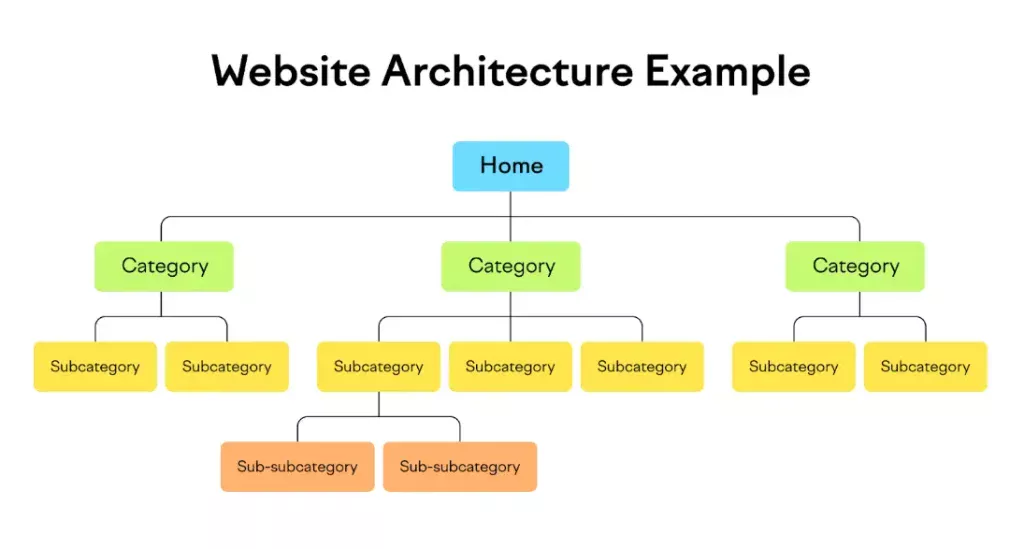
- Website Architecture and Crawl Depth: A clear, logical site structure helps both users and search engines navigate your content. Key pages should be easy to find, ideally within a few clicks of the homepage, and content should be grouped into clear topical sections.
- Site Speed and Page Performance: Slow websites frustrate users and reduce conversions. One study found 45.4% of consumers are less likely to make a purchase if an eCommerce site loads slower than expected, and 11% will go one step further and tell a friend. Aim for fast load times across key pages and optimise images, hosting, and caching where needed.
- Crawl Errors and Broken Pages: Issues such as 404 errors, broken internal links, and blocked pages prevent search engines from discovering and indexing your content effectively. These issues also create poor user experiences and should be identified and fixed through regular site audits.
- Schema Markup: Structured data helps search engines and AI systems understand the context of your pages. Implementing schema markup for elements such as organisations, products, reviews, and FAQs can improve how your content appears in search results.
Charlie Marchant emphasises having a clean, logical website architecture: “I like to think of this a little bit like a library. If you walk in and you’re looking for a book, you want to be able to find it alphabetised by the author on the shelf where you think it should be.
If you walk into a library and all of the books are just thrown on the floor, there are no categories, there’s no alphabetisation, there are no authors, it would be a nightmare. The easier it is to actually navigate through your website, the cleaner the architecture, the more well-organised your filing cabinet is, the more likely AI platforms and search engines will trust your content and be able to find what they need to surface it.”
For larger businesses with an enterprise SEO strategy, technical SEO is not a one-off project. It requires ongoing attention as websites evolve and new content is added.
Charlie Marchant adds to this point: “The bigger the business and the bigger the website, the more complex technical SEO becomes. It’s where you want to start, but it’s also something you want to review at least quarterly. If you have a very large site or you’re running a particularly large eCommerce site, for example, or a booking site, you’re going to want to keep track of your technical SEO even more frequently than that to make sure you don’t have new errors cropping up.”
Step 5: Optimise Your Site for Search Success
Once your technical foundations are solid, the next step is optimising the pages that need to rank, attract qualified visitors, and convert them into leads or sales.
This is the onsite layer of Charlie Marchant’s SEO pyramid: the work you do directly on your website to align pages with search demand, satisfy search intent, and move users toward a commercial action.
Start with the pages closest to revenue:
- Homepage
- Category pages
- Core service pages or product pages
- High-value landing pages.
These are the pages most likely to rank for commercial keywords and generate meaningful business outcomes.
As Charlie Marchant explains: “Product or service pages are incredibly important for SEO because they should be showing for commercial keywords. You should have targeted keywords that convert for those pages, and they should be bringing the most commercial traffic through to the website.”
Every priority page should match this on-page SEO checklist:
- A clear keyword focus aligned with commercial search demand.
- An optimised meta title and meta description to improve visibility and click-through rates in search results.
- A clear page structure, using logical headings (H1, H2, H3) to organise content for both users and search engines.
- Short, descriptive URLs that include relevant keywords and clearly signal what the page is about.
- Persuasive, benefit-led copy that communicates your value proposition and differentiators.
- Strategic internal links to supporting content and related commercial pages.
- Clear calls to action (CTAs) that guide users toward the next step, whether that’s an enquiry, demo, booking, or purchase.
- Optimised images and media, including compressed files, descriptive filenames, and alt text to support page speed, accessibility, and search visibility.
This is also where SEO and Conversion Rate Optimisation (CRO) begin to overlap.
Driving more traffic is only half the job. The real commercial impact of SEO comes from what happens after someone lands on the page.
We saw this clearly with our client, DSLD Mortgage. After launching their rebuilt website and implementing the first phase of onsite SEO improvements, organic visibility and traffic increased quickly. But that success revealed a new problem: the site was generating too many unqualified enquiries.
The sales team was overwhelmed with leads that weren’t a good fit, which reduced their efficiency and slowed down the sales process.
To solve this, we shifted focus from traffic growth to lead quality optimisation. By refining the page copy and adjusting the lead qualification form, we made it clearer who the service was for and introduced steps that helped filter out lower-intent enquiries earlier in the process.
The result was a significant improvement in lead quality, allowing the sales team to spend their time on the prospects most likely to convert.
It’s a good example of how SEO and CRO work best together. SEO brings the right people to the page; CRO ensures those visitors turn into valuable commercial opportunities for the business.
In fact, the results from this campaign were strong enough that we were invited to present the approach at brightonSEO, one of the world’s leading search marketing conferences.
Step 6: Create Content That Attracts and Converts Traffic
Content marketing remains one of the core drivers of SEO performance. Its role in a strategy is simple: build visibility around the topics your buyers care about and move them toward a commercial action.
What has changed is how content creates value.
For many informational searches, AI Overviews and AI search platforms now answer questions directly. As a result, some top-of-funnel content generates fewer clicks than it once did. But that doesn’t mean it has lost value.
Instead, it increasingly influences visibility and brand recognition inside AI-generated answers.
Charlie Marchant explains: “If someone sees your brand in AI answers while they’re researching different options, they start to recognise you as a trusted source. And when they want more detail, or they’re ready to make a purchase, that’s when they come to your website.”
This shift makes mid-funnel content especially valuable in 2026. Comparison guides, use-case articles, and “best option” pages position your brand when buyers are actively evaluating solutions.
Content that answers these types of questions often performs well in both traditional search and AI-generated responses.
Long-tail keywords are particularly valuable here. These are longer, more specific search phrases that typically have lower search volume but higher intent. They tend to be easier to rank for, attract more qualified visitors, and convert better than broad head terms.
They are also increasingly important in the age of AI Search. When platforms like ChatGPT or Google’s AI Overviews generate answers, they often use a process called query fan-out, which breaks a single query into multiple related questions to build a comprehensive response.
Charlie Marchant explains: “When AI performs a query fan-out, it breaks a search into lots of related versions of that query. To appear in those answers, your content needs to reflect the topics and questions your customers actually care about.”
This means creating AI-friendly content that covers specific questions, comparisons, and detailed subtopics has a much stronger chance of appearing in AI-generated answers.
For your SEO-friendly content strategy, Charlie Marchant offers an effective three-step content plan:
- Kill: “Pruning content is incredibly important because you don’t want AI platforms or search engines confused about what your business does. Go into your Google Analytics 4 (GA4), identify the pages that don’t rank, don’t attract traffic, and don’t contribute anything meaningful, then prune them back. In most cases, that means removing generic explainer content that AI can easily summarise and has no real value for your visibility or your audience.”
- Keep: “This is the content that’s already performing well, or the mid-performing pages that could improve with updates and optimisation. These pieces are worth refining rather than replacing because they already have visibility or authority.”
- Create: “Then create new content that helps AI and search engines clearly understand the entities and topics your business specialises in. You should also prioritise publishing original data, testing, and insights that provide information AI can’t easily replicate elsewhere. This could come from your own case studies, customer data studies, or research that generates both PR opportunities and genuinely unique content for your website.”
Step 7: Build Authority
Once your technical foundations and onsite optimisation are in place, the final layer of the strategy is building authority beyond your website.
Typical authority-building tactics include:
- Digital PR and media coverage in relevant industry publications.
- Expert commentary in news articles and journalist requests.
- Mentions in comparison articles or “best of” lists related to your category.
- Relevant niche directories and industry listings.
- Partnerships, sponsorships, and sector-specific collaborations.
- Customer reviews and third-party citations that reinforce credibility.
The key principle is relevance over volume. A single mention or backlink from a respected industry publication is often far more valuable than dozens of links from generic websites.
This matters because search engines use external references as signals of trust and authority. When credible websites mention or link to your business, it reinforces your brand as legitimate, knowledgeable, and relevant in its field. These signals help search engines determine which businesses deserve to rank for competitive queries.
But this is even more important in AI Search.
Large Language Models (LLMs) often generate answers by drawing on information from multiple sources across the web, not just a company’s own website. That means your brand’s presence in trusted third-party publications, industry sites, reviews, and comparison lists can directly influence whether your business appears in AI-generated answers.
This shifts offsite SEO from simply building links to building reputation. The goal is to ensure that when AI systems and search engines analyse the wider web, they consistently see your brand associated with the topics, services, and expertise you want to be known for.
Charlie summarises the shift clearly: “You want your brand mentioned on other trusted sites around the internet in connection with the topics you want to own. That’s how search engines and AI systems start to see you as an authority.”
Step 8: Track Performance and Refine SEO Strategy
Search algorithms evolve, competitor tactics shift, and user behaviour changes, meaning what works for you today might not work in six months. That’s why tracking, testing, and adjusting your SEO strategy is essential for maintaining and improving rankings, traffic, conversions, and SEO ROI.
Here are the key metrics to monitor and what tools to use:
- Organic Traffic: The number of visitors coming to your site from organic search over a set period. A steady increase indicates your SEO efforts are working, while a decline signals potential issues such as algorithm updates, lost rankings, or technical problems.
- Tool: Google Analytics 4 (GA4)
- Keyword Universe: The total number of keywords your site ranks for. A growing keyword universe means Google sees your site as an authority and is ranking you for more relevant searches.
- Tools: Semrush or Ahrefs
- Keyword Rankings: The position you’re ranking in for important keywords. Tracking where your most important keywords rank helps you understand if your content is improving or dropping in rankings.
- Tools: Semrush or Ahrefs
- Average Engagement Time: How long, on average, users stay on your pages. If engagement time is low, it may indicate thin content, poor readability, or a disconnect between search intent and your content.
- Tool: GA4
- Conversions: The amount of traffic that’s turning into leads and sales. If you’re getting visitors but not conversions, you may need to refine your calls to action (CTAs), improve your site’s UX, or target higher-intent keywords.
- Tool: GA4
- AI Mentions, Citations, and Sentiment: How often your brand is referenced in AI-generated answers, which sources are cited, and whether AI platforms describe your brand positively or negatively.
- Tools: Profound, Peec AI, and Semrush are our top AI Search visibility tools.
- AI Traffic and Conversions: The number of visitors and conversions coming from AI platforms such as ChatGPT, Gemini, or Perplexity, helping you understand how AI Search is contributing to leads and revenue.
- Tool: GA4.
Rank and Scale Faster with SEO Experts
To dominate search results in 2026, your SEO strategy needs to:
- Drive Commercial Outcomes: Your SEO KPIs should align with revenue- or lead-focused goals.
- Improve Website Performance with Technical SEO: Improve website structure, site speed, mobile performance, and use structured data.
- Master On-Page SEO: Perform effective keyword research and optimise content, meta tags, URLs, and internal linking.
- Leverage Off-Page SEO: Build high-quality backlinks and earn brand mentions.
- Create Content That Ranks and Converts: Align new and refreshed content with search intent, readability, and AI-driven search results.
- Optimise for AI Search: Ensure your brand is visible in Google’s AI Overviews and AI platforms.
We’ve put everything together in a concise SEO checklist to help busy marketing leaders.
But strategy is just the start. Execution is where businesses win or lose in SEO.
Implementing and maintaining a high-performing strategy requires expertise, constant optimisation, and staying ahead of Google’s updates.
That’s where we come in.
Our award-winning SEO experts help businesses rank faster, drive more traffic, and scale smarter. Let’s build an SEO strategy together that fuels real growth.
FAQs
What is an SEO strategy?
An SEO strategy is a structured plan for improving your website’s visibility in organic search results to drive relevant traffic and commercial outcomes. It covers the technical health of your site, on-page optimisation, content creation, authority building through offsite signals, and visibility within AI Search. A strong SEO strategy is tied to specific business goals rather than relying solely on vanity metrics like traffic volume.
How should SEO fit into a wider digital marketing strategy?
SEO works best when it’s integrated with other marketing channels. Organic content supports paid campaigns by capturing prospects at various funnel stages. Email nurture sequences can be built around top-performing organic content. Brand campaigns reinforce SEO by making your business more recognisable in search results. The businesses that get the most from SEO treat it as one high-performing part of a coordinated strategy, not a standalone tactic.
How can you prioritise SEO opportunities for the highest ROI?
Start by mapping your keyword opportunities to commercial intent. Keywords that signal buying, comparing, or evaluating are almost always more valuable than broad informational terms, even if the latter have higher search volumes. Prioritise the combination of high commercial intent, achievable ranking difficulty, and relevance to your highest-value products or services.
How do you measure the business impact of an SEO strategy?
The most meaningful metrics are organic conversions, organic-influenced revenue, and the quality of leads generated from organic traffic. Tracking keyword rankings for your commercial terms and monitoring visibility in AI Overviews and AI platforms adds further strategic context.
How long does it take for an SEO strategy to show results?
Realistic timelines vary depending on the competitiveness of your market, the current state of your website, and the scale of your investment. For most businesses, meaningful movement in commercial keyword rankings takes three to six months of consistent effort, with significant traffic and lead generation growth more typically seen at the 6-12 month mark. SEO is a compounding channel; the longer you invest consistently, the stronger and more durable the returns.
How often should an SEO strategy be reviewed or updated?
Your keyword rankings and organic performance should be reviewed monthly. Technical SEO should be audited at least quarterly, or more frequently for large or regularly updated sites. Your overall strategy should be reviewed at least twice a year.
How does AI Search affect modern SEO strategy?
AI Search affects SEO strategy in three main ways. First, AI Overviews are reducing clicks on top-of-funnel informational queries, shifting the emphasis towards mid-funnel and commercial content that AI cites rather than replaces. Second, AI systems use query fan-out to process searches as hundreds of related queries, meaning content that covers topics comprehensively and contextually is more likely to be surfaced. Third, Google’s AI Mode represents a structural shift in how search will be delivered, requiring businesses to optimise for AI citation as well as traditional rankings.
*Disclosure: This page contains referral links. If you purchase through these links, we may receive a commission at no additional cost to you.