SEO Is Changing: Are You Ready for AI Search?


Exposure Ninja's CEO, Charlie Marchant, was a key expert in a recent Semrush webinar entitled "The Impact of ChatGPT and Generative AI on Search:". Semrush has kindly allowed us to reshare this webinar on-demand.
Remember when finding information online meant typing a few keywords into Google and clicking the blue links? Those days are quickly becoming history.
We’re witnessing something extraordinary in the world of search — for the first time since its launch in 1998, Google is seeing its traffic share decline. This isn’t just another headline; it’s a sign that how people discover information online is fundamentally changing.
“This is a significant milestone for search,” explains Charlie Marchant, our CEO here at Exposure Ninja, during a recent roundtable with the team at Semrush (which you can watch above).
“The data shows that this is the first year Google has lost search traffic share. While they remain the dominant player, this signals a fundamental change in how people are searching for information.”
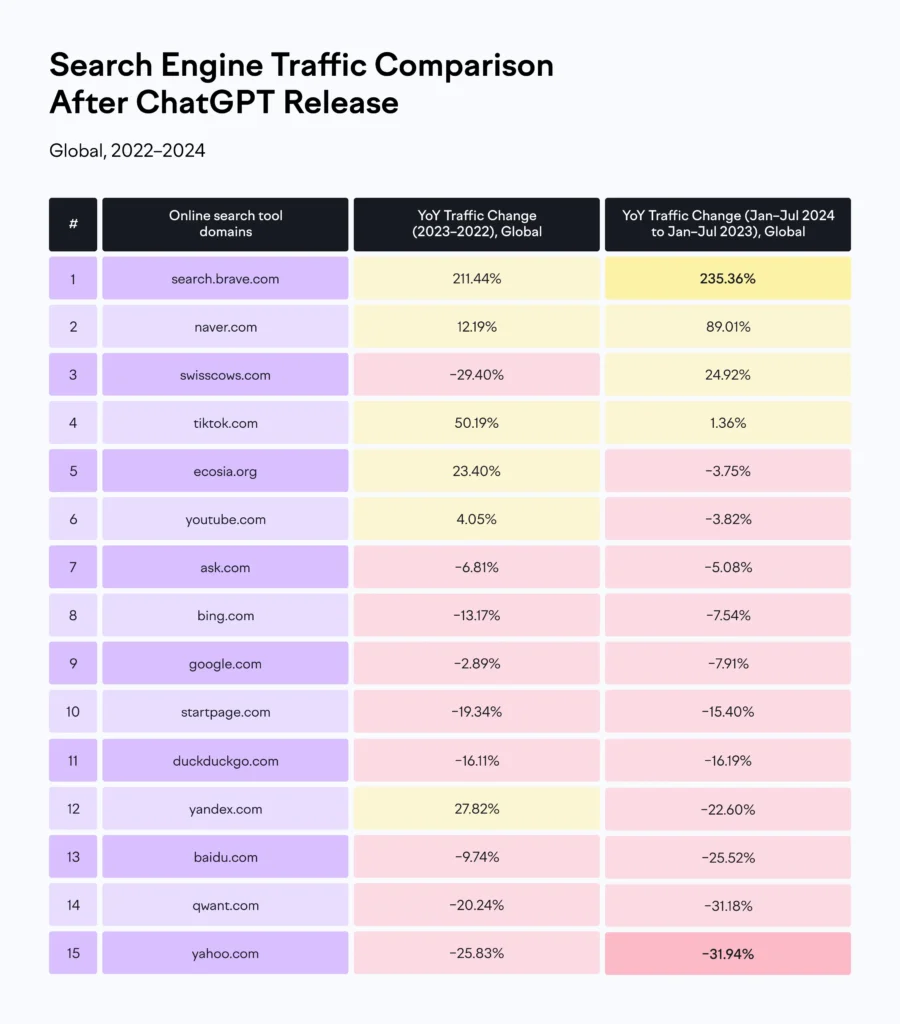 The signs have been there: ChatGPT is on the rise, with millions of people using it on a regular, if not daily, basis. Perplexity’s user base is growing rapidly too. Claude is becoming the darling of creative writers too.
At the end of 2024, Ofcom (the UK’s government-approved regulatory and competition authority for communication) released a report covering Google’s initial signs of decline, as covered in depth in our video below.
Let’s explore what this means for your business and — more importantly — how you can stay ahead of the curve.
Understanding the AI Search Revolution
Here at Exposure Ninja, we’re seeing this transformation first-hand. “For a lot of our clients, we’ve already started to see a bit of a shift,” Marchant notes. “It depends a lot on their industries, but we’re seeing traffic actually coming through from ChatGPT and other Gen AI chatbots.”
This isn’t just another tech trend — it’s a fundamental shift in how people find and consume information online.
To learn more about this revolution and evolution of search, download a copy of Semrush and Statista’s new report, Online Search After ChatGPT: The Impact of Generative AI, as discussed during the roundtable via the Semrush website.
Why Traditional SEO Is Getting a Makeover
Remember when optimising for search meant focusing primarily on keywords and backlinks? Those days aren’t exactly over, but they’re evolving into something far more sophisticated. Generative Engine Optimisation (GEO) is changing the game entirely.
“The mistake would be to think that it works the same way as Google’s algorithm or search engine algorithms,” Marchant points out. “Even if some AI tools are utilising traditional search in the background, like Bing search, they’re not using the same ranking factors.”
Think of it this way: if traditional SEO was like preparing for a written exam with clear right and wrong answers, GEO is more like preparing for an interview panel that considers your entire professional reputation. It’s not just about what you say — it’s about what everyone else is saying about you, too.
The Three Pillars of Modern Search Success
1. Your Technical Foundation Matters More than Ever
Just as you wouldn’t build a house without solid foundations, ranking in Google’s AI Overviews starts with getting your technical SEO spot-on. But there’s a twist.
“At the basis of all these AI chatbots, there are Large Language Models, and they work based on recognising patterns,” Marchant explains. “Content needs to be really well structured on a website so these machines can actually recognise what is being said.”
What does this mean in practice? Your website needs to be more than just technically sound — it needs to be crystal clear in its organisation and structure. Think of it as making your website not just readable but truly comprehensible to both humans and AI.
2. Your Brand’s Digital Reputation Is Everything
Welcome to the new era of SEO, where your brand’s reputation across the entire internet impacts your visibility. It’s like word-of-mouth marketing has gone even more digital, and every mention matters.
As Marchant puts it: “One thing is being mentioned. The second thing is being mentioned the way you want to be. You might not want to be called ‘the cheapest in your industry’. Maybe you do. You might want to be called ‘the best value’.”
AI search engines are picking up conversations about your brand from:
- Reddit discussions
- Quora answers
- Review sites
- Social media conversations
- Industry publications
- Forum discussions.
Each mention helps build a picture of your brand’s authority and expertise.
3. Content That Speaks Human and AI
Creating content for AI search requires a delicate balance. You’re essentially writing for two audiences: your human readers and AI systems that help those readers find you. The key is making your content clear, comprehensive, and genuinely helpful.
The Road Ahead: What’s Coming in Search
The future of search is evolving rapidly, and it’s going to get personal. Really personal. Marchant predicts something fascinating: “We’re going to start seeing different search results for our searches for the same keywords from other people based on our individual search preferences.”
Imagine having a research assistant who knows exactly:
- How you like information presented
- Which sources you trust most
- What level of detail you prefer
- Your industry-specific needs
- Your previous search patterns.
That’s where we’re heading, and it’s going to transform how people find and interact with your business online.
Your Action Plan for 2026
Ready to future-proof your digital presence? Here’s what you need to focus on:
- Start Monitoring Your Traffic Sources — Keep a close eye on where your visitors are coming from. Are you seeing traffic from new AI-powered platforms? How are these visitors behaving differently?
- Build Your Brand Everywhere That Matters — Don’t put all your eggs in one basket. Your digital presence needs to be broad but authentic across multiple platforms where your audience spends time.
- Create Content That Serves a Purpose — Every piece of content should answer a specific question or solve a particular problem. Make it clear, helpful, and comprehensive.
- Focus on Genuine Value —The best way to be recommended by AI is to be genuinely recommendable. Focus on excellent products, services, and customer experiences.
- Stay Curious and Adaptable — “Businesses need to be ready and expect that we’ve seen [SEO and search] rapidly improve already in this sort of past two-year period,” Marchant advises. Keep learning, keep testing, keep adapting.
Time to Take Action
The future of search isn’t a distant concept — it’s unfolding right now. While Google remains the biggest player in town, the rules of the game are changing rapidly. Think of this as your opportunity to get ahead of the curve.
Remember: in digital marketing, timing is everything. The businesses that adapt earliest to these changes won’t just survive; they’ll thrive in this new AI-powered landscape. Ready to get started?
Want to dive deeper into how these changes might affect your specific business? Our comprehensive guide to Generative Engine Optimisation is a great next step.