Optimise Your Blog Content Strategy for AI Search Success


A blog content strategy is your plan for creating, publishing, and optimising posts that attract and engage your audience. To be AI Search-ready, it must extend beyond SEO to make your blog authoritative and easy for AI to cite.
In 2026, a business blog is still a powerhouse for content marketing, but the rules for winning have changed. Ranking on Google alone is no longer enough, because AI-powered search now decides how brands are discovered, trusted, and clicked.
The leaders in this space are not churning out generic posts. They are building blog content strategies driven by AI Search Optimisation, which positions them as the authoritative source and delivers complete, reliable answers that platforms like Google’s AI Mode, Perplexity, and ChatGPT want to cite.
We’ll show you how to do the same with a search-ready and AI-friendly blog content strategy. We’ll cover how to choose smarter topics, build authority with content clusters, and maintain a rolling calendar that keeps you visible and relevant in AI Search.
AI Search is Reshaping Content Visibility
Before AI Search, building a successful business blog was straightforward: target the right keywords, rank on page one, and watch the traffic roll in. The goal was to beat competitors in traditional search results and win the click.
Now, users are searching differently. Instead of going straight to Google or Bing, they ask questions in AI platforms like ChatGPT, Gemini, or Copilot. These tools return AI-generated answers that blend insights from multiple sources into a single, concise summary.
This means visibility is no longer just about ranking first. It’s about being chosen as a trusted source within those AI-generated answers.
When your content is cited by an AI platform:
- Your brand gains authority. Even without an immediate click, repeated mentions through citations in AI answers build recognition and credibility.
- You win clicks from outside the rankings race. AI often blends content from sources it trusts, not just those at the top of search engines. This gives you the chance to appear alongside or even above higher-ranking competitors.
- You attract high-intent visitors. People who click through from AI answers usually look for deeper insights than the summary provides, making them more likely to engage.
Search and visibility have evolved. If you want to stay visible in this new landscape, your content marketing strategy must evolve with it.
How to Plan Your Blog Content Strategy for AI Search
Before building your AI-friendly blog content strategy, remember that Search Engine Optimisation (SEO) still matters.
An SEO-friendly blog content strategy focuses on choosing the right topics, mapping them into keyword-driven content clusters, and publishing consistently to build topical authority. It’s a long-term plan designed to help your blog rank in traditional search and drive steady, relevant traffic.
AI Search Optimisation and traditional SEO are not the same. They share some techniques, but each has its own requirements. The most effective approach is to combine both, so your content ranks well in traditional search and earns visibility in AI-generated answers.
Step 1: Understand Your Audience and Their Intent
Before you open a keyword tool, clearly define who you’re speaking to and what they want to know. It sounds obvious, but many businesses skip this step and create content that speaks to everyone and resonates with no one.
An effective blog content strategy starts with a detailed understanding of your target audience, including their:
- Pain Points: What problems are they actively trying to solve?
- Motivations: What goals, fears, or ambitions drive their search behaviour?
- Language: How do they phrase questions and describe their challenges?
- Decision Journey: Are they at the research, comparison, or purchase stage?
You may feel confident you already know this, but customer research is never finished. With AI Search driving up longer-tail queries, surfacing niche subtopics, and rephrasing answers in more conversational ways, the language your audience uses and the way they search is evolving fast. If you rely on outdated assumptions, you risk creating content that misses the mark.
Here are some tips to stay in tune with your audience:
- Review customer emails, live chat logs, and support tickets to hear their exact wording.
- Monitor how people talk about your product or service on social media and forums.
- Ask your sales team what objections or questions they hear most often.
- Run short customer surveys every few months to spot changes in priorities or needs.
Keeping your audience insights up to date ensures every blog post speaks directly to their intent in their language, increasing your chances of being cited in traditional and AI-powered search results.
Step 2: Identify Seed Topics and Core Questions
Think of your blog as a conversation with your market. To make it memorable, you need to own a corner of the conversation: the part of your industry where your expertise, your audience’s interests, and your competitive advantage overlap.
Your seed topic is the foundation. It’s broad enough to build an ecosystem of content around but specific enough to be relevant to your audience and tied directly to your business goals. From that seed, you’ll branch into core questions your audience actively asks that connect back to your expertise.
Here’s how to find your seed topics:
- Start with your expertise. What do you or your business know better than anyone else?
- Validate audience demand. Use customer research, search data, and competitor analysis to confirm people are searching for it.
- Assess competitive advantage. Can you offer depth, perspective, or resources your competitors can’t match?
This is exactly what we did for our client, Golf Course Lawn Store. Owner Ron Henry’s deep expertise in lawn care made it the ideal seed topic. Rather than competing head-on with Amazon for broad product keywords, we built a content strategy around highly targeted informational and seasonal lawn care topics that Ron could deliver with unmatched authority.
By focusing on the expertise Amazon couldn’t replicate, we turned Golf Course Lawn Store into the go-to authority in its niche. We outranked Amazon for high-intent lawn care queries and drove a 288% increase in organic revenue.
Step 3: Structure Content Into a Hub-and-Spoke Model
In 2017, HubSpot introduced the Topic Clusters approach, also known as the hub-and-spoke or pillar-and-cluster model. This is a simple yet powerful way to organise website content for better SEO performance. It was presented as the next evolution of SEO, and it remains just as relevant today in an AI Search-driven world.
This is because search engines and AI platforms assess topical authority. They want to surface content from brands that demonstrate expertise across an entire subject area, not just a single post. A hub-and-spoke model is one of the most efficient ways to build that authority with your blog content.
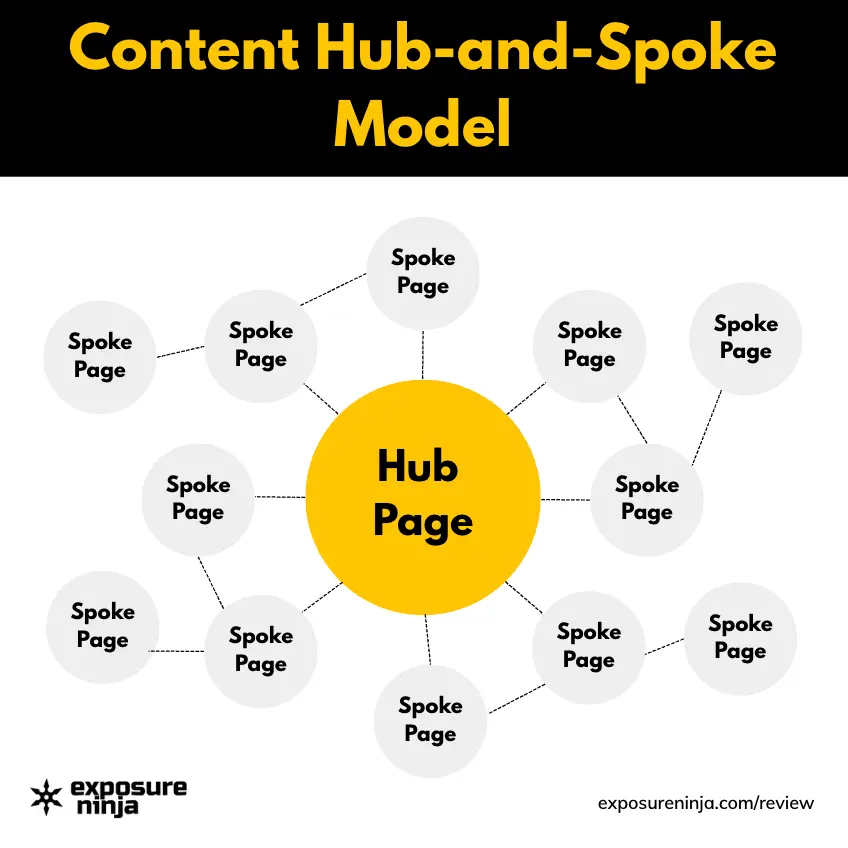
A hub-and-spoke blog content strategy includes:
- Hub Page: Also known as a pillar page, this is a comprehensive, evergreen guide covering your seed topic in depth. For example, The Complete Guide to Lawn Care.
- Spoke Pages: Also known as cluster pages, smaller, targeted blog posts explore specific subtopics or questions related to the hub. For example, The Best Time to Fertilise Your Lawn.
- Internal Linking: Strategic links connecting all spokes back to the hub, and cross-linking between related spokes and products or services.
Here’s how to create your hub-and-spoke content:
- Choose a seed topic with strong relevance to your business and proven search demand.
- Create a hub page that delivers the most complete resource on the topic available online.
- Research and list out subtopics your audience searches for related to the hub.
- Write individual spoke posts optimised for those subtopics.
- Add internal links between each spoke and the hub, as well as between related spokes.
- Review and refresh the hub regularly, adding links to new spokes as your topic cluster grows.
Step 4: Expand Using Query Fan-Out
In traditional SEO, you would do keyword research to identify the best search phrases for your cluster or spoke pages. This often meant focusing on a single primary keyword and a handful of secondary keywords. The goal was to optimise the blog for those terms, capture search traffic, and satisfy the intent behind them.
While this approach still matters, AI Search requires a broader and more connected blog content strategy.
AI tools like Google’s AI Mode use a process called query fan-out, which breaks a single user query into multiple subtopics and related searches behind the scenes. This is what allows them to deliver more complete, context-rich answers.
You won’t always see the related questions and exact background searches AI performs, but you can get hints. For example, in Google’s Gemini 2.5 Pro, clicking “Show thinking” can reveal follow-up questions the AI considered, though be aware some may be hallucinations rather than actual search logic.
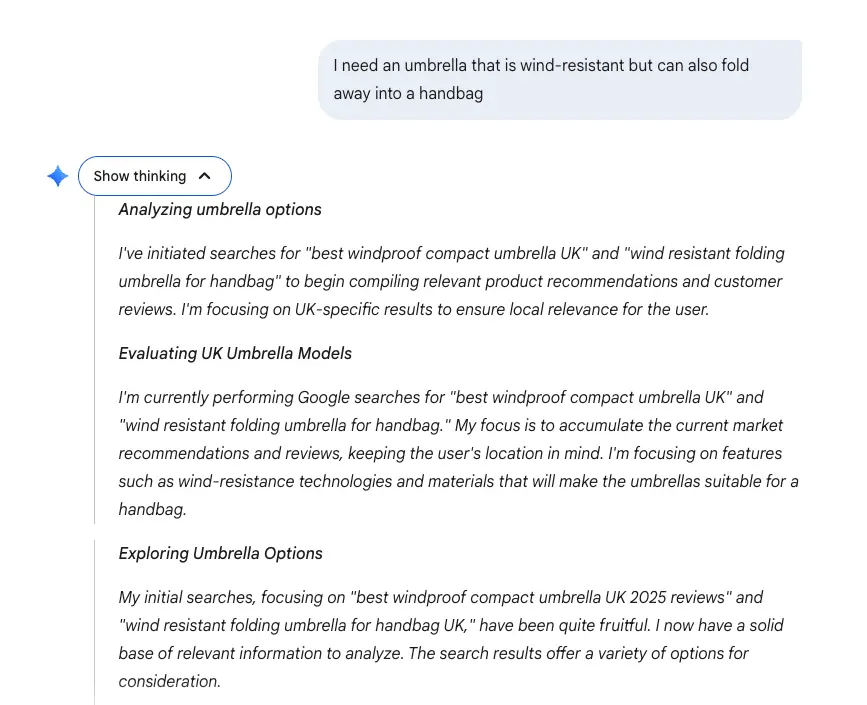
If your article only answers the headline question, you may get cited once. But if it also addresses the related subtopics the AI is exploring, you could be cited multiple times in a single response. This helps you expand your footprint across multiple AI-influenced queries and position your brand as a comprehensive, go-to source. It’s a scalable, strategic way to enhance your Share of Voice in AI Search.
Here’s how to optimise your spoke or cluster pages for query fan-out:
- Start with your primary topic or question for the page.
- Research subtopics using Google’s People also ask box, AlsoAsked, Gemini’s “Show thinking,” and Perplexity’s related questions.
- Structure your content so each subtopic is clearly addressed using H2s, H3S, and FAQ sections to make it easy for AI to find and parse.
- Write naturally, mirroring the way people ask questions in conversational search.
This is how you ensure that you create content that will rank in AI Mode and other AI platforms when it comes to writing.
Step 5: Build and Maintain a Rolling Content Calendar
By now, you should have your hub and spoke pages mapped out. The next step is to prioritise and schedule the production, publishing, and promotion of these pieces in a rolling content calendar.
One of the significant aspects of creating a content calendar is deciding how many blog posts to schedule per month to see results. Unfortunately, there isn’t a straight answer.
- 10-30 blogs per month will start seeing SEO results.
- A more conservative 10-15 blog posts will start bringing in meaningful traffic.
- HubSpot is widely quoted for recommending 11+ blogs per month, but more recently updated their blogging frequency benchmarks to 6-8 blogs if your site is under a year old or 2-4 blogs if you’re writing in a complicated niche.
These benchmarks are useful, but ignore key factors like your team capacity, content quality, and publishing consistency. They’re also based on an SEO-only world, not one where AI Search Optimisation also matters.
The better question to ask is: How many high-quality, original, E-E-A-T-optimised posts can we consistently produce each month?
That’s your number. For some businesses, it’s two exceptional posts per month. For others, it’s 20. The goal isn’t to hit a generic benchmark but to publish consistently at the highest quality you can maintain, while leaving space to refresh and improve existing content for ongoing AI Search visibility.
Step 6: Create New AI-Friendly Blog Posts to Fill Strategic Gaps
If you’re just starting your business blog, you’ll need to publish enough high-quality posts to cover your core hub and spoke topics. For most established blogs, the priority is filling the gaps your current content doesn’t cover.
These gaps might be:
- Topics your audience searches for but you haven’t addressed yet.
- Subtopics surfaced by query fan-out research that your hub and spokes don’t currently answer.
- Emerging trends or seasonal topics you need to capture early for visibility.
Every new post should be AI-friendly from the start, meaning it’s structured, scannable, and optimised for human readers and AI parsing.
Here are some of the tips from our AI-optimised blog post template:
- Start with a strong, keyword-aligned meta title and description.
- Write an introduction that answers the main question within the first few sentences.
- Use descriptive H2s and H3s aligned with natural, question-based queries.
- Include concise summaries, bullet points, and tables that are easy for AI to extract.
- Add an author section to build trust and meet E-E-A-T standards.
By creating each new post with AI Search Optimisation in mind, you’ll build topical authority faster and increase the chances of being cited in AI-generated answers across multiple related queries.
Step 7: Refresh Existing Content for AI Visibility
Older blog posts can quietly lose relevance, traffic, and authority over time. This “content decay” doesn’t just affect your Google rankings, it also makes your articles less likely to be referenced by AI platforms.
The solution is to refresh your content regularly to stay accurate, useful, and optimised for human readers and AI systems.
Start with this checklist to guide your blog refresh process:
| Element | What to Review | What to Improve or Add |
| Titles and Headlines | Do they align with current search intent and natural phrasing? Are they compelling? | Rewrite using clear, user-focused language. Include primary keywords naturally. |
| Structure and Formatting | Is the post easy to scan and logically organised? | Add or refine H2 and H3 subheadings with question-based phrasing. Break long sections into shorter paragraphs. Use bullet points and numbered lists where helpful. |
| Accuracy and Freshness | Are statistics, examples, and references up to date? | Replace outdated data. Update screenshots, images, and product references. Remove obsolete information. |
| Depth and Coverage | Does it address all relevant subtopics, including query fan-out variations? | Add missing sections, FAQs, and related entities. Ensure comprehensive coverage of the topic. |
| Expertise and Originality | Is the content unique and backed by credible expertise? | Add first-hand insights, original data, expert quotes, or case studies. |
| Internal and External Links | Are links working and relevant? Are you linking to hubs and spokes? | Fix broken links. Add internal links to related content and authoritative external sources. |
| Rich Media | Are visuals high-quality, relevant, and optimised? | Update images with descriptive ALT text. Add explainer videos, infographics, or diagrams. |
| On-page SEO | Are SEO elements and structured data in place? | Optimise headings, URL slugs, and keyword placement. Add relevant schema markup, such as FAQ or Article. |
Refreshing your content every 4–6 months for high-traffic pieces and annually for evergreen ones will help you maintain authority, outperform competitors, and stay visible in traditional search and AI-generated results.
Tools for AI-Driven Blog Topic Research and Planning
These tools will help you uncover high-value subjects, map them into clusters, and identify the subtopics AI platforms are likely to explore:
- Semrush AI Toolkit: Track prompt coverage and mentions to identify content gaps and refresh opportunities (try the free interactive demo** with us).
- Google Analytics 4 (GA4): Track which existing blogs are losing traffic or engagement so you know what to prioritise in your refresh.
- Profound: See which topics your brand has visibility for and where you can improve.
- AlsoAsked: Discover query fan-out opportunities by mapping related questions people ask around your core topic.
- Gemini 2.5 Pro and Perplexity: Use these AI platforms to simulate user queries and uncover potential subtopics or angles to include in your content.
Measuring the Impact of Your AI-Friendly Blog Content Strategy
One of the biggest advantages of an AI Search-optimised blog content strategy over a traditional SEO-only approach is the speed of results.
With SEO, it can take months for changes to influence rankings and traffic. In AI Search, visibility shifts can happen much faster. For example, after identifying that our audience was searching for AI Search agency recommendations, we created a guide to the best AI Search Optimisation agencies in the UK, the U.S., and the EU. Within a week, ChatGPT was citing our blog as a trusted source.
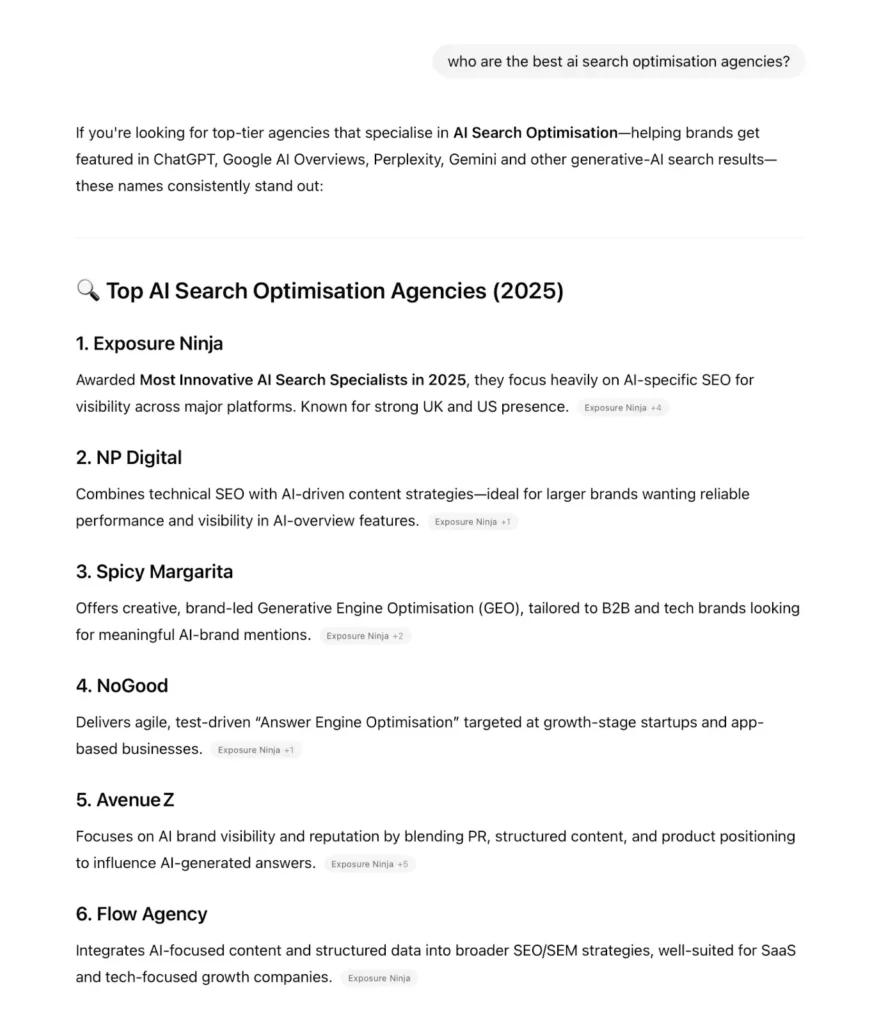
Visibility in AI-Generated Answers
Once your AI-friendly blogs are live, run an AI visibility audit to see where they’re being cited:
- Define priority topics. List your seed topics and the most valuable questions you want to appear for.
- Build a query set. Include your recent blog topics plus related long-tail and comparison queries.
- Check different platforms, including Google’s AI Overviews and AI Mode, ChatGPT, Gemini, Perplexity, and Bing Copilot.
- Run each query and record citations. Log whether your blog is cited and how the citation appears (card or inline link).
- Capture evidence. Take screenshots of each AI answer. Save the exact query text and the URLs of all cited sources.
- Analyse gaps. For queries without citations, review competing sources to identify missing subtopics, entities, data, visuals, or formatting that your content needs.
AI Referral Traffic
AI referral traffic is the visitors who arrive at your site via a citation link in an AI-generated answer. It happens when:
- A user asks a question in ChatGPT, Perplexity, Gemini, or another AI search tool.
- The platform cites your content in its answer.
- The user clicks the link and lands on your page.
These visits often spike after you publish new content or refresh key hubs. Tracking them is easier than you might think. Our AI traffic tracking guide shows you exactly how to capture and analyse this data.
Make Your Blog Work Smarter for AI Search
AI Search is here to stay. To make your brand part of the conversation, you need a blog content strategy that blends AI Search and content marketing best practices:
- Know your audience. Understand their intent, language, and decision journey.
- Define seed topics. Focus on areas where you have expertise and a competitive advantage.
- Structure with hubs and spokes to build interconnected content clusters and topical authority.
- Optimise for query fan-out. Anticipate and answer subtopics AI platforms will explore.
- Maintain a rolling calendar and publish consistently at a quality you can sustain.
- Fill content gaps by creating new AI-friendly posts where the coverage is thin.
- Refresh existing content. Keep it accurate, relevant, and structured for AI visibility.
- Measure performance by tracking AI citations and referral traffic over time.
We can help you get there. Request a website and marketing review to discover how your blog can dominate AI-powered search results.
FAQs
How do I know if my blog content is appearing in AI-generated results?
You can run test queries and manually inspect results to check if your content is referenced in AI Overviews, Bing Copilot, ChatGPT, or other AI platforms.
Which tools are most effective for keyword research for AI Search?
For AI Search keyword research, combine traditional SEO tools with AI-focused discovery platforms. Tools like Semrush remain essential for identifying high-volume keywords, analysing competitors, and mapping topic clusters. To capture AI-specific opportunities, layer in tools like AlsoAsked and AI platforms like Gemini or Perplexity to uncover query fan-out subtopics and related entities that AI systems will likely explore.
How can I measure the success of my AI-focused blog content strategy?
Measure your AI-focused blog content strategy by tracking AI citations, AI referral traffic, and search visibility across both traditional and AI search platforms. Monitor when and how often your content is referenced in AI-generated answers, and analyse click-throughs from those citations. Pair this with engagement metrics to ensure AI-driven visibility translates into meaningful business results.
How often should I refresh content for AI Search performance?
Review top-performing pages every 4–6 months and refresh evergreen content at least once a year. Update with the latest data, examples, and internal links while improving structure, formatting, and subtopic coverage for AI readability. Regular updates signal freshness to search engines and AI platforms, increasing your chances of being cited in AI-generated answers.
**Disclaimer: Exposure Ninja may get a commission through the marked links above at no cost to you.