Charlie Marchant Speaks at Ecommerce Scotland: Q&A Highlights


On 12 March 2026, Charlie Marchant took to the stage at Ecommerce Scotland to explain how businesses can dominate AI Search in 2026.
Charlie Marchant, CEO of Exposure Ninja and well-known SEO speaker and AI Search thought leader, spoke on stage at Ecommerce Scotland.
Charlie presented on How to Dominate in AI Search in 2026, covering:
- How the buyer journey is becoming compressed thanks to platforms like ChatGPT and Google’s AI Overviews.
- The three pillars of AI Search Optimisation, including technical foundations, clear positioning and content, and web-wide authority.
- She included examples from The Ordinary and ZUGU, showcasing the real results of an expert AI Search Optimisation strategy.
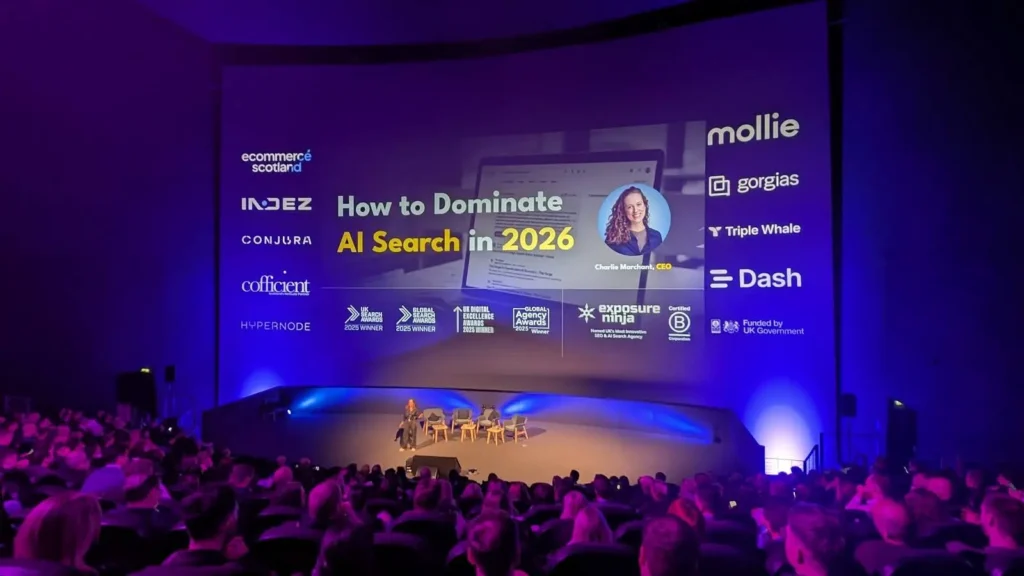
Charlie’s talk was a major success, with viewers coming up to her afterwards to comment, “it was enlightening,” “I had no idea….” and “you really are market-leading.” To attend a talk by Charlie Marchant, keep an eye on her AI Search and SEO speaker page for upcoming events, webinars, and podcasts.
Ecommerce Scotland Q&A
After the talk, Charlie Marchant and Dale Davies, Head of Marketing at Exposure Ninja, continued the conversation at the Exposure Ninja stand, hosting a live Q&A with attendees.

Here are the standout questions and answers:
Is SEO and AI Search Optimisation the same?
One attendee asked, “What is the difference from SEO then? All the things sound like the same things you do for SEO.”
When it comes to SEO vs AI Search Optimisation, there are overlaps, but they are not the same.
Traditional SEO is about improving your visibility in search engines like Google and Bing. The aim is to help your pages rank well, attract clicks, and drive traffic to your website.
AI Search Optimisation is about increasing your visibility in AI-generated answers on platforms like ChatGPT, Gemini, Perplexity, AI Overviews, and AI Mode. The goal is not just to rank, but to be cited, mentioned, and recommended when these tools answer a user’s question.
As Charlie explained in her talk, SEO still matters because AI platforms often rely on search indexes and web content to inform their answers. But getting to the top of Google alone is not enough. AI tools also look at how clearly your brand is positioned, how well your content answers real questions, and what trusted third-party sources say about your business.
The businesses in the best position will invest in both an AI Search and an SEO strategy. That way, they can reach customers whether they are searching on Google or asking AI tools.
Search has changed massively over the last two years. It’s no longer just about ranking in Google, because people are now researching through AI tools as well as search engines. The brands that win will be the ones that combine strong SEO foundations with the authority and clarity needed to appear in AI-generated answers.
 Charlie Marchant
CEO
Charlie Marchant
CEO
What should I do first if I want to show up in ChatGPT?
One question asked was, “What is the number one thing I should do first if I want to show in ChatGPT? I’ve already checked by robots.txt and allowed ChatGPT to crawl, so discounting that, what’s next?”
Whether you want to appear in AI Overviews, ChatGPT, or Gemini specifically, the prioritised steps are:
- Clear Brand Positioning: Explain exactly what your business does, who it helps, and what makes it different in one simple sentence.
- Strengthen SEO Foundations: Ensure your technical SEO is solid and optimise your on-page SEO elements.
- Create AI-Friendly Content: Create structured, high-quality content that directly answers customer questions and is easy for AI tools to interpret.
- Build Authority Beyond Your Website: Earn brand mentions, backlinks, reviews, and citations from trusted third-party sources.
We’ve put this into a quick AI Search strategy checklist that you can download.
How do I see if my brand is performing in AI Search?
Before you can improve your visibility in AI Search, you need to understand where you stand today.
Unlike traditional SEO, there’s no simple “ranking position” to check. AI platforms don’t return a list of ten blue links; they generate personalised answers to long, complex queries. That means your performance is based on whether you’re being mentioned, cited, or recommended within those AI-generated answers.
To understand brand performance in AI Search, one attendee asked if they should start by searching their brand name in ChatGPT.
That’s a great starting point, but it’s only part of the picture.
You also need to search like your customers. Ask the questions they would ask when they’re researching solutions, comparing options, or getting ready to buy. These are the prompts that should lead to your business. If your brand isn’t appearing in those responses through citations or mentions, that’s your visibility gap.
This manual approach is useful, but it can also be time-consuming and limited.
If you want a faster, more reliable way to track performance, use AI Search visibility tools. These show how often your brand appears, where you’re being mentioned, and which competitors are showing up instead.
Is digital PR a part of AI Search Optimisation?
“Digital PR, citations, and reviews, pretty much your online reputation, is probably the juiciest and most influential part of what we need to look at for AI Search,” says Charlie Marchant.
Digital PR plays a direct role in whether your brand shows up in AI-generated answers because AI tools don’t just rely on your website. They look across the internet to decide which brands are credible, trustworthy, and worth recommending. If your business is consistently mentioned in trusted sources, you’re far more likely to appear.
One attendee summed up a common challenge: “We’ve never done PR or citations. We’re starting from zero. How do we start PR? Do we just have to be ballsy and contact editors? Why would they care what we have to say?”
Charlie Marchant’s answer highlights the reality: “If you’re a business that’s been doing digital PR for years, you’re probably in a much stronger position in AI Search as a starting point. If it’s new for you, you’re probably seeing that your visibility tends to be a lot lower.”
The good news is that there’s a clear opportunity. If you’re starting from zero, focus on building momentum with a simple, structured digital PR strategy:
- Get Clear on Your Angle: What expertise, insight, or data can you share that others can’t?
- Create Something Worth Featuring: Think data studies, expert commentary, or useful guides. Customer data, case studies, and internal insights can also become PR assets.
- Target Relevant Publications: Focus on sites your audience already trusts, not just big names.
- Pitch with Purpose: Show journalists why your insight matters to their readers.
- Build Consistent Mentions: Aim for steady visibility over time.
Recent data shows that over 80% of what AI platforms surface comes from third-party websites, not your own. That means your visibility isn’t just about your site; it’s about how often and where your brand is mentioned across the web. If you’re not being talked about, you’re far less likely to be recommended.
Charlie Marchant
CEO
How do we approach content creation to show up in AI Search?
Every business needs a dedicated blog content strategy for AI Search.
Strong content marketing helps AI platforms understand what you do, what topics you are credible on, and when your business should be recommended. It also gives you more chances to appear for the real questions customers ask before they are ready to buy through citations.
But one attendee raised a very common challenge: limited resources. They explained that order fulfilment is the priority, and having someone dedicated to writing content feels like a luxury.
That is completely understandable, but showing up in AI Search does not mean publishing endless blog posts. It means being more strategic with the content you do create.
Here’s the best approach:
- Focus on the questions customers ask most often.
- Prioritise topics closest to buying intent, not generic top-of-funnel explainers.
- Turn existing knowledge into content, using sales emails, FAQs, customer service questions, and product comparisons.
- Build a small but consistent plan rather than trying to publish at high volume.
- Refresh and improve existing pages before creating everything from scratch.
- Organise content clearly, so related blogs and key pages support each other.
That kind of content is useful for people and for AI, and much easier to produce for businesses short on time.
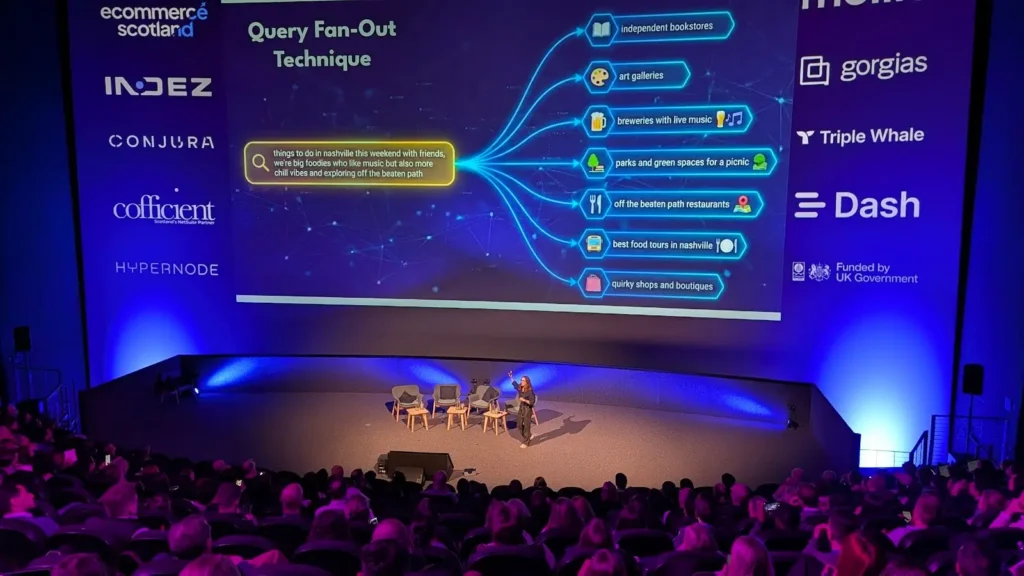
How do we clearly describe our business for AI Search?
One attendee shared a common challenge: “We sell firewood, hot tubs, and we’ve just started selling saunas. But AI seems confused about what we do. I listened to what you said and looked at our website, and I can see why, because we haven’t described the business clearly in one sentence. How do we do this? How do we get customers looking for saunas to find us in ChatGPT?”
The business owner pointed out the problem. AI platforms look for consistent signals across your website and the wider web about what you do and who you serve. If you describe your business in different ways across pages, AI will try to piece it together, often incorrectly.
This is a prevalent problem, even for enterprise-level businesses. A German DAX 30 company worked with us to solve a reputational issue: AI platforms didn’t recognise them as “innovative.” That perception was impacting how stakeholders viewed the business.
By aligning their messaging, content, and digital PR strategy, we helped improve how AI platforms understood and described the brand.
If your positioning is unclear, that’s exactly what our Branding and Positioning Accelerator is designed to fix. We analyse your customers, competitors, and current messaging, then rebuild your positioning so your business is clear, differentiated, and easy for both customers and AI to understand.
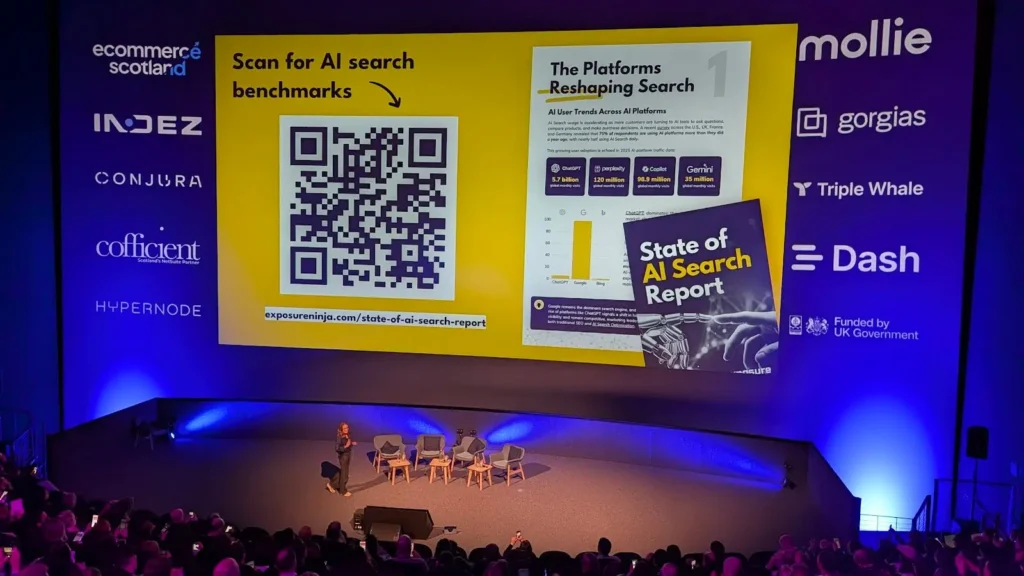
Is AI Search Optimisation relevant for B2B brands?
Ecommerce Scotland is a retail and digital marketing conference, so naturally, many of the examples in the talks leaned towards B2C.
But one attendee raised a valid point: “If you’re B2B, say selling components, how do you manage ChatGPT then? Is it the same? Because many examples were for B2C, but are people looking for components in ChatGPT?”
AI Search Optimisation is just as relevant for B2B brands as it is for B2C. This is because B2B buyers aren’t just using Google anymore; they’re also having detailed conversations with AI tools to understand technical requirements, find solutions, and compare suppliers.
Where B2B differs is in which platforms matter most and how they’re used. Charlie Marchant explains: “B2B buyers may use Copilot significantly more because many B2B businesses have to work on Microsoft suite and so they’re required to use Copilot.
This is incredibly important because optimising for ChatGPT doesn’t mean you’ll also do well in Perplexity, Copilot, or Gemini. So, if you know the platform that most of your customers and your audience use, you can focus on that particular AI Search platform and try to be visible in the relevant answers there.”
Here’s what your B2B marketing strategy needs to focus on:
- Identify which AI tools your audience uses.
- Test real queries your buyers would ask.
- Ensure your brand appears in those conversations.
- Build visibility across both your website and third-party sources.
Dominate AI Search in 2026
One attendee summed up a shift many businesses are still catching up to:
“I use ChatGPT all the time. It sounds silly, but I hadn’t even thought about people looking for our products in ChatGPT. No question, just wanted to say your talk was enlightening, because I’d never thought about this!”
When Charlie Marchant asked the Ecommerce Scotland audience, “Are you optimising your website to appear in AI searches?” 60% said no. That means the majority of businesses still aren’t actively competing for visibility in AI Search.
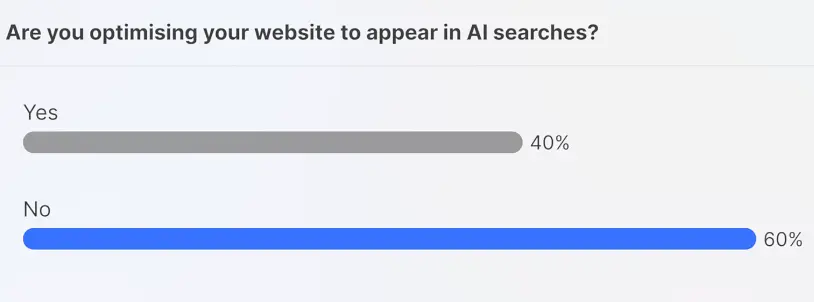
But 40% said yes. That’s a significant jump from just 3% when Charlie asked the same question to the crowd at MozCon London 2025.
Right now, you’re in a position where:
- Most competitors aren’t optimising for AI Search.
- Some are starting to invest seriously.
- Early adopters are already gaining visibility.
That combination creates a clear advantage for businesses that act now.
If you’re not sure where you stand, the first step is understanding your current visibility and gaps. Request a website and marketing review, and we’ll show you exactly how to improve your visibility in AI Search.