AI Search Optimisation vs Traditional SEO: Key Differences (And Why You Need Both)


Has AI Search Optimisation made SEO obsolete? Or is it just typical SEO with an AI twist? Find out how they’re different and why you need both to stay competitive.
AI Search is impacting the future of traditional search engines.
Semrush predicts that AI Search traffic is on track to surpass traditional search traffic by 2028. Gartner’s calling it even earlier: they expect traditional search traffic to drop by 25% by 2026. If Google rolls out its new AI Mode as the default experience, that shift could happen sooner.
Where are these users going? They’re turning to platforms like ChatGPT, Perplexity, and Gemini for instant, personalised answers to their questions. Even on Google, searchers are interacting with AI Overviews or switching to AI Mode to get direct insights, not just a list of links.
But this shift doesn’t mean it’s time to abandon traditional Search Engine Optimisation (SEO). While Google has seen its first YoY market share dip in years, it still commands just under 90% of global search traffic and remains a driver of user discovery and decision-making.
We’ll explain the differences between AI Search Optimisation vs traditional SEO and why you need both to stay visible in 2025 and beyond.
Isn’t AI Search Optimisation Just SEO?
It’s a question we’ve been asked frequently this year, especially at AI Search webinars where our CEO, Charlie Marchant, has been invited to speak. While the two strategies share some similarities, they’re designed for very different environments and goals.
Traditional SEO focuses on helping your website rank in search engines like Google and Bing. That means targeting relevant keywords, optimising your on-page content, building backlinks, and ensuring optimal technical SEO performance. The main aim is to appear at the top of the organic search results and drive traffic to your site.
AI Search Optimisation is about gaining visibility within AI-powered tools like ChatGPT, Claude, Perplexity, Gemini, and Google’s AI Overviews and AI Mode. These tools don’t just show users a list of links; they deliver direct, summarised answers within the AI platform, often referencing trusted sources from across the web.
In this context, the goal is to become a source the AI cites or recommends when answering a user’s query.
So, while SEO and AI Search Optimisation aim to improve visibility, they do so through entirely different mechanisms. Traditional SEO helps you win clicks from search results. AI Search Optimisation helps you earn trust and exposure within the answer itself.
Businesses with both an SEO strategy and an AI Search Optimisation strategy will be in the strongest position to reach their audience, whether they’re browsing Google or asking a question in ChatGPT.
The Big Differences Between AI Search Optimisation and Traditional SEO
Visibility Goals
In traditional SEO, visibility means landing on page one of the search results. The higher you rank, the more clicks and traffic you’ll likely get. That’s been the standard goal for years.
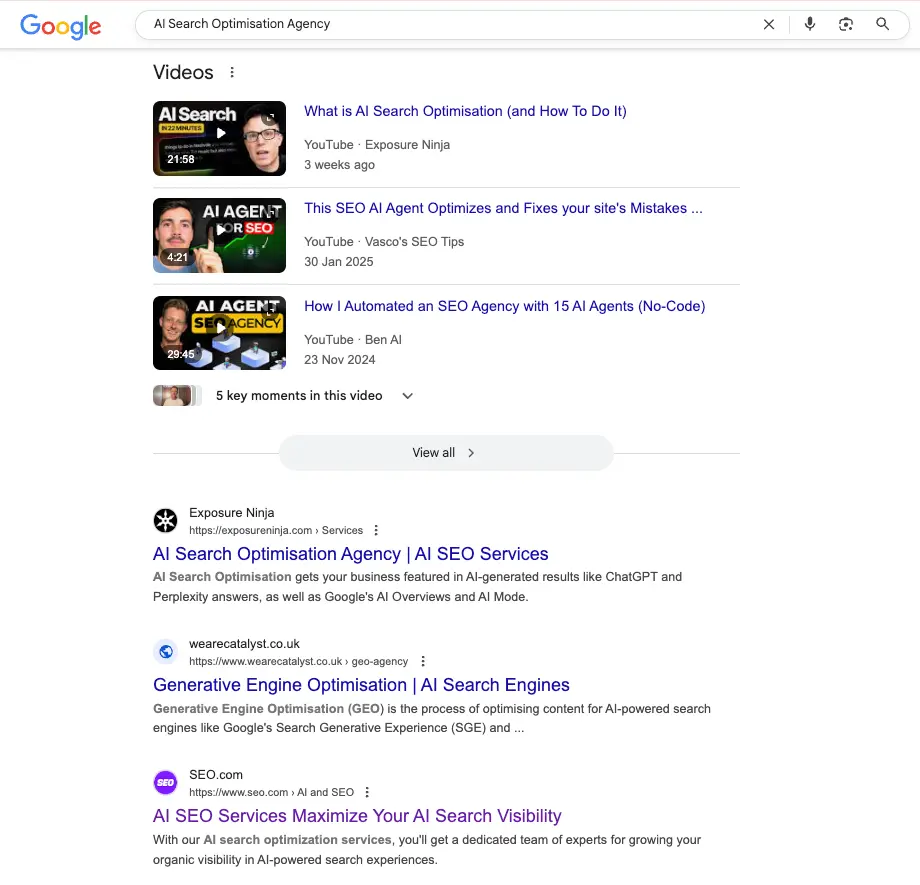
For example, when you search “AI Search Optimisation Agency” on Google, you’ll see our AI SEO agency service page ranking at the top of the organic results, right below the video carousel (where we also feature). That’s a textbook case of traditional SEO working exactly as intended.
AI Search tools work very differently from traditional search engines. Rather than presenting users with a ranked list of links, they generate direct answers, often pulling from multiple sources across the web or their underlying knowledge bases.
This changes what “visibility” means (and what makes tracking brand visibility in AI Search more challenging). Instead of aiming solely for a top-ranking position, your goal becomes earning a presence within the AI-generated response. These are the ways your content or brand can appear in these answers:
- Direct Mentions: This is when your brand or website is mentioned by name within the AI’s answer.
- Cited Source: The AI includes your page as a clickable link or in the sources section. Your content has been used to help inform the answer, even if your brand isn’t mentioned explicitly in the main text.
- Recommendations List: Your brand is featured in a curated list of suggested providers. This positions you as a recommended solution, similar to a roundup article but generated by AI.
When searching for “AI Search Optimisation Agency”, Google’s AI Overview generates a summary explaining what these agencies do. Our service page is cited directly beneath the answer as one of the sources used by the AI to build its response.

This is a clear example of AI Search Optimisation visibility, where the content doesn’t just rank in organic search, but is also trusted enough to be referenced within an AI-generated explanation.
It might be tempting to draw a simple conclusion from the example above: if the AI Search Optimisation page ranks first in Google and is cited in the AI Overview, then SEO alone must be responsible for both. In other words, SEO equals AI search optimisation, right?
Not quite.
A strong SEO foundation helps your content perform well in traditional search and AI-powered results. Technical performance, keyword targeting, and content structure still matter.
But those factors alone aren’t enough.
What you see in this example is the result of a combined strategy. We applied traditional SEO best practices and AI Search Optimisation techniques to ensure visibility across both environments.
Good SEO got us on page one. AI Search Optimisation got us in the answer. You need both working together to maximise your visibility in today’s evolving search landscape.
To summarise:
- The SEO visibility goal is to rank prominently in search engine results and drive clicks to your website.
- AI Search Optimisation’s visibility goal is to be cited, mentioned, or recommended within AI-generated answers to build trust.
Content Strategy
An SEO content strategy is driven by search intent and keyword targeting. This typically looks like:
- Identify your target audience to understand their needs, pain points, and search behaviour.
- Conduct keyword research to find relevant terms your audience is actively searching for.
- Map keywords to search intent to determine the type and purpose of content required.
- Plan your content calendar around high-priority keywords, business goals, and content gaps.
- Create high-quality, optimised content that answers queries clearly and provides real value.
- Apply on-page SEO best practices, including meta tags, headings, internal links, and structured formatting.
- Promote your content through email, social media, and outreach to maximise visibility and engagement.
- Monitor performance using tools like Google Analytics 4 and Semrush to track traffic, rankings, and conversions.
- Refine and update content regularly to maintain competitiveness and capture evolving search demand.
This approach remains highly effective. As long as users turn to Google to type specific queries, keyword-optimised, search-intent-aligned content will continue to perform. Blog posts, landing pages, and product pages designed around known keyword demand are still core to organic growth.
But, AI Search Optimisation requires a different content strategy — one that prioritises depth, clarity, and contextual relevance over traditional keyword metrics.
Here’s how it differs:
1. Conversational and Long-Tail Focus
AI platforms are designed to respond to more natural, conversational language. Instead of short, transactional search terms like “best CRM software”, users might ask: “What’s the best CRM for a B2B company with a remote sales team?”
Your content needs to address these longer-tail, highly-specific questions in a way that provides clear, structured answers. While traditional keyword tools might not even show search volume for these queries, they’re increasingly common in AI interactions and present new opportunities to capture visibility.
2. Covering Query Fan-Out
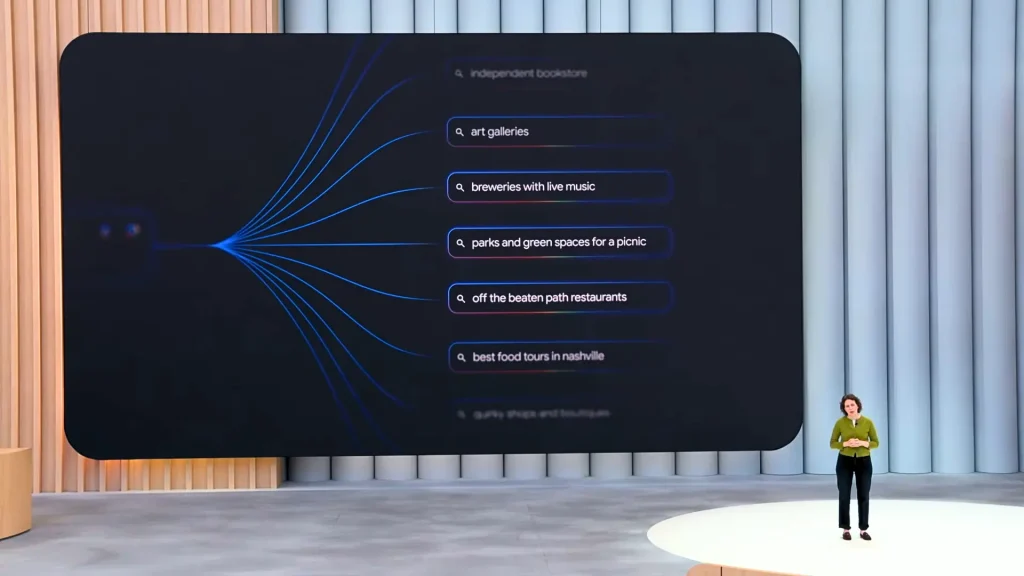
AI tools don’t just pull one answer for one question; they interpret a broader range of related questions that can stem from a single topic. This is known as query fan-out: when a user asks one question, the AI model may tap into a network of related sub-queries to generate a more complete response.
To be included in that process, your content needs to go beyond surface-level answers. It should:
- Address the core topic comprehensively
- Include relevant subtopics or follow-up questions
AI tools favour content that’s useful beyond just one keyword. The more angles you cover clearly and concisely, the more likely your content will rank in AI Mode and other AI platforms for various AI outputs — even for queries you didn’t explicitly optimise for.
3. Topical Authority
Establishing topical authority is key to earning trust from search engines and AI platforms.
In a traditional SEO context, this usually means publishing a high volume of high-quality content around a specific topic on your own site. This would include detailed guides, FAQs, service or product pages, and case studies related to your niche. The more depth you show, the more search engines understand you as a credible source in your industry.
But for AI Search Optimisation, building topical authority goes beyond your website.
AI platforms like ChatGPT and Perplexity consider web-wide brand signals when deciding which sources to reference. That includes:
- Brand mentions in trusted third-party publications.
- Consistent quote contributions across platforms.
- Guest posts on authoritative websites.
- Positive reviews on industry directories or aggregators.
- Mentions in community forums or Q&A platforms.
So it’s not just what you publish on your own site that matters; it’s how the wider internet talks about you.
To summarise:
- SEO content strategy focuses on ranking web pages in search engine results by targeting keywords with clear intent, building on-site content depth, and earning backlinks to drive organic traffic.
- AI Search Optimisation content strategy focuses on earning citations within AI-generated answers by creating content that matches conversational queries and query fan-out, while building web-wide authority through credible mentions and sources.
Content Format and Structure
In traditional SEO, we’re already familiar with the structural basics that help content rank:
- Clear use of H1, H2s, and H3s.
- Strategic keyword placement.
- Compelling meta descriptions and meta titles.
- Internal linking to relevant pages.
- Including FAQs to address related queries.
These elements still matter. But to increase your chances of being referenced in AI-generated answers, your content needs to go beyond being well-written and optimised for search engines. It must be written and structured so that AI models can easily interpret and extract from it.
Here are the key elements of AI-friendly content:
- Structured Data: Use schema markup such as FAQ, how-to, author, and review schemas to help AI tools understand your content.
- Author Section: AI platforms value E-E-A-T, especially first-hand experience. Include visible author bios that highlight expertise, credentials, and relevant experience to signal trustworthiness to AI systems.
- Clear Subheadings: Use descriptive H2s and H3s that reflect conversational, real-world questions. This improves readability and aligns with how users phrase queries in AI tools.
- Shorter Paragraphs and Summaries: Break down content into concise sections with clear summaries or key takeaways. This improves scanability and makes it easier for AI models to extract relevant information quickly.
- Multimedia Elements: Incorporate charts, tables, images, and videos where appropriate. These elements enhance user engagement and help AI tools more accurately understand the context and structure of your content.
We’ve put together an AI-optimised blog post template you can copy and customise to ensure your content is structured for maximum visibility in AI-generated answers.

To summarise:
- SEO-friendly content formatting and structure focuses on keyword-optimised, well-structured pages designed to rank in search engines and guide users through on-site journeys.
- AI Search-friendly content formatting and structure prioritises machine-readable, expert-led content with a clear, conversational structure to increase the likelihood of being cited in AI-generated answers.
Metrics and Success Signals
Here’s where things get even more distinct between AI SEO vs traditional SEO.
In traditional SEO, success is typically measured through well-established, quantifiable metrics, such as:
- Keyword Rankings: How high your pages appear in the search engine results for target keywords.
- Organic Traffic: The number of users landing on your site via unpaid search results.
- Click-Through Rate (CTR): The percentage of users who click on your link after seeing it in the SERPs.
- Time on Page / Engagement: How long visitors stay on your page, indicating content relevance and quality.
- Conversion Rate: The percentage of visitors who complete a desired action, such as filling out a form or making a purchase.
These performance indicators help you measure how well your content attracts, engages, and converts search-driven traffic.
In AI Search Optimisation, the metrics are more nuanced and still evolving, but they’re no less meaningful. Success is about being recognised, referenced, and trusted by AI systems that generate answers for users.
Although AI-specific metrics can be difficult to track using traditional analytics tools, we’ve developed an AI Visibility Tracker to help you monitor brand mentions, source citations, and recommendations across AI-generated search results.
To summarise:
- SEO success signals are rankings, organic traffic, engagement metrics, and conversions that indicate how well your content performs in search engine results.
- AI Search Optimisation success signals are brand mentions, source citations, and content summarisation within AI-generated answers that reflect authority and relevance in AI Search.
Why You Need Both AI Search Optimisation and SEO
SEO and AI Search Optimisation aim to increase your visibility, but they require different strategies. One focuses on ranking in search results; the other on being referenced in AI-generated answers. Prioritising one at the expense of the other leaves gaps in your visibility strategy.
Here’s why you need both working together:
- Search Behaviour Is Fragmenting: Your audience isn’t just using Google anymore. They’re turning to ChatGPT for research, scanning AI Overviews for instant answers, and using tools like Perplexity for product recommendations. Relying on a single platform is no longer enough; your brand needs to show up wherever people ask questions, whether that’s in traditional SERPs or inside AI-generated summaries.
- Trust Is Built Through Repetition: When users see your brand appear across multiple platforms, like a top-ranking page in Google, a citation in an AI response, and a mention in a video, it reinforces credibility. That repeated visibility creates a trust loop that strengthens your brand and drives conversions over time.
- It Future-Proofs Your Brand: Search is changing. Google is integrating AI more deeply into the search experience, and users are adapting just as quickly. By investing in both SEO and AI Search Optimisation now, you’re ensuring your content remains visible and competitive in whatever the next phase of search looks like.
It’s not AI Search Optimisation vs traditional SEO; it’s SEO and AI Search Optimisation working together. The best AI Search Optimisation agencies are supporting brands to master both. If you need support from a dedicated AI SEO agency, Exposure Ninja specialises in both.
Will SEO Be Replaced by AI Search Optimisation?
AI Search Optimisation isn’t replacing SEO — it’s building on top of it. In fact, a strong traditional SEO foundation remains essential for success in AI-driven search environments.
What’s likely is that, as search behaviour continues to evolve, search engines will adapt — and so will SEO. We’re already seeing signs of this with Google’s new AI Mode.
Rather than being replaced, SEO is evolving alongside AI. The brands that recognise and adapt to this shift by combining strong SEO with AI Search Optimisation strategies will be best positioned to stay visible, competitive, and trusted in the years ahead.
Dominate Traditional and AI Search
Success in 2025 doesn’t come from choosing between SEO and AI — it comes from mastering both. To future-proof your visibility, your strategy needs to work across search engines and AI platforms alike.
| Feature | Traditional SEO | AI Search Optimisation |
| Goal | Rank in search engine results and drive organic traffic. | Be cited, mentioned, or recommended in AI-generated answers. |
| Optimised For | Search engine algorithms, like Google or Bing. | Large Language Models (LLMs) like ChatGPT and Perplexity, as well as Google’s AI Overviews and AI Mode. |
| Key Tactics | Keyword targeting, backlinks, and technical SEO. | Structured data, conversational questions, extraction-friendly formatting, and first-hand experience. |
| Main Metrics | Rankings, clicks, engagement, and conversions. | Mentions, citations, recommendations, and trust-driven clicks. |
At Exposure Ninja, we’re not just SEO specialists; we’re also leading the way in AI Search Optimisation. Our tailored AI Search Strategy helps you earn visibility inside AI-generated answers, while our SEO team ensures you stay competitive in the traditional search landscape. Request a callback to speak about boosting your visibility across traditional and AI Search.
FAQs
Is SEO still relevant in 2025?
SEO remains a critical part of digital marketing in 2025. Google is still the dominant search engine globally, and organic search continues to drive high-quality, high-intent traffic. While SEO is evolving alongside AI, it’s far from obsolete.
Will AI replace the Google search engine?
AI is enhancing the search experience, not replacing it. Google’s AI Overviews integrate AI into the search experience to deliver faster, more contextual answers, but search engines still play a central role in how users discover information. Brands need to optimise for both AI and traditional search to stay visible.
Is SEO dead due to AI?
SEO is adapting to the changing landscape, and AI is simply adding another layer to how users access and engage with information. The most effective strategies now combine strong SEO fundamentals with AI Search Optimisation to maximise visibility across both environments.