How to Track Brand Visibility in AI Search: 2 Steps


Want to know how visible your brand is across platforms like ChatGPT, AI Overviews, and Gemini? Here's our two-step method to start tracking your brand presence in AI-generated answers.
AI Search is changing the rules of organic visibility.
With traditional Search Engine Optimisation (SEO), your strategy was straightforward: target the right keywords, build content around search intent, earn backlinks, then monitor rankings and clicks. That’s all still important — but it’s no longer the whole picture.
With AI Search, platforms like ChatGPT, Gemini, and Google’s new AI Mode generate answers using more than just keywords and backlinks. They consider brand sentiment, market share, and topical authority to decide which brands to mention.
This shift makes tracking your brand’s visibility more complex, but not impossible. We share our top two ways to track brand visibility in AI Search, with insights from Nicola Tuxford, SEO Strategy Manager at Exposure Ninja.
What Is Brand Visibility in AI Search?
Brand visibility in AI Search refers to how often and in what context your brand appears across AI-generated results. This includes:
- Direct Mentions: When a platform recommends your brand, product, or service by name.
- Citations or Sources: When your website or content is used as a reference.
- Recommendation Lists: When your brand appears in curated lists alongside competitors.
This type of visibility goes beyond traditional search rankings. It’s not just about showing up — it’s about being chosen as a trusted, authoritative answer or recommendation.
Why Tracking AI Search Visibility Matters
The way people search for information has changed.
Users aren’t just typing queries into Google anymore. They’re asking longer, complex questions in AI platforms like ChatGPT, Gemini, and Perplexity. These tools respond with conversational answers that feel personal and helpful.
Even if users start with Google, many now find what they need within the AI Overview — often without clicking through to a website.
These AI platforms are becoming gatekeepers for online reputation. They’re deciding which brands to mention, which sources to cite, and which products or services to recommend as the most reliable, relevant, and valuable to the user.
This influences how your potential customers see your brand, whether they trust you, and whether they choose to engage. If your brand is included in their answers, you gain instant credibility. If you’re not mentioned, you’re invisible—no matter if you rank at the top of Google.
The way people search is changing fast. Instead of scrolling through search results, users now get direct answers from AI platforms like ChatGPT, Google’s AI Overviews, and Gemini. With the rollout of AI Mode in the U.S., brands must keep an even closer eye on how they’re represented, because a single mention can shape how users perceive them.
 Nicola Tuxford
SEO Strategy Manager
Nicola Tuxford
SEO Strategy Manager
This is why tracking your visibility in AI search matters. You need to know when your brand is being mentioned, where it’s showing up, and how it’s being represented. Just as importantly, you need to understand why your competitors are getting the spotlight when you’re not.
With this information, you can make smarter, data-driven AI Search Optimisation decisions.
Warning: AI Brand Visibility Tracking Isn’t Easy
Tracking your brand’s visibility in AI search isn’t as simple as running a keyword report. Unlike traditional SEO, there’s no single, stable ranking to monitor because AI-generated responses are dynamic and personalised.
AI Responses Vary by Platform and Person
Tracking brand visibility in AI search isn’t straightforward because AI results aren’t consistent.
- Platform-by-Platform Variation: In traditional search, a keyword would generally return a consistent set of results to most users. In AI Search, the different platforms have their own data sources, training models, and response styles. This means you can ask the same question on different AI platforms and get slightly different answers.
- Person-by-Person Variation: Even within the same platform, results can change depending on who’s asking. AI tools adjust their responses based on the user’s intent, phrasing, preferences, or search history (if enabled).
- Constantly Evolving: AI responses aren’t static. They’re influenced by real-time updates, model refinements, and user feedback. This means a prompt that gets your brand mentioned this week might not include you next week.
Let’s look at the platform-by-platform variation. When asked “Which is the best at-home gel nail kit?” in ChatGPT, it immediately followed up with questions to provide a more personalised response:
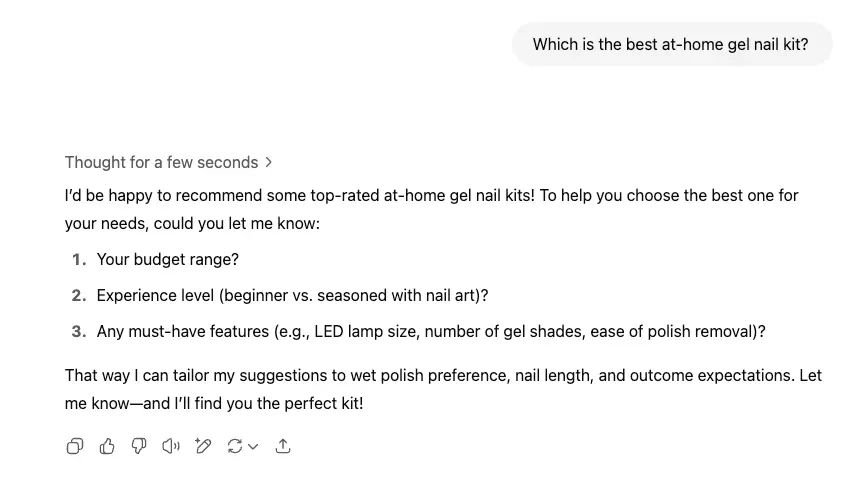
Whereas in Perplexity, it immediately provided a list of recommendations when asked the same question:
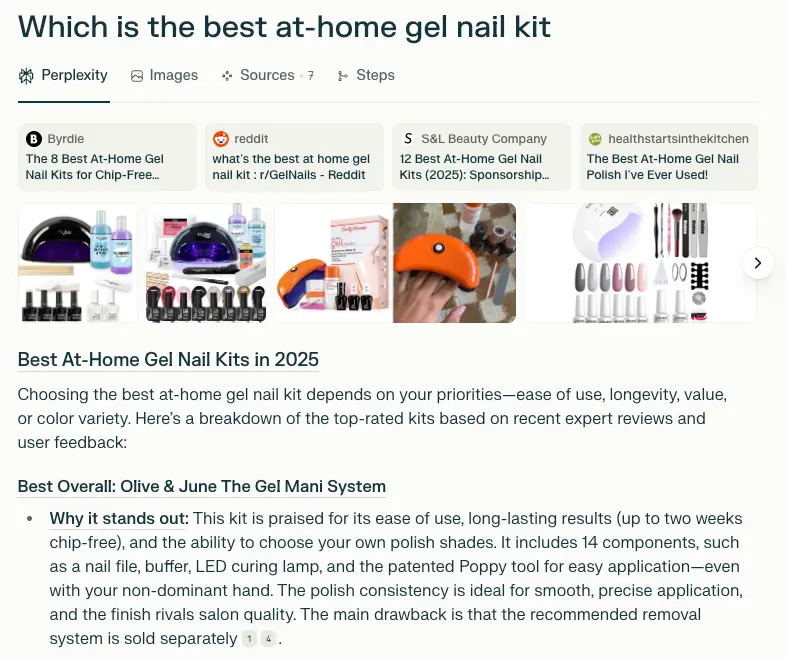
Nicola Tuxford expands: “It’s not a simple list of rankings anymore. AI results are conversational, adaptive, and vary wildly depending on the user’s query. Two people could ask about the same product but get completely different answers based on their needs. Add in multiple platforms, and consistency goes out the window, which makes tracking more complex.”
This unpredictability doesn’t mean tracking isn’t possible; you just need the right approach. Monitor AI responses across multiple platforms, test different queries regularly, and regularly analyse how and whether your brand is showing up.
Most Tracking Tools Are Still in Beta
AI Search is still in its early days, and the tracking tools available reflect that.
Even the most advanced platforms are in development mode, refining how they detect, measure, and report brand visibility across AI responses. The insights they provide are useful, but they can also be incomplete and inconsistent.
Nicola Tuxford explains the challenge: “AI Search is so bespoke that it is almost impossible to track visibility consistently. Available tools are currently unable to predict the likelihood of visibility being retained and the search terms that are being used, because of the way people are communicating with AI platforms.”
Because AI platforms respond to natural, unpredictable human language, the queries triggering your brand mentions constantly shift. Tools can give you a rough overview, but they can’t fully capture the nuance of personalised, real-time AI answers.
That’s why tracking needs to be hybrid. Use tools where you can, but back them up with manual checks.
How to Track Visibility Across AI Platforms
Step 1. Run Manual Checks
Manual checking is crucial to understanding how AI platforms perceive your brand. Nicola Tuxford breaks down how we do this as part of our AI Search Strategy:
“You need to dig deep into how your brand is represented across every major AI platform. Start by asking simple questions like, ‘Have you heard of [your brand]?’ Then go broader: ask for recommendations in your category, check how it describes your competitors, or prompt it with questions your site is built to answer.”
The goal here is to determine your brand’s visibility, trust, and authority from the AI’s perspective.
To get clean, unbiased results, use incognito mode or turn off memory when prompting. Make sure to try different versions of the same question to surface phrasing-based variations in results.
As you review responses, you want to track:
- Is your brand mentioned at all?
- How is it described — positively, negatively, or neutrally?
- Are competitors appearing more frequently or more favourably?
- Are you included in any recommendation lists or cited as a source?
We recommend logging this data monthly using our AI Visibility Tracker (or your own spreadsheet), noting the platform, query category, prompt, brand mention status, mention type, position, cited URLs, sentiment, and competitors mentioned.
Run these checks monthly. Over time, patterns will emerge, giving you insight into which platforms need more attention, which topics lack authority signals, and where to focus your digital PR or content efforts next.
Step 2: Tools Designed for AI Visibility
Manual checks are a strong start, but you’ll need dedicated tools to scale visibility tracking across platforms and time.
There are two great options here:
Semrush AI Search Report
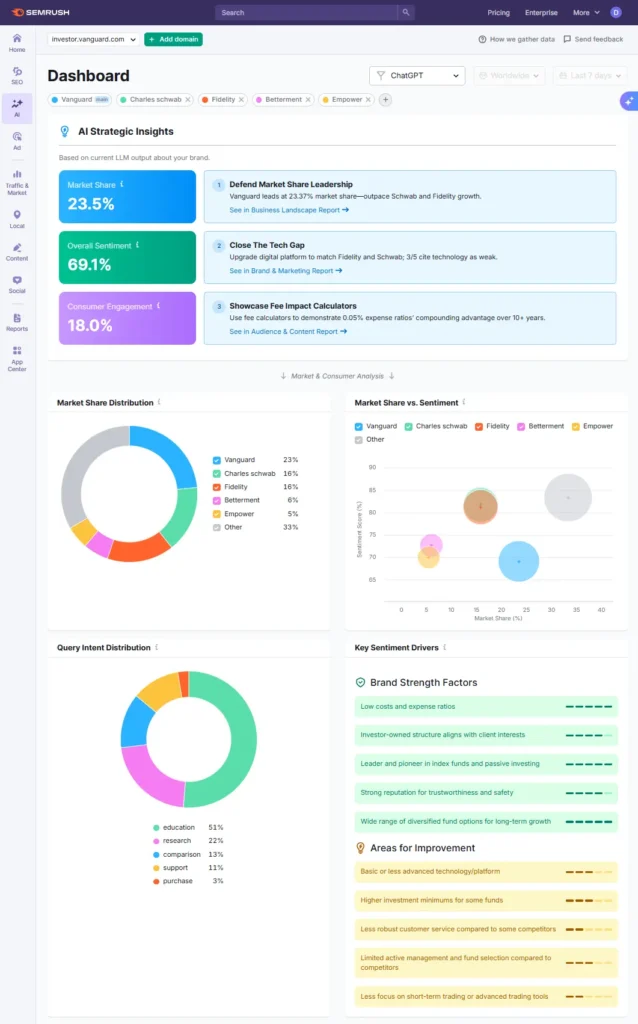
Semrush’s AI Toolkit* provides comprehensive insight into how your brand is represented across AI platforms (you can try the free interactive demo** with us).
The main dashboard gives an overview of your:
- Market share against your competitors in different AI platforms.
- Brand sentiment across different AI platforms.
It gives more granular, specific recommendations against these findings, such as areas you could improve in your service offering to improve sentiment. You also receive short-term, medium-term, and urgent AI Strategic Opportunities that you can start implementing in your AI Search Optimisation strategy.
If that wasn’t enough, it breaks down into three different reports looking at Business Landscape, Brand and Marketing, and Audience and Content, providing tailored results and opportunities.
Combining this tool’s bounty of useful insights with your manual checks will help you generate the most growth in AI Search.
Profound
Profound is another platform offering a comprehensive solution for tracking and improving AI visibility. It provides a detailed overview of how your brand is represented across AI platforms compared to competitors, along with actionable recommendations to improve your overall visibility score (still in beta).

One of its standout features is the Conversations Report (also in beta), which reveals the types of prompts users enter for key industry terms. For example, if you’re targeting the keyword “asset management,” Profound can show the full range of conversational queries users are submitting:
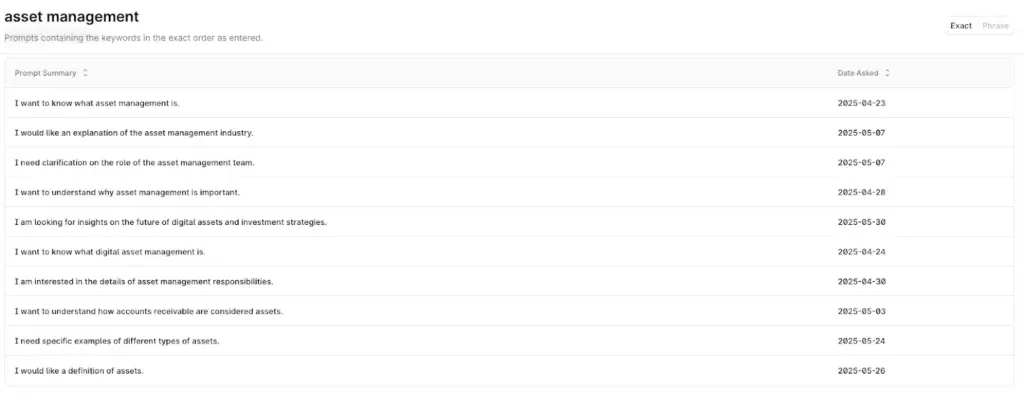
This insight is especially powerful when paired with your manual checks. It ensures you’re not just tracking brand visibility, but also covering all the different ways your audience might phrase their questions, helping you uncover blind spots and optimise for real-world search behaviour across AI tools.
Boost Your Brand Visibility Across AI Search
Knowing how to track brand visibility in AI Search is just the start. The real value comes from acting on these insights to improve your visibility, credibility, and performance across platforms like ChatGPT, Perplexity, and AI Overviews.
Dominating this new marketing battleground needs a multi-layered strategy, including:
- Strengthening your on-page and technical SEO foundation to ensure your content performs well in traditional search.
- Nailing your brand positioning, so AI tools can easily understand what your brand does, who it serves, and why it matters.
- Creating E-E-A-T, AI-friendly content while covering relevant subtopics that AI (and users) care about.
- Earning brand mentions on third-party websites to build trust and authority beyond your own site.
These are a few of the signals AI tools use to determine whether to cite your brand, recommend your services, or include you in their answers.
If you’re ready to increase your presence across AI platforms, we can help. Our AI Search Optimisation service is designed to turn your brand into the most trusted, frequently cited answer in your category.
Request a callback to learn how we’ll make your brand unmissable in the AI Search era.
FAQs
What does brand visibility in AI Search mean?
Brand visibility in AI Search refers to how frequently and in what context your brand is mentioned across AI-generated answers. This includes direct mentions, citations as a trusted source, and inclusion in product or service recommendation lists. These mentions significantly influence user perception and purchase decisions.
How is AI Search visibility different from SEO rankings?
SEO rankings are based on keyword targeting and page optimisation. AI Search visibility is more fluid and focuses on web-wide citation frequency, brand sentiment, and your authority on thematic topics.
Why is tracking brand visibility in AI Search so difficult?
AI platforms return personalised and context-sensitive answers, making results inconsistent across users and queries. Limited tools are also available to track this consistently. It requires a combination of manual testing and emerging tools.
Can I track AI visibility in Google Search Console?
Not fully. While traditional SEO data is visible, AI-driven results aren’t yet clearly tracked. Google is slowly integrating AI Mode data into Google Search Console (GSC), which could soon provide better visibility insights. We anticipate that this will change soon, so watch this space!
How often should I check my AI visibility?
Monthly is ideal. Unlike traditional SEO, AI visibility shifts based on algorithm updates and conversational trends. Frequent checks help you stay ahead and adapt your strategy in real time.