How to Create an AI Search Optimisation Strategy in 2026


Looking for a proven, future-proof roadmap to dominate ChatGPT, Google's AI Overviews, AI Mode, and more? Use our expert tactics to build a winning AI Search Optimisation strategy.
Do you want to be overlooked by AI-powered search?
Right now, your target customers are researching on ChatGPT or Perplexity, relying on Google’s AI Overviews for product comparisons, and using Google’s AI Mode to make buying decisions.
Imagine AI Mode recommends services in your niche, but your brand doesn’t even get a mention. Or your audience asks ChatGPT for the “best [your service]” and gets directed straight to your competitors.
Unless you’re actively optimising for AI Search, your competitors will be recommended, not you.
If you want to dominate this new search landscape, you need a structured AI Search Optimisation strategy to boost your visibility across AI Search, and we’re going to show you how to create one.
What Is an AI Search Optimisation Strategy?
AI Search Optimisation is the practice of improving your brand’s visibility and authority within AI platforms, such as ChatGPT, Perplexity, Gemini, AI Overviews, and AI Mode, Google’s latest search feature. While Search Engine Optimisation (SEO) is about climbing search engine rankings like Google or Bing, AI Search Optimisation is about becoming the source AI tools trust, cite, and promote.
An AI Search Optimisation strategy is the targeted plan that ensures your business is mentioned and recommended by these tools during high-intent, decision-making moments.
In 2026, having this kind of strategic approach is no longer optional. For the first time in years, Google’s market share has dropped. More and more users are no longer defaulting to traditional search engines — they’re turning to conversational AI for faster, more confident decision-making.
This isn’t just another SEO trend. It’s a measurable shift, and the data shows just how fast it’s accelerating:
- A recent study by Semrush predicts AI Search will overtake traditional search engines by 2028. If Google makes AI Mode the default (as expected), that shift could arrive even sooner, leaving unprepared businesses behind as visibility shifts from web pages to AI summaries.
- Meanwhile, Google’s AI Overviews are already active for over 1.5 billion users, replacing standard search results with condensed, source-cited answers. If your business isn’t one of the few sources AI pulls from, you can disappear from the discovery journey entirely.
- ChatGPT is now receiving over 5 billion visits a month globally. Many users rely on it for real-time product research, recommendations, and buying decisions. If your competitors are being mentioned and you’re not, that’s lost leads and revenue.
If you want your business to be found, trusted, and chosen in the AI-first era, you need to optimise for where your audience is already making decisions — not where they used to. That’s where the AI Search Optimisation strategy comes in.
Is an SEO and AI Search Optimisation Strategy The Same?
We hear this a lot: “AI Search Optimisation is just SEO.”
That’s not accurate, and thinking that way could cost you visibility in the channels where buying decisions are increasingly being made.
As Charlie Marchant, CEO of Exposure Ninja, puts it: “Marketers and business owners need to start taking AI Search seriously. Because while some traditional SEO techniques and optimisations do influence rankings in Large Language Models (LLMs) like ChatGPT and AI Mode, there are huge nuances here.”
You still need a strong SEO strategy that sets you up for success in traditional search. You need crawlable content, clean structure, schema, fast-loading pages, keyword optimisations, and internal and external links. These are still key signals that help AI find and interpret your content.
But AI Search demands more. LLMs like ChatGPT and Gemini aren’t restricted to Google’s top-ranked pages. They’re looking for trusted, well-structured answers — and they often source them from deeper in the search engine result pages (SERPs). As shown by Semrush, nearly 90% of ChatGPT citations come from content ranking beyond position 21.

This means your content or website could be optimised for SEO and be ranking well in the SERPs, but still miss out entirely in AI responses.
With AI Search, you’re optimising for LLMs that are trained to evaluate trust, summarise quickly, and deliver confident, source-backed recommendations. That’s a step beyond keyword targeting, and it’s why AI Search Optimisation needs its own strategy based on the latest AI Search trends.
Step 1: Audit AI Performance
A comprehensive AI Search audit is the first step in any serious AI Search strategy. It tells you how visible your brand is, how you’re positioned in AI tools, and where your biggest opportunities lie.
Check Your Brand’s Visibility in AI Tools
Brand visibility in AI Search refers to how often and in what context AI platforms mention your business. This visibility can take different forms:
- Direct Mentions: AI tools explicitly recommend your business or products.
- Citations or Sources: Your website is linked or referenced as a factual source either in the response or the link card.
- Recommendation Lists: Your brand appears alongside others in ranked or unranked product or service suggestions.
Tracking your brand visibility in AI is more complex than monitoring search rankings. Each AI platform generates responses dynamically based on individual prompts, user context, and real-time data. That means your presence can vary across platforms, users, and even sessions.
That said, you can audit visibility manually by prompting the different AI tools with questions about your brand and high-intent queries your audience is likely to use.
For more scalable tracking, tools like Semrush’s AI Toolkit* are beginning to fill the gap. Their AI Toolkit can show which platforms are mentioning your brand and the associated sentiment and positioning. If you want to give it a try, you can try the free interactive demo** with us!
This isn’t a one-off task. AI platforms evolve fast, and so do the answers they generate. To stay visible and competitive, you should audit your presence across AI tools at least once a month to catch shifts in citations, sentiment, and competitor mentions before they cost you visibility.
Analyse What AI Tools Are Saying About You
When auditing your AI visibility, pay attention to how your brand is being presented.
AI platforms summarise your brand based on available data from your website content, external reviews, mentions across the web, and third-party sentiment. To optimise effectively, you need to understand how these tools interpret and present your business.
When reviewing AI-generated responses:
- Check for descriptive accuracy. Are the AI tools correctly highlighting your services or products and intended audience?
- Assess the tone and sentiment. Determine whether your brand is being described in a positive, neutral, or negative light, as this can directly influence user perception and trust.
- Evaluate your positioning. Does the AI capture the brand positioning you want to be known for?
- Examine your placement within the response. Are you the lead recommendation, part of a broader list, or just mentioned in passing with little context?
- Review the source attribution. Identify which of your web pages (if any) are being cited and consider whether they’re relevant and optimised for the queries generating those AI responses.
These insights reveal how AI perceives your brand and whether that aligns with how you want to be positioned.
But don’t just analyse your own brand. Assess how your competitors are represented as well. This gives you a benchmark and highlights where you can differentiate or improve your own visibility and positioning.
Identify Your AI Content Gaps
Once you’ve audited your visibility and brand perception, the next step is understanding where you’re not being mentioned but should be. These are your AI content gaps: high-intent queries where your competitors are getting cited, and you’re not.
There are two approaches to finding these gaps:
1. Find Gaps in Existing Content
Start by running relevant queries that you have created content on in tools like ChatGPT, Perplexity, or Google’s AI Mode.
Pay close attention to which brands are being mentioned and whether your content is cited as a source. If it’s not, ask yourself:
- Is your content covering this topic with enough depth?
- Is it structured clearly, with digestible headings and factual takeaways?
- Are you building authority through reviews, mentions, and internal linking?
Review the content that is getting cited. What makes it more credible or useful in the eyes of the AI? Then, update your own page using those cues, like better formatting, clearer language, more actionable detail, or stronger trust signals.
2. Find Gaps in Your Overall Content Strategy
The second approach is identifying topics you haven’t covered yet — areas where you should be showing up but have no content in place.
Perplexity is especially useful here. Start by running a query where you know your content is already cited. For example, our client DSLD Mortgage is referenced in response to the question, “How do you calculate a mortgage payment?”

Now, explore the “related questions” that Perplexity suggests. These are the natural follow-ups your audience is likely to ask next.
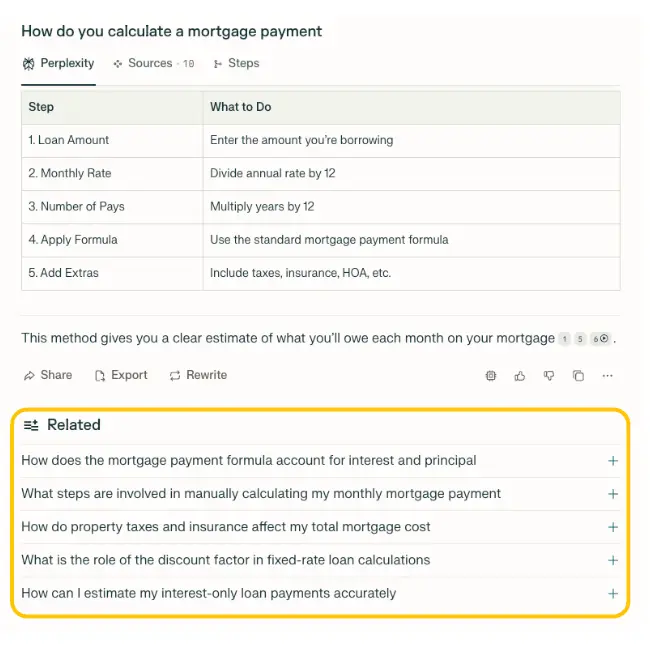
Click through each one. The moment your brand drops out of the cited sources is your content gap. These are high-relevance topics where your brand has the authority to contribute but no existing page or blog post to support the query.
You can either refresh your existing content to capture this query or create a new piece if it’s a topic worthy of comprehensive insight. Creating content around these gaps increases your chances of being cited in future responses — and strengthens your AI visibility across the buyer journey.
Step 2: Build a Strong SEO Foundation
Traditional SEO still matters.
If you want to rank in Google’s AI Overviews or have AI platforms like ChatGPT and Perplexity cite your content, your site first needs to be visible and valuable in the traditional SERPs. That’s because, for certain queries, AI tools perform web searches on traditional search engines like Google or Bing (or sometimes its own custom search index) to source and validate the answers they provide.
When we analysed the content being cited in responses from tools like Perplexity and AI Mode, we found a consistent pattern: the articles being referenced were clearly optimised around conventional SEO best practices. They used keyword-aligned titles, structured formatting, and clear topic focus — just like you’d expect from pages built to rank.
Take our client, DSLD Mortgage, for example. Their guide on determining mortgage payments is cited in AI responses and ranks in traditional search for the same query. It’s no coincidence — AI tools selected it because it was already optimised, crawlable, and relevant.
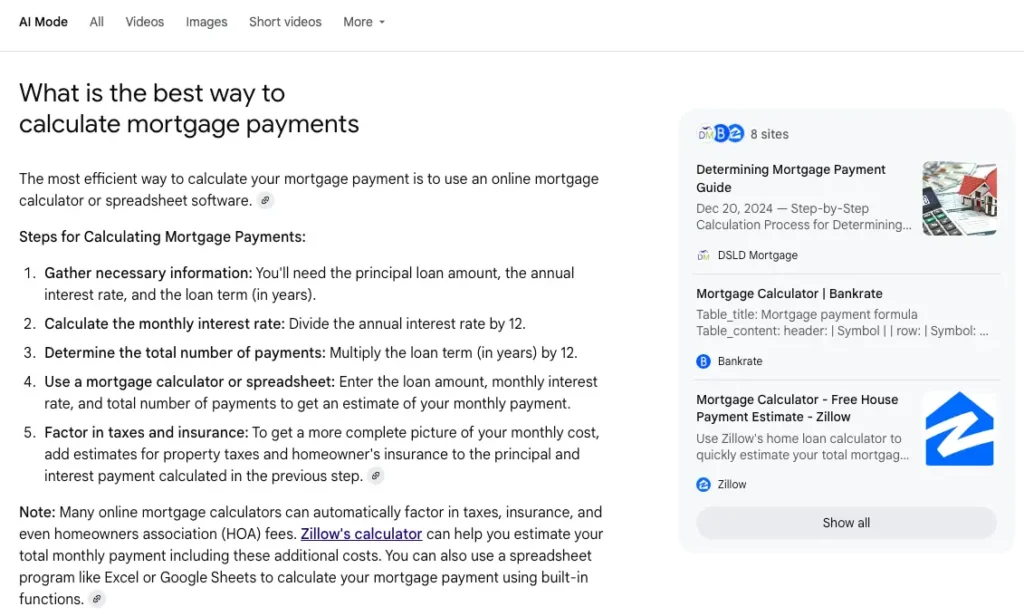
Ranking alone doesn’t guarantee selection. Tim Cameron-Kitchen, Founder of Exposure Ninja, explains: “Ranking on Google through traditional SEO isn’t enough to get visibility in this new era of AI Search, whether that’s in AI Overviews or AI Mode or other tools like ChatGPT, Perplexity, and Claude.” But without it, your content may never have surfaced in the first place.
Here’s how to strengthen your foundation so your content is both discoverable and AI-ready:
Improve On‑Page SEO Signals
To boost AI visibility, you need strong on-page SEO. These are the cues that tell both search engines and AI tools what your page is about — and whether it’s worth citing.
Key actions include:
- Targeting intent-driven, longer-tail keywords.
- Optimising your meta titles and descriptions.
- Using clear, structured headings (H1–H3).
- Writing in natural, conversational language.
- Including an FAQ section (with schema markup).
- Adding first-hand experience or unique insights.
Together, these on-page elements make your content easier for AI to parse (understand), easier for users to trust, and more likely to be featured in AI-generated answers.
Strengthen Technical SEO
Your on-page SEO might be brilliant — but if AI tools can’t access or interpret it correctly, it won’t matter.
That’s where technical SEO comes in. It’s the infrastructure that ensures your site is fast, accessible, structured, and ready to be crawled, not just by search engines but by AI models pulling data from the web.
Here’s what to focus on:
- Apply schema markup. Use markup types like FAQPage, Product, HowTo, and Author to help AI tools parse your content contextually. This makes it more likely to be used in summarised answers.
- Ensure fast page load times and mobile-first design. AI platforms often favour sources that provide a smooth user experience.
- Check crawlability for AI agents. Don’t block AI bots in your robots.txt file or meta tags. Ensure tools like Gemini and ChatGPT’s web crawlers can access the pages you want featured.
- Use logical URL structure and internal linking. This improves content discoverability across your site and strengthens topical authority in the eyes of both search engines and AI.
It’s no exaggeration to say this is a once-in-a-generation opportunity for businesses that can figure this stuff out and have these AI tools recommending them. Just like when SEO first came to the fore in the 2000s, we saw businesses grow and we saw businesses decline based on whether they were able to use this new tool to drive more customers. We’re going to see the same pattern here as users move over to this new generation of AI Search.
 Tim Cameron-Kitchen
Founder
Tim Cameron-Kitchen
Founder
Step 3: Create AI‑Friendly Content
Since early 2023, we’ve been analysing which types of content AI platforms like ChatGPT, Perplexity, and Google’s AI Overviews consistently cite. After testing these insights across dozens of client campaigns, we’ve identified a repeatable, AI-optimised content strategy.
If you want AI to cite your site, you need to tailor your content to match the format these systems are trained to favour. Here’s how to do it:
Target Fan‑Out Query Topics
One of the biggest shifts in AI Search is how tools like ChatGPT, Gemini, and Perplexity break down user prompts into clusters of related queries — a process called “query fan‑out.”
Let’s say a user asks, “What is the best organic dog food for small dogs?” AI won’t just answer that one question. Behind the scenes, it breaks the query down into subtopics and related web searches to give a more comprehensive answer, such as:
- “Best organic dog food for small dogs reviews 2025.”
- “What to look for in organic dog food for small breeds.”
- “Cost of organic dog food.”
You won’t always see the exact background searches AI tools perform — but there are ways to get a rough idea of how they break down queries.
For example, for Google’s AI Mode, you can enter a query in Gemini 2.5 and click “Show thinking” to view the follow-up questions the AI considers when building its answer. Just be aware: these aren’t always reliable, as some of the questions shown may be AI hallucinations rather than real search logic.
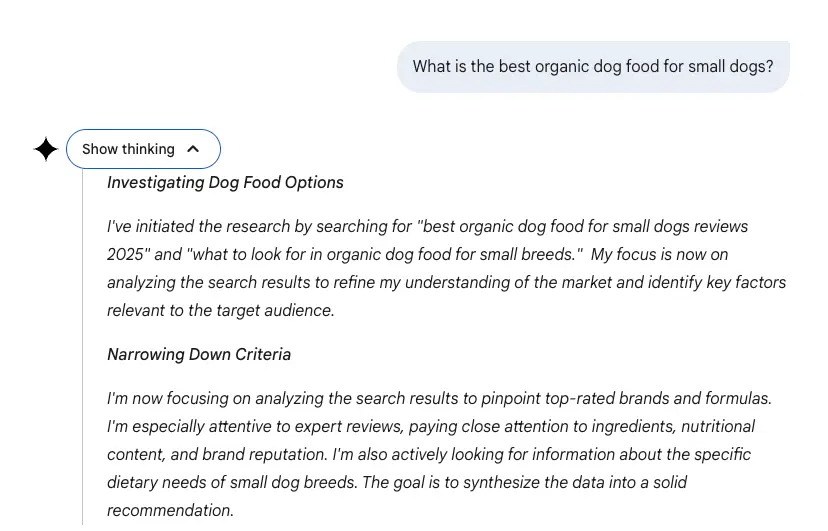
The takeaway isn’t to reverse-engineer every query — it’s to recognise the bigger pattern.
To rank in AI Search, your content needs to comprehensively cover the topic, not just target a single keyword. That means anticipating the sub-questions and context the AI (and your potential customers) might explore next — and addressing those in your content.
By creating focused, high-quality content that answers these sub-questions, you’re doing three things:
- Expanding your footprint across multiple AI-influenced queries
- Positioning your brand as a comprehensive, authoritative source
- Increasing the likelihood of being cited, even if you’re not the top search result
It’s a scalable, strategic way to build topical authority that AI tools recognise and reward. If you want to become the brand AI trusts to explain a subject from every angle, this is where you start.
Create High‑Quality, Authoritative Content
One thing stands out when you look at the content being cited by AI platforms: it’s consistently high-quality.
But what does “high-quality” mean in the context of AI Search?
It means content that aligns with Google’s E-E-A-T quality principles — Experience, Expertise, Authoritativeness, and Trustworthiness. These are core signals that help search engines and AI tools decide whether your content is credible enough to recommend. And as AI becomes more conversational and user-centric, showing first-hand experience is becoming even more critical.
AI tools are prioritising content that doesn’t just explain a topic but demonstrates it. That includes:
- First-hand insights from someone who’s done it.
- Real-world examples, case studies, or personal outcomes.
- Expert quotes or analysis.
- Proprietary data from surveys or research.
- Content authored by individuals with proven credentials.
- Supporting media, like photos or video, to show the process in action.
Let’s look at an example. Our client, Golf Course Lawn Store, has a blog post on common weed killer mistakes. It’s cited in AI Mode for multiple related queries like, “Should I spray weed killer on my lawn during the night or day?”
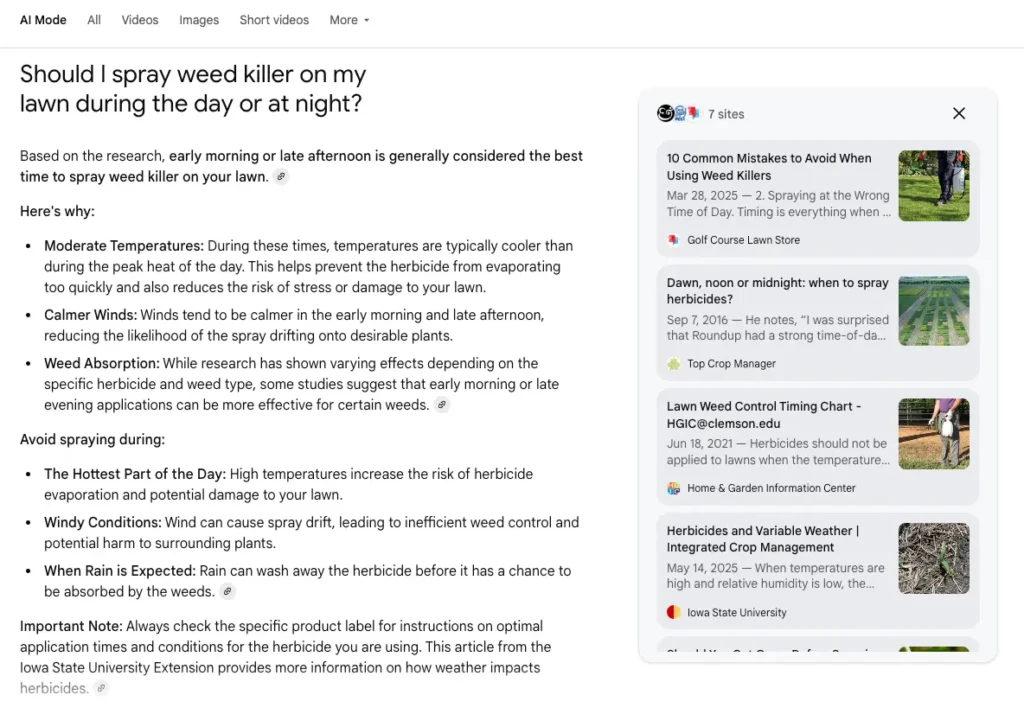
It’s cited for various related queries because the post covers the full context of weed killer application and is written by Ron Henry, a recognised expert in lawn care. It’s packed with personal experience, actionable advice, and even a video tutorial showing Ron applying weed killer himself.
That’s what AI tools are trained to trust. It’s not just keyword targeting — it’s content that demonstrates real expertise and authority backed by lived experience. That’s the kind of content AI platforms cite, recommend, and build their answers around.
For your AI Search Optimisation strategy, this is key. To be featured, you need to publish content that feels human, credible, and helpful.
If an AI tool is going to cite your content as a source, there needs to be a reason. If your content is generic, thin, or clearly AI-generated without any added value, there’s no incentive for an LLM to reference it. It can generate that kind of content on its own. To earn citations, your content has to offer something AI can’t: originality, depth, or real expertise.
Tim Cameron-Kitchen
Founder
Structure Your Content for AI
Formatting matters more than ever in the AI-first era.
AI platforms don’t “read” content the way humans do. They extract, summarise, and synthesise information based on structure, clarity, and context. If your content isn’t cleanly organised, it’s more difficult for AI tools to interpret, making it much less likely to be cited.
Here’s how to make your content AI-extractable:
- Use short, focused paragraphs. Stick to 2 – 3 sentences max. This improves readability for users and helps AI tools parse content without confusion or misinterpretation.
- Write clear, descriptive headings (H2s/H3s). Headings should reflect the specific questions or subtopics you’re addressing. This improves semantic understanding and increases your chances of appearing in response to targeted prompts.
- Lead with a strong summary. Open each page or section with a concise, well-structured answer. Think of it like writing a Featured Snippet: clear, helpful, and standalone.
- Include bullet-point summaries. Where relevant, summarise key points using bullet lists. AI tools often favour list formats for quick citations and skimmable answers.
Move Beyond Text
To perform in AI Search, you need to leave the white-page-black-text mindset behind.
AI tools like ChatGPT, Gemini, and Google AI Overviews increasingly favour content that goes beyond plain text. Structured visuals, like comparison tables, annotated images, and embedded videos, make it easier for these tools to extract, summarise, and trust your content.
We’re already seeing this shift in action. YouTube videos are appearing more and more in AI Mode and AI Overviews. Google also recently confirmed that YouTube will be integrated into Google Ads campaigns, further signalling that video is becoming an essential discovery asset across platforms.
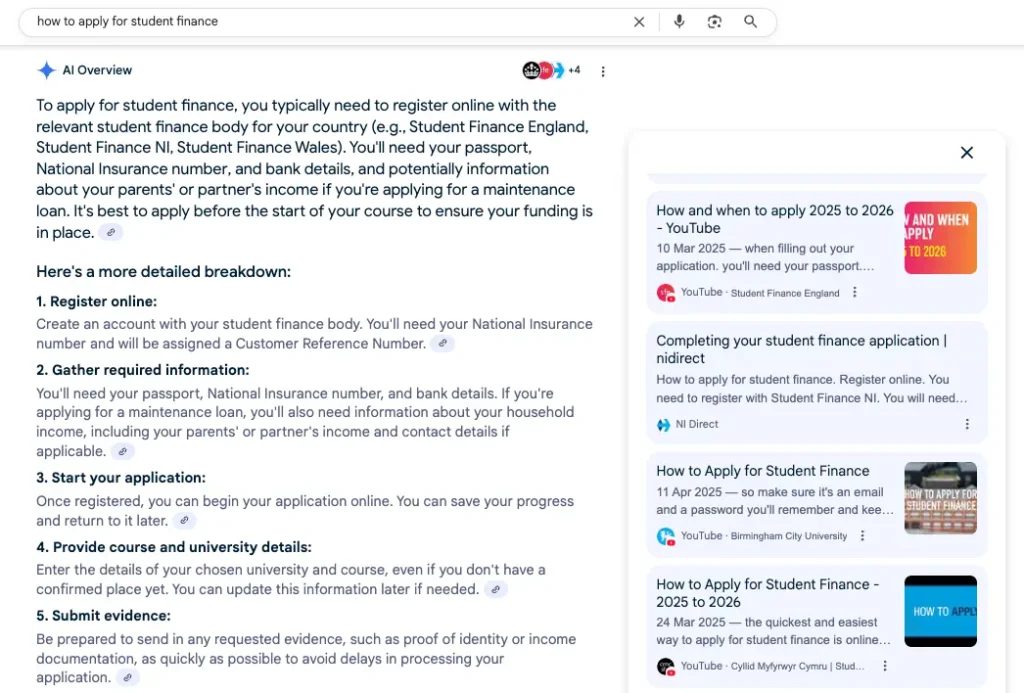
To stay competitive, your content must go beyond words. Visual formats help clarify complex information, reinforce credibility, and make it easier for AI systems to understand and extract the key takeaways from your page.
To make your content more AI-friendly, incorporate formats like:
- Infographics and Tables: Offer clarity for complex information at a glance — great for both AI summarisation and user engagement.
- Tutorial Videos or Explained Clips: Embedding video demonstrates real expertise and makes your content AI-ready. AI tools prioritise varied formats—don’t be text-only.
- Screenshots and Data Visuals: Graphs, charts, and annotated visuals support factual claims and strengthen trust.
Step 4: Build Brand Authority
AI search doesn’t just pull from your website or owned channels — it pieces together a full picture of your business from everywhere you’re mentioned online.
AI tools synthesise information from various sources, like news outlets, product reviews, Reddit threads, YouTube videos, testimonials, and community forums. They’re assessing sentiment, spotting brand associations, and comparing consistency between your website and what others say about you.
That means if you’re only focusing on your website, you’re leaving major visibility and credibility on the table. As Tim Cameron-Kitchen puts it: “The piece that I think very few businesses are doing currently, and are going to have to do a lot more of, is increasing brand mentions and improving sentiment across the web.”
To build authority with AI tools and earn visibility in AI responses, you need to take control of your brand narrative across three fronts:
- Positioning: What your brand is known for.
- Sentiment: How people feel about your brand.
- Mentions: How often and where your brand is being talked about.
Nail Down Your Positioning
In traditional SEO, you could get away with simply ranking for high-volume terms. In AI Search, that’s no longer enough.
You need to be unmistakably known for something — and you need to repeat that identity consistently across every digital touchpoint: your website, content marketing, digital PR, and third-party mentions. That’s how AI models learn what core concepts to associate with your brand.
There are two main ways to define your positioning:
- Audience-first, like Polly. They’re known as the insurance brand for mums. It’s a niche, emotional positioning that’s reinforced in all their content, messaging, and partnerships.
- Value-first, like Smol, whose identity as the planet-friendly cleaning brand shows up in their product pages, social content, and user reviews.
A textbook example of a brand nailing its positioning and sharing its core concepts widely and consistently across the web is The Ordinary. They have relentlessly focused on the concepts of “affordable skincare” and “science-backed skincare.” Over time, these repeated associations make it easy for AI tools to build a profile: The Ordinary = affordable, science-first skincare.
When we asked ChatGPT, “Which is the top most affordable, but scientifically-backed, skincare brand?” look who it recommends:
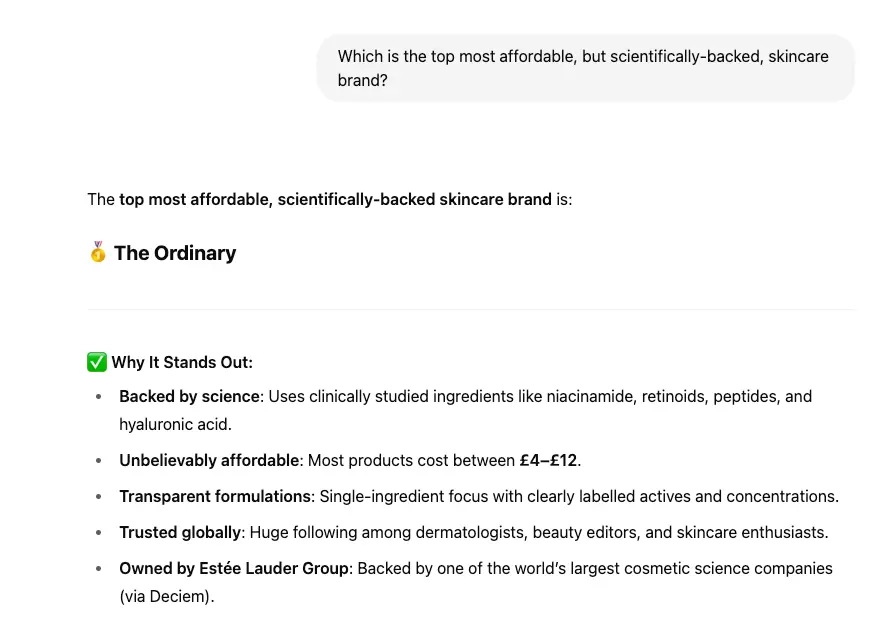
Importantly, it didn’t do a background search to provide this answer. This is because the association between The Ordinary and its core concepts are so widely and consistently mentioned across the web that it has become embedded in the LLM’s knowledge base.
That’s the goal of your AI Search Optimisation strategy. You’re not just trying to rank — you’re trying to become the default brand that AI platforms recommend in your niche.
And that all starts with nailing your positioning, which can be more difficult than it sounds. Most brands aim too broad and end up forgettable. That’s why we created the Branding and Positioning Accelerator to help businesses uncover what makes them stand out and repeat it until the market and the AI remember it.
Enhance Your Brand Sentiment
In AI Search, how people talk about your brand is just as powerful as where they talk about it.
Tim Cameron-Kitchen explains: “When AI tools go out and scan the web, they pick up product recommendations, reviews, and user-generated content from sources like Reddit, YouTube, forums, and high-authority publications. That sentiment is what builds trust and earns recommendations.”
That’s why managing your brand sentiment is essential. When AI tools encounter consistent, positive language around your brand across third-party platforms, they position your brand as trustworthy, credible, and worthy of recommendation.
While you can’t control what people say about you, you can ensure that there are plenty of reviews for the AI to get a balanced perspective.
- Get more reviews using email marketing flows after a sale or service to request Google or Trustpilot reviews.
- Respond to all reviews, especially the negative ones. It signals accountability and builds trust, both with customers and AI systems.
Take our client, Personal Injury Law Firm. We helped them implement a review generation programme using automated email flows as part of a local SEO strategy. This approach boosted their Google review count in two competitive Texas markets, helping contribute to their overall 727% increase in monthly leads.
Boost Your Brand Mentions
In traditional SEO, backlinks have long been the benchmark for trust and authority. That hasn’t changed — but now, brand mentions are just as important for performance in AI Search.
AI tools like ChatGPT, Perplexity, and AI Overviews don’t just crawl for links. They scan the entire web for mentions of your brand, whether you’re linked or not. These mentions, when repeated across trustworthy sites, shape how AI systems perceive your brand’s authority, sentiment, and relevance in a given niche.
This is where digital PR and strategic content placement come in. Getting featured on high-quality sites in your niche boosts your presence across the web in a way AI tools notice. It’s about generating natural mentions in places that users trust, and AI tools read.
Here are a few ways to strategically earn more high-quality brand mentions:
- Publish guest posts or features on high-authority blogs and news sites in your niche.
- Engage with user-generated content platforms like Reddit, Quora, and niche forums.
- Get featured in YouTube videos and product round-ups where your brand can be reviewed, tested, or recommended.
A perfect example of this strategy is our client, ZUGU. Ask Perplexity or Google’s AI Mode to recommend the best iPad cases, and you’ll often find ZUGU at the top. Tim Cameron-Kitchen explains: “A big part of this success is because of the number of mentions for ZUGU across the internet and the sentiment attached to the brand.”
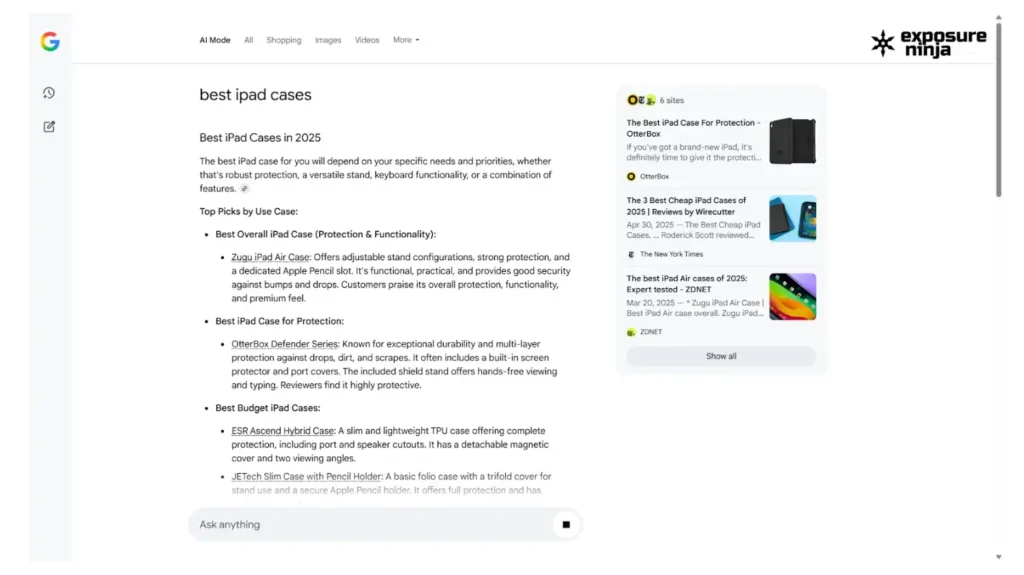
If you want AI to recognise your brand as a leader in your space, make sure it’s being talked about often and positively across the places that matter most..
Step 5: Optimise Your PPC Strategy for AI Search
AI Search isn’t just changing how users find information — it’s changing how ads are triggered, delivered, and interacted with.
Google Ads are already appearing in AI Overviews and are currently being tested in AI Mode in the U.S.
To appear in AI Mode, AI Overviews, and future LLM-driven ad placements, your campaigns must be built for machine learning. That means rethinking your account structure and switching to formats that give Google and other AI systems the flexibility and signals they need to match your Pay-Per-Click (PPC) ads with the right queries.

Ad placements in AI responses are already impacting our U.S. audience, but UK advertisers need to act now. You need an AI-ready strategy built into your ad account before AI Mode launches here and before other LLMs like ChatGPT begin pulling ads into their responses.
 Rebecca Pilkington
Head of PPC
Rebecca Pilkington
Head of PPC
Switch to AI‑Friendly Campaign Structures
Traditional PPC structures no longer align with how AI systems match ads to user intent. Rebecca Pilkington, Head of PPC, explains: “A lot of B2B accounts we audit are still using old-school structures like campaigns filled with exact and phrase match keywords in rigid ad groups. That used to be best practice, but it doesn’t work for AI-driven search anymore.”
Instead, you should be using broad match keywords paired with smart bidding strategies. This gives Google’s AI the freedom to connect your ads with more relevant, intent-rich searches — especially the longer, more conversational queries that Google’s AI Overviews and AI Mode favour.
Rebecca Pilkington adds, “You need to have campaigns that are using machine learning. This is the only way that your Shopping ads or Search ads will appear in Google’s AI Overviews and AI Mode.”
Use PMax Campaigns and Feed Them Smart Data
Google has confirmed that one of the campaign types you need to use for your ads to appear in its AI-generated responses is Performance Max (PMax).
PMax is built on machine learning, making it one of the most AI-aligned tools in Google Ads. But to unlock its full potential, you have to feed it the right data.
To maximise impact, you should be feeding PMax with:
- All 25 Search Themes to guide targeting.
- Combined lists, like keyword lists and competitor URLs.
- First-party data from your CRM.
- Offline conversion uploads for deeper optimisation.
- Well-optimised, keyword-rich landing pages.
As Rebecca Pilkington explains: “The more smart data you give PMax campaigns, the more accurate, powerful, and profitable your campaigns become.”
We used this exact approach with Age Care Bathrooms, generating over 3,800 leads in nine months and a 363% increase in PPC performance by enriching PMax with first-party data, CRM insights, and precision-built landing pages.
Leverage Dynamic Search Ads
Another campaign type to add to your AI-focused PPC strategy is Dynamic Search ads.
Unlike standard search campaigns that rely on manually selected keywords, Dynamic Search ads automatically match search queries to relevant content on your website — generating ad headlines and landing page links based on your site’s structure and content.
This makes them especially valuable in an AI-driven search landscape, where user queries are more conversational, unpredictable, and often long-tail. These ad types use Google’s crawling and indexing capabilities to dynamically match intent, which is critical for appearing in AI-generated results and staying relevant as search behaviour evolves.
“DSAs are a little AI trick,” says Rebecca Pilkington. “They pull keywords and landing pages together to match what users are actually searching. It’s not always right for every business, but for many, it’s a smart way to expand reach in an AI-first world.”
Test AI‑Generated Ad Copy
Google offers AI-generated ad copy suggestions directly within the campaign builder. This is great to use in your AI-driven PPC strategy if you have high-quality landing pages.
When creating your landing page, you would have already done your keyword research, optimised the page, and written effective, high-converting copy. This means the AI can generate ad headlines and descriptions that are tightly aligned with your target keywords and messaging.
However, this isn’t a perfect approach. “Often, the AI-generated ad copy can feel very uncreative,” explains Rebecca Pilkington. “But, we often see these ads performing better because they are so aligned to the keywords and landing page, which leads to higher Quality Scores and better ad placement.”
That said, it’s not a one-size-fits-all solution. Our recommendation is to run A/B tests: one version to be written manually, and the other generated by AI. Measure performance across both traditional and AI search environments, then optimise based on what actually drives clicks and conversions.
Step 6: Monitor and Adapt
AI Search is constantly evolving. Just because your brand or content appears in AI-generated results today doesn’t mean it will tomorrow or next month.
To maintain and grow your visibility, you need a strategy that evolves with the platforms. That means regularly monitoring where you appear, experimenting with new tactics, and adapting your approach based on performance.
- Monitor AI Visibility and Campaign Performance
- Run monthly AI audits to check where your brand appears in AI Overviews, Google’s AI Mode, and tools like ChatGPT and Perplexity.
- Analyse which content, landing pages, and data inputs are driving visibility.
- Experiment with New Tactics
- Test PPC campaign formats, keyword strategies, and Google’s generative ad copy.
- Trial fresh content approaches, like targeting new conversational queries or adding schema to boost AI interpretability.
- Adapt Based on Results
- Identify what’s consistently getting picked up or ignored and adjust accordingly.
- Double down on content formats or campaign types that are driving results.
AI Search isn’t just about showing up — it’s about staying relevant. The brands that actively monitor, test, and refine will be the ones leading AI rankings.
Dominate AI Search With AI Experts
Here’s a quick step-by-step recap of how to create an AI Search Optimisation strategy from one of the top AI Search agencies:
- Audit your AI visibility. Find out where and how your brand is appearing across ChatGPT, AI Overviews, and other AI platforms.
- Build a strong SEO foundation. Ensure your site is technically sound, well-structured, and optimised for traditional search to support AI discoverability.
- Create AI-friendly content. Focus on high-quality, well-structured content that answers related subtopics and shows real-world expertise.
- Strengthen brand authority. Increase positive brand mentions and sentiment across third-party platforms to boost AI trust and citations.
- Optimise your PPC for AI. Use AI-compatible campaign types like PMax and Dynamic Search Ads, and test AI-generated ad copy.
- Monitor and adapt. Run monthly AI audits, test new approaches, and adjust based on performance data.
If you’re serious about getting found and chosen by AI platforms, you don’t have time to play catch-up.
At Exposure Ninja, we’ve been at the forefront of AI Search since day one, helping ambitious businesses earn visibility in ChatGPT, Google AI Overviews, Perplexity, and more. Whether you’re just starting out or ready to scale, we’ll build a bespoke AI Search Strategy that puts your brand where high-intent buyers are already looking.
Ready to lead in AI Search? Request a callback, and let’s build your roadmap to AI dominance.
*Some links in this article are affiliate links that Exposure Ninja receives a fee for promoting (these links are not sponsored). Exposure Ninja only promotes services we already use within our marketing stack.
FAQs
Which AI platform is ideal for search optimisation?
Our AI Search Optimisation strategy is designed to work across all AI platforms, like Perplexity, ChatGPT, and Google’s AI Mode. Each platform will have its slight nuances, but the fundamentals of trust, authority, and content quality apply across all platforms.
Can I optimise for ChatGPT, Perplexity, and Google at the same time?
Yes, and you need to. A unified AI Search Optimisation strategy ensures your brand shows up consistently, no matter which platform your customers use. Optimising across all platforms gives you full visibility in the AI-driven decision-making journey.
How often should I update my content for AI visibility?
As a minimum, review your high-priority content every quarter or sooner if you’re missing from key AI-generated responses. AI tools pull and summarise data quickly, and fresh, authoritative updates can dramatically improve your visibility. In some cases, even small updates can boost citations in tools like ChatGPT and AI Overviews within days.
**Disclaimer: Exposure Ninja may get a commission through the marked links above at no cost to you.