Step-by-Step PPC Strategy That Delivers ROI


PPC is about smarter targeting, optimising relentlessly, and making AI work for you. This guide breaks down how to build a PPC strategy that actually drives ROI.
Pay-per-click (PPC) advertising is one of the fastest ways to drive targeted traffic to your website. You can set up PPC ads on Google, Microsoft, Facebook and Instagram, Pinterest, Amazon, LinkedIn, and many others.
The benefits of PPC ads are clear: you only pay when someone clicks on your ads, and you can spend as little or as much as you want. Plus, there’s none of the wastage of traditional mass media advertising, where you cast as wide an ad net as possible and hope to reach some people in your target audience.
But without a solid strategy, it’s easy to waste the budget on clicks that don’t convert. We’ll cover how to create a PPC strategy that works, whether you’re running Google Ads, Meta Ads, Microsoft Ads, or beyond
What Is a PPC Strategy?
A PPC strategy is a structured plan for running paid ads that drive profitable results. It includes setting goals, choosing platforms, targeting the right audience, and optimising campaigns to improve performance over time.
But PPC in 2026 isn’t just about advertising on Google. Search is now happening everywhere. Users browse products on Instagram, search for local businesses on Bing, and click sponsored content on LinkedIn. A strong PPC strategy needs to adapt to these changes to ensure your brand shows up wherever your customers are searching.
And no two businesses will have the same strategy. Oracle won’t run the same broad, high-volume ad campaigns as Amazon. You’ll need to create tailored PPC advertising strategies that align with your audience, industry, and business goals.
Why You Still Need a PPC Strategy in the Age of AI
While the fundamentals of PPC have remained the same, there were some major shifts in 2024:
- Performance Max (PMax) campaigns now dominate Google Ads, using AI to optimise ad placements across YouTube, Search, Display, and Shopping.
- AI-driven bidding strategies have made manual bidding less effective.
- Broad match improved in accuracy, making it a more effective and relevant keyword match type in PPC campaigns.
- Audience signals and first-party data have become more critical due to data privacy changes.
- More businesses started to diversify their PPC spend beyond just Google and Meta.
AI has revolutionised PPC, but it’s not a magic bullet. For some B2B lead generation businesses, AI-driven campaigns have brought in massive traffic but not qualified leads. Without the right guardrails, like audience signals and exclusions, automation can prioritise volume over quality, leading to a wasted budget on irrelevant clicks.
While automation now plays a bigger role than ever, it still needs human oversight, strategic input, and clear goals. Otherwise, AI will optimise for clicks, not necessarily profitability.
How to Create a PPC Strategy That Works
Step 1: Define Your PPC Goals
Before you even think about launching a new PPC campaign, you need to define your goals. Yes, the endgame is always more sales, but from who and for what?
- Are you focused on upselling to existing customers or brand-new buyers?
- Do you want to push high-margin products or drive demand for a service that needs more visibility?
- Is your focus on lead generation to bring in potential customers to nurture through your sales funnel?
Brand awareness is often mentioned as a goal, but it’s too vague on its own. To be effective, you need clear, measurable objectives. The more precise your goals, the easier it is to build a campaign that drives real business impact, not just clicks.
Step 2: Identify Your Metrics
PPC success isn’t about getting the cheapest clicks — it’s about getting the right clicks at a cost that makes sense for your business. To determine what you can afford to spend, you need to calculate two key numbers:
- Profit Margin: This determines how much of your budget you can afford to spend on PPC.
- Maximum Cost Per Acquisition (CPA): This is the most you are willing to spend to generate a lead or sale.
For example, if you sell a product for £100 with a 50% profit margin, you have £50 left after costs. If your maximum CPA is £40, that leaves you with £10 profit per sale.
Some brands aim for immediate profitability, while others are happy to break even or even run at a loss on the first sale, knowing they’ll make it back through repeat purchases or subscriptions. A business with strong customer lifetime value (LTV), like a subscription service, can afford to spend more upfront to acquire a customer because their revenue accumulates over time.
Understanding these numbers ensures you’re investing in PPC strategically, not just chasing cheap traffic.
Step 3: Choose the Right Platform
Choosing the right PPC platform will maximise results while minimising wasted spend. Google Ads remains dominant for high-intent searches, but search behaviour has evolved — users now discover brands and products or services through social media, video platforms, and marketplaces. Your platform should match where your audience spends the most time.
- Google Ads: Best for users actively searching for products or services.
- Meta Ads: Great for brand awareness, visual storytelling, and retargeting audiences.
- Microsoft Ads: Less competition than Google, making it a gem for B2B and older demographics.
Not every business has the time or resources to target every PPC platform, and this isn’t necessarily the best PPC approach. Instead of spreading your budget too thin across multiple platforms, start with one or two that align with your goals. Once you’ve proven profitability, then expand.
Step 4: Perform Keyword Research
If you’re running search-based ads, keyword research is where success begins. Your focus should be on commercial and transactional keywords — the terms people search for when they’re actively looking to buy, sign up, or take the next step. To find these high-intent keywords, use tools like Google Keyword Planner (free), SEMrush* (free trial), or Ahrefs (paid).
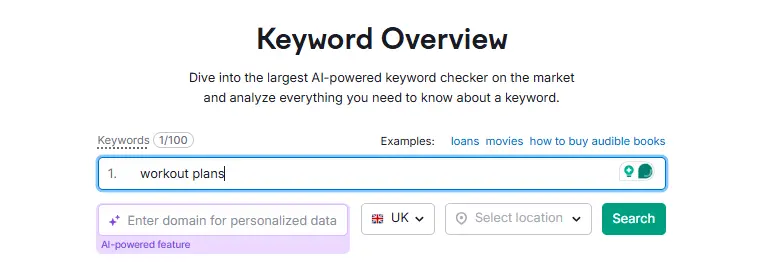
Open your tool and enter a broad header term that is related to your product or service (known as a seed keyword). Let’s say you sell workout plans. You’ll place the seed keyword “workout plans” into Semrush’s Keyword Overview, set your location, and hit search.
Next, use the Keyword Magic Tool to generate a list of potential keywords. Analyse each one against these key metrics to ensure you’re targeting the most profitable options:
- Search Intent: Does the keyword indicate buying intent? Prioritise Commercial (C) and Transactional (T) keywords over purely Informational (I) searches.
- Search Volume: How many people are searching for this term each month? Higher volume can be appealing, but low-volume, high-intent keywords often convert better.
- Keyword Difficulty (KD): Can you realistically compete for this keyword? If it’s too competitive, you’ll burn the budget with little return.
- Cost Per Click (CPC): How much will you pay per click? Make sure the CPC aligns with your profit margin and maximum CPA.
Build a refined keyword list that prioritises high-intent, low-competition terms. This ensures your ads appear in front of users who are ready to take action rather than wasting the budget on unqualified or informational searches.
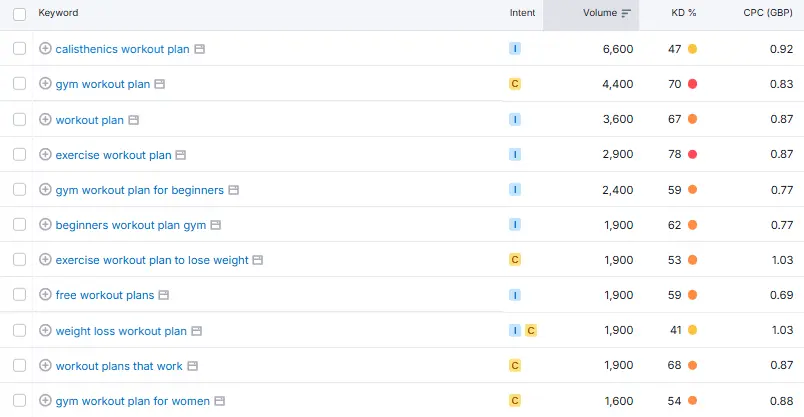
Knowing what keywords you don’t want to target is also just as important. If you sell premium workout plans designed specifically for women, you’ll want to exclude keywords like “free workout plans” or “men’s gym workout plan” to avoid wasting budget on the wrong audience. A strong negative keyword list ensures your ads show up for the right searches — not just any searches.
Step 5: Analyse Your Competition
Your competitors have already spent time and money testing what works — and what doesn’t. Analysing their strategy allows you to spot opportunities, avoid costly mistakes, and refine your own approach.
One of the best ways to conduct PPC competitor research is through SEMrush’s AdClarity App. While it’s a paid tool, the depth of data it provides is invaluable. It gives you a breakdown of:
- Estimated ad spend across Display, Social, and Video channels.
- Ad type distribution, so you can see whether they prioritise search, video, or display ads.
- Channel spend trends help you spot shifts that could signal where the best ROI is right now.
- Ad creatives, spend, and performance, showing which ads ran the longest and drove the most impressions.
- Landing page analysis, so you can reverse-engineer how they convert traffic.
- Campaign structures, revealing seasonal patterns and messaging trends.
This data helps you read between the lines. If a competitor suddenly drops social ads and doubles down on video, that’s a clue. If they run an ad for months without changing it, it’s likely performing well.
And just as importantly — watch what they stop doing. If a competitor abandons a platform or stops running a particular ad type, that’s just as valuable as knowing what’s working.
While you don’t want to copy their strategy, these insights can shape your own messaging, ad formats, and channels for your PPC strategy.
Step 6: Create Your Ad Copy and Creatives
A great PPC ad does two things: grabs attention and compels action. If your ad isn’t stopping the scroll or standing out in search results, you’re losing potential customers. But attention alone isn’t enough — you also need a clear, compelling reason for users to click. That’s where engaging and conversion-optimised ad copy and ad creative come in.
The channel you’re advertising on determines how you should structure your ad:
- For Google and Microsoft search ads, your focus is on keywords that match user intent, a clear call to action (CTA), and benefits-driven descriptions.
- Social media ads rely on visuals, conversational ad copy, and strong CTAs for audience engagement.
To see what’s working in your industry, use SEMrush’s AdClarity App to analyse your competitor’s top-performing ads. You can also do a manual competitor search by looking at what your competitors are doing in Google Search, Instagram, and TikTok.
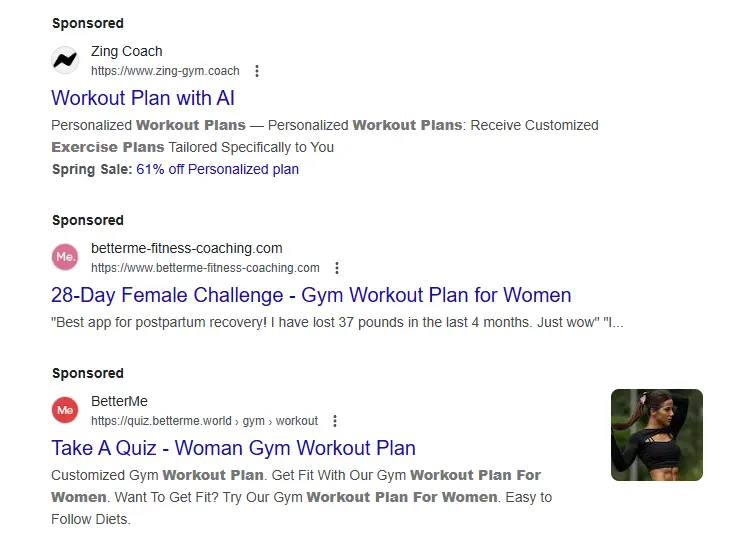
Let’s say you’ve identified BetterMe as a competitor for your workout plan business. You can see BetterMe’s Google Ad for “workout plan for women” uses an action-driven headline (“Take a Quiz”) and a compelling description that emphasises the benefits of ease and customised workouts. They also stand out from other ads by incorporating a visual, helping potential buyers envision what they could achieve with this workout plan.
You could also look at another potential competitor, Beyond Body, which takes a different approach to Instagram ads. Instead of relying on eye-catching visuals, they use text-heavy creatives that highlight the product being free. The ad also uses emojis, helping it blend naturally into users’ feeds rather than feeling like a blatant ad. This native, conversational style makes the messaging feel more personal — a smart tactic for boosting engagement and clicks.

On your chosen channels, play with different ad formats and copy to see what grabs attention and converts. Test punchy headlines, unexpected CTAs, and creative visuals — sometimes, the ads that stand out the most are the ones that break the rules.
Step 7: Choose the Best Bidding Strategy
Your bidding strategy determines how much you pay for clicks and conversions — and whether you’re getting the best possible return on ad spend (ROAS). There are two main types of PPC bidding strategies: automated and manual.
Automated bidding allows platforms like Google Ads, Meta Ads, and Microsoft Ads to adjust your bids based on user intent, competition, and conversion likelihood. Some automated strategies include:
- Maximise Conversions: AI adjusts bids to get the most conversions for your budget.
- Target Cost Per Acquisition (CPA): Keeps your cost per lead or sale within a set amount.
- Target ROAS: Bids are adjusted to maintain a specific revenue return on every pound spent.
- Maximise Clicks: Optimises bids to drive as many clicks as possible within your budget.
Manual bidding gives you full control over your bid amounts, allowing you to adjust bids at the keyword, audience, or ad level.
Bidding is a constant balancing act between automation, strategy, and ongoing optimisation. Relying too much on AI can lead to unpredictable spend and wasted budget if you’re not actively monitoring performance. But going fully manual can mean losing out on real-time bidding advantages that AI provides. The key is to test different strategies, track profitability, and refine your bidding approach over time.
Many business owners often hesitate to allocate budget to branded terms, thinking it’s a waste of budget — but it’s actually a smart defensive move. If competitors are showing up when people search for your brand, you’re losing clicks to them. Running a branded campaign pushes them down the SERP, helping to keep you in the top spot on Google. Plus, users who click your branded ad signals to Google who your ideal customers are, helping improve targeting across all your campaigns.
Step 8: Set Up Audience Targeting
Even the best ads won’t convert if they’re shown to the wrong people. Audience targeting ensures that your PPC campaigns reach the users most likely to buy from you.
You first need to do customer research to define your target audience. This research will tell you who your ideal customers are, where they are, what they need, and how they will search for solutions.
Using these insights, you can then create targeted ads based on demographics, geographics, and interests. But to really maximise the performance of your PPC strategy, you need to go beyond the basics and use first-party data, lookalike audiences, and intent-based targeting to refine your reach.
- First-party data, like customer email lists, past website visitors, and purchase history, allows you to retarget warm leads.
- Lookalike audiences expand your reach to users who share characteristics with your existing customers.
- Custom intent audiences allow you to target users actively researching similar products or services based on their recent search behaviour.
To get the best results, layer multiple targeting options to narrow your focus while still reaching a broad enough audience. For example, instead of targeting “all women in the UK,” refine your audience to UK-based women aged 25-45 who have searched for “best workout plans for beginners” and have visited a competitor’s website.
But don’t forget to test and adjust over time. Audience behaviours change, and what works today might not work six months from now. Regularly reviewing your audience data ensures your ads stay in front of the right people at the right time.
Step 9: Build High-Converting Landing Pages
Your ad can do everything right, but if your landing page doesn’t deliver, those clicks won’t turn into conversions. A high-converting landing page needs to:
- Drive a single goal, whether that’s getting the sale or capturing a lead.
- Deliver on your ad’s promise, so that users don’t bounce out of confusion.
- Include an optimised primary CTA, with a secondary lower commitment CTA if needed.
- Have trust-building signals, like review stars, customer testimonials, or case studies.
- Have a clear and user-friendly design with an above-the-fold form placement.
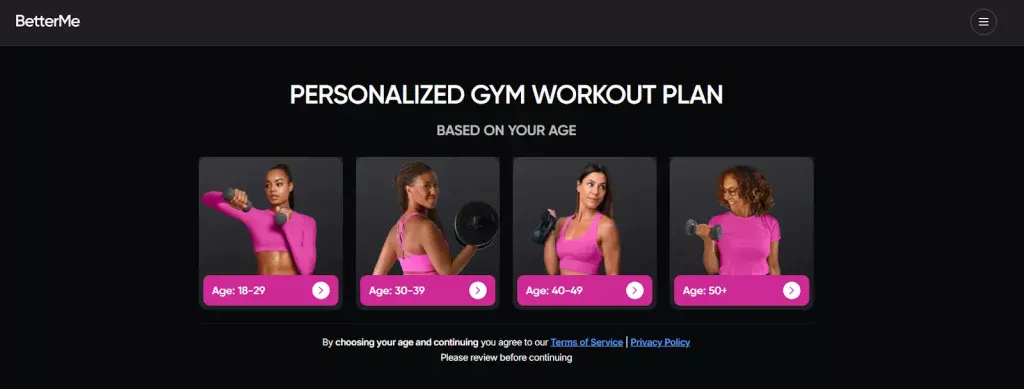
It also helps to analyse what’s working for your competitors. Take BetterMe’s landing page for their Google Ad. Their ad promises a custom workout plan based on a quiz. Click through, and you land on a long-form interactive page that immediately asks for personal details like age. As users progress, trust signals appear along the way to keep them engaged and reduce drop-offs.
Step 10: Analyse and Improve Your Ads
The most successful PPC campaigns aren’t the ones that are launched and left alone — they’re the ones that are constantly monitored, tested, and optimised. Ads can become less effective over time due to ad fatigue, audience shifts, or increased competition. That’s why you need to regularly analyse these key metrics:
- Click-Through-Rate (CTR): How many people are clicking on your ads, and is it going up or down? If your CTR is dropping, testing different ad variations can often revive underperforming campaigns.
- CPC: Is there more competition for your target keywords and the cost of each click is going up? To get the best possible return on your spend, you want as low a CPC as possible.
- Conversion Rate: How many people are clicking on your ads, arriving on your landing page, and converting into leads or sales? If it’s low and falling, there may be something off about the page, and you may need to optimise it for higher conversions.
Continually tweaking your PPC ads and optimising them and your landing page are the keys to a successful campaign that will get you results.
PPC Advertising Strategies to Try in 2026
With AI evolving, new platforms emerging, and user behaviour constantly changing, staying ahead in PPC means testing, optimising, and adapting. Here are some PPC strategies to keep your campaigns competitive and profitable in 2026.
Automate and Scale with AI PPC Strategies
While some marketers are clinging to manual advertising, the ones embracing AI are scaling campaigns faster and cheaper.
Take Performance Max campaigns on Google Ads. They use machine learning to decide where, when, and to whom your ads should be shown — across Search, YouTube, Display, Shopping, and Gmail.
Then there’s AI-powered bidding strategies, like Target ROAS and Maximise Conversions. These take the guesswork out of manual bidding by adjusting your bids in real time based on user intent, device, and time of day.
But AI isn’t perfect.To get the best results, you need to feed AI the right data, refine audience signals, and step in when needed to keep campaigns aligned with business goals.
Advertise on Multiple Platforms
Relying on a single PPC platform is risky — if performance dips, so does your revenue. Google Ads is powerful, but your audience isn’t just searching Google anymore, so your PPC strategy shouldn’t stop there.
Look at your audience research and identify where else they’re active. Are they engaging with video content? Test YouTube Ads. Do they shop on Instagram? Run Meta ad campaigns. Expanding beyond Google helps you reach new customers, lower ad costs, and reduce dependency on a single platform.
Try Different Ad Types
Users are engaging with ads in new ways, which means your PPC strategy needs to match how they consume content.
Take video ads, which are outperforming static images in engagement, conversions, and brand recall. Even Google is prioritising video-heavy formats in Performance Max and Shopping ads. If you’re not running video ads, you’re missing a major opportunity.
Beyond video, carousel ads and shoppable ads are changing how users interact with brands. Carousel ads let you showcase multiple products or tell a story, while shoppable ads allow users to buy directly from the ad without leaving the platform. The brands testing and optimising these formats will outpace those still relying on outdated PPC tactics.
Launch a Remarketing Campaign
Most people don’t buy the first time they see an ad. That’s why remarketing exists — it’s your second chance (or third or fourth) to turn a window shopper into a paying customer.
Dynamic remarketing is a great strategy for eCommerce. Instead of showing a generic ad, dynamic remarketing automatically displays the exact products users viewed on your website, nudging them to come back and complete their purchase.
For service-based businesses, remarketing works differently — but just as effectively. Instead of hitting users with the same ad over and over, set up a remarketing funnel:
- Show them a brand awareness ad.
- Follow up with a case study or testimonial-based ad.
- Create an ad offer for a live demo or consultation invite.
The key is to keep adding value rather than just reminding them you exist. Done right, remarketing can cut your acquisition costs and boost conversions.
Get a Custom PPC Strategy Created by Experts
If you’re still running Google-only, text-ad-only campaigns, it’s time for a rethink. PPC in 2026 isn’t about sticking to one platform, one strategy, or one ad format. The brands that win are those that test, automate, diversify, and adapt before their competitors do.
Want an expert PPC strategy built for 2026? Get a PPC audit and find out exactly where you can improve and how to scale smarter.
Keep levelling up your digital marketing strategies with our expert guides:
Or watch:
FAQs
Do PPC strategies differ for sales vs lead generation?
Yes. Sales-focused PPC ads will target users actively looking to buy and focus on high-intent keywords. Lead generation PPC uses educational content and gated offers to capture users who may be interested but not yet ready to buy.
What’s the best way to test new PPC platforms without overspending?
Start with a small, controlled budget and measure cost per conversion over time. If results are promising, scale up gradually.
How do you scale a successful PPC campaign without wasting budget?
Increase budget incrementally, focusing on the best-performing audiences and keywords.
*Some links within this article are affiliate links which Exposure Ninja receives a fee for promoting (these links are not sponsored). Exposure Ninja only promotes services we already use within our marketing stack.