How to Optimise for AI Search: Your Free CMO Checklist


Are your competitors already showing up in ChatGPT responses while your brand stays invisible? This checklist helps marketing leaders and CMOs build a future-ready AI Search strategy that drives visibility, authority, and leads in 2026 and beyond.
Building a future-ready AI Search Strategy isn’t optional anymore.
This is because the way people search has changed. Instead of typing their short queries into Google, they’re asking long, complex queries in AI platforms like ChatGPT, Perplexity, or Gemini. And if your brand isn’t being mentioned or cited in those AI-generated answers, you’re losing ground to competitors who’ve already adapted their strategy.
This isn’t about abandoning traditional Search Engine Optimisation (SEO). It’s about evolving your approach to include AI Search Optimisation so that AI platforms can find, understand, and recommend your business.
If you want to know how to optimise for AI Search quickly, download our AI Search Strategy checklist, and use this guide to dive deeper into what CMOs need to prioritise to win visibility, trust, and leads in 2026 and beyond.
Why You Need a Strategy for AI Search in 2026
AI Search has changed the way people look for information, compare brands, and make purchases.
Here are the facts:
- ChatGPT gets over 193 million visits per day.
- A survey showed that 71.5% of individuals use AI tools for search, with 14% using them daily.
- McKinsey projects that $750 billion of consumer spend will flow through AI platforms by 2028.
This means one thing: your brand needs to be visible in AI Search, whether through direct mentions, source citations, or recommendation lists.
To do this, you need to create a dedicated AI Search Optimisation strategy.
We’ll walk you through the steps outlined in our downloadable AI Search Strategy checklist, which is the same framework we use to help our clients stay visible, trusted, and ahead of their competition.
Build a Solid SEO Foundation
AI Search Optimisation and SEO are not the same, but you still need SEO to get mentioned or cited in AI Search results.
Here’s why SEO is still essential in 2026 and beyond:
- AI platforms use web crawlers to find and index content, just like traditional search engines.
- Structured data makes it easier for machines to summarise and surface your information.
- Slow, confusing websites get ignored by users and AI platforms.
This is why the AI Search Strategy checklist starts with the essentials. Before you go chasing AI mentions, you need to tick these SEO boxes:
- Fix crawl errors and broken links.
- Optimise on-page SEO elements.
- Implement schema markup.
- Simplify site architecture.
- Improve page speed and mobile UX.
Clarify Brand Positioning
If AI platforms can’t figure out who you are and what you do, they won’t recommend you.
Here’s what clear brand positioning looks like:
- A short, punchy explanation of what you do.
- Specific messaging for your target audience.
- A clear value proposition explaining why you matter and how you’re different.
- Consistent language and messaging across your website, social media, directories, and third-party sites.
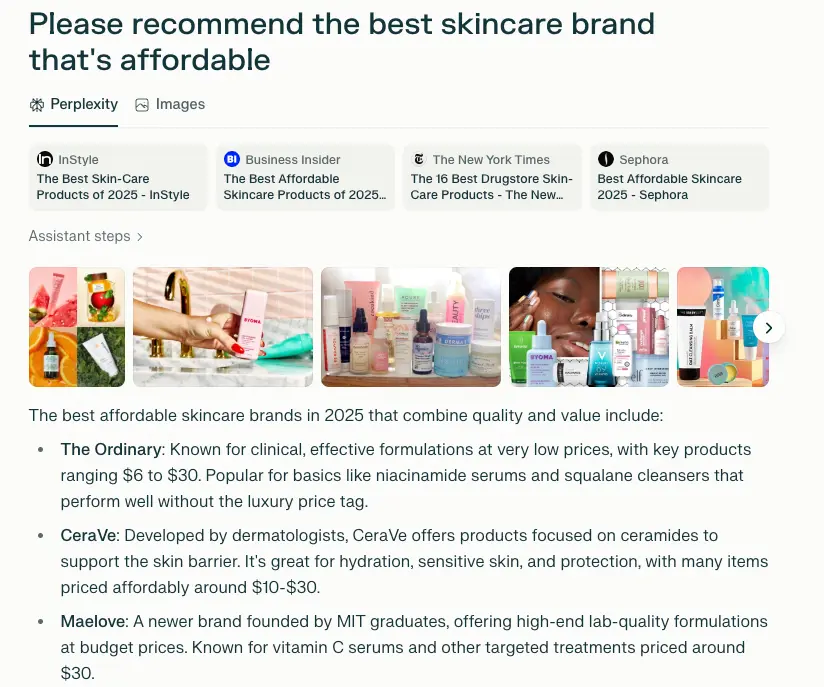
A great example of this is The Ordinary. They have a clear brand positioning and message: affordable, science-backed skincare. That positioning is evident everywhere on their site and social media, as well as in third-party features.
Because The Ordinary has created a clear positioning and repeated it consistently, they now appear in almost every AI platform for relevant prompts.
Here’s what you need to do:
- Define clearly what you do, who it is for, and why it matters.
- Consistently communicate this on your website and across the web.
Earn Web-Wide Brand Mentions
AI platforms prioritise brands mentioned by credible third-party sources.
That’s because AI platforms don’t just read your website. They scan the entire internet to decide which brands are credible, trustworthy, and worth recommending. If your name keeps popping up on authoritative sites, review platforms, and roundups, that’s a big signal that you’re a brand worth mentioning or citing.
This is the starting point for your brand mentions strategy:
- Launch digital PR to earn features on high-authority websites.
- Get listed in buying guides, roundups, and niche publications.
There are other tactics to boost your web-wide brand mentions, like pitching expert insights and quotes to journalists through platforms like Qwoted.
You can also create and promote proprietary data or original research, like industry surveys, trend reports, or benchmark studies. You can then use that content to secure media coverage, backlinks, and citations from sites AI trusts.
Create AI-Readable Content
If AI tools can’t easily scan, extract, and summarise your content, they won’t cite or recommend it.
These tools prioritise content that’s well-structured, easy to interpret, and directly answers user queries. The more accessible your content is to these AI machines, the more likely it is to be included in AI-generated responses.
To optimise your content strategy for AI Search, follow these strategies:
- Structure content with clear headings and concise, direct answers.
- Include FAQs and question-led sections that match real user prompts.
- Publish original data, insights, and reports that add unique value.
- Refresh outdated pages with current facts, stats, and examples.
Track AI Visibility and Sentiment
Tracking monthly allows you to identify trends, uncover content gaps, and respond faster than competitors. It also tells you if your AI Search Optimisation strategy is actually working.
But traditional SEO metrics like keyword rankings, search volume, and organic traffic don’t reflect how AI platforms surface or reference your brand.
To measure success in AI Search, you need to track new signals, including:
This also means using new tools. Standard SEO software doesn’t yet account for AI visibility, but platforms like Peec AI, Profound, and Semrush’s AI Visibility Toolkit are specifically designed for this purpose.
And as always, tie these insights back to what actually matters: tracking AI traffic and conversions.
Here’s your go-to checklist:
- Test prompts to track brand mentions, tone, and competitor visibility.
- Use tools like Peec, Profound, or Semrush to monitor AI visibility and sentiment.
- Set up AI traffic and conversion tracking using GA4 or Looker Studio.
Let Us Optimise Your AI Search Strategy
Our AI Search Strategy checklist covers everything a brand needs to perform in AI Search:
- A technically sound website that AI tools can access and understand.
- Clear brand positioning that is consistent across your site and the wider web.
- Authoritative third-party mentions to validate brand credibility.
- Structured, AI-readable content that provides clear, direct answers.
- Ongoing tracking of AI visibility, sentiment, and conversions using specialised tools.
However, implementing this strategy is not one-size-fits-all. Every business has its own strengths, weaknesses, and market conditions. Some websites suffer from serious technical SEO issues that prevent AI tools from accessing key content. Others struggle with inconsistent messaging or a lack of brand mentions in credible sources.
That’s why we offer a customised AI Search Strategy. We break it down into three phases, including:
- Technical SEO Audit
- AI Visibility Strategy
- Citation & Digital PR Strategy
This approach provides you with a clear, actionable plan, along with expert guidance, to improve your visibility in AI Search. With these tailored insights, you’ll be positioned to drive qualified traffic and leads from AI platforms in 2026 and beyond.
*Disclosure: This page contains referral links. If you purchase through these links, we may receive a commission at no additional cost to you.