
Prove Your SEO ROI in 3 Simple[-ish] Steps


Want to know if your SEO spend is actually making you money? This guide walks you through how to calculate SEO ROI step-by-step with expert insight.
Most businesses spend between £5,000 and £10,000 per month on Search Engine Optimisation (SEO). At that level of spend, you need more than just rising rankings — you need proof that it’s driving real revenue.
That’s where measuring SEO ROI (return on investment) comes in. But while it sounds simple enough, calculating ROI from SEO is often tricky, especially for lead-generation businesses where the path from click to cash isn’t always clear.
To break it all down, we spoke to Andrew Tuxford, Head of SEO at Exposure Ninja, about how to measure the ROI of SEO properly — and why it can be challenging.
What Is SEO ROI?
SEO ROI measures the financial return your business gets from its SEO efforts compared to what you spend. It answers a critical question: Is our SEO investment generating meaningful revenue, or just traffic that doesn’t convert?
In practical terms, SEO ROI tells you whether your SEO strategy is profitable — and by how much. A positive SEO ROI means your revenue from organic search is higher than the total cost of your SEO activities, which may include agency fees, tools, in-house resources, and content production.
This metric matters because SEO isn’t just about rankings or traffic — it’s about delivering measurable business impact.
Why Measure the ROI of SEO?
Tracking SEO ROI shows whether your investment is actually growing your business or just burning through budget. It helps you:
- Prove the profitability of your SEO strategy
- Compare performance against other channels like PPC
- Spot which tactics are delivering results
- Justify budget increases based on actual return
As Andrew Tuxford put it: “You’re putting money into SEO to grow your business and grow sales. If you don’t know if it’s working, you’re just throwing money into something without knowing what it’s doing for your business. With SEO, you should be making money. If you’re not, something needs to change.”
SEO ROI Formula
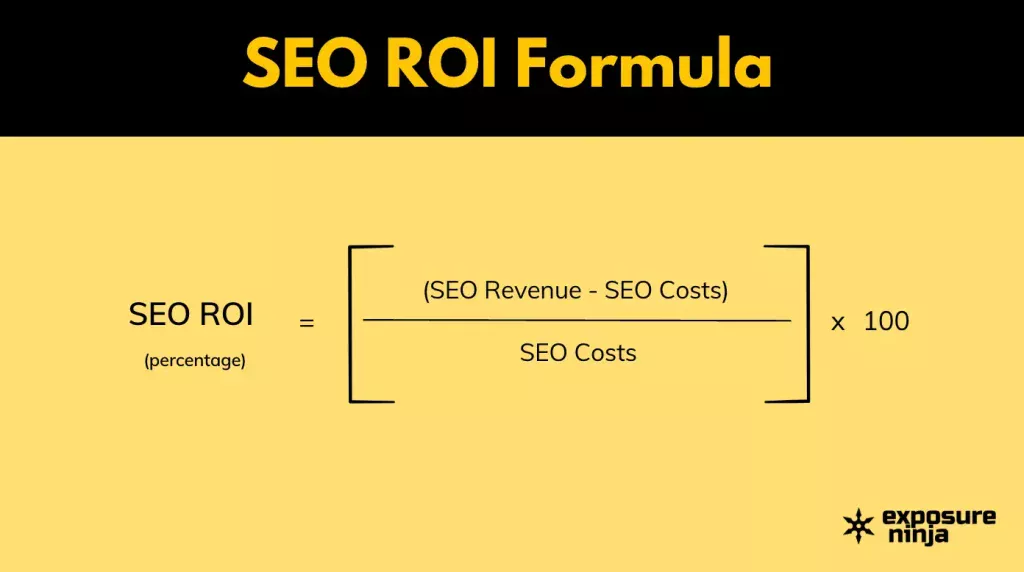
Calculating SEO ROI is technically a basic formula:
SEO ROI = [(SEO Revenue – SEO Cost) / SEO Cost] × 100
Let’s say:
- You spend £4,000/month on SEO
- You generate £12,000/month in revenue from SEO
That’s: [(12,000 – 4,000) / 4,000] × 100 = 200% ROI
That means for every £1 spent, you made £3 back.
How to Measure SEO ROI in 3 Steps
Step 1: Calculate Your SEO Investment
Start by calculating your total monthly SEO spend. Include any SEO costs, such as:
- Monthly SEO agency retainer
- Paid tools like Semrush or Screaming Frog
- Content creation and distribution costs
- Link building expenses
- Website maintenance costs
- Time spent by internal staff or freelancers implementing SEO recommendations
Let’s say you’ve partnered with an SEO agency, and you pay £7,500 per month to cover all your SEO needs.
Step 2: Calculate Conversion Value
Once you’ve calculated how much you’re investing in SEO, the next step is to determine what you’re getting back in revenue. This means assigning a monetary value to your conversions from organic traffic.
The way you calculate this depends entirely on the type of business you run.
For eCommerce Businesses
If you’ve set up Google Analytics 4 (GA4) correctly, you can easily measure revenue from organic traffic.
To do this:
- Open GA4 and go to Reports → Monetisation → eCommerce Purchases
- Filter by Session source/medium → “google/organic”
- Click the “Insights” icon at the top
- The total revenue shown is your SEO-attributed revenue for that period
This gives you a clean figure to plug into your ROI formula.
For Lead Generation Businesses
This is where things get more complex because leads aren’t sales, and Google Analytics doesn’t know what your leads are worth unless you tell it.
Here’s how to assign value to lead-gen conversions:
- Track Your Conversions: Use GA4 to track key actions like form submissions, phone clicks, or demo signups. These should be marked as “conversions” in GA4 under Admin → Events → Create Event → then toggle Mark as conversion. You’ll now see your event as a conversion under Reports → Engagement → Conversions.
- Assign a Monetary Value: You’ll need to apply a value to each conversion based on your average customer value and close rate. Use this formula: Conversion Value = Customer Lifetime Value × Lead-to-Sale Conversion Rate. You can add this value to the event inside GA4 using Parameter modifications to ensure it’s tracked alongside your conversions.
- Calculate Total Monthly Revenue from SEO: Let’s say you receive 40 leads per month from organic search. If 25% of those leads convert and your average deal value is £2,000, your SEO-attributed revenue is: 40 leads × 25% = 10 customers × £2,000 = £20,000/month in revenue.
Step 3: Calculate Return on Investment
Once you’ve got your total investment and your SEO-attributed revenue, plug them into the ROI formula.
If your revenue from SEO is £20,000 and you’re spending £7,500/month, you’re looking at a 166.6% ROI.
That means you’re generating more than double your investment every month — and that’s before factoring in the long-term compounding benefits of SEO.
Challenges with Measuring ROI of SEO
Even with all the right tools, measuring SEO ROI isn’t always straightforward. There are three common roadblocks:
1. Missing Revenue Data
This is one of the most common issues, particularly in lead-generation campaigns.
If you’re not capturing what a lead is worth or how many leads are converting into actual sales, you can’t tie revenue back to SEO. And if you can’t tie revenue to SEO, calculating ROI becomes guesswork.
“We often know how many leads we’ve delivered, but if the client doesn’t tell us how many of those leads convert or what a customer is worth to them, we can’t measure ROI,” explained Andrew Tuxford.
2. Profit Isn’t Factored In
There’s a big difference between revenue and profit. A campaign that looks successful at the top line might actually be losing money once costs and margins are considered.
“A lot of businesses say, ‘We spent £5,000 and made £10,000 in sales, so we’ve doubled our investment.’ But if you’re only making 10% profit, that’s £1,000 — and you’ve actually lost money,” explained Andrew Tuxford.
3. SEO Doesn’t Work in a Vacuum
SEO rarely acts alone in a customer journey. It might be the first interaction, the second, or just the credibility boost that convinces someone to come back and convert via another channel like direct mail or email.
The challenge is that Google Analytics often gives all the credit to the last touchpoint, which means SEO’s influence gets under-reported.
“If someone finds you through Google, then comes back directly later to buy, that sale shows up as a direct conversion. But SEO still did the heavy lifting — it brought them in,” Andrew Tuxford explained.
How Long Does It Take To See the ROI of SEO?
On average, most businesses start seeing a positive ROI around 6 to 9 months in.
But it depends.
- If your site is in poor shape, fixing technical issues might deliver faster wins.
- If you’re in a competitive niche, it might take longer to gain traction.
- If your internal team takes weeks to implement recommendations, it’ll slow things down.
- If you invest heavily and implement changes quickly, you’ll see a faster impact on your rankings, traffic, and revenue.
“SEO results depend on how fast you move. The biggest delays come when work isn’t implemented. You can have the best strategy in the world, but if it’s not on the site, it’s not helping you rank,” said Andrew Tuxford.
How Does SEO ROI Compare to Other Channels?
Unlike paid ads, SEO is slower to start but stronger over time.
“It’s not a silver bullet,” said Andrew Tuxford. “At first, your ROI might be lower than channels like PPC. But if you keep going, SEO builds and keeps building. Over time, it usually delivers the highest ROI of any marketing channel.”
That’s because SEO is cumulative. The longer you invest, the more you get out. And once ROI tips into the positive, it can scale significantly without dramatically increasing costs.
SEO Services That Deliver ROI
SEO has never been a quick win, and in 2026, it’s even more of a long game.
With AI overviews affecting click-through rates, Google losing ground to alternative search engines, and the increasing complexity around E-E-A-T, SEO requires more than a few optimised pages to generate real returns.
But that doesn’t mean it’s not profitable. It means you need the right strategy, consistent implementation, and a clear understanding of what success looks like.
Embed Quote: Andrew Tuxford: “SEO is definitely still profitable, but you need to stick at it. It’s not something that’s going to take a couple of months to rake in a really high ROI. It takes time to build. You should at least give it a year before reviewing it.”
At Exposure Ninja, we deliver strategic, results-focused SEO designed to make you money, not just boost your rankings. We work with businesses across complex sectors and our strategies are tailored to deliver a measurable return.
Ready to see what SEO could be worth to your business? Request a callback and we’ll show you where your SEO is working, what’s holding it back, and how to scale your results.
FAQs
Does SEO have a high ROI?
Yes — especially over time. Unlike paid ads, SEO builds momentum — the more consistent your investment, the better the returns.
What is the best ROI for SEO?
There’s no fixed benchmark, but a positive ROI within the first 6 – 9 months is a strong start.
Is SEO still profitable?
Absolutely. SEO remains one of the most profitable digital channels, especially when it’s implemented strategically and measured properly. It’s not instant, but the long-term gains are hard to beat.