
How Much Should You Spend on Digital Marketing in 2026?


Most businesses either overinvest in channels that do not deliver or spread their marketing budget too thin. So, how much should you spend on digital marketing to drive real results? This guide covers real cost benchmarks and the key factors that shape effective investment.
Setting a digital marketing budget is one of the most important decisions a marketing leader makes.
Benchmarks and average channel costs provide a useful starting point, but they do not tell you how much to invest to hit your growth targets.
This guide breaks down the real cost of digital marketing and the key factors that determine how much you should spend on digital marketing, so you can allocate your investment with confidence.
How Much Does Digital Marketing Cost in 2026?
Digital marketing costs in the UK vary widely, but they average £1,000 to £10,000 per month in 2026.
Budget allocation is often benchmarked against revenue. The Gartner 2025 CMO Spend Survey found that businesses across industries tend to allocate 7.7% of revenue to marketing on average, a figure that has remained flat since 2024. Within that, Gartner also found that digital marketing typically accounts for more than 60% of the marketing budget.
These ranges reflect typical agency pricing and execution costs, but actual spend depends on competitiveness, required output, and performance targets:
| Service | Average Monthly Cost in the UK |
| SEO Cost | £5,000-£10,000+ |
| Content Marketing Cost | £1,500-£15,000+ |
| PPC Cost | £5,000-£50,000+ |
| Email Marketing Cost | £500-£2,000+ |
| Social Media Marketing Cost | £800-£3,000+ |
AI Search Optimisation is an emerging investment area. It focuses on improving visibility in AI-driven search experiences such as Google’s AI Overviews and ChatGPT. At this stage, there is no reliable benchmark data on average spend. Most businesses are still in the testing phase, allocating budget from existing SEO or content marketing activity. As adoption increases, clearer pricing models and industry benchmarks are expected to follow.
What Impacts the Cost of Digital Marketing?
1. Number of Marketing Channels
The number of channels in your digital marketing strategy is one of the most significant drivers of cost.
Each channel requires its own strategy, execution, and optimisation. SEO needs technical input, content production, and link acquisition. PPC requires ongoing bid management, creative testing, and landing page optimisation. Email and social demand consistent content, segmentation, and performance tracking. As channels increase, so do the resources needed to run them effectively.
For most businesses, performance improves when investment is concentrated. A few well-funded, well-executed channels will outperform a fragmented approach spread across multiple channels with insufficient budget.
You should be able to justify marketing spend to your C-suite by tying each channel to clear commercial outcomes. If a channel cannot demonstrate a contribution to the pipeline or revenue, it should not dilute the overall investment.
2. Number of Markets and Regions
Geographic scope directly affects how much to spend on digital marketing, particularly for enterprise organisations operating across multiple regions.
Each additional market introduces new layers of complexity. Keyword strategies must be localised to reflect language, search behaviour, and intent. Content must be adapted or recreated to meet cultural expectations and regional nuances.
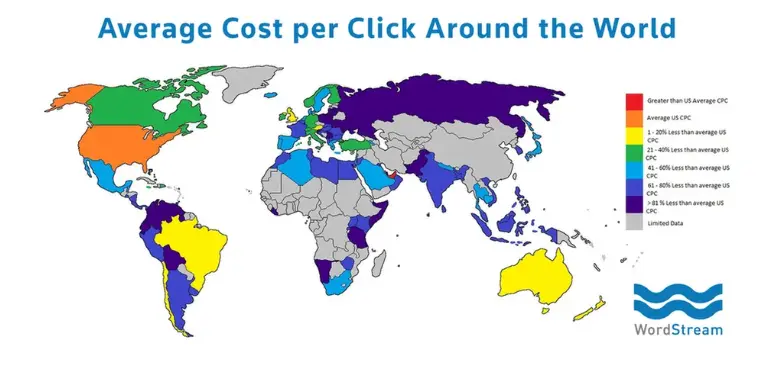
Paid media costs also vary significantly by market, with competition and cost-per-click (CPC) often differing. 2025 WordStream data shows just how much this can vary:
Effective budget allocation in this context requires prioritisation. High-growth or high-margin markets should receive the majority of investment, while emerging regions can be tested with controlled budgets and clear performance benchmarks.
3. In-House Team vs Agency Support
Whether you choose an in-house marketing team or to hire an agency will impact your overall digital marketing spend.
On average, you can expect:
- In-House Marketing Costs: £23,000-£65,000 annually per role, plus benefits, management, overheads, and more.
- Marketing Agency Costs: £3,000-£20,000+ per month, depending on scope.
For enterprise organisations, the most effective structure is often a hybrid model. A lean in-house team owns brand, strategy, and internal alignment, while an agency delivers channel execution and specialist expertise.
4. Technology, Data, and Martech Stack
Tools are often overlooked in digital marketing budgets until costs start to stack up.
A typical mid-market martech setup includes a CRM such as HubSpot or Salesforce and an SEO platform such as Semrush or Ahrefs. Beyond that, most teams rely on project management tools, design software, cloud storage, analytics platforms, and reporting dashboards to run campaigns efficiently.
Combined, these tools will typically cost £1,000+ per month, with spend increasing as your reporting, automation, and data integration requirements become more advanced.
When working with an agency, the costs of tools will be included within the retainer. This should be factored into cost comparisons, as bundled access to the data in premium tools can significantly reduce the need for separate software investment.
Make Your Marketing Budget Work Harder
The businesses getting the best returns from their digital marketing budgets are not the ones spending the most. They are the ones spending with clarity.
They focus on the channels that drive revenue. They track performance against commercial outcomes. They scale what works and cut what does not. This is what turns a fixed budget into a growth engine.
If you are unsure how much to invest in each channel, or where your next pound will have the biggest impact, this is where expert input makes the difference.
At Exposure Ninja, we build data-driven strategies that align your budget with measurable growth. Tell us your goals, your current spend, and where you want to get to. We will show you exactly how to get there.
FAQs
What percentage of revenue should go to marketing?
According to the Gartner 2025 CMO Spend Survey, businesses allocate an average of 7.7% of revenue to marketing. This figure is a useful benchmark, but the right percentage depends on your growth stage, competitive intensity, and profit margins.
How do you justify marketing spend to the board?
Link marketing activity directly to revenue by focusing on metrics such as customer acquisition cost, lifetime value, and pipeline contribution. Show what is already working and quantify the commercial impact of increasing or reducing investment in each channel. Present a clear, simple narrative that connects spend to business outcomes and highlights the risk of underinvestment.
Should you invest more in brand or performance marketing?
Most businesses need a balance of both, as they serve different commercial goals. Performance marketing drives immediate demand and revenue, while brand marketing builds awareness and trust, lowering acquisition costs over time. A common starting point is a 60/40 split in favour of performance, adjusted based on growth stage and market maturity.