
Law Firm Marketing Strategy 2026: 5 High-ROI Tactics for UK Solicitors


We share five law firm marketing strategies you need to dominate in 2026, with proven client-backed results.
Having a law firm digital marketing strategy isn’t optional in 2026.
65% of law firm marketing budgets go towards online strategies, and for good reason. 87% of people turn to Google to research finding a lawyer when they have a serious legal issue, followed by ChatGPT. This, plus how optimising for traditional search delivers 122% ROI on average for law firms, shows that digital marketing can be a profitable long-term investment.
We’ll show you the five most effective law firm marketing strategies to help you stand out in a saturated market, build trust with potential clients, and generate high-quality legal leads that actually convert.
Why UK Law Firms Need Digital Marketing in 2026 (And What Changes Next)
If You’re Not at the Top of Search, You’re Invisible
When someone faces a legal issue, their first instinct is to search on Google.
In fact, a recent survey of 1,052 participants found that 87% turned to Google to research finding a lawyer when they have a serious legal issue. Plus, 94% of people searching for legal services only look at the first three results. That means if your law firm isn’t ranking at the top of Google, you’re effectively invisible to the vast majority of potential clients.
What was even more interesting is that 28% of those same people said they’d turn to ChatGPT as part of their legal research.
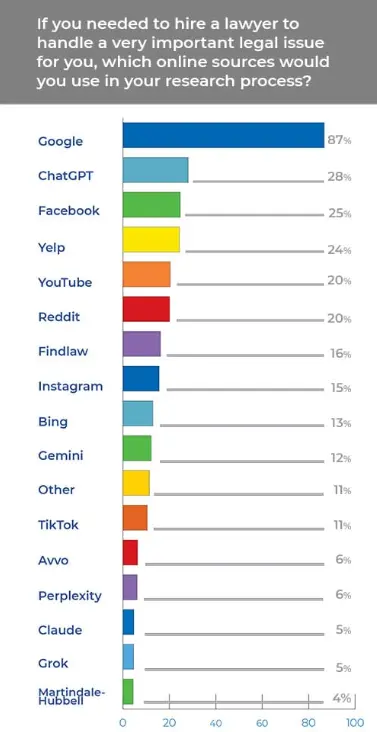
This isn’t surprising. AI tools, like ChatGPT, Perplexity, and AI Mode, are reshaping how people discover legal services. Instead of clicking through endless search results, users can ask complex, personalised questions and get instant, conversational answers with recommendations built in. This makes AI Search particularly attractive for people researching their options for legal problems.
AI Search is the next frontier of legal client discovery. If your law firm isn’t optimised to appear in AI-generated results, you’re missing qualified, high-intent leads that are ready to take action.
Trust Is Now Built Online, Not in the Waiting Room
Legal services require an extraordinary level of trust. Clients are entrusting you with their freedom, their family, their assets, or their livelihood. That trust often starts the moment they encounter your brand online.
Research consistently shows that potential clients evaluate law firms based on their digital presence long before making contact. For example, a study found that 81% of consumers feel that reviews are important or very important in the legal sector.
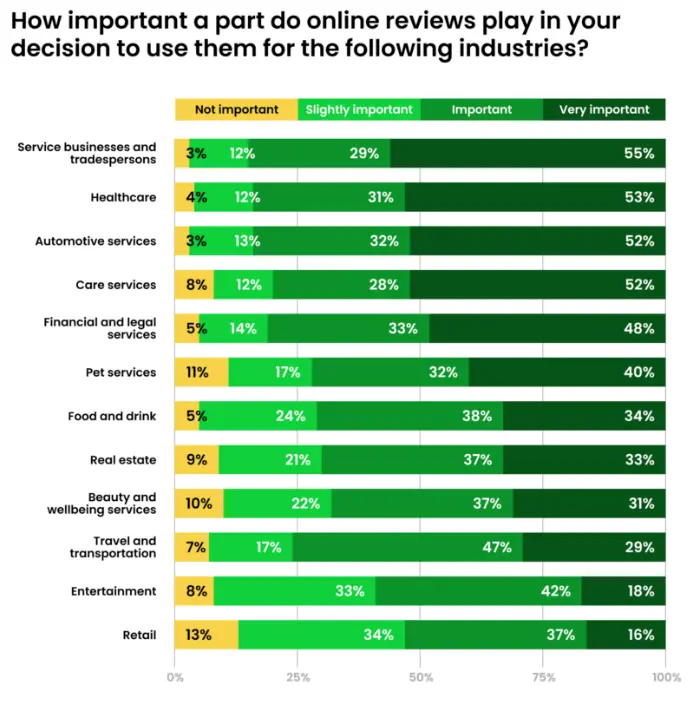
But reviews are just one piece of the puzzle. Your online visibility, website design, content, thought leadership articles, case results, lawyer bios, and client testimonials all contribute to whether someone feels confident reaching out to your firm.
Stand Out in a Crowded UK Legal Market
The legal industry is one of the most competitive sectors in digital marketing. With high client lifetime values and lucrative case settlements, law firms are willing to invest heavily in client acquisition.
In 2025, law firms have been increasing their spending on marketing. The average law firm marketing budget rose from 2.7% in 2024 to 3.1% of revenue in 2025. With 65% of these marketing budgets going towards online strategies, it shows just how much firms are finding value in online channels.
This level of competition means that simply having a website or running a few Google Ads isn’t enough. You need a law firm marketing strategy that differentiates your firm, demonstrates your value, and converts visitors into consultations.
This allows you to:
- Stand out through thought leadership content that positions your lawyers as experts in their field.
- Target specific practice areas and geographic locations with precision that traditional advertising can’t match.
- Track and measure ROI so you know exactly which marketing channels are delivering results.
- Build long-term assets like search rankings and email lists that compound in value over time.
5 High-ROI Law Firm Marketing Strategies for 2026
AI Search Optimisation: The Strategy Most UK Law Firms Are Missing
With ChatGPT being the second go-to source for researching legal issues or finding law firms, you need AI Search Optimisation in your 2026 marketing strategy for law firms.
Legal prospects are increasingly researching solicitors in ChatGPT, Gemini and Perplexity before they ever open Google. AI search optimisation for law firms means building entity authority, using structured schema markup, and earning third-party citations, so AI platforms have accurate, citable information about your firm to draw on. The firms building AI search visibility today are establishing citation authority before most competitors even know the channel exists.
This isn’t just SEO with a different name. it’s an entirely new approach focused on making your firm discoverable and recommendable in AI-generated responses. This happens through either:
- Direct brand mentions, such as when your name is included in the “best personal injury lawyers in San Antonio” list.
- Source citations, such as when your blog content is quoted or used to support an AI-generated response.
It’s not just standalone platforms like ChatGPT or Perplexity you need to focus on. AI-generated results are also included in traditional search results with Google’s AI Overviews. This is driving up zero-click search, making presence in these AI results even more important for brand visibility, trust, and traffic.
Whether someone sees your name listed in an AI summary or clicks through from an AI-sourced answer, presence here builds brand salience, increases branded search, and drives high-intent referral traffic from tools most law firms aren’t even tracking yet.
The law firms that invest in an AI Search Optimisation strategy now will have a significant competitive advantage as adoption continues to accelerate through 2026 and beyond. Here’s what you need to focus on:
- Create AI-friendly content. Write clear, well-structured articles that directly answer common legal questions and are easily scannable by AI systems.
- Build web-wide brand mentions. Earn mentions in legal publications, get featured in news articles, collect client reviews, and build citations across legal directories. Third-party validation carries enormous weight.
- Audit your AI visibility regularly. Track whether your firm appears, in what context, and alongside which competitors in AI-generated answers.
- Monitor AI referral traffic. Use Google Analytics 4 (GA4) to track visits from chat.openai.com, perplexity.ai, and other AI platforms.
- Optimise your technical SEO. AI agents increasingly perform tasks on behalf of users, like gathering information or even booking consultations.
SEO for Law Firms: Ranking When Potential Clients Are Searching
SEO remains one of the highest-ROI channels for law firm marketing, with firms seeing on average 122% ROI.
Ranking at the top of Google and Bing for these high-intent searches delivers a steady stream of qualified leads month after month. Unlike paid advertising, which stops the moment you turn off the budget, SEO builds long-term assets that continue generating value.
A highly effective strategy for law firms is local SEO, which we proved with Personal Injury Law Firm.
When the Personal Injury Law Firm approached Exposure Ninja in 2021, they’d already worked with seven previous SEO agencies without seeing results. Operating two personal injury practices 200 miles apart in Texas, they faced entrenched competitors with much larger budgets.
The challenge was significant. The primary keyword “personal injury lawyers” had fewer than 200 monthly searches across both locations combined. To hit ambitious growth targets, we needed to think beyond the obvious keywords and get creative with local targeting.
Our strategy focused on two core elements:
- Expand geographic targeting. Instead of just optimising for McAllen and San Antonio, we identified where potential clients actually lived and worked and we created location-specific pages for smaller cities and towns in these regions. This opened up entirely new markets that competitors had overlooked.
- Optimise Google Business Profile (GBP). We audited top-ranking competitors in each location, analysed their strengths and weaknesses, then optimised Personal Injury Law Firm’s listings to outperform them.
For local law firms, an optimised Google Business Profile is often the highest-ROI single action in your law firm marketing strategy. It’s free, it’s fast to set up, and it’s frequently the first thing a prospective client sees before they ever reach your website.
This approach helped website traffic grow 314%, with homepage traffic specifically up 641%. The firm secured position 1 rankings for multiple commercial terms and dominated the local map pack for priority keywords. Phone call conversions from the homepage increased 43%, and their top-performing blog post went from 0 conversions to 42.
Personal Injury Law Firm achieved all this whilst facing fierce competition in one of the most expensive legal marketing sectors. Their success demonstrates what’s possible when you combine technical SEO excellence, strategic local targeting, genuine expertise, and conversion optimisation.
These are our top recommendations for a successful legal local SEO strategy:
- Target surrounding towns, suburbs, and commuting zones with dedicated pages and optimised content.
- Build and maintain Google Business Profiles for each office location. Update regularly with fresh, location-relevant content.
- Use GBP features strategically. Add services, publish local news updates, and include FAQs based on real client queries.
- Improve content depth and clarity to demonstrate expertise and local relevance. Avoid thin or generic pages.
- Research competitors in your local market. Study their rankings, reviews, and GBP activity to uncover tactical gaps.
- Prioritise mobile usability. Most local searches happen on mobile and conversion rates are higher when UX is smooth.
Content Marketing: Building Legal Authority That Attracts Clients
Content marketing is one of the most powerful tools in your law firm marketing strategy to drive trust and action. Done well, it positions your lawyers as trusted experts, educates potential clients, answers their questions, and guides them toward choosing your firm.
One study found that law firms that produced blog content acquired 67% more leads compared to those that didn’t. But it’s not simply about producing more written content. The legal industry is flooded with generic blog posts that regurgitate the same information everyone else publishes.
This creates an opportunity for law firms willing to invest in genuinely helpful, expert-led, high E-E-A-T content. When you publish articles that demonstrate real legal knowledge, provide actionable guidance, and address the specific concerns your potential clients have, you stand out dramatically from the competition.
We saw this first-hand with the Personal Injury Law Firm when we used content marketing to boost legal leads.
As part of a broader SEO strategy, we developed a content plan that focused on three priorities:
- Supporting local SEO and GBP rankings through location-specific landing pages and blog content.
- Establishing the Personal Injury Law Firm as an authority in personal injury law, especially around car accidents, traffic law, and client rights.
- Driving conversions by optimising content layout, adding strategic CTAs, and making the content genuinely helpful.
Instead of pushing out basic blogs, we created content that tapped into real local events and client concerns. For example, when severe storms hit the Rio Grande Valley, we published a blog urging drivers to stay safe and explaining what to do in case of an accident; demonstrating care, authority, and availability in one post.
We also didn’t stop at blog posts. We created:
- Interactive tools like a Personal Injury Calculator and a Statute of Limitations Quiz.
- Original data content using Texas crash reports, beating the Department of Transportation to publish 2023 crash statistics.
- Legal commentary on trending cases like the $16 million TBI truck accident verdict and even celebrity cases like the Gwyneth Paltrow ski trial, positioning the Personal Injury Law Firm as a thought leader with a pulse on what clients are talking about.
All of it built trust, earned backlinks, attracted thousands of visits, and converted.
Here’s how you can build an effective content marketing strategy for your law firm:
- Start with real client questions. Your intake team already knows what people are confused about, so turn those questions into articles and guides.
- Map content to location. Create hyper-local content targeting areas your firm serves (or can expand into) to boost local SEO and GBP visibility.
- Go beyond basic blog posts. Use tools, calculators, checklists, explainers, and videos to educate and engage across multiple formats.
- Prioritise E-E-A-T. Assign content to qualified legal professionals, cite trustworthy sources, and include bios and credentials to build authority.
- Optimise every blog post for conversions. Add embedded CTAs, sidebars, sticky buttons, or in-line forms that make it easy to book a consultation.
- Tie content to your SEO strategy. Build internal links from blog posts to core service pages to boost their visibility and relevance in search.
- Respond to current events. Publishing timely legal insights on local news or emerging issues builds relevance and shows you’re active and engaged.
Email Marketing: Nurturing Legal Leads from Enquiry to Client
Email marketing is one of the most cost-effective channels in your law firm marketing strategy, yet it’s surprisingly underutilised in the legal sector. When done correctly, email nurtures relationships with potential clients, keeps your firm top-of-mind during long consideration periods, and drives consistent consultations.
The key advantage of email marketing for law firms is that it works during the extended decision-making process most legal services require. Someone researching divorce options, for example, might spend weeks or even months gathering information before they’re ready to hire a lawyer. Email keeps you present throughout that journey.
Another overlooked benefit of email is its ability to generate client reviews. Automated email sequences can politely prompt satisfied clients to leave a review, helping you build social proof over time. This matters when you remember that 81% of legal consumers say reviews are important or very important when choosing a firm.
These are our top tips to build an effective law firm email marketing strategy:
- Segment by practice area and intent. Create separate email sequences tailored to each practice area and where people are in their decision-making process.
- Automate your nurture sequences. Set up triggered email series that automatically send when someone downloads a guide, requests a consultation, or subscribes to your newsletter.
- Provide consistent value through newsletters. Send regular (weekly or fortnightly) emails that share helpful legal updates, answer common questions, highlight recent case results, and demonstrate your expertise.
- Make it easy to take action. Every email should have a clear CTA, whether that’s booking a consultation, calling your office, or reading a relevant article.
Paid Advertising: Immediate Visibility for High-Intent Legal Queries
PPC advertising offers law firms immediate visibility and the ability to generate leads whilst longer-term strategies like SEO build momentum.
For example, when someone searches for “employment lawyer near me” or “urgent criminal defence solicitor,” a well-optimised Google Ad or Microsoft Ad can put your firm in front of them at the exact moment they’re ready to hire.
But the legal industry is notoriously expensive for paid advertising. Attorney and lawyer-related keywords are in the top 20 for the highest cost per click (CPC) on Google Ads. These high costs reflect high client lifetime values; a single case can generate revenues that dwarf the acquisition cost.
Here’s how to maximise ROI from paid advertising with expert law firm PPC:
- Use AI-powered automation strategically. Let AI handle bid adjustments and micro-targeting whilst you control messaging, budget allocation across practice areas, and overall strategy.
- Go multichannel. Don’t limit yourself to Google Ads. Microsoft Ads often delivers cheaper clicks for similar search intent.
- Create conversion-focused landing pages. Build dedicated landing pages for each practice area and campaign with clear value propositions, trust signals (reviews, credentials, case results), and prominent contact forms.
- Test video and visual creative. Especially on Meta Ads, video ads and client testimonials significantly outperform static image ads.
One more thing to check before you brief any paid or content campaign: all law firm marketing in England and Wales must comply with the SRA Code of Conduct and ASA advertising rules, including the SRA’s 2024 warning notice on marketing to the public. Make sure whoever signs off your campaigns understands this regulatory context, it differentiates a specialist legal marketing partner from a generalist agency.
Referral marketing is the oldest channel in legal client acquisition, and it still works alongside digital. Warm introductions from past clients, other solicitors, and professional contacts like accountants and financial advisers convert at a higher rate than most digital channels, precisely because trust is already established before the first conversation.
A structured referral strategy, rather than hoping referrals happen organically, means actively asking satisfied clients for introductions, building relationships with complementary professionals in your area, and making it easy for referrers to pass your details on. Digital and referral marketing reinforce each other: the same trust signals that convert a referral, reviews, case results, a professional website, are exactly what your digital channels are also building.
The Best Law Firm Marketing Strategy in 2026: How to Combine These Tactics
The most effective law firm marketing strategy isn’t built around a single channel. It’s an integrated approach where multiple tactics work together, each amplifying the others to deliver compounding results.
Here’s why integration matters:
- SEO builds long-term visibility and attracts high-intent prospects actively searching for legal help.
- Content marketing educates potential clients, demonstrates expertise, and feeds both SEO and email strategies.
- Email marketing nurtures relationships during extended consideration periods and converts prospects who aren’t ready to hire immediately.
- PPC captures immediate demand whilst organic visibility builds, and retargets engaged visitors who didn’t convert initially.
- AI Search Optimisation ensures your firm appears in the AI-powered search platforms shaping modern legal research.
- Digital PR and link building supports SEO performance whilst building brand authority across the wider web for AI Search.
- Referral development creates warm, high-trust leads that complement your digital channels, rather than competing with them.
When these channels work together, they create a marketing ecosystem where the whole significantly exceeds the sum of its parts.
This integrated approach is exactly what drove Personal Injury Law Firm’s leads from 357 per year to 2,957, a huge 728% year-on-year (YoY) increase in lead generation. They didn’t succeed by focusing exclusively on content or local search optimisation. They succeeded because all of these tactics worked together strategically, each one reinforcing the others.
The firms that will dominate legal marketing in 2026 and beyond understand this principle. They’re not looking for a magic bullet or a single tactic that solves everything. They’re building comprehensive digital marketing strategies that attract, educate, and convert clients across multiple touchpoints and channels.
Ready to Grow Your Law Firm? Work With a Specialist Legal Marketing Agency
Creating an effective law firm marketing strategy requires expertise, consistent execution, and the ability to adapt.
This is where working with a specialist legal marketing agency delivers significant advantages. At Exposure Ninja, we’ve built our reputation helping law firms navigate exactly these challenges, combining technical expertise with a deep understanding of how legal clients make decisions.
Our work with firms like the Personal Injury Law Firm demonstrates what’s possible when strategy, execution, and expertise align. We don’t just drive traffic; we generate qualified leads that convert into clients and revenue.
We’re ready to help you earn more legal leads through strategic digital marketing. Request a website and marketing review, and our team will show you exactly how to outperform your competition.
Law Firm Marketing FAQs
What is the average marketing budget for a law firm?
Law firm marketing budgets in 2025 were on average 3.1% of revenue, rising from 2.7% in 2024, according to a recent survey. The key is not the percentage but ensuring your budget generates measurable ROI through strategic channel allocation.
What is the best form of advertising for a lawyer?
The most effective advertising channel varies by practice area, but Google Ads consistently delivers the highest ROI for most law firms because it captures high-intent searchers actively looking for legal help right now. The best approach combines paid advertising with long-term assets like SEO and content marketing to reduce acquisition costs over time whilst building sustainable visibility.
How do law firms engage clients?
Law firms engage clients most effectively by demonstrating expertise through helpful content, being present when potential clients are researching their legal options, and making it incredibly easy to take the next step toward hiring. This means a user-friendly website, responsive intake processes, and follow-up sequences that nurture relationships until clients are ready to commit.