The Complete Guide to AI Search Optimisation


AI Search is changing how people discover, research, and choose who to buy from, and most businesses aren’t ready. Our guide covers everything you need to know to get cited, recommended, and trusted by AI tools using AI Search Optimisation.
Most marketers aren’t ready for AI Search Optimisation.
When Charlie Marchant, CEO of Exposure Ninja, took the stage at London MozCon 2025, she stood before a packed room of 300 SEOs, marketers, and Heads of Growth.
Before sharing our client wins from the likes of DSLD Mortgage, The Ordinary, and ZUGU, she kicked things off with a simple poll, and the results were quite shocking:
- Raise your hand if you’ve optimised to gain an AI Overview before? About 25-30% of the 300 audience.
- Raise your hand if you’ve started optimising to show in ChatGPT or other Gen AI answers? About eight people.
- Raise your hand if you’ve started optimising to show in AI Mode answers? About four people.
Only 2.5% of the attending marketers are actively optimising for AI Search. This shows that even among forward-thinking marketers, AI Search Optimisation is still uncharted territory.
But here’s the thing: AI Search isn’t coming; it’s already here. And it’s changing how your customers discover, research, and choose who to buy from. You’re already playing catch-up if you’re not actively working to get your brand recommended by AI tools like ChatGPT, Google’s AI Overviews, or Perplexity.
We’ll walk you through everything you need to know about AI Search Optimisation, including what it is, how it works, and the strategies you need to stay visible (and competitive) in 2025 and beyond.
Executive Summary:
AI Search is changing how people find, research, and buy, and traditional Search Engine Optimisation (SEO) tactics alone won’t keep your brand visible. Tools like ChatGPT, Perplexity, and Google’s AI Overviews now generate direct, conversational answers instead of simply listing web results.
AI Search Optimisation is the strategy of getting your brand recommended, cited, and trusted by these tools. It blends SEO, content marketing, digital PR, Conversion Rate Optimisation (CRO), paid media, and branding with AI-optimised tactics to help AI understand and elevate your brand in its answers.
To succeed, you’ll need to:
- Build a focused, topic-led content strategy that shows depth of expertise.
- Optimise for AI readability using structure, schema, and E-E-A-T.
- Secure third-party brand mentions and reviews across the wider web.
- Track AI visibility, sentiment, and referral AI traffic using Google Analytics 4 (GA4) and new tools like Peec or Profound.
Key metrics are shifting away from rankings and pageviews. Now, it’s about visibility in AI answers, positive sentiment, and measurable clicks from AI tools.
Looking ahead to 2026, we predict:
- Organic traffic will continue to fall as AI becomes the default search experience.
- Paid placements in AI Search will expand, making visibility increasingly “pay-to-play.”
- Agentic AIs will begin making buying decisions on behalf of users, meaning websites must be technically flawless, fast, and conversion-optimised.
You may already be invisible if your brand isn’t cited by AI tools. This guide will help you fix that.
Understanding AI Search
AI Search is the next evolution of how people find information online.
“AI is, essentially, a technology that’s now being used within search to improve how information is retrieved, how it’s interpreted, and how it’s then presented back to the searcher for their query.
Unlike traditional Google search, which relies on keyword matching, AI understands context and human phrasing. It scans far more results than a human could in a fraction of the time and delivers something much more relevant and personal, ” explains Charlie Marchant.
Instead of showing users a list of ten blue links like traditional search engines, AI Search engines deliver direct, conversational AI-generated answers. Where traditional search engines rely on keyword matching and backlinks, AI Search engines understand intent, scan thousands of sources, and generate a human-like response.
We’ve put together a comparison table between traditional and AI Search:
| Traditional Search | AI Search | |
| Search Platforms | Traditional search engines, like Google or Bing | AI Search platforms, like ChatGPT, Perplexity, Gemini, and Google’s AI Mode or AI Overviews |
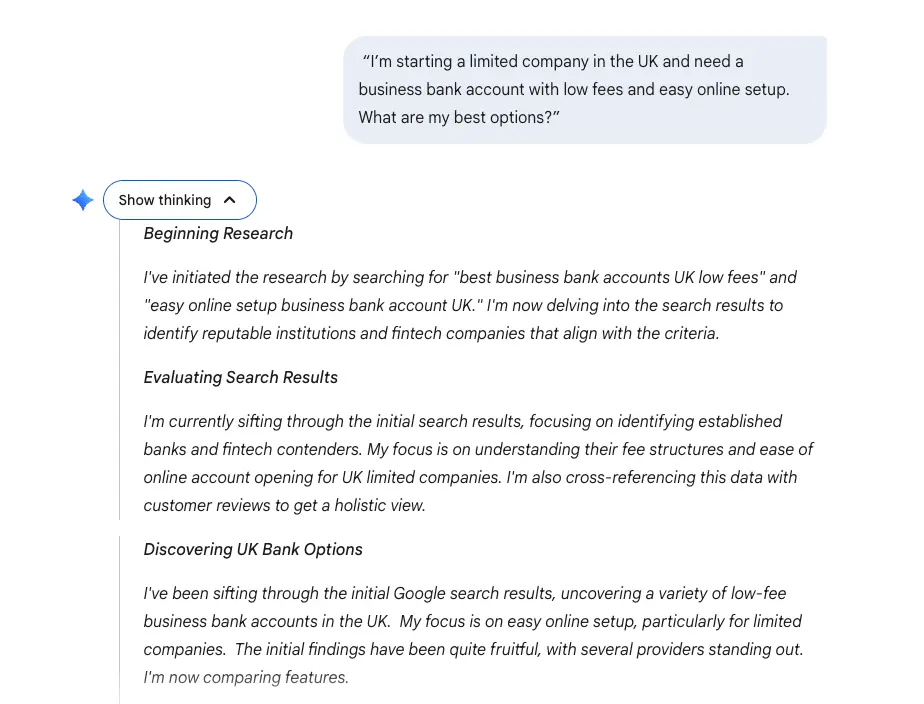
| Query Style | Typically short, keyword-led queries. For example, “best UK business bank accounts.” | Longer, more natural language queries and prompts. For example, “I’m starting a limited company in the UK and need a business bank account with low fees and easy online setup. What are my best options?” |
| Result Generation | Search algorithms match queries to indexed content based on relevance, authority, and technical SEO signals. | Responses generated by Large Language Models (LLMs) that scan, summarise, and synthesise data from across the web and/or proprietary databases. |
| What the User Sees | A standard search engine results page (SERP) with a mix of organic links, paid ads, featured snippets, maps, videos, or image packs. | AI-generated summaries that are often personalised and contextualised. Can include inline citations, source cards, and brand or product and service recommendations. Results can also include maps, videos, or image packs. Paid placements are starting to appear. |
How AI Search Engines Work
AI Search is happening across a growing number of platforms that combine search and conversation in powerful new ways.
Some of the most well-known AI Search platforms right now are:
- Google’s AI Overviews and AI Mode
- ChatGPT
- Perplexity
- Gemini
- Claude
- Copilot.
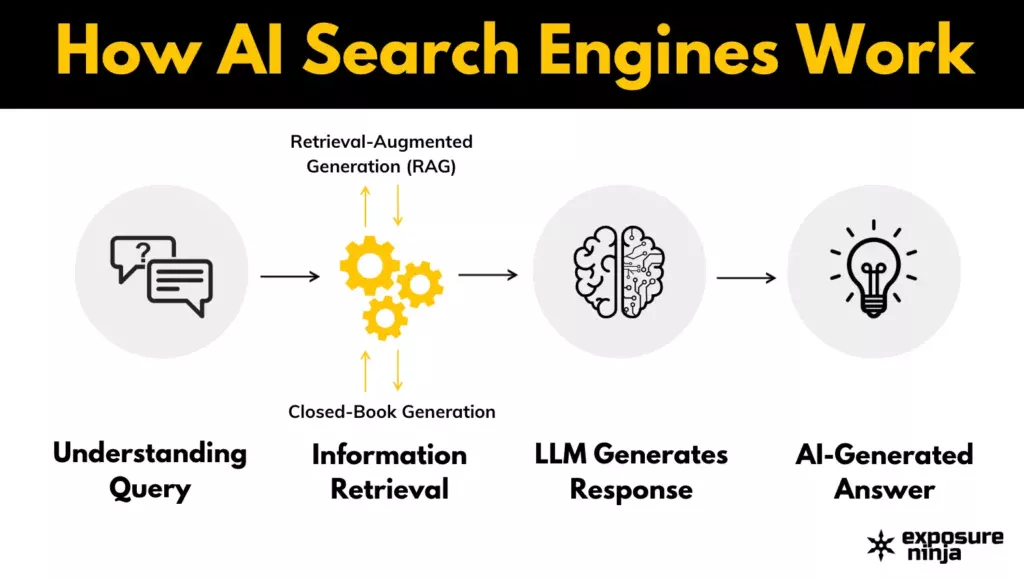
These AI engines don’t just match keywords to web pages and show a list of blue links like traditional search engines. Instead, AI Search engines use large language models (LLMs) to interpret the user’s query, search their training data or the live web, and generate a conversational answer.
“The capabilities of AI Search engines have changed a lot over the past twelve to eighteen months,” explains Charlie Marchant. “Originally, they had loads and loads of data imputed into them, and many of the early models couldn’t search the internet live. If they did, it was limited to a specific timeframe, not up to the present day.
Now, a lot of them can retrieve and search directly on the internet very quickly. They scan hundreds of results and pull content from different websites to repurpose into new answers.”
Here’s how this process works:
1. Understanding the Query
AI Search engines don’t just look at the words you type; they try to understand what you mean. Using natural language processing (NLP), they analyse your full question, identify your intent, and interpret the context behind it.
The goal isn’t to find pages that match your exact wording. It’s to deliver the most relevant answer based on what you’re actually trying to find out.
2. Retrieving Information
There are two ways AI Search engines find information:
- Retrieval-Augmented Generation (RAG): This method uses live search to pull in current data from the internet. The model breaks down your question into subtopics, searches for each, and pulls relevant content from multiple sources.
You won’t always see the exact searches or background logic AI platforms use, but some tools offer clues. For example, in Google’s Gemini 2.5 Pro, clicking “Show thinking” reveals the follow-up questions the AI considered. Just note that these may be AI-generated assumptions rather than actual reasoning.
- Closed-Book Generation: This mode doesn’t search the web at all. Instead, the AI uses only its internal training data. This is the massive dataset it was trained on, which includes books, websites, and publicly available information up to a specific point in time.
These answers are built from the AI’s learned patterns and statistical relationships between words and concepts, not from live or recent data.
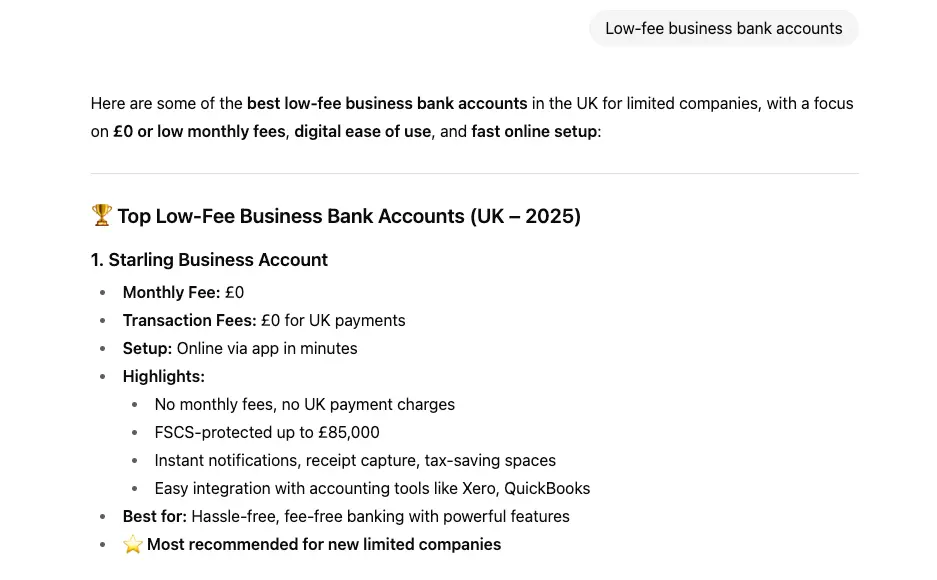
For example, when asked for “low-fee business bank accounts,” ChatGPT provides a list of suggestions without sources or link citations. That’s because it’s pulling from its pre-trained language model, not retrieving information live from the web.
3. Generating a Response
Once the AI has the information it needs, it builds a natural-language response. This is not copied text. The answer is newly written by the model based on what it has learned or retrieved.
The result usually sounds (relatively) human, is structured clearly, and is tailored to the intent behind the query.
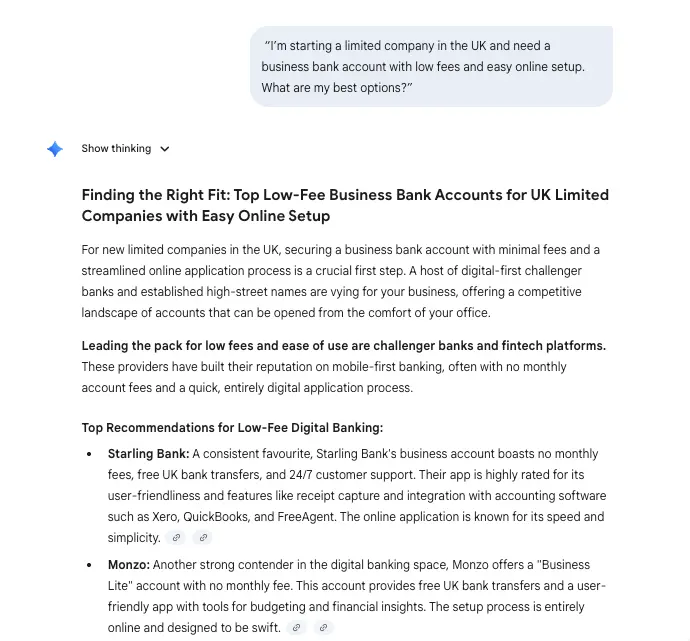
4. Citing Sources
When AI Search platforms generate answers, some include citations that link directly to the sources they pulled information from.
These citations matter. Being referenced by AI Search engines puts your brand in front of potential buyers even if they never visit your website directly. Getting your content featured as a source is one of the most powerful ways to build authority, trust, and visibility in the AI Search era.
What Is AI Search Optimisation?
AI Search Optimisation is the process of improving your brand’s visibility and authority in AI Search so that AI systems can choose your content, products or services, or brand as part of their answers.
“AI tools like ChatGPT and Perplexity are becoming more comfortable recommending products, services, and businesses to their users, and that means there’s a massive opportunity to drive traffic and sales if you know how to get them recommending your business,” says Tim Cameron-Kitchen, Founder of Exposure Ninja.
AI Search Engine Optimisation blends SEO, content marketing, digital PR, CRO, paid media, and brand strategy with AI-focused optimisation techniques to get mentioned, cited, and trusted by AI platforms.
Is Generative Engine Optimisation Different?
You might have heard us use the term Generative Engine Optimisation (GEO). It refers to the same goal as AI Search Optimisation: helping your brand get mentioned, cited, or recommended by generative AI tools like ChatGPT, Google’s AI Overviews, and Perplexity.
As this space is still evolving, you’ll come across various names for similar strategies, including AI SEO or LLM Optimisation (LLMO). While the terminology may vary, the objective is the same: make sure your brand appears when AI delivers an answer.
Whether you call it AI Search Optimisation or GEO, the playbook is about positioning your content, products or services, and brand to be visible in a search world that’s no longer just about blue links.
Is AI Search Optimisation the Same as SEO?
Let’s make this clear: AI Search Optimisation differs from SEO.
SEO improves your website’s visibility in traditional search engines like Google or Bing. It focuses on ranking in the organic search results by aligning your pages and content with ranking signals such as:
- Keyword relevance.
- Backlinks.
- On-page SEO, like metadata, headings, and structure.
- Technical SEO performance, like page speed and mobile usability.
- User signals, such as time spent on the site and click-through rates (CTRs).
- Content quality, authority, and trustworthiness.
A strong SEO strategy generates consistent, compounding traffic to your site. It includes keyword research, content creation, technical audits, link building, and performance monitoring through Google Analytics 4 (GA4).
AI Search Optimisation is about increasing your brand’s visibility in AI-generated answers.
Instead of chasing the top spot on a list of links, you’re trying to be in the answer or at least be cited when someone asks a question in AI tools. AI Search Engine Optimisation includes:
- Getting your brand mentioned and recommended in AI-generated responses.
- Having your content cited as a trusted source.
- Shaping how AI platforms perceive your brand (sentiment and authority).
- Understanding what prompts your audience use and where you do (or don’t) show up.
- Earning visibility across the entire web, not just your own website.
A strong AI Search Optimisation strategy involves more than just SEO tweaks, which we’ll cover below.
Why AI Search Optimisation Matters
Are you seeing a drop in website traffic this year? You’re not alone.
While there are many reasons why website traffic can fall, one of the biggest recent contributors is AI Search.
- Gartner predicts that traditional search volume will drop by 25% by 2026 due to the growing popularity of AI search engines.
- Ahrefs found that when AI Overviews are present, clicks drop by 34.5%, aligning with the rise in zero-click search.
- In June 2025, 5.6% of U.S. search traffic went to AI platforms like ChatGPT and Perplexity, as reported in the Wall Street Journal.
Less traffic is a problem because it can result in fewer leads or sales. But here’s what really matters:
- People haven’t stopped searching.
- They haven’t stopped buying, booking, or inquiring.
- They’ve just changed how they do it.
AI Search is now guiding the journey by filtering, summarising, and recommending before a user reaches your website. And that means if your brand isn’t being mentioned or cited in AI-generated answers, you’re invisible.
- AI is becoming the first, and sometimes only, touchpoint in the buyer journey.
- If your brand isn’t optimised for AI visibility, you’re missing out on traffic, sales or leads, and trust.
If you want to future-proof your visibility, it’s time to get your brand cited, recommended, and trusted by AI.
Top AI Search Optimisation Strategies
As one of the best AI Search Optimisation agencies, we’ve been helping brands like Golf Course Lawn Store, DSLD Mortgage, The Ordinary, Personal Injury Law Firm, and ZUGU win in AI Search, and we’re happy to share the AI Search-focused strategies we use:
Sound SEO
Before you dive into AI Search Engine Optimisation, you need to have a solid SEO foundation in place.
- You need to rank well in traditional search engines so AI tools find and trust your content.
- You need structured, scannable content so AI systems can easily summarise and extract relevant information.
- You need high-authority backlinks and technical health so your site is considered trustworthy.
- You need to match search intent so the right pages appear for the right questions.
When all the SEO basics are done right, your website can rise to the top of Google and be found and crawled by AI search engines.
But ranking isn’t enough anymore. AI Search doesn’t just cite or recommend brands in the top 10 blue links. It curates, synthesises, and selects sources based on context, credibility, and clarity. In other words, just because your website or blog post ranks number one doesn’t mean you’ll be directly mentioned, recommended, or cited in AI responses.
Audit AI Performance
Unlike a traditional SEO audit, which focuses on your own site’s performance in search engines, an AI Search audit looks at how your brand is being interpreted and represented by AI platforms.
An AI audit involves:
- Running in-depth queries across major AI search platforms. You’ll search for branded and non-branded queries relating to your products, services, and market. This reveals how (or if) you’re currently being featured, cited, or recommended.
- Analysing how your brand is positioned and perceived. Are AI tools describing your business accurately? Are they highlighting your core differentiators? Or is your brand invisible, misrepresented, or being outshone by competitors?
- Identifying sentiment, gaps, and brand associations. AI pulls from both high-authority publications and user-generated content. Your audit should include an analysis of where you’re being mentioned, how often, and in what context (positive, negative, or neutral).
- Spotting opportunities and setting clear priorities. Which platforms offer the biggest potential gains? Where are the quick wins? What gaps in visibility can you close right away, and which areas need long-term digital PR or content investment?
From here, you can build a step-by-step AI Search plan that is aligned with your wider digital marketing strategy.
Create E-E-A-T, AI-Friendly Content
Creating high-quality content that aligns with Google’s E-E-A-T principles (Experience, Expertise, Authoritativeness, and Trustworthiness) has long been key to ranking well in search results.
But with the rise of AI Search platforms, your content strategy has additional layers to consider.
To make your content not just E-E-A-T-aligned but truly AI-ready, focus on the following:
- Build authority with a focused blog content strategy. Consistently publish around your core topics to demonstrate expertise. AI tools are more likely to recommend brands that show depth in a specific area.
- Use a clean, structured AI-optimised blog post format. Make your posts easy for AI (and humans) to scan and summarise. Use clear headings, bullet points, short paragraphs, and summaries that quickly explain what the page is about.
- Keep content updated and accurate. Refresh older posts with current facts, trends, and links. AI prefers timely, reliable sources, and so do your readers.
- Include first-hand experience and unique insight. Whether it’s real reviews, case studies, or expert commentary, AI tools favour content that adds original value.
Boost Web-Wide Brand Mentions
Ranking in AI Search isn’t just about optimising your website for AI. If you want AI tools like ChatGPT, Perplexity, or Gemini to recommend your brand, product, or service, you must exist across the wider web.
AI doesn’t rely solely on your site; it pulls from various third-party sources. That means visibility, consistency, and sentiment everywhere else matter just as much.
This is where increasing web-wide brand mentions comes in. The more your business is talked about in relevant, trusted, and authoritative spaces, the more likely AI systems are to view your brand as a reliable recommendation.
Increasing brand mentions can include:
- Using digital PR to get featured in trusted publications
- Being discussed on Reddit, Quora, and LinkedIn in a natural, genuine way.
- Having videos on YouTube related to your niche
- Gathering reviews on platforms like Trustpilot.
- Inclusion in buying guides, “best of” lists, or forums related to your category
One great example of this is ZUGU. When users search for “best iPad case” in ChatGPT or Perplexity, ZUGU is often one of the top recommendations.
That visibility didn’t come from SEO alone. It came from a strong digital PR campaign, consistent reviews on high-authority sites, user-generated conversations on Reddit, and an AI Search-driven brand presence across multiple trusted platforms.
AI tools picked up on that consistency and sentiment, and as a result, they now recommend ZUGU organically.
Tracking AI Search Visibility, Sentiment, and Traffic
In traditional SEO and paid media, measurement is clear. “You can track rankings. You can see if you’re in position one or have a featured snippet. In paid ads, we get a nice dashboard where we can see how much we spend, how many clicks we’ve got, and how many conversions we’ve had,” explains Tim Cameron-Kitchen.
But AI Search is different. “With ChatGPT, it’s just a black box. There’s no search console for Perplexity. Google’s not going to tell you how to win in AI Mode,” Tim Cameron-Kitchen says.
That’s why AI Search Optimisation introduces two new performance metrics: AI visibility and brand sentiment.
Visibility refers to how often your brand, content, or products are mentioned, recommended, or cited in AI-generated responses across platforms. This could include being listed in a product roundup, cited as a source, or mentioned in a follow-up suggestion. It’s the closest AI equivalent to “ranking,” though it’s far more dynamic.
“These AI models work differently from traditional search because they’re not deterministic,” Tim Cameron-Kitchen explains. “They come up with a new response every time. So, your visibility can jump around a lot. What we’re really looking for is to collect lots of data across lots of prompts over a long time period so we can then see general trends and movements.”
Visibility is only part of the story. The tone of how your brand is referenced matters just as much.
“Sentiment is how positively, negatively, or neutrally your brand is referred to in the AI answers,” Tim Cameron-Kitchen says. “It’s really no good being recommended if the tools are saying, ‘Don’t use this one; it sucks and the reviews are terrible.”
To influence customer decisions, you need consistent mentions, backed by trustworthy and favourable language.
Together, visibility and sentiment give you a clearer picture of how your brand is perceived in the AI landscape, and where you have opportunities to improve.
How to Track Brand Sentiment and Visibility
You can take a manual approach to tracking brand visibility and sentiment. You’d need to enter prompts across platforms like ChatGPT, Perplexity, and Google’s AI tools, log where and how your brand is mentioned, and repeat the process frequently to spot trends.
We recommend reviewing performance monthly using a structured spreadsheet or a tool like our AI Visibility Tracker for manual tracking.
While manually tracking visibility and sentiment is possible, it’s time-consuming. New AI search tracking platforms are emerging to automate this work, collecting visibility data and analysing sentiment for you at scale. Our top recommended tools are Peec, Profound, and Semrush’s AI Dashboard (which you can try the free interactive demo**).
These platforms allow you to:
- Track brand visibility across time and platforms.
- See top-performing queries powering your AI brand mentions.
- Receive actionable recommendations on how to improve visibility and sentiment.
- Benchmark against your competitors.
- View top sources and pages being cited.
- Identify opportunities for brand positioning and content targeting.
Together, these insights give you a much clearer picture of where your brand stands in AI Search and where you can improve to gain more (and better) mentions.
You Can Also Track AI Traffic
AI Search doesn’t just increase visibility; it can also drive measurable traffic to your website.
When your brand is cited or recommended in AI-generated answers, users may click through to learn more. You can then track this AI traffic in Google Analytics 4 (GA4) under Referral traffic, from domains like:
- chatgpt.com
- perplexity.ai
- gemini.google.com
- copilot.microsoft.com.
To get clearer insights, you can create custom channel groups in GA4. This lets you isolate AI traffic, track conversions, and compare performance across platforms.
“The benefits of tracking AI traffic are the same as any other channel: you know where your traffic’s coming from, you know what’s working, and you can make smarter decisions,” says Andrew Tuxford, our Head of SEO.
Monitoring AI referrals gives you a more complete picture of how your AI Search Optimisation efforts are performing, and where to double down.
AI Search Optimisation Predictions for 2026
1. Organic Traffic Will Keep Falling
AI-powered search platforms are becoming the default.
Just look at the explosive growth in usage for ChatGPT, according to DemandSage:
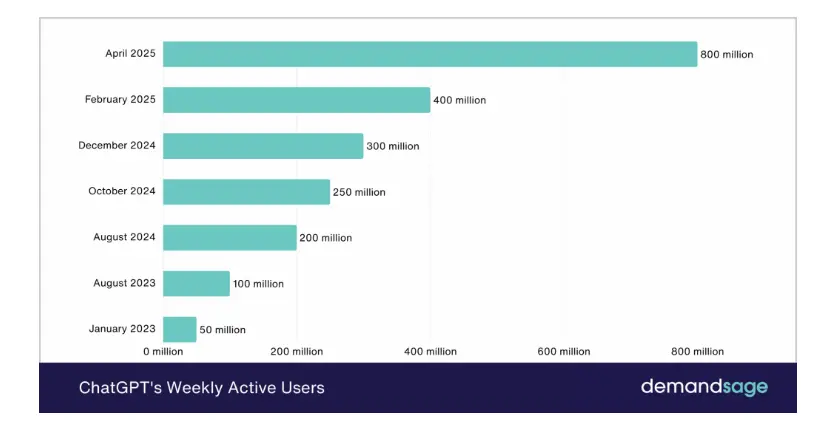
ChatGPT’s weekly active users grew from 50 million in January 2023 to 800 million by April 2025; a 16x increase in just over two years. This sharp rise signals a dramatic shift in user behaviour away from traditional search engines toward AI-driven answers.
And ChatGPT isn’t alone. Google’s AI Overviews have steadily increased this year, appearing on a high 20% of searches in the U.S. in May 2025. Perplexity and other conversational tools are gaining market share quickly, especially among younger users and professionals.
As a result, traditional organic traffic is declining and will continue to fall into 2026 and beyond.
“It’s not that people are searching less; they’re just not clicking as much,” explains Charlie Marchant. “If your brand isn’t being mentioned in AI tools, you’re missing the moment when decisions are being made.”
This is why visibility and sentiment are becoming the new performance metrics. It’s no longer enough to rank number one in Google. If your brand isn’t showing up or being talked about positively in AI-generated responses, you’re invisible to the growing share of users who never even see the SERP.
2. AI Visibility Will Become Pay-to-Play
We’re already seeing the beginnings of monetised AI results.
- Google has already begun integrating ads into AI Overviews and is actively testing sponsored placements in AI Mode.
- Perplexity is experimenting with “sponsored follow-up questions,” clickable prompts that guide users toward advertiser-aligned results.
ChatGPT hasn’t included advertising in its responses yet. But Charlie Marchant feels that ad placements in AI answers will be inevitable:
“Billions of people use Google every day and accept ads as part of the experience. We tolerate Spotify ads between songs because we understand the trade-off for a free product. The same logic will likely apply here. Initially, there’ll be pushback, but over time, ads in AI responses will become the new normal, just like they did with search.”
Rebecca Pilkington, our Head of PPC, adds: “Ad placements in AI responses are already impacting our U.S. audience, but UK advertisers need to act now. You need an AI-ready strategy built into your ad account before LLMs like ChatGPT begin pulling ads into their responses.”
This means that AI Search Optimisation won’t just be an organic play. To compete effectively, brands will need a PPC strategy tailored for AI environments, including AI-optimised campaign structures, Performance Max, and Dynamic Search Ads.
3. Agentic AI Will Make More Buying Decisions
Agentic AI is changing how people buy.
In July 2025, OpenAI released ChatGPT Agent, a major upgrade that gives the chatbot its own virtual computer. These agents can now browse the internet, open apps like Chrome, search for products, compare prices, and initiate purchases on behalf of users.
Charlie Marchant tested this feature with a simple task: “I told it I needed more coffee that was locally roasted, fresh, one kilogram, and delivered to my house. In under three minutes, it searched, compared options, added the item to a cart, and took me straight to checkout. All I had to do was enter my card details.” The entire process ran live on screen. As she put it, “You can watch it working, or just walk away and come back when it’s ready.”
Agentic AIs don’t browse like humans. They don’t skim headlines or bounce around pages. If they hit an error or can’t find what they need, they don’t troubleshoot; they move on.
“When it ran into a broken page during the test, it didn’t try to figure it out. It just skipped that site entirely and picked the next most relevant one,” says Charlie Marchant.
That means your website needs to be technically sound, fast, and friction-free. Agents respond best to clear layouts, readable product information, working schema, easy navigation, and minimal steps to conversion. Overcomplicated checkouts or hidden content could cost you the sale.
“We have to get used to the idea that we’re not really designing websites purely for humans anymore. Humans might only visit your site 20% of the time in five to ten years, and I’m being generous with that number,” says Charlie Marchant.
Ready to Dominate AI Search?
AI Search is already here. Businesses that adapt fast will see faster growth, increased visibility, and stronger brand recognition.
At Exposure Ninja, we’ve been pioneering AI Search Optimisation since the end of 2023, and we’ve just been named Most Innovative SEO and AI Search Specialists 2025. This is a proud moment for us because it’s a testament to the great AI Search results we’ve been achieving for our clients.
Do you want your brand to perform in AI Search? Request a website and marketing review and get personalised recommendations to improve your search performance.
If you’re looking to create your own AI Search Strategy, read:
If you need more convincing that AI Search Optimisation needs to be in your 2026 digital marketing plan, watch:
FAQs
What future trends should I anticipate for AI Search Optimisation strategies?
Expect a drop in traditional traffic, more AI-generated answers, and the rise of agentic AIs searching (and buying) for users.
Is AI Search Optimisation only for big brands?
Not at all. Smaller brands that move quickly and define their niche can dominate. AI tools favour relevance and authority over size.
Can AI Search Optimisation lead to traffic or conversions?
Yes. When your brand is cited or recommended in AI answers, you gain trust and can drive high-converting, branded traffic.
**Disclaimer: Exposure Ninja may get a commission through the marked links above at no cost to you.