How to Choose an AI Search Agency: 11 Questions to Ask Before You Hire


We outline the 11 questions to ask an AI Search agency before hiring them and explain what to look for in their answers. Use this guide to find a partner who can deliver real visibility, traffic, and conversions from AI Search in 2027.
AI Search is now part of how your buyers find and shortlist suppliers. Pew Research Center found that about half of US adults now use AI chatbots, up from a third in 2024 (survey of 5,119 adults, February 2026). Our own 2026 State of AI Search report found that, for the same question on the same day, ChatGPT and Google’s AI Overviews didn’t cite a single website in common in 49% of comparisons (59 UK prompts tracked daily from 24/06/2026 to 07/08/2026, 7,965 answers). Being visible in one AI platform doesn’t mean you’re visible in the others.
Buyers are looking for help, too. UK searches for “AI search agency” have risen from about 30 a month in December 2025 to 140 a month now (SE Ranking, November 2026), and Q4 is a common time to review agencies ahead of a new year.
If your business plans to grow in 2027, visibility in AI Search isn’t optional. You need a specialist AI Search Optimisation agency to help you stay visible, attract qualified traffic, and drive conversions as search behaviour evolves.
But hiring the right AI Search partner can be challenging. AI Search Optimisation is still new territory, and many agencies are experimenting without clear strategies, benchmarks, or results.
That’s why vetting an AI Search agency requires a different set of questions than traditional Search Engine Optimisation (SEO).
To help, we’re sharing the 11 most important questions to ask an AI Search agency before hiring them, and the answers you should expect from a credible partner. We’ve also added the red flags that should end the conversation.
Quick Checklist to Evaluate AI Search Agencies
The best AI Search Optimisation agency should be able to clearly answer all of these:
- Service Scope: What’s included in their AI Search Optimisation package?
- Strategic Differentiation: How does their AI Search work differ from standard SEO?
- Content Approach: How do they create content that earns AI citations?
- Brand Authority: What’s their strategy for increasing web-wide brand mentions?
- Audit Capability: Do they offer a comprehensive AI Search audit?
- Platform Coverage: Which AI platforms do they optimise for?
- Tracking Tools: What tools do they use to monitor AI visibility?
- Prompts and Citations: Which buyer prompts will they track, and do they report mentions and citations separately?
- Measurement: How do they track AI-driven traffic and conversions?
- Competitive Advantage: What makes their agency different from others?
- Proven Results: Can they demonstrate real AI Search outcomes for clients?
If an agency struggles with any of these questions, that’s your signal to keep looking, and to move on to the next name on your shortlist of AI Search agencies.
What to Ask an AI Search Agency (and Answers to Expect)
1. What’s Included in Your AI Search Optimisation Service?
AI Search Optimisation, also known as AI SEO or Generative Engine Optimisation, is being used everywhere right now, but not always accurately. Some agencies are genuinely leading in this space. Others are using the term to appear innovative, without offering a clear strategy or delivering meaningful results.
Capturing visibility in AI-generated answers isn’t something that can be improvised. It requires a structured AI Search Optimisation strategy built specifically for how AI platforms cite information and recommend brands, products, or services.
One of the simplest ways to identify whether you’re speaking to a credible AI Search agency is to ask for a detailed breakdown of what their service includes, how it works, and what results it’s designed to achieve.
If an agency can’t clearly explain what they’ll actually do for your business, that’s a sign they don’t have a real service.
What a Good Answer Looks Like:
At Exposure Ninja, our AI Search Optimisation service includes:
- AI Search Audit: We evaluate your brand’s current performance across AI platforms and identify gaps in visibility and brand sentiment.
- AI Search Strategy: We develop a tailored plan to position your business for citations and recommendations.
- On-Page Optimisation and Technical SEO: We optimise your site architecture, structured data, and performance signals so AI engines can crawl, understand, and use your content.
- AI-Focused Content Strategy: We create content designed for how AI processes, summarises, and cites information.
- Website Optimisation for AI Agents: We prepare your site for agentic AI browsing tools that visit on behalf of users.
- Multi-Platform Coverage: We optimise for visibility across ChatGPT, Perplexity, Google’s Gemini, Claude, Google’s AI Overviews, AI Mode, and Microsoft Copilot.
- Brand Mention Campaigns: We use tailored digital PR to increase your authority through earned media and high-quality backlinks.
- Review Generation: We help you secure strategic reviews that show buyers and AI platforms what your customers say about you.
2. How Does AI Search Optimisation Differ from SEO?
If an agency tells you AI Search Optimisation and SEO are the same thing, that’s your signal to look elsewhere. They’re related, but the visibility goals, content strategies, and success metrics are completely different.
Traditional SEO focuses on helping your website rank in search engines. That means targeting relevant keywords, optimising your on-page content, building backlinks, and ensuring optimal technical SEO performance. The primary goal is to rank at the top of Google or Bing and drive traffic to your site.
AI Search Optimisation aims to get your brand cited and recommended by AI platforms when users ask questions.
You need both strategies working together to ensure you’re discoverable in traditional search and recommended when AI platforms generate answers. The good news is that most of the groundwork is shared: our SEO services cover AI Search as standard, because the same technical health, content quality and authority help you in both.
What a Good Answer Looks Like:
A credible AI Search agency will explain that SEO and AI Search Optimisation are complementary but distinct, and should highlight these key differences:
- Visibility Goals: SEO aims to rank on page one. AI Search Optimisation aims to be cited within the answer itself.
- Content Strategy: SEO targets keyword-driven content. AI Search Optimisation prioritises conversational queries, query fan-out coverage, and extraction-friendly formatting.
- Authority Signals: SEO relies heavily on backlinks. AI Search Optimisation values web-wide brand mentions, whether or not they include a link.
- Success Metrics: SEO measures rankings, impressions, clicks, and traffic. AI Search Optimisation tracks visibility score, citations, AI referral visits, and AI-driven conversions.
3. How Do You Build Content That Earns AI Citations?
AI Search platforms, such as ChatGPT, Perplexity, and Google’s AI Overviews, cite content from cerdible sources. That credibility is earned through content that’s accurate, authoritative, well-structured, and written in a way that aligns with how users ask questions.
If an agency can’t clearly explain how they create content that meets these standards, they’re not working from a defined, repeatable strategy.
What a Good Answer Looks Like:
A worthwhile AI Search agency will describe a blog content strategy built specifically for AI visibility, like the step-by-step GEO strategy we use.
At Exposure Ninja, our approach includes:
- Audience and Intent Mapping: Identify your target audience, understand their search intent, and align content with their decision-making journey.
- Strategic Topic Selection: Define seed topics where your brand has genuine expertise and the potential to offer unique or authoritative insights.
- Hub-and-Spoke Structure: Build interconnected content clusters to establish topical authority and support AI systems in recognising subject depth.
- Query Fan-Out Optimisation: Expand beyond the primary question by addressing related queries and follow-up topics likely to be included in AI-generated answers.
- Content Gap Identification: Regularly audit your topic clusters to identify and fill gaps with AI-optimised content where coverage is lacking.
- Content Refresh Process: Keep existing content up to date, accurate, and structured in a way that supports AI comprehension and extraction.
- Consistent Content Production: Maintain a realistic publishing schedule focused on long-term quality and relevance.
- Performance Tracking: Monitor AI citations, brand mentions, and AI referral traffic as key indicators of success.
4. How Do You Drive More Web-Wide Brand Mentions?
Brand mentions are one of the strongest signals for AI Search visibility.
Ahrefs research shows that branded web mentions now correlate more strongly with AI visibility than backlinks alone. AI platforms scan the web to understand which brands are credible, trusted, and frequently discussed in relevant contexts. If your brand isn’t showing up in blogs, podcasts, news articles, reviews, and forums, AI systems may not recognise you as an authority.
An agency without a clear strategy to grow your brand presence across the wider web is leaving a major gap in your AI Search visibility.
What a Good Answer Looks Like:
A capable agency will present a proactive, multi-channel plan to increase your brand mentions in high-authority, relevant contexts.
This isn’t about manipulating algorithms. It’s about building genuine authority and visibility in places AI platforms are already reading and citing.
At Exposure Ninja, our strategy includes:
- Digital PR Campaigns: We secure coverage on high-authority third-party websites through expert insights, data-driven stories, and timely pitches.
- Strategic Guest Posting: We contribute expert-led content to reputable industry blogs, earning contextual brand mentions that reinforce topical authority.
- Product Round-Ups: We position clients to be included in trusted recommendation lists and reviews that AI platforms frequently cite.
- Review Generation: We implement ethical review campaigns across various platforms, including Google, Trustpilot, and niche directories, to establish credibility signals.
5. Do You Offer an AI Search Audit?
A proper AI Search Optimisation audit provides the baseline for any effective strategy. Without understanding how your brand is currently performing across AI platforms, any plan is just guesswork.
A good AI Search audit will show:
- Which AI platforms are mentioning your brand.
- How your business is described in those responses.
- Where your competitors are earning more visibility or citations.
- Which content and authority gaps are limiting your brand’s inclusion.
- What opportunities exist to improve trust signals and citation likelihood.
If an agency skips this step or offers a generic report, it’s a sign they’re not set up to deliver measurable results.
What a Good Answer Looks Like:
At Exposure Ninja, our AI Search Strategy begins with two foundational audit phases:
- Phase 1: Technical SEO Audit: We assess your website’s structure, crawlability, speed, schema markup, and content quality to ensure AI platforms can access, interpret, and use your site. This creates the foundation for both traditional SEO and AI Search visibility.
- Phase 2: AI Search Performance Audit: We analyse your current visibility across AI platforms like ChatGPT, Perplexity, and Google’s AI Overviews. This includes how your brand is being presented, where competitors are outperforming you, and which content or authority signals are missing.
Based on these audits, we deliver a prioritised, step-by-step roadmap to increase your AI Search visibility with clear actions focused on citations, mentions, and conversions.
Want a quick benchmark before you speak to any agency? Our free AI Search Scorecard shows how your business shows up in AI Search, measured against your top competitors.
6. Which AI Platforms Do You Optimise For?
Your customers aren’t just using Google anymore. They’re asking questions in ChatGPT, researching with Perplexity, using Copilot for work tasks, and exploring Gemini or Claude for creative projects. Each platform has different strengths, user bases, and content preferences.
A narrow AI Search strategy leaves visibility on the table.
What a Good Answer Looks Like:
A strong AI Search agency will optimise for multi-platform visibility, not just one tool.
At Exposure Ninja, we optimise for:
- ChatGPT: The most widely used conversational AI.
- Perplexity: A fast-growing AI search engine that prioritises real-time, cited answers.
- Google’s AI Overviews and AI Mode: Google’s AI-enhanced search experiences that are reshaping traditional search behaviour.
- Gemini: Google’s standalone AI platform, integrated across Google Workspace and consumer tools.
- Microsoft Copilot: Embedded in Microsoft 365, Bing, and Windows, reaching enterprise and consumer audiences.
- Claude: Known for nuanced, detailed responses, popular with researchers and professionals.
7. What Tools Do You Use to Track Brand Visibility in AI Search?
If you’re wondering what to ask an AI Search agency to assess their ability to measure success, this is a key question.
Traditional SEO tools like Semrush and Ahrefs track keyword rankings and backlinks, but they don’t show you how often your brand is mentioned in ChatGPT or cited in Perplexity. Without specialised tools and consistent monitoring, you have no way to know if your AI Search Optimisation strategy is actually working.
If an agency can’t explain their measurement approach, they can’t prove their work is delivering results.
What a Good Answer Looks Like:
A credible agency will use a combination of AI-specific tracking tools and custom monitoring processes.
At Exposure Ninja, we use the Semrush AI Toolkit, Profound, and Peec AI. These tools help us track brand and competitor visibility, brand performance, brand sentiment, prompt performance, and citations. They also highlight relevant opportunities to boost performance in AI Search.
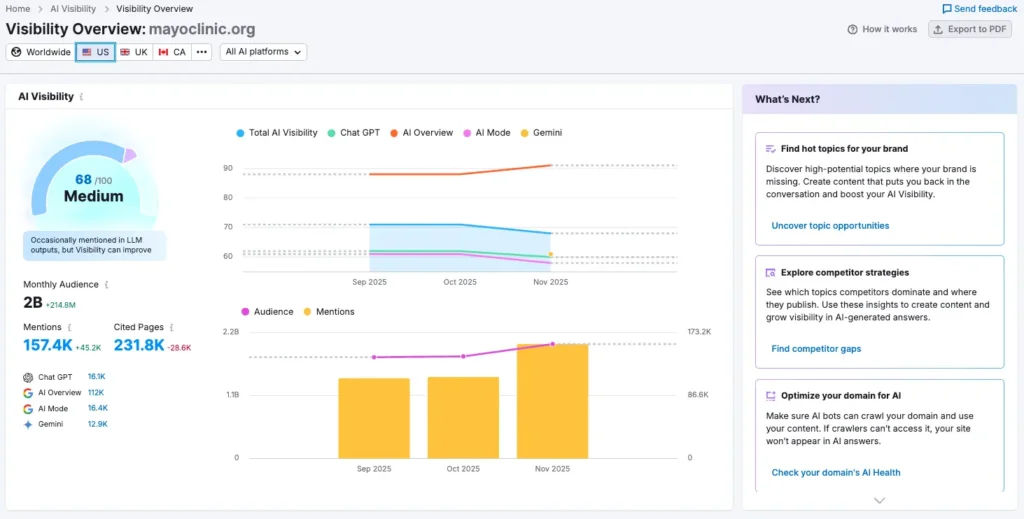
We also set up custom reporting dashboards, allowing you to track your progress over time, identify which AI platforms are driving visibility, and make informed decisions about where to invest.
8. Which Prompts Will You Track, and How Do You Separate Mentions From Citations?
An AI visibility score is only as good as the prompts behind it. If an agency tracks prompts that already include your brand name (“Is [your brand] any good?”), your score will look high without telling you anything about whether buyers find you. Ask to see the actual list.
Then ask how they report what the AI said. A mention is when an answer names your brand. A citation is when the answer shows your website as a link. A source is any page the AI read to build its answer, whether or not it links to it. AI tools often read more pages than they link to, so a page can shape the answer without ever appearing as a link. Good AI Search visibility tracking shows all three.
What a Good Answer Looks Like:
A credible agency will build the prompt list with you, from the questions your buyers actually ask before they shortlist a supplier, and will keep branded prompts separate. In our work, those questions come from sales calls, enquiry forms and the questions people ask at our webinars.
It will also run prompts repeatedly rather than relying on a single check, because AI answers change from day to day. In our own tracking for the 2026 State of AI Search report, ChatGPT returned the same set of cited websites on consecutive days in only 2% of comparisons. A screenshot of one answer proves very little.
Finally, it will report mentions, citations and share of voice against named competitors as separate figures each month, so you can see which one is moving.
9. How Do You Measure AI-Driven Traffic and Conversions?
AI Search visibility means nothing if it doesn’t drive traffic and conversions.
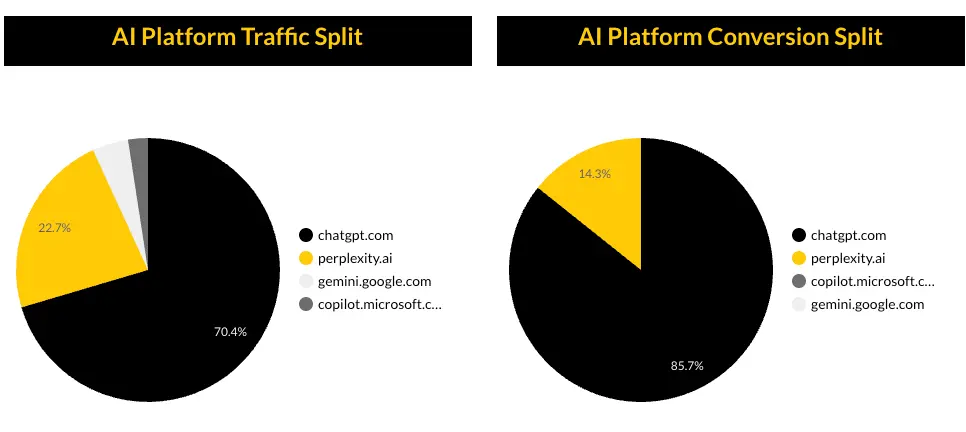
AI-generated traffic behaves differently from traditional search traffic. It often arrives through referral sources like chatgpt.com or perplexity.ai, and without proper setup, it gets buried in generic referral data. You need a clear system to track AI traffic and whether those visitors convert.
If an agency can’t show you how they track AI-driven results in your analytics, they’re not delivering measurable value.
What a Good Answer Looks Like:
A strong agency won’t just talk about visibility; they’ll show you exactly how AI Search Optimisation is impacting your traffic and conversions. That means setting up proper tracking and reporting to measure performance across platforms.
At Exposure Ninja, we provide a fully customised Looker Studio dashboard that gives you complete visibility into your AI Search performance. This includes:
- A clear view of AI-driven traffic over time.
- Breakdown of which AI platforms are driving the most traffic.
- Insights into the top pages receiving AI traffic.
- Conversion data segmented by AI platform, so you can see what’s delivering real business value.
We ensure that you can quantify AI Search visibility in terms of impact and ROI.
10. What Sets Your AI Search Agency Apart?
Most agencies will tell you they’re ahead of the curve, but few can prove it. This question helps you cut through generic claims and assess whether the agency truly understands AI Search and has a track record of delivering results in this fast-moving space.
What a Good Answer Looks Like:
A credible agency will demonstrate thought leadership, proven expertise, and a track record of staying ahead of AI Search trends.
Here’s what sets us at Exposure Ninja apart:
- Pioneers in AI Search: We’ve been implementing and refining AI Search strategies since late 2023, long before most agencies recognised it as a critical channel.
- Award-Winning: We’ve been named the SEO Agency of the Year and Integrated Search Agency of the Year at the Global Agency Awards 2026.
- Industry Thought Leadership: We publish an annual State of AI Search report built partly on our own tracking data. We’ve shared insights at MozCon London, Axel Springer’s Web Performance Summit, and Spotler Live. Our CEO, Charlie Marchant, and founder, Tim Cameron-Kitchen, regularly share what’s working in AI Search on the Exposure Ninja YouTube channel.
11. Do You Have Any AI Search Results?
This is one of the ultimate questions to ask an AI Search agency before hiring them. If an agency can’t show you real, measurable results from their AI Search Optimisation work, they’re not ready to handle yours.
Case studies, data, and proof points matter. Look for specific indicators, such as increases in AI-driven traffic, growth in brand mentions, improvements in citation frequency, and, most importantly, AI Search-attributed conversions and revenue.
What a Good Answer Looks Like:
A strong agency will share concrete examples of how their AI Search Optimisation strategies have delivered measurable outcomes for clients.
At Exposure Ninja, we’re delivering real, measurable AI Search results, including:
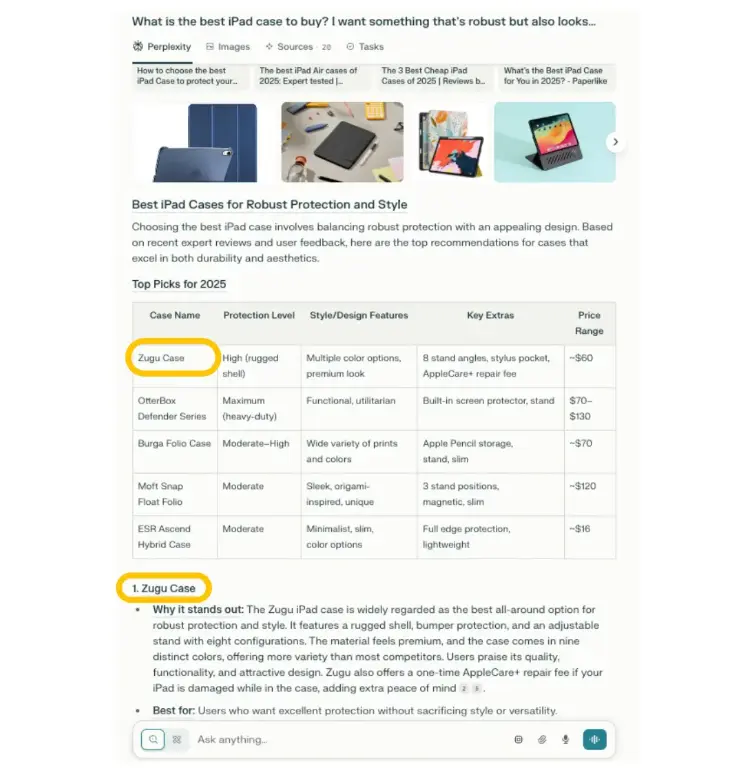
- ZUGU: Our integrated SEO, content and digital PR campaign delivered a 243% increase in AI platform traffic.
- Renew & Sustain: Our integrated campaign secured 171 keywords ranking in position 1, with 94% appearing in AI Overviews.
- The Ordinary: Our early adoption of AI Search Optimisation helped the brand appear in Google AI Overviews and ChatGPT-generated answers.
- Golf Course Lawn Store: Through content restructuring and boosting on-site credibility, we improved its eligibility for Google’s AI Overviews and AI Mode, alongside $459k in organic revenue for Golf Course Lawn Store.
- OPTOMAN: Digital PR, link building and AI Search Optimisation delivered a 31% increase in AI visibility for this B2B laser optics manufacturer.
Red Flags When Hiring an AI Search Agency
Some answers should end the conversation, however good the pitch deck looks:
- Guaranteed Rankings or AI Placements: No agency controls what ChatGPT, Gemini or Google shows. Anyone promising a guaranteed spot in AI answers is selling something they can’t deliver.
- No Prompt List: If they can’t show you which prompts they’ll track, you can’t check their numbers.
- Only Branded Prompts: Prompts that name your brand inflate your visibility score without measuring whether new buyers find you.
- Screenshots as Proof: A single ChatGPT answer isn’t evidence. Answers change daily, so ask for tracked results over time.
- AI Search Sold as a Separate Bolt-On: If their AI Search work ignores your website’s technical health, content and authority, it has nothing to stand on.
- No Link to Revenue: Visibility reports with no traffic, enquiry or sales data can’t tell you whether the work is paying off.
More Questions? Speak to Our AI Search Team
Choosing the right AI Search agency is one of the most important decisions you’ll make for your brand’s future visibility. With AI platforms reshaping how people discover and choose businesses, the agency you work with must be able to demonstrate:
- A clearly defined AI Search Optimisation service.
- A strategy that goes beyond traditional SEO.
- Proven success in creating content that earns AI citations.
- A plan to grow brand mentions across trusted third-party sources.
- A structured audit process that informs all recommendations.
- Multi-AI Search platform optimisation capabilities.
- Access to specialist tools to track AI visibility.
- A transparent prompt list, with mentions and citations reported separately.
- Transparent reporting on AI-driven traffic and conversions.
- A track record of innovation and thought leadership.
- Real-world client results backed by data.
At Exposure Ninja, we’ve been working on AI Search since 2023, long before most agencies entered the space. We were named SEO Agency of the Year and Integrated Search Agency of the Year at the Global Agency Awards 2026, and we’re happy to answer every question on this list.
Ready to put these questions to us? Book a consultation with our AI Search agency team. We’ll review where your business shows up in Google and AI Search today, where your competitors are ahead, and what we’d do first.