7 SEO Trends for 2026 (and How to Master Them)


SEO trends are more than just hype; they’re your competitive edge. Discover how to adapt to the seven most crucial changes this year.
Search Engine Optimisation (SEO) is changing.
AI platforms are transforming how people discover information, Google is integrating more AI into its results, and the rules that once defined a successful SEO strategy are shifting. For marketing leaders, this raises the question: What actually matters for SEO in 2026?
We’re covering the top 7 SEO trends 2026, with expert insights from:
- Charlie Marchant, CEO of Exposure Ninja and international SEO and AI Search speaker.
- Tim Cameron-Kitchen, Founder of Exposure Ninja and host of our 100,000+ subscriber YouTube channel.
- Andrew Tuxford, Head of SEO at Exposure Ninja and the lead strategist behind award-winning SEO campaigns.
1. AI Search Is Mainstream
2025 saw the rise of AI Search.
AI Search is the search experience powered by Large Language Models (LLMs) that generate direct answers, summaries, and recommendations in natural language. Instead of returning a list of ten blue links like Google or Bing, these platforms interpret intent and synthesise information from either the database or the web to provide a human-like response. It includes AI platforms like:
- Google’s AI Overviews, AI Mode, and Gemini
- ChatGPT
- Perplexity
- Claude
- Microsoft Copilot
These platforms have revolutionised how people find information online, leading to a dramatic shift in user behaviour:
- 37% of consumers now start their searches in AI platforms rather than Google.
- ChatGPT alone has 810 million users as of November 2025, an astonishing growth from 1 million users in November 2022.
- OpenAI released data saying that 49% of prompts in ChatGPT are categorised as “asking,” meaning that consumers are actively using the platform for information rather than just task completion.
- A recent study found that AI referral traffic accounts for 1.08% of all website traffic, and is increasing 1% month-over-month (MoM).
This user data shows that AI Search is officially mainstream, but mainstream doesn’t mean dominant.
What You Need to Do
This shift to AI Search doesn’t mean you need to abandon optimising for Google and other traditional search engines.
The Ofcom Online Nations Report 2025 noted that while these AI platforms are changing the search journey, Google still remains the most-used search service, with 3 billion monthly searches in the UK alone.
That means getting to the top of Google should still be a top investment priority for businesses. Andrew Tuxford explains: “At its core, SEO is about making your business visible wherever your customers are searching. Google remains the dominant search platform, so for most businesses it should still command the largest share of investment.”
What you do need to do is to include AI Search Optimisation in your digital strategy. This is the process of improving your brand’s visibility and authority in AI Search so that AI platforms choose your content, products or services, or brand as part of their answers. It’s how you:
- Get your brand and products or services mentioned in AI-generated answers.
- Get your content cited as a source on AI platforms like AI Overviews, AI Mode, or Perplexity.
- Capture more branded searches, AI-driven traffic, and conversions.
With a dedicated AI Search Optimisation strategy working alongside your SEO strategy, you maintain visibility everywhere your audience researches and compares solutions.
This is exactly what we saw with our finance client, Value Capital Funding. Our integrated strategy delivered strong traditional SEO results, including a 172% increase in traffic and a 640% increase in overall conversions. Organic search became a consistent, scalable lead generator rather than something dependent on paid ads.
At the same time, our AI Search Optimisation work increased visibility across platforms like ChatGPT and Perplexity, driving a 1,100% increase in AI-driven conversions.
But more importantly, prospects started mentioning AI tools as their discovery channel. During sales calls, new enquiries increasingly reported that they had asked ChatGPT or similar platforms for recommendations, and Value Capital Funding appeared at the top. This shows how both strong SEO and AI Search are needed to keep driving high-intent leads in 2026.
2. More AI in Google
One of the top AI Search trends this year that will impact SEO is the deeper integration of AI into Google itself.
We already saw AI Overviews become a feature of many search results and the launch of AI Mode in 2025. But in 2026, Google has been clear about its direction of travel.
Google’s CEO, Sundar Pichai, stated in an interview that the current plan is for AI Mode to remain separate, but Google will “keep migrating it to the main page.” In other words, the features being tested in AI Mode will increasingly influence AI Overviews and the core search experience itself.
Andrew Tuxford explains: “Google has been clear that, at some point, AI Mode is likely to become the default search experience. I don’t expect a sudden switch. More likely, Google will continue integrating AI deeper into its standard results until traditional search gradually evolves into something that looks very similar to AI Mode. The fundamentals of SEO won’t disappear, but how content is surfaced and evaluated will continue to change.”
This means the line between Google SEO and optimising for AI Search will start to blur. It also means that Google’s AI systems will increasingly determine your overall online visibility.
What You Need to Do
Charlie Marchant advises not to wait for AI Mode to become the default before you act: “AI Mode doesn’t return the same results as traditional Google. In our testing across multiple industries, we’ve seen it reference different sites, reorder sources, combine content from several pages, and rewrite answers depending on the query. If you assume what works in classic SEO will translate directly, it won’t.”
To prepare for a more AI-driven Google, marketing leaders can use our checklist to rank in AI Mode:
- Define two to three core brand themes and use them consistently across all digital channels.
- Search your brand and products or services in AI Mode to assess how you’re represented and spot gaps.
- Keep your messaging consistent across every owned platform to reinforce clear positioning.
- Create content covering related subtopics to strengthen topical authority.
- Use structured data and clean HTML so AI can easily interpret your content.
- Demonstrate real expertise through named authors, case studies, and updated content.
- Structure content clearly with summaries, FAQs, and concise answers for easy AI extraction.
- Earn credible third-party mentions to increase authority in AI-generated results.
3. Success Metrics Need to Adapt
Zero-click search remains a defining SEO trend in 2026.
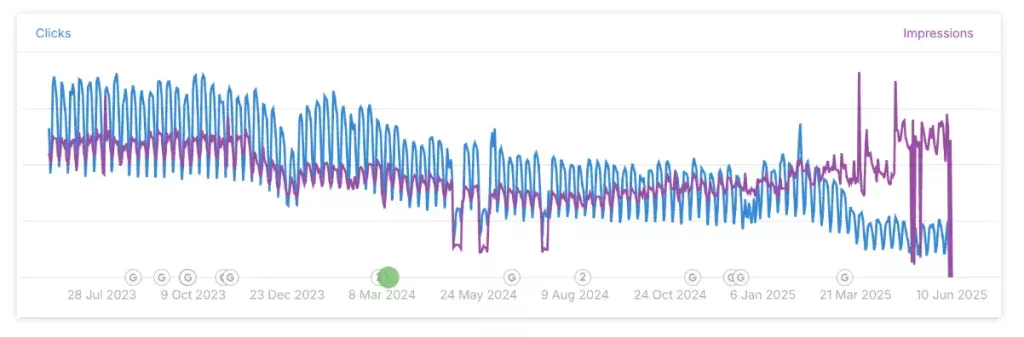
Zero-click search isn’t new, but features like Google’s AI Overviews have intensified the effect. New data shows that AI Overviews correlate with a 58% lower CTR for the top-ranking page, increasing from 35% in March 2025. That means even if you rank in position 1, far fewer users are clicking through to your site.
This has resulted in what Ahrefs has called “The Great Decoupling:” impressions are higher than before, but clicks are at an all-time low.
That puts traffic as a core performance metric in a difficult position. But traffic alone should never have been the primary goal of SEO in the first place.
What You Need to Do
First, it’s important to recognise that AI Overviews are not entirely negative.
Ahrefs analysed 1.9 million AI Overview citations and found that while 76% come from pages already ranking in the top 10, 24% come from pages ranking outside the top 10. Nearly a quarter of citations in AI Overviews is content that previously had little visibility, giving more brands exposure in search results.
They are also shortening the user journey.
In the past, someone searching for “running shoes for flat feet” might read several blog posts to understand the problem and compare options. Today, an AI Overview can summarise the key information in seconds. This moves users more quickly from research to decision-making.
For brands, if your content is cited or referenced within an AI Overview, you gain visibility at the exact moment users are forming their opinions. Even if they don’t click immediately, that exposure can influence which brand they choose later.
So while AI Overviews may reduce top-of-funnel informational traffic, they can also filter out low-intent visitors. Users who click through are often further along in their journey and more likely to convert.
To increase your chances of appearing in AI Overviews:
- Provide clear, concise answers to common questions within your content.
- Structure pages logically with strong headings and well-organised sections.
- Use schema markup and structured data to help Google understand your content.
- Demonstrate expertise with original insights, case studies, and expert authorship.
- Build strong topical authority by covering related questions and subtopics.
- Earn credible mentions and links from trusted external sources.
In 2026, SEO success is no longer just about maximising traffic. It’s about ensuring your brand is visible and trusted in all the answers shaping customer decisions, so that the traffic you get is ready to convert.
If your brand appears in AI Overviews when people are researching a topic, you start to build familiarity and trust. They may see your name in one AI Overview, then again in another search. Even if they don’t click immediately, that repeated exposure positions you as a credible source. And while many users will get what they need directly from the AI summary, it only takes a few who want to explore further for them to click through to your site and engage with your brand.
 Charlie Marchant
CEO
Charlie Marchant
CEO
4. Technical SEO Matters More
Technical SEO has always mattered, and these SEO statistics show why:
- 88.5% of users say slow loading time is the top reason visitors leave a website.
- A one-second delay in page load time can decrease conversion rates by 7%.
- Pages with schema markup see a 40% higher CTR in search results.
But in 2026, it’s not just traditional search results that improve when you have a strong technical SEO foundation. A study by Aiso found that websites with schema markup had a 30% improvement in AI visibility.
Andrew Tuxford explains: “Schema markup is becoming more and more important, but it’s not just covering the basics; it’s about making sure you’re comprehensive in your schema. We believe this will be a really big factor going forward, especially for eCommerce.”
Website architecture is another critical factor. Over time, many sites accumulate hundreds or thousands of pages with inconsistent internal linking or unclear hierarchies. While this was already problematic for SEO, it becomes even more challenging when AI systems attempt to understand relationships between pages and topics.
The big reason behind the need for stronger technical SEO is AI agents. These AI systems don’t just provide answers but actively perform tasks on behalf of users. These agents can interpret prompts, browse websites, gather information, and complete actions such as product purchases.
And they have very little patience for technical issues. Charlie Marchant tested ChatGPT’s Agent Mode by asking it to purchase a bag of coffee and noticed something revealing: “When it ran into a broken page during the test, it didn’t try to figure it out. It just skipped that site entirely and picked the next most relevant one.”
In 2026, technical issues won’t just hurt rankings; they can remove your site from consideration altogether when AI agents are selecting sources.
What You Need to Do
In 2026, a strong technical foundation is essential not only for users and search engines but also for AI platforms and agents navigating the web.
That means ensuring:
- A clear and logical site structure.
- Comprehensive schema implementation.
- Fast loading speeds.
- Minimal site errors such as broken links, 404 pages, and redirect loops.
The best place to start is with a comprehensive technical audit. This will identify structural issues, crawlability problems, and schema gaps that may be preventing both search engines and AI systems from properly understanding your site. From there, you can prioritise the fixes that will have the biggest impact on visibility and performance.
Our work with Russell Regulatory Consultants shows how strong technical foundations can have a dramatic impact on performance.
This niche healthcare consultancy had generated just 24 leads in 12 months before working with us. Their website had limited organic visibility due to several technical issues that prevented search engines from properly crawling and indexing pages.
We began with a detailed technical audit, identifying and resolving key issues across the site. After improving crawlability and increasing the site health score to 90+, we launched the full SEO campaign. Within just six months, the site achieved a 297% increase in leads.
We’re anticipating that schema markup in particular is going to become more important in 2026 because of the rise of AI agents browsing websites. Structured data gives these systems a clear shortcut to understand what’s on a page. For eCommerce businesses especially, comprehensive product schema helps AI tools quickly identify attributes like pricing, availability, and product specifications, which increases the chances of that information being surfaced in AI-generated answers.
 Tim Cameron-Kitchen
Founder
Tim Cameron-Kitchen
Founder
5. AI-Enabled Websites Will Become Standard
One of the biggest predicted SEO trends in 2026 is websites with built-in AI Search.
Businesses are already experimenting with AI agents built directly into their websites. These are not just live chat widgets, but tools that help customers find the right product, compare options, and navigate complex decisions without leaving the site.
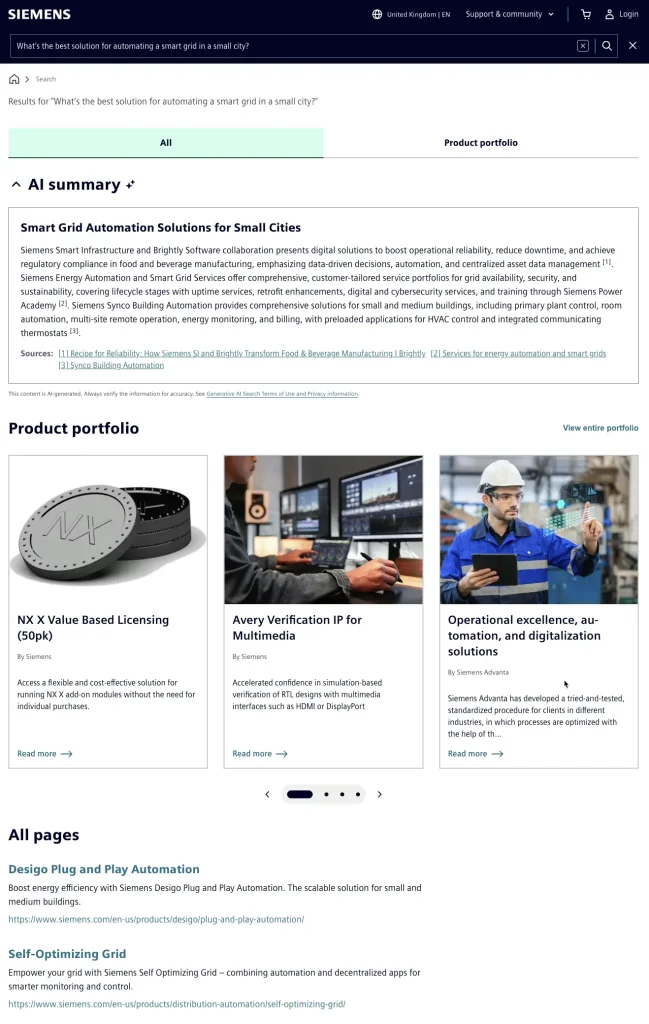
An example of this is Siemens. You can use the advanced AI assistant as a site-wide navigation discovery tool. For example, searching “What’s the best solution for automating a smart grid in a small city?” produces an AI summary, a list of relevant products, and recommended blogs on this search.
Andrew Tuxford says, “This is going to be similar to the implementation of site search. Sites never used to have it, now it’s incredibly common and almost unheard of for an eCommerce site to not have it.”
Tim Cameron-Kitchen adds: “This means that SEO is not just about optimising your website for humans, but it’s also about optimising your website so that these AI crawlers can find the information that they need.”
The latest SEO trends increasingly point to this blurring of lines between SEO, UX, and AI implementation.
What You Need to Do
Start by understanding how visitors actually use your website today. Analyse behavioural data such as heatmaps, session recordings, internal search queries, and drop-off points in analytics to identify where users struggle to find information or complete tasks. These friction points are the best opportunities for AI-enabled assistance.
Next, identify one or two high-impact use cases where on-site AI could meaningfully improve the experience. For many businesses, the most valuable areas include:
- Product Discovery: Helping users quickly find the right product or service based on their needs.
- Complex Decision Support: Guiding users through comparisons, specifications, or configuration choices.
- FAQ and Support Queries: Answering common questions instantly without requiring users to search multiple pages.
- Content Navigation: Recommending relevant articles, guides, or resources based on the user’s query.
The goal is to solve real user problems that currently slow down or interrupt the customer journey.
6. Authority Signals Are Not Just Backlinks
For years, the SEO playbook for authority was clear: get more backlinks from reputable sites. That still matters, but the definition of authority has expanded, and leaning on backlinks alone is no longer enough.
Charlie Marchant explains: “We know that Google cares about backlinks, and for a long time, SEO has been focused on making sure that we’ve got a specific hyperlink on specific anchor text.
Now that we’re evolving and AI Search is coming to the forefront as well, AI doesn’t require a hyperlink to understand the business being mentioned. Much more important is the context around that business’s name being mentioned or the products that are mentioned, because AI can read and understand that context as well.”
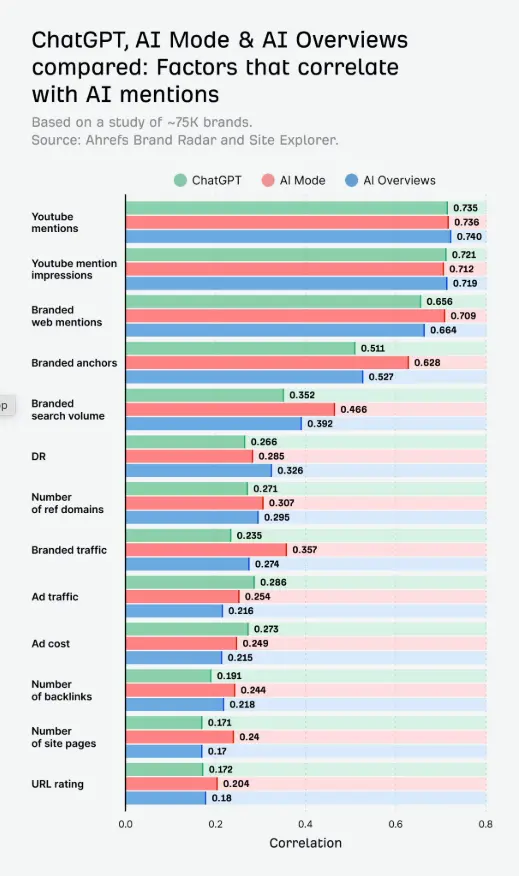
A recent study by Ahrefs confirms this. When analysing 75,000 brands, they found that branded web mentions had a stronger correlation with visibility in AI Mode, AI Overviews, and ChatGPT than the number of backlinks.
What You Need to Do
This makes securing brand mentions, even without the link, a key SEO trend to focus on in 2026.
Here are some practical steps you can take:
- Broaden how you define authority. Backlinks still matter, but the goal is now broader brand visibility and credibility across the web, not just link acquisition.
- Audit your off-site presence. Look beyond backlinks and analyse where your brand is mentioned, discussed, reviewed, or recommended across media sites, communities, and industry platforms.
- Develop a digital PR strategy. Focus on earning coverage in reputable industry publications, podcasts, newsletters, and expert roundups where your brand is referenced within a relevant context.
- Become a cite-worthy brand. Publish expert insights, original data, guides, and opinion-led content that journalists, creators, and AI systems are likely to reference when discussing your topic.
- Track branded search growth. Monitor branded search volume and brand queries as indicators of increased awareness and authority generated by your PR and visibility efforts.
We applied this approach with our client ZUGU, combining SEO, content marketing, and targeted digital PR to secure coverage in major tech publications, including WIRED and ZDNet. These mentions strengthened the brand’s authority signals and helped ZUGU gain visibility in AI-generated answers across platforms like ChatGPT and Perplexity, driving a 243% increase in AI-driven traffic.
7. Brand Clarity Will Be Your Differentiator
The difference between brands that simply do SEO and those that dominate search in 2026 will increasingly come down to brand clarity.
For years, SEO strategies have often focused on analysing competitors and replicating what already works in the SERPs. While competitor analysis still has value, it rarely leads to true differentiation.
Andrew Tuxford explains: “The brands that tend to perform best are the ones that are very clear about who they are and how they provide value to their customers. They really understand what makes them different and lean into that.
Looking at competitors can give useful insights, but if you’re just doing what they do, you’re unlikely to beat them. The brands that win are the ones that go beyond that. They understand where they excel, what makes them special, and they build their strategy around it.”
This matters even more in AI Search. AI systems don’t just analyse keywords or backlinks; they interpret entities, context, and brand signals across the web. If your positioning is vague or inconsistent, AI struggles to understand what your business actually stands for.
Clear positioning helps AI systems and customers quickly understand who you are, what you do, and why you’re the best choice.
What You Need to Do
Start by defining your core brand positioning.
Write a single sentence that clearly explains what your business does, who it serves, and why it’s different from competitors. If this statement isn’t obvious and memorable, neither search engines nor customers will fully understand your value.
Then audit your website and marketing channels. Your homepage, service pages, and About page should clearly and consistently reinforce the same positioning. Visitors and AI systems should immediately understand your expertise and the problem you solve.
Then extend this clarity beyond your website. The context around your brand mentions in media coverage, reviews, podcasts, and industry discussions should reinforce the same story about what makes your business distinctive.
This is exactly what our Branding and Positioning Accelerator is designed to deliver. In a focused 4–6 week process, we analyse your customers, competitors, and current brand to rebuild your positioning, messaging, and core brand assets so your business becomes clearer, more differentiated, and easier to choose.
How to Keep up with SEO Trends
In 2026, some SEO fundamentals remain the same, while others are changing quickly. Certain tactics are becoming less effective, while new opportunities are emerging across AI Search, technical optimisation, and brand authority.
For busy marketing leaders already juggling campaigns, budgets, and team priorities, keeping up with these shifts can feel overwhelming.
That’s where we come in. At Exposure Ninja, we regularly share practical insights to help businesses stay ahead of the latest search trends.
- On the Exposure Ninja YouTube channel, Tim Cameron-Kitchen breaks down strategies, emerging trends, and real-world brand examples to show what’s working in search today.
- Our podcast, hosted by Charlie Marchant, explores the latest developments in SEO and AI Search, translating industry updates into practical strategies for business growth. You can listen on Spotify or Apple Podcasts.
- On our blog, our team publishes in-depth guides covering everything from foundational SEO principles to advanced enterprise SEO strategies for scaling organic growth in competitive markets.
The Future of SEO Is Here: Is Your Business Ready?
The future of SEO is dynamic, exciting, and full of opportunities. Success will depend on your ability to rethink traditional strategies and focus on what your audience truly needs.
Want to know how your website stacks up against these new SEO trends? Request a website and marketing review today and future-proof your SEO strategy.
FAQs
What is the future of SEO in 2026?
The future of SEO in 2026 involves adapting to AI Search, strengthening technical SEO foundations, and building clear, authoritative brands that Google and AI systems recognise and cite. Businesses that embrace these SEO trends will stay ahead.
Will SEO be replaced by AI Search?
No. As Charlie Marchant, CEO at Exposure Ninja, puts it: “AI will change how SEO works but won’t replace it.”
Is SEO still relevant in 2026?
Absolutely. Even as AI Search grows, Google retains the majority of the search market. A well-executed SEO strategy in 2026 should optimise for traditional Google results and AI platforms simultaneously, with the balance determined by where your specific audience spends their time.
What is the most important SEO trend in 2026?
The single most impactful shift is the mainstream adoption of AI Search. Businesses that build an integrated strategy combining technical SEO, brand clarity, and AI Search Optimisation in 2026 will be significantly ahead of competitors who are still treating SEO as purely a Google optimisation exercise.