AI Search Trends for 2026: What Marketing Leaders Need To Do


We cover the top five AI Search trends and predictions shaping 2026, what these shifts mean for marketing leaders, and show how CMOs can act now to stay ahead of the competition.
Proactive CMOs aren’t ignoring AI Search.
They recognise that platforms like ChatGPT, Perplexity, and Google’s AI Overviews are reshaping how people search, compare, and buy.
They’re already integrating AI Search Optimisation into their digital strategies to stay visible in AI-generated answers, not just traditional rankings.
And they’re paying close attention to the AI Search trends set to define 2026, including:
- The decline of traditional organic traffic.
- The rise of AI agents as buyers.
- The commercial intent of AI prompts.
- The shift toward paid visibility in AI platforms.
- More AI in Google.
We’ll unpack where these AI trends are coming from, what they mean for your business, and the steps CMOs can take now to stay competitive in AI Search.
1. Search Traffic is Shifting
2025 saw organic traffic take a major hit as AI Search became the default way many users search for information.
If you noticed a drop in website traffic last year, you aren’t alone. Site owners on Reddit were worried about a 66% drop in website visitors. DMG Media (which owns publications like Daily Mail and Metro) reported an 89% decline in click-through rates (CTRs) in July 2025. Even major sites like HubSpot saw dramatic declines in organic traffic.
This trend is related to the rise in zero-click search. According to SparkToro, 58% of all Google searches in the U.S. now end without a click, with HubSpot’s CEO, Yamini Rangan, referring to this as a “traffic apocalypse” at INBOUND 2025.
There are two main drivers behind this shift:
- Explosive Growth of AI Platforms: In August 2025 alone, ChatGPT had over 5 billion visits. Perplexity and Claude had 176 million and 167 million visits, respectively. That’s a lot of people turning away from traditional search engines to find answers to their questions.
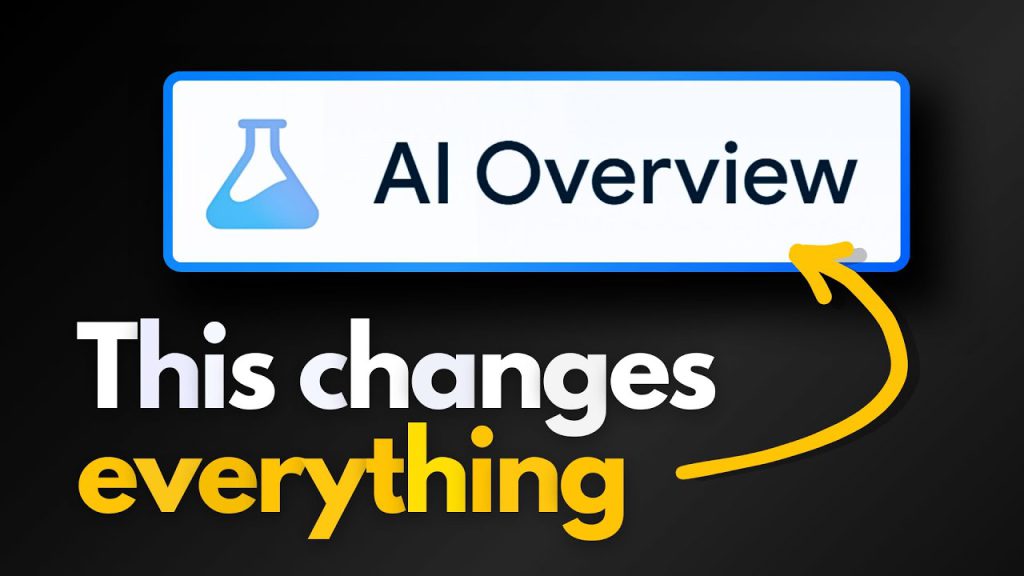
- Google’s Rollout of AI Overviews: Google’s AI Overviews aggregate information from multiple sites and display it above organic results. According to a recent study, this feature has reduced CTRs by up to 80% in some industries.
At the time, this didn’t look like it would slow down. Gartner predicted search engine volume could drop by as much as 25% by 2026, while Semrush forecast that AI Search visitors would surpass traditional search visitors by 2028. It seemed like the beginning of the end for organic search traffic.
But a recent study sheds new light. After reviewing 40,000 of the largest U.S.-based websites, researchers found an overall traffic decrease of 2.5% year-on-year (YoY). While that is a definite drop, it’s not a total collapse.
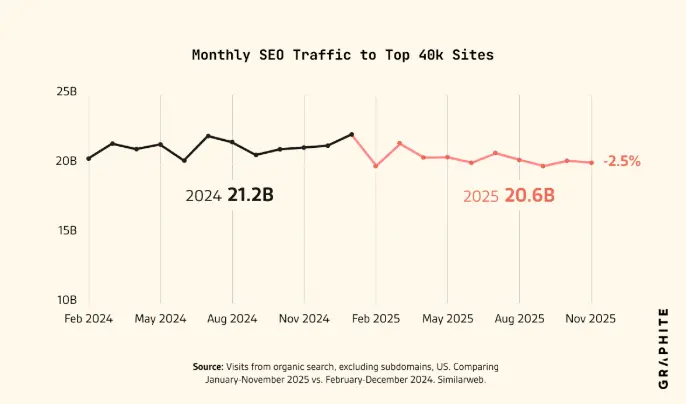
This shows that Search Engine Optimisation (SEO) is still incredibly relevant in 2026. Google still dominates the search engine market share, bringing in a massive 98.2 billion global visits monthly. And according to the latest data, 52.7% all searches are still informational, and 14.5% have commercial intent. This means people are still using Google to research and buy, and you need an SEO strategy to capture this traffic.
But the way AI Search is reshaping user behaviour means SEO alone is no longer enough. To stay competitive, your website needs to do more than rank. Your brand and pages need to be mentioned and cited within AI-generated answers, whether that’s an AI Overview or ChatGPT response.
That’s where two major opportunities emerge:
- AI Referral Traffic: When your content or pages are cited, it allows users to click the link straight to your website. This presents a new traffic channel opportunity, and according to Ahrefs, 63% of the websites they analysed had already received referral traffic from AI-generated answers.
- Citations Build Brand Salience: Even if a user doesn’t click immediately, seeing your brand cited in multiple AI answers primes them to return later. When they are closer to a purchase decision, they are more likely to search for your brand directly thanks to your strong AI Share of Voice (SoV).
To succeed in 2026, you need to continue optimising for traditional search while also building an AI-friendly content strategy that earns citations, driving AI referral traffic and brand recall.
Here’s the CMO action plan:
- Audit your traffic sources and benchmark your organic search performance.
- Start tracking AI referral traffic from ChatGPT, Perplexity, Claude, and Google’s AI Overviews.
- Optimise content to be structured, credible, and citation-worthy for AI systems.
- Maintain strong SEO performance to continue capturing commercial-intent search traffic.
- Build an AI Search Optimisation strategy to future-proof your visibility across all search channels.
2. AI Agents Will Become Your New Buyers
AI agents are becoming customers, and your website and paid media campaigns need to be ready.
In 2025, agentic AI became a reality:
- ChatGPT released Agent Mode in July 2025, which is “bridging research and action” using the live web. This feature can perform tasks, like buying recipe ingredients or booking a flight.
- ChatGPT also rolled out Instant Checkout in September 2025, allowing users in the U.S. to buy directly from Etsy sellers within the platform. Shopify connection is coming soon, which will take agentic commerce to the next level.
- Google’s AI Mode agentic capabilities were rolled out, letting individuals use AI to book restaurants, buy event tickets, and more.
2026 has come with even more updates. Google released three major search shifts in the first few weeks of this year, including Universal Commerce Protocol (UCP). The UCP framework enables product discovery and checkout directly inside AI Mode and Gemini, allowing users to complete purchases without visiting your website.
In a recent interview with Clutch, Charlie Marchant, CEO of Exposure Ninja, explains, “Online shopping is a manual process: opening multiple tabs, comparing products, reading reviews, and going back and forth for days before making a purchase decision. Agentic AI compresses all of that into minutes.”
As AI agent functionality becomes more powerful and more accessible, adoption is likely to increase, especially among digital-first and convenience-driven consumers. A 2024 Salesforce study found that:
- 33% of consumers would rather purchase through an AI agent than interact with a person.
- 24% of consumers are already comfortable with AI agents shopping for them. Among Gen Z, that number rises to 32%.
This means websites can no longer be built solely for humans. You are now designing for both people and intelligent agents acting on behalf of users.
These AI agents evaluate websites differently, based on structure, data clarity, and the ability to complete a task efficiently. To remain competitive, this will require a few changes to your website, including:
- Schema markup must be implemented across all product pages to allow AI agents to extract key information like price, availability, and delivery options.
- Agentic or API-based checkout allows AI agents to complete purchases directly by integrating with platforms like Instant Checkout or Stripe, without requiring user input.
- Product pages need detailed content, including technical specs, comparison tables, FAQs, and user reviews, all structured for easy parsing.
But AI agents are not just analysing the organic content on your website; they are also interacting with paid ads in their live search.
A 2025 research paper from the University of Applied Sciences Upper Austria looked at how AI agents interact with ads in the travel and hotel sector. The study found that keyword-aligned, text-based ads outperformed image-led formats across most metrics. AI agents responded more consistently to ads with clear, structured, and query-matched language.
This means your paid search strategy also needs to evolve. Traditional creative-led campaigns still have value, but they must be balanced with performance-focused formats that work for AI buyers as well.
What CMOs need to do now:
- Audit your website for AI agent readiness.
- Enable agentic or API-based checkout so agents can complete purchases without manual input from users.
- Enrich product pages with structured, detailed content.
- Optimise your paid search strategy to prioritise clear, keyword-aligned, text-based ads that are easily understood by AI systems.
3. Commercial Intent Prompts Will Grow
There is still a common assumption that AI platforms are primarily used for informational queries or content generation. In 2026, that’s no longer true, making this one of the most commercially significant AI Search trends.
Throughout 2025, user behaviour shifted. People are moving beyond simple informational queries and using AI to support actual buying decisions.
The data confirms this shift:
- An AI Search intent study by Profound found that 9.5% of ChatGPT prompts are commercial in intent.
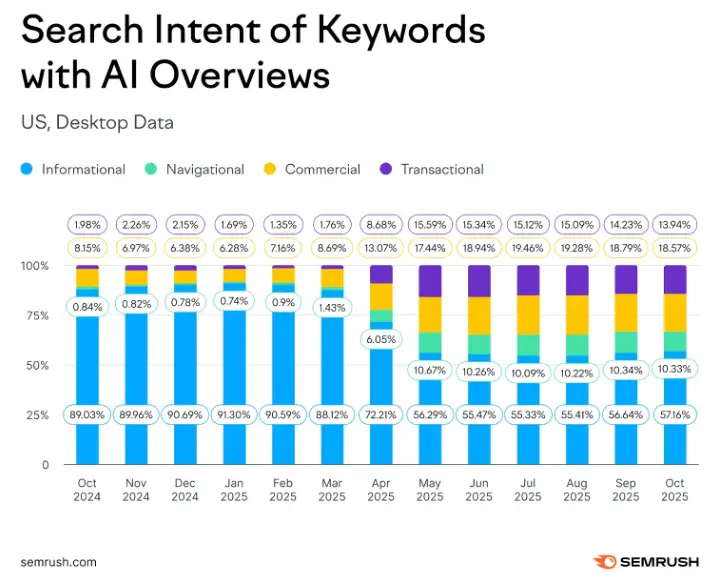
- Commercial keywords triggering an AI Overview increased by 128% YoY, rising from 8.15% in October 2024 to 18.57% in October 2025, according to Semrush.
Commercial intent inside AI platforms isn’t just growing, it’s converting.
Adobe’s 2025 holiday season data revealed that traffic from generative AI tools increased by 693% YoY for retail alone. Travel saw a 539% increase, financial services 266%, tech and software 120%, and media 92%. More importantly, AI-driven traffic converted 31% higher than other traffic sources, nearly doubling YoY.
They also found that the users landing on sites from AI platforms were:
- 33% less likely to bounce
- Spending 45% more time on-site
- Viewing 13% more pages per visit
When you combine rising commercial prompts with higher conversion rates, the implication is clear:
AI platforms are no longer just influencing awareness. They are influencing revenue.
For CMOs, this changes priorities. It’s not enough to win informational visibility. You must win decision-stage visibility inside AI platforms.
What CMOs need to do now:
- Identify high-value commercial prompts your buyers are likely to ask AI tools.
- Create structured comparison and decision content that aligns with real commercial prompts.
- Strengthen credibility signals, like case studies, testimonials, awards, and third-party brand mentions, that AI systems can reference confidently.
- Align landing pages to decision intent to ensure pages receiving AI traffic are conversion-ready.
- Monitor AI-driven traffic and conversion metrics and compare against other channels.
4. Rise of Pay-to-Play AI Visibility
Paid placements are entering AI-generated responses, and brands will need to pay for visibility in high-intent queries, just like they do in search today.
AI platforms are shifting toward monetisation. Here’s what we know so far:
- Back in November 2024, Perplexity announced experimenting with advertising in the form of sponsored follow-up questions in the U.S. with pilot groups. In early 2026, Perplexity announced abandoning ads.
- Ads went live within Google’s AI Overviews in October 2024 for mobile users in the U.S.
- OpenAI launched ad testing in ChatGPT in the U.S. in February 2026.
- Google is testing a new shopping ad format in AI Mode as of February 2026.
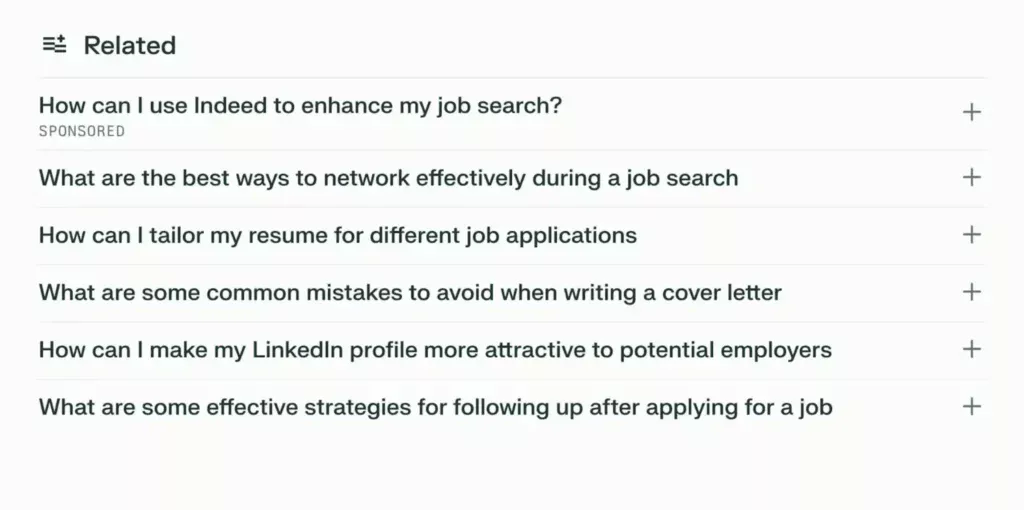
“Ad placements in AI answers are inevitable,” says Charlie Marchant. “Billions of people use Google every day and accept ads as part of the experience. We tolerate Spotify ads between songs because we understand the trade-off for a free product. The same logic will likely apply here.
Initially, there’ll be pushback, but over time, ads in AI responses will become the new normal, just like they did with search.”
This marks a turning point. The AI platforms users trust for quick, accurate answers will soon become monetised spaces. For brands, this brings a clear opportunity and challenge:
- Opportunity: AI platforms surface answers to highly targeted, high-intent prompts. Early advertisers may benefit from lower competition, better placement, and more contextually relevant exposure.
- Challenge: Unlike Google Ads or Microsoft Ads, AI ad placements will be new and potentially require a new ad format playbook.
What CMOs can do to prepare:
- Monitor ad rollout developments across Perplexity, AI Mode, AI Overviews, and ChatGPT.
- Allocate experimental budget to test emerging AI Search advertising opportunities.
- Prepare your teams to adapt creative and landing page formats for AI-native ad delivery.
5. More AI Embedded Into Google
Google has been clear about its direction of travel.
In an interview, Google’s CEO, Sundar Pichai, stated that the current plan is for AI Mode to remain separate, but Google will “keep migrating it to the main page.” In other words, the features being tested in AI Mode will increasingly influence AI Overviews and the core search experience itself.
Charlie Marchant adds, “AI is going to become a deeper part of the search experience, which means marketers need to test it now and understand how it behaves. AI Mode doesn’t return the same results as traditional Google. In our testing across multiple industries, we’ve seen it reference different sites, reorder sources, combine content from several pages, and rewrite answers depending on the query. If you assume what works in classic SEO will translate directly, it won’t.”
This means the line between Google SEO and AI Search Optimisation will start to blur. It also means that Google’s AI systems will increasingly determine your visibility, not just for informational queries, but also for commercial and transactional ones.
We’ve put together an 8-step AI Mode checklist CMOs can use to start ranking in AI Mode now, in preparation for the changes expected in 2026.
Is Your Business Ready for AI Search in 2026?
Our five AI Search trends and predictions for 2026 reveal a clear shift in how people search, choose, and make purchases.
If your business isn’t earning visibility in AI answers, enabling agent-friendly checkouts, or preparing for AI platform advertising, you’re at risk of falling behind.
But if you’re ready to get your business ready for AI Search in 2026, we can help. Request a website and marketing review, and we’ll audit your current SEO and AI Search readiness. We’ll then give you clear next steps to improve visibility and performance in 2026.
FAQs
What is the future of AI Search?
AI Search is moving toward becoming the dominant way people discover information, compare options, and make buying decisions. Traditional search will remain relevant, but AI-generated answers will increasingly mediate the journey between question and purchase. The future will likely involve a hybrid landscape: organic rankings, AI citations, and paid AI placements all playing a role in brand visibility.
Which AI tool is trending now?
ChatGPT continues to dominate, holding an 80.49% global market share among AI chatbots like Perplexity, Microsoft Copilot, Gemini, and Claude.
Will I need a prompt strategy like I have a keyword strategy?
Yes, and the businesses that build one early will have a significant advantage. A prompt strategy isn’t about replacing keyword research. It’s about understanding the full context of your buyers’ decisions and mapping content to the prompts they’re likely to use in AI platforms at each stage of the funnel.
Can I pay to be featured in AI answers?
It depends on the AI platform. Google has started rolling out ads in AI Overviews, and Perplexity is testing sponsored answers. OpenAI hasn’t launched ads in ChatGPT yet, but job listings suggest it’s coming soon.
Is it too late to get ahead of this AI Search shift?
No, but waiting much longer puts you at a disadvantage. The shift to AI Search is already reshaping how buyers discover and evaluate options, and most businesses haven’t adapted yet. Acting now gives you a chance to build visibility, earn citations, and test ad strategies before your competitors catch up.