What to Look for in a Great Marketing Agency Pitch


Not all marketing agency pitches are worth your time. This guide shows marketing leaders how to evaluate a marketing agency pitch with confidence.
A business owner recently forwarded me a marketing pitch they had received. They weren’t sure whether to move forward, and needed someone with marketing experience to help them decide if the offer was good.
There was no meeting or context, just a generic slide deck sent cold via email. It listed a wide range of services with hefty price tags, but failed to explain what the business would actually receive or the expected outcomes.
This situation is far too common. Too many marketing agency pitches are built to impress visually but lack strategic thinking, commercial relevance, and a clear roadmap to results.
That’s why we’re outlining what you should expect from a high-quality marketing agency pitch and how to evaluate whether an agency is worth your time and investment.
Before the Agency Pitch
Develop Your Brief
Before shortlisting agencies, start with a clear brief or formal Request for Proposal (RFP). This is the foundation of any worthwhile pitch process.
Developing the brief first ensures you know exactly what you’re asking agencies to solve. Without it, you risk attracting vague proposals that focus more on the agency’s service list than your business goals. A strong brief gives structure to your selection process, making it easier to identify which agencies understand your needs and which are simply selling a one-size-fits-all approach.
Your brief or RFP should include key information such as:
- Your business objectives and marketing goals
- Current performance and challenges
- Target audience and competitive context
- Budget range and timelines
- Internal capabilities and resource gaps
- How you’ll define success.
Taking the time to document this upfront allows agencies to craft tailored, relevant pitches. It also helps internal stakeholders align on what you’re really looking for in a marketing partner.
Create an Agency Shortlist
Once you have your brief or RFP in place, it’s time to identify which agencies you actually want to hear from.
Choosing a marketing agency is a strategic decision. A focused shortlist leads to stronger pitches, clearer comparisons, and faster decision-making. Aim for three to five agencies that align with your needs, budget, and internal setup.
Here are some key tips to build a solid shortlist:
- Start with your scope and goals. Match agencies to the type of work you need, whether that’s SEO, AI Search Optimisation, or full digital marketing services.
- Review case studies and client results. Look beyond headlines and focus on commercial outcomes, strategy, and relevance to your business challenges.
- Understand their service model. Decide whether you need a full-service agency for integrated campaigns or a specialist for one priority channel. Each has pros and cons depending on your internal resources.
- Check cultural and operational fit. Beyond capability, consider how the agency works. You’ll get better results with a partner who collaborates well with your internal team.
Schedule a Discovery Call
Once you’ve reached out to your shortlisted digital marketing agencies, the next step is the discovery call.
Any agency that doesn’t request a discovery call before preparing its pitch can be removed from consideration. A discovery call is a necessary step in building a strategic, relevant proposal. If an agency is willing to pitch without fully understanding your business, objectives, and challenges, they’re not developing a solution worth your time.
Discovery calls also aren’t about selling; they’re about gathering the information needed to deliver a focused, strategic response. If the agency isn’t curious at this stage, don’t expect their pitch to reflect much understanding either.
What a Great Marketing Agency Pitch Should Include
Your Current Situation, Goals, and Constraints
A strong agency pitch should begin with a clear summary of your current position. They should explain your marketing challenges, commercial goals, and any limitations that might affect results.
Look for evidence that they have assessed your situation. That might include commentary on your current drop in website traffic, the quality of your leads, visibility in key markets, or issues with conversions. These details show they have taken the time to understand what is and isn’t working.
This proves the agency has done its homework. If they only repeat your words from the brief or discovery call without adding insight or context, they haven’t done the work.
They should then connect this analysis to your goals. For example, increasing visibility in specific locations, generating a set number of high-quality leads per month, or attracting larger clients. This shows they are thinking strategically and aligning their recommendations to what matters most to your business.
Constraints also matter. Whether it’s a limited budget, lack of internal resource, or upcoming changes to your website, a good agency will factor these into their approach from the start.
This section of the pitch should give you confidence that the agency understands your current reality and is thinking clearly about how to move your business forward.
The Market Reality You’re Competing In
Exceptional agencies don’t lead with tactics. They start with context.
This part of the pitch should demonstrate a clear, informed view of the external forces shaping your marketing performance. That includes:
- How your competitors are positioning and differentiating.
- Where new threats and growth opportunities are emerging.
- The shift toward zero-click search and AI-influenced buying behaviour.
AI Search must be part of this analysis. Platforms like ChatGPT, Perplexity, Gemini, and Google’s AI Overviews and AI Mode are changing how buyers discover and evaluate providers. Getting to the top of Google is no longer enough. If your content isn’t optimised for these new formats, you’re already at a disadvantage.
A forward-thinking agency will explain how these shifts impact your sector and how your business can adapt to maintain visibility and relevance. That might mean optimising your blog strategy for AI visibility or updating your schema markup to support faster retrieval and semantic relevance.
This section is where your digital marketing strategy starts to take shape. It tells you why results have been hard to come by, where others in your space are gaining ground, and what’s needed to break through.
The Recommended Strategy and Why It Will Work
This is where most pitches either stand out or fall flat.
A strong strategy section is directly tied to your goals. It should walk you through the logic, not just the tactics. If the target is 200 qualified leads per month and your current conversion rate is 2%, the agency should calculate the traffic required and show how they will generate those visits.
This part of the pitch is about prioritisation, not just activity. You do not need an agency to list services. You need a clear explanation of which channels will drive the fastest and most sustainable returns, and in what order.
For example, if they recommend starting with website redesign, branding, and conversion rate optimisation (CRO) before targeted PPC, they should justify that decision based on ROI, time to impact, and existing funnel gaps.
This section should leave you with a clear, confident answer to a simple question: Does this strategy give us the best path to hitting our goals?
What Working With the Company Looks Like
A strong marketing agency pitch explains the partnership, not just the services.
This section should outline how the agency works with clients day to day. It should cover:
- The team members you will work with and their responsibilities.
- How the strategy will be delivered over time.
- How approvals, feedback, and communication will be handled.
This is a great moment in the pitch to ask about their client retention rate. Agencies with retention above 90% usually focus on long-term performance and consistent delivery. If retention is low or not addressed at all, it may suggest issues with delivery, results, or communication.
You are not just buying a marketing service. You are choosing a team to work alongside your business. This section of the pitch should make it clear what that working relationship will look like from day one.
Relevant Case Studies and Results
This is where the agency proves they can deliver.
Strong marketing agency pitches include a few case studies that closely align with your goals, market, or challenges. These examples may not be publicly available, making this an opportunity to see results that directly support the strategy they’re proposing.
Each case study included in the pitch should include:
- The client’s starting point and challenges.
- The strategy and tactics used.
- Specific results, tied to timeframes and commercial outcomes.
- Evidence of ongoing performance or long-term impact.
Look for real numbers. Phrases like “boosted traffic” or “improved leads” are meaningless without context. You want specifics, such as “600+ Leads for B2B Energy Consultants,” “Data-Led Strategy Drives 395% ROI for The Ordinary,” or “129% Conversion Rate Boost for Eco Retrofitter.”
You can also use this part of the pitch to ask deeper questions, such as:
- What didn’t go to plan?
- How long did it take to see results?
- What would they approach differently next time?
The answers will reveal whether the agency understands how to learn, adapt, and scale, or whether they’re just showing highlight reels.
How Success Will Be Measured and Reported
This is where a great agency demonstrates how they track performance, report results, and stay accountable.
A strong pitch should clearly define what success looks like, how it will be measured, and how often you’ll be kept informed. That means prioritising commercial KPIs, like leads, revenue, and conversion rates, not just surface-level metrics like impressions or sessions.
You should expect:
- Defined success metrics tied to your goals.
- Reporting frequency and review process.
- Clarity on which tools and dashboards you’ll use.
The best agencies connect marketing activity to real business outcomes. “50,000 website visitors” means very little without conversion context. “50,000 visitors generated 200 qualified enquiries at £125 per lead” shows commercial understanding.
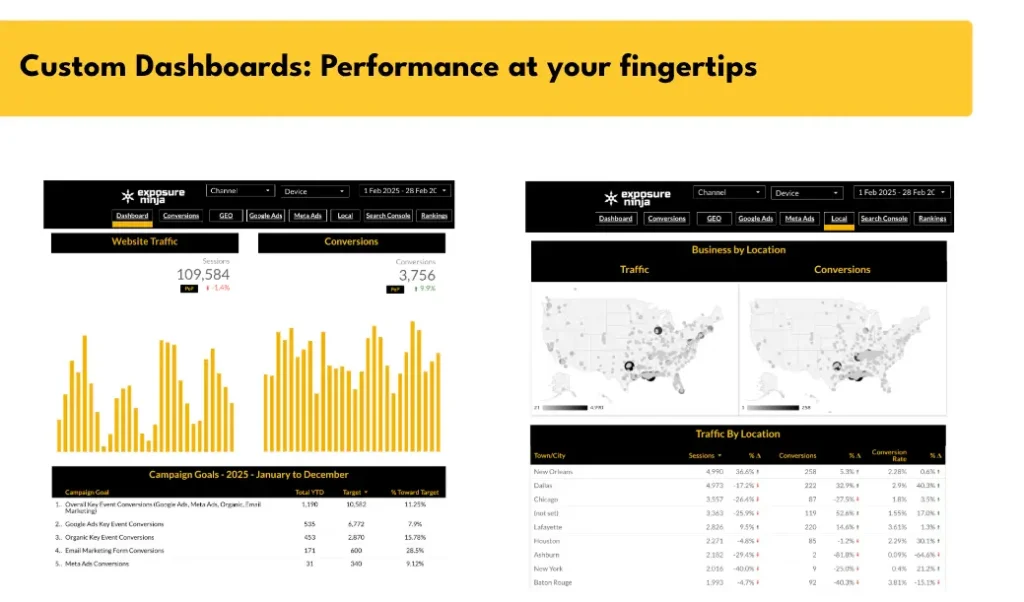
At Exposure Ninja, we provide custom analytics and data dashboards built in Looker Studio, combining data from Google Analytics 4 (GA4), Google Search Console, Google Ads, and more. You’ll have full visibility into campaign performance by channel, region, and conversion path, updated in real time, accessible whenever you need it.
It’s also worth asking how the agency handles underperformance. Do they review and adapt proactively, or wait until you raise concerns? The answer reveals how seriously they take ownership of your results.
Investment and Scope
This part of the pitch should include a clear recommendation on investment and scope, whether through a monthly retainer or a one-off project.
The agency should outline:
- The recommended investment level.
- What’s included in that fee.
- Timelines, deliverables, and reporting frequency.
If a retainer is suggested, the pitch should specify what will be delivered each month, such as technical SEO, Google Ads, content marketing, and strategy support.
If a one-off project is proposed, such as a website redesign, the agency should define the scope, cost, expected outcomes, and what happens next.
There should be no vague pricing or open-ended scopes. A great agency will explain exactly what you’re paying for, why it matters, and how it supports your goals.
Next Steps and Decision Process
A strong pitch ends with a clear and professional outline of what happens next.
This section should include:
- Your decision deadline.
- Contract and start date.
- Onboarding process and key contacts.
- Initial campaign setup and launch timeline.
- First reporting and review checkpoint.
This shows the agency has a structured process and respects your time. Agencies that offer clarity and space to make the right decision build credibility. Those who use pressure tactics or limited-time pricing undermine it.
How to Compare Agency Pitches and Make the Right Decision
You’ve now reviewed at least three agency pitches. Now comes the decision, but how do you choose?
The easiest way to approach this is to create a simple scorecard covering these dimensions:
- Understanding: Did they show a clear grasp of your business, market, and challenges?
- Strategy: Was their approach logical, prioritised, and tied to your specific goals?
- Evidence: Were the case studies relevant, detailed, and commercially credible?
- Chemistry: Can you see yourself working with this team when things get tough?
- Transparency: Were they honest about risks, timelines, and expected investment?
Score each agency from 1 to 10 in each area. The top score often points to the best fit, but gives extra weight to chemistry and transparency. A technically capable agency is only valuable if you can trust them and collaborate effectively.
You can also use this time to request references. Speak to current and former clients, if possible, and ask about real experiences, including how the agency handled challenges, not just the wins.
Trust your instincts on cultural fit. You’ll be sharing sensitive business data and making strategic decisions together. If something feels off, there’s usually a reason.
Ready to Hear the Best Marketing Agency Pitch?
If you’re looking to add an award-winning digital marketing agency to your shortlist, consider Exposure Ninja.
We specialise in search marketing for B2B and B2C lead-generation businesses, helping brands drive more leads, revenue, and ROI through SEO, AI Search Optimisation, and PPC.
Here’s what our pre-pitch process looks like:
- You request a free website and marketing review.
- A marketing consultant schedules a call to understand your goals and challenges.
- We produce a tailored review video that analyses your website, current marketing performance, and opportunities for growth with clear, actionable recommendations.
- You review the video in your own time, then join us for a follow-up call to ask questions and explore the next steps.
If there’s a strong fit, we move into the formal pitch process, starting with a discovery call, followed by pitch preparation and delivery.
We put real time and care into this process to make sure we’re the right agency for you. Our goal is to develop a strategy aligned to your goals, your commercial reality, and the internal resources you already have. We also assess whether we have the right team and expertise to deliver results with confidence and consistency.
If you’re serious about scaling and want a partner who brings clarity, strategy, and measurable results, request your free marketing review, and let’s start the conversation.
FAQs
How many marketing agency pitches should we look at?
Three to five agency pitches are ideal for most businesses. Fewer than three limits your ability to compare approaches and value. More than five creates decision paralysis without adding meaningful insight.
Should we pay marketing agencies to pitch work?
For standard pitches and proposals, no. But if you’re requesting extensive custom research, detailed audits, or strategy documents, offering a pitch fee is reasonable and attracts higher-quality responses.
How long should an agency pitch be?
60-90 minutes is standard for a comprehensive pitch, including questions and discussion. The best agencies respect your time by being concise and structured, whilst allowing space for detailed discussion on areas that interest you.
What are the biggest red flags in agency pitches?
Guaranteed rankings, unrealistic timelines, or promises of specific leads or revenue without a deep understanding of your business should concern you. Vague pricing, junior team members presenting, or inability to share relevant case studies also signal problems.