AI Search Is Rewriting the Rules: What Marketing Leaders Need to Know


AI Search is changing how people find brands, products, and services by replacing traditional blue links with instant, AI-generated answers. If your business isn’t being cited in those answers, you’re losing visibility, traffic, and leads.
Traditional Search Engine Optimisation (SEO) isn’t dead, but it’s no longer enough.
AI Search is changing how people discover brands, products, services, and answers online. If your brand isn’t being cited in those AI-generated results, you’re not just losing visibility. You’re losing high-intent traffic, leads, and revenue.
We cut through the hype and deliver what growth-focused marketers actually need to know:
- What the AI Search shift means for your visibility and traffic.
- Why traditional SEO strategies are no longer enough to stay competitive.
- How to optimise for AI Search and protect your pipeline.
The AI Search Shift Is Happening
AI Search refers to search experiences powered by large language models (LLMs) that generate direct, conversational answers to user queries. These AI tools pull information from various sources across the web and their underlying databases, then summarise and rephrase it to deliver fast, contextual results.
While Google still dominates search with a global market share of just under 90%, AI Search platforms are rapidly gaining ground:
- ChatGPT has experienced huge growth, jumping from 1 million weekly users in November 2022 to 800 million in May 2025. It currently processes over 1 billion queries per day.
- Perplexity has grown from 3,000 daily queries to an average of 30 million daily queries, according to CEO Aravind Srinivas. In May 2025 alone, it received 780 million queries.
- Google’s Gemini has grown from just under 100 million monthly active users in October 2024 to 450 million in July 2025.
- AI Overviews now have 2 billion monthly users across 200 countries and territories, according to Google’s CEO Sundar Pichai.
- AI Mode has reached about 100 million monthly active users in the U.S. and India. With the recent UK rollout and other countries on the way, this growth is expected to continue.
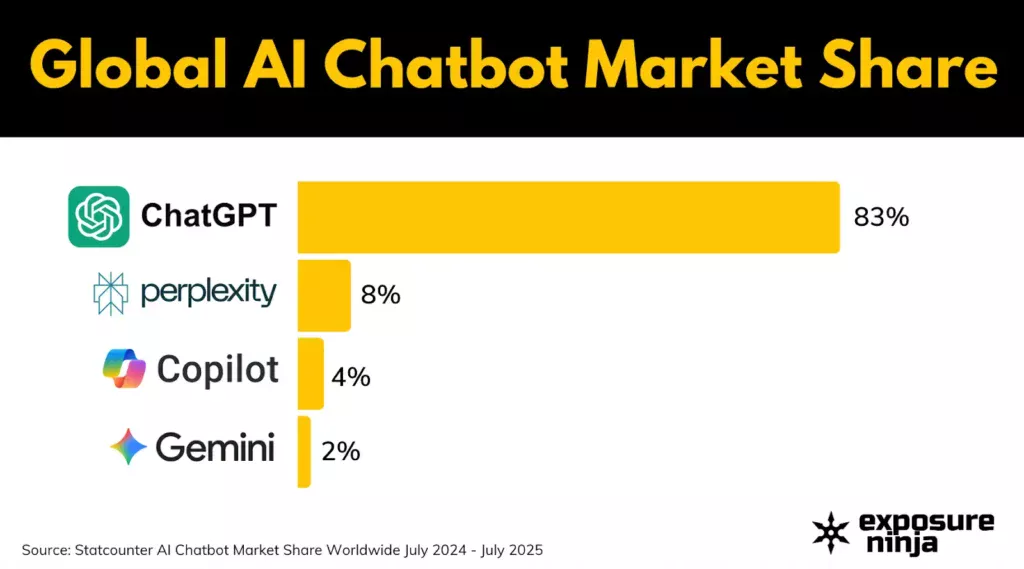
The growing market share of AI chatbots shows how user behaviour is shifting. Instead of sifting through a list of 10 blue links on traditional search pages, your audience is already getting the answers they need directly from AI.
For marketing leaders, you need to be present where your audience is now looking. Ranking in organic results is no longer enough; your brand must be inside the AI answer.
Right now, there is a huge shift in the world of search. People are turning to tools like ChatGPT, Perplexity, and Gemini to find answers, products, and services they used to look for in Google. These AI tools are comfortable recommending businesses, and that presents a massive opportunity if you know how to get them to mention your brand. Just like when SEO first emerged in the 2000s, we’re about to see a major divide between the businesses that adapt and thrive, and the ones that fall behind.
 Tim Cameron-Kitchen
Founder
Tim Cameron-Kitchen
Founder
Why AI Search Puts Your Brand at Risk (or Ahead)
AI Search doesn’t just change how users get answers; it’s changing which brands are seen, trusted, and clicked.
Traditional search engines like Google or Bing crawl and index web pages, then rank them based on well-known SEO signals like keywords, backlinks, and technical performance. You get visibility and traffic if your page ranks in the top 10 positions.
AI Search engines work differently. Instead of returning a list of links, they analyse the context and intent of the user query to generate a direct, often personalised answer. This means visibility in AI Search is when:
- Your brand is mentioned by name.
- Your product or service is in an AI-curated recommendation list.
- Your content is cited in the summary.
That visibility is not earned through keywords or backlinks alone, but through the AI’s perceived relevance, authority, and real-world usefulness of your brand, offering, or web page. This means that even if your SEO is strong, you could be excluded from AI-generated results if:
- You aren’t clear about your brand positioning.
- Your website isn’t structured to allow AI-friendly extraction.
- Your content doesn’t establish your authority in your niche.
- Your brand isn’t mentioned on the third-party sites that AI models consider when forming an answer.
But there’s also a significant upside. AI doesn’t default to the biggest brand or the top-performing websites. It favours the best source; the one that consistently provides relevant, structured, and trustworthy information. That means brands with smart positioning, strong web-wide presence, and a strategy focused on being helpful and cited can quickly gain visibility in AI-generated answers.
And right now, very few competitors have adapted to this shift.
At MozCon London 2025, Exposure Ninja CEO Charlie Marchant opened her talk with a simple poll. She asked the audience to raise their hands if they had started optimising for AI Overviews, AI Mode, ChatGPT, or other AI platforms.
Out of the 300 SEOs, marketers, and Heads of Growth in the room, only a handful raised their hands.
This is a clear opportunity.
While most businesses continue focusing solely on traditional SEO, marketing leaders who act now will gain a first-mover advantage.
Ranking at the top of Google isn’t enough anymore. AI Search engines like ChatGPT and Perplexity pull from a wide range of sources and generate direct answers, which means your brand only gets visibility if it’s cited, recommended, or named in those answers. That depends on how well your brand is positioned, how often you’re mentioned on credible sites, and how clearly your expertise is communicated. You could have great SEO and still be invisible in AI Search if you’re not building the kind of authority AI trusts.
Tim Cameron-Kitchen
Founder
How to Optimise for AI Search
Just like SEO helps you rank in traditional search engines, AI Search Optimisation is how your brand earns visibility in AI platforms like ChatGPT, Google’s AI Mode, and Perplexity.
Here’s a quick overview of our AI Search Optimisation strategy we use to help brands like Golf Course Lawn Store, DSLD Mortgage, The Ordinary, Personal Injury Law Firm, and ZUGU win in AI Search:
- Build a Strong SEO Foundation: AI Search Optimisation and SEO aren’t the same, but AI platforms still use search engines to crawl and source trusted content. Your site needs to be technically sound and optimised for traditional search to be found and trusted by AI.
- Clarify Your Brand Positioning: AI won’t know when to recommend you if your brand positioning isn’t obvious. Define clearly what you want to be known for and ensure that messaging is consistent across your website and external mentions.
- Establish Topical Authority: AI rewards brands that dominate a subject. Build a blog content strategy tailored to your niche and expertise, and interlink pages to reinforce your authority. Amplify your authority by building high-quality backlinks to your content from trusted, relevant sites to signal credibility and strengthen your position as a go-to source in your space.
- Prioritise Content Clarity: Create AI-friendly content that can be easily extracted and cited. Keep language simple, answers structured, and format your content using lists, bullets, and summaries.
- Earn High-Quality Brand Mentions: AI looks for third-party validation. Boost your web-wide brand mentions by getting cited by trusted sources, participating in relevant forum discussions, and investing in digital PR to build credibility beyond your own site.
- Monitor and Improve Brand Sentiment: AI factors how your brand is talked about online. Track digital sentiment, implement changes to address negative signals, and encourage positive reviews on reputable platforms.
AI Search Optimisation has three core pillars: solid SEO, well-structured content, and strong brand signals across the web. These tools favour clear, scannable pages, firsthand experience, and credible third-party mentions. We’ve helped brands improve AI visibility by publishing expert-led content, earning placements in trusted media, and making sure every page is built for clarity and extraction. When done right, we’ve seen clients go from zero to top visibility in AI Search within weeks.
Tim Cameron-Kitchen
Founder
Boost Visibility, Traffic, and Conversions in AI Search
Your audience is still searching and buying, but AI Search is changing who they discover and why they convert. The brands that appear in AI-generated answers are the ones earning visibility and driving high-intent traffic that converts.
At Exposure Ninja, we’ve led the way in AI Search Strategy since 2023, and were recently named Most Innovative SEO and AI Search Specialists 2025. That recognition reflects the impact we’ve made for our clients, and the results we’re ready to help you achieve next.
Request your AI Search review and let’s find out how we can get AI Search to work for you, not against you.
FAQs
How is AI Search affecting organic traffic?
AI Search is reducing the number of clicks to traditional organic listings by answering user queries directly in the AI platform. As a result, even high-ranking pages may see a drop in traffic.
Can we measure AI-driven leads or conversions?
Yes, you can track AI traffic and conversions in Google Analytics 4 (GA4):
- Go to Reports > Life cycle > Acquisition > Traffic acquisition.
- Filter by Referral.
- Add the Session source to break conversions down by AI platform.
- View Event count (or filter by a specific conversion event.
What’s the ROI of AI Search Optimisation?
Early adopters are already gaining visibility and traffic that competitors aren’t even tracking. ROI comes from owning AI-generated answers before the market catches up.