Google’s AI Mode Goes GLOBAL + NEW Agentic Features!

While your marketing team debates the latest algorithm update, Google has quietly rolled out its most significant search interface change in decades — and it’s now available globally. AI Mode isn’t just another feature; it’s a complete reimagining of how high-value customers will discover and evaluate your business.
The timing couldn’t be more critical. As marketing leaders grapple with rising acquisition costs and increasingly sophisticated buyers, Google’s AI Mode represents both an unprecedented opportunity and a potential blind spot that could leave your competitors miles ahead.
Executive Summary
Google’s AI Mode has expanded globally, bringing conversational AI search to markets worldwide — except the European Economic Area and Switzerland due to regulatory constraints. This isn’t merely an incremental update; it’s a fundamental shift towards agentic AI that can perform complex tasks like restaurant reservations and ticket purchases on behalf of users.
Key developments include:
- Global rollout across most markets (excluding EEA and Switzerland)
- Agentic capabilities for booking reservations and purchasing tickets
- Enhanced personalisation through Labs experiments
- Premium tier pricing at $250/month for advanced features
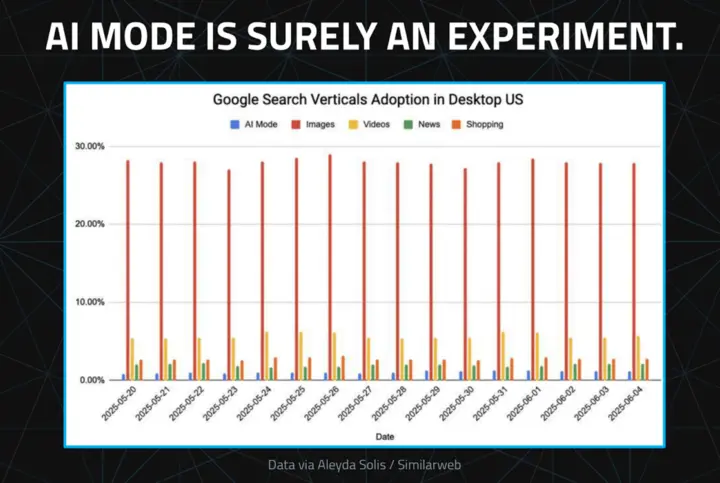
However, current adoption remains surprisingly low at 1-2% of total search traffic in the US, trailing significantly behind traditional search verticals like Images (high usage) and even News. This creates a strategic window — and a business case for an AI Search Optimisation Strategy — for forward-thinking marketing teams to establish dominance before mainstream adoption accelerates.
What Is Google’s AI Mode and Why Should Marketing Leaders Care
Google’s AI Mode represents a complete departure from traditional search results. Rather than presenting the familiar “10 blue links,” it delivers a conversational AI experience similar to ChatGPT, complete with comprehensive answers and source citations.
Think of it as Google’s response to the ChatGPT phenomenon, but with one crucial difference: it’s integrated directly into the world’s most-used search platform.
Why this matters for marketing leaders:
- Compressed customer journeys — AI Mode answers multiple questions in a single response, potentially eliminating several touchpoints in your traditional funnel
- Different ranking factors — websites that dominate traditional Google results don’t automatically excel in AI Mode responses
- Content amalgamation — AI Mode combines information from multiple sources, rewriting and reordering content based on query context
The implications extend far beyond SEO. Your carefully crafted customer journey, from awareness through consideration to purchase, may be condensed into a single AI-powered interaction.
Where AI Mode Is Now Available Globally
The global rollout encompasses virtually every market except those constrained by AI regulations. Here’s the current availability:
Available markets:
- United States (launched May 2025)
- United Kingdom (launched July 2025)
- All other global markets (launched August 2025)
Restricted markets:
- European Economic Area countries
- Switzerland
These restrictions stem from complex AI regulations that have already complicated Google’s AI Overviews rollout in these regions. For businesses operating in affected markets, this creates both a delay and an opportunity to observe and learn from implementations elsewhere before the eventual rollout.
Market-specific considerations:
- Early adoption patterns vary significantly by region
- Mobile usage appears higher than desktop for AI Mode interactions
- Query complexity differs based on local search behaviours and language nuances
What New Agentic Features Are Coming to AI Mode
Google’s latest update introduces genuinely transformative capabilities that go far beyond answering questions. These agentic features can perform real-world tasks on behalf of users:
Restaurant reservations:
AI Mode will search platforms like OpenTable, compare availability against user criteria (time, location, party size), and facilitate actual bookings.
Ticket purchasing:
For events like concerts or sports matches, AI Mode can research multiple ticketing platforms, filter by price ranges and seating preferences, and guide users through purchase decisions.
Multi-site research:
Rather than requiring users to visit multiple websites, AI Mode conducts comprehensive research across relevant platforms and presents consolidated findings.
The strategic implication: Your business needs to be discoverable and well-represented across the platforms and databases that AI Mode consults, not just on your own website.
Who Can Access These Advanced Features Right Now
Access to agentic capabilities operates on a tiered system that reflects both Google’s testing approach and the computational costs involved:
Immediate access (Premium tier – $250/month):
- Google AI Ultra Plan subscribers
- Must opt-in through Google Labs experiments
- Full agentic capabilities
Personalisation features (Standard access):
- Available through Google Labs (free)
- Enhanced query understanding based on search history
- Location-aware customisation
- Requires manual opt-in
Standard AI Mode (Global access):
- Basic conversational search interface
- Citation-backed responses
- No agentic capabilities
The pricing structure suggests Google views these advanced features as premium offerings, at least initially. The $250 monthly fee significantly exceeds ChatGPT’s $20 Pro plan, indicating substantial operational costs.
How Much Are People Actually Using AI Mode
Despite the revolutionary potential, current adoption data reveal surprisingly modest usage patterns. Research from Moz’s Tom Capper shows AI Mode capturing just 1-2% of total US search traffic — significantly lower than other Google search verticals.
Comparative usage data (US, desktop):
- Images: Substantially higher usage than AI Mode
- Shopping: Strong adoption for commercial queries
- News: Moderate but consistent usage
- Videos: Higher adoption than expected
- AI Mode: 1-2% of total search traffic
This low adoption rate reflects several factors:
Behavioural inertia: Users default to familiar search patterns
Limited awareness: Many users haven’t discovered or understood AI Mode’s capabilities
Interface separation: AI Mode requires deliberate navigation to a separate tab
However, these numbers don’t account for mobile usage, where the conversational interface may prove more intuitive.
Why This Low Adoption Rate Doesn’t Tell the Full Story
While 1-2% adoption might seem negligible, this perspective misses the strategic significance of early positioning in AI search. Several factors suggest this low adoption rate creates opportunity rather than concern:
Google’s deliberate approach: Google appears to be intentionally maintaining AI Mode as a separate experience to avoid disrupting their primary revenue stream while testing and refining the technology.
Behavioural shifting in progress: Google’s advertising campaigns actively encourage longer, more conversational queries in traditional search, suggesting they’re gradually merging these experiences.
Quality over quantity: Early AI Mode adopters likely represent more engaged, tech-savvy users — precisely the audience many B2B companies prioritise.
Integration trajectory: Evidence suggests Google plans to integrate AI Mode functionality directly into traditional search results, eliminating the need for tab navigation.
The takeaway: Low current adoption provides a window for strategic positioning before mainstream adoption accelerates.
When Marketing Teams Should Start Adapting Their Strategy
The data suggests now is the optimal time to begin AI Mode optimisation, despite current low adoption rates. Google’s accelerated rollout timeline — global availability months ahead of predictions — indicates they’re not hesitating to advance AI search capabilities.
Immediate action items:
Technical foundation audit:
- Ensure website speed optimisation
- Resolve technical SEO issues
- Improve user experience metrics
Content clarity assessment:
- Review homepage and service page messaging
- Eliminate cryptic or overly creative headlines
- Ensure clear value proposition statements
Brand monitoring setup:
- Track mentions across platforms AI Mode might reference
- Monitor sentiment on review sites and forums
- Establish a presence on platforms like Reddit, where AI systems increasingly source information
The strategic rationale: AI Search significantly overlaps with traditional SEO best practices, meaning improvements benefit both channels simultaneously.
How to Begin Optimising for AI Mode Without Abandoning SEO
The relationship between traditional SEO and AI Mode optimisation is complementary rather than competitive. Successful AI Mode performance builds upon solid SEO foundations while extending into new areas.
Foundational overlaps:
Technical excellence remains crucial:
- Site speed affects AI crawling efficiency
- Mobile responsiveness impacts AI understanding
- Structured data helps AI interpret content
Content quality standards apply:
- Authoritative, well-researched content performs better in both contexts
- Clear, scannable formatting aids both human and AI consumption
- Comprehensive topic coverage satisfies diverse query intents
AI-specific optimisations:
Enhanced clarity requirements:
AI systems require more explicit content structure than human readers. This means:
- Direct value propositions rather than clever wordplay
- Specific benefit statements instead of vague promises
- Clear service descriptions without industry jargon
Multi-platform presence strategy:
AI Mode references diverse sources, making off-site presence crucial:
- Industry publication features and expert quotes
- Review platform optimisation across multiple sites
- Social proof accumulation on platforms AI systems monitor
Measurement and iteration:
Separate traffic tracking:
- Configure Google Analytics to identify AI Mode referral traffic
- Monitor conversion patterns from AI versus traditional search
- Track engagement metrics for AI-sourced visitors
Lead attribution clarity:
Add “How did you hear about us?” fields to capture AI discovery paths that analytics might miss.
Next Steps
Week 1: Foundation Assessment
- Audit current website clarity — can a newcomer understand what you do within 10 seconds?
- Review homepage and key service pages for cryptic messaging
- Check technical SEO basics (speed, mobile experience, structured data)
Week 2: AI Mode Exploration
- Test AI Mode with your key search terms
- Document which competitors appear in AI responses
- Identify content gaps where competitors outperform your visibility
Week 3: Content Strategy Adjustment
- Rewrite unclear value propositions using direct language
- Create FAQ sections addressing common customer questions
- Develop content that clearly states benefits rather than features
Month 2: Multi-Platform Presence
- Identify industry publications for thought leadership opportunities
- Optimise profiles on review platforms and directories
- Establish or enhance your presence on platforms where your audience seeks advice
Month 3: Measurement Implementation
- Set up AI Mode traffic tracking in analytics
- Implement lead attribution fields in forms
- Begin monthly reporting on AI versus traditional search performance
Resources Mentioned
- Google Labs: Access point for AI Mode personalisation experiments
- Project Mariner: Google’s agentic AI browser automation experiment
- Exposure Ninja’s AI Search Metrics Guide: Comprehensive tracking strategies for AI search performance
In Conclusion
Google’s AI Mode global rollout represents more than a new search feature — it’s the beginning of a fundamental shift in how customers discover and evaluate businesses. While current adoption remains low, this creates a strategic opportunity for marketing leaders who act decisively.
The businesses that establish strong AI Mode presence now, while their competitors remain focused solely on traditional search, will build an insurmountable advantage as adoption accelerates. The technical foundations remain the same, but the content strategy, measurement approach, and multi-platform thinking required for AI search success demands immediate attention.
Your next search might be your customer’s first interaction with AI Mode. Make sure they find you there.
Watch This Next
You need to know how to rank in Google’s AI Mode, but knowing how to rank in any AI platform will get you most of the way there, which you can learn in this guide. You can also watch and learn all about it this video.
Alternatively, if you’re just starting to learn about what AI Search Optimisation is and how to create an AI Search strategy, then start your learning journey with these guides: