What is AI Search Optimisation (and How To Do It)

The ground is shifting beneath your feet, and most marketing leaders haven’t even noticed yet.
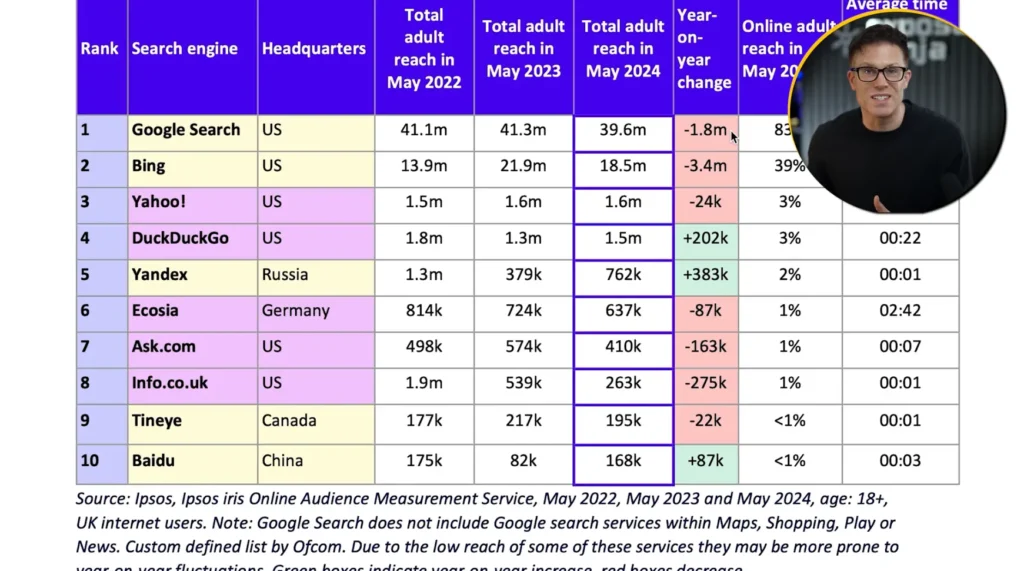
While you’ve been perfecting your SEO strategy, a new search revolution has quietly begun. ChatGPT usage has increased fourfold in recent months, with relative interest up 50% compared to Google searches. Even more telling? All three major traditional search engines — Google, Bing, and Yahoo — saw declining UK adult reach between 2023 and 2024.
This isn’t just another marketing trend you can afford to monitor from the sidelines. When 30% of Perplexity’s 15 million monthly users hold senior leadership positions, and 65% work in high-income white-collar professions, we’re talking about your exact target audience making purchasing decisions through AI-powered search tools.
The question isn’t whether AI Search will disrupt your current marketing strategy — it’s whether you’ll be the brand these tools recommend when your prospects ask for solutions.
Executive Summary
AI Search Optimisation is the practice of positioning your brand, products, and services to be recommended by artificial intelligence tools like ChatGPT, Perplexity, Claude, and Google’s AI Overviews.
Unlike traditional SEO that focuses on ranking in search results, AI Search Optimisation ensures your business gets mentioned and recommended when users have conversations with AI assistants.
The opportunity is massive. Forward-thinking businesses are already seeing 100-300% increases in AI mentions within three months of implementation. The same number of products and services will be purchased in this new AI-driven world — the only question is whether customers will be directed to you or your competitors.
This comprehensive guide reveals the three-pillar framework for AI Search dominance: building strong SEO foundations, optimising content for AI clarity, and strategically managing mentions and sentiment across the digital ecosystem.
The Seismic Shift in Search Behaviour
Before diving into tactics, let’s acknowledge the magnitude of what’s happening. We’re witnessing the most significant change in how people find information since Google’s inception.
Traditional search followed a predictable pattern: user types query, clicks result, visits website. AI Search creates an entirely different dynamic: the user asks a question, AI analyses multiple sources, and provides a recommendation with reasoning.
This fundamental shift changes everything about how customers discover and evaluate solutions. Instead of hoping users will click through to your website, you need AI tools to actively recommend your business over competitors.
Consider this scenario: A marketing director searches “best marketing automation platform for B2B SaaS companies.” In the old world, they’d scan search results and visit several websites. Today, ChatGPT might respond: “Based on current reviews and feature comparisons, I’d recommend HubSpot for comprehensive needs or Marketo for enterprise-level automation…”
The AI tool has essentially made the purchasing decision. Your job is ensuring it recommends your solution.
The Three-Pillar AI Search Optimisation Framework
Pillar 1: Build Unshakeable SEO Foundations
Here’s what most people miss: you need to dominate the old game before you can win the new one.
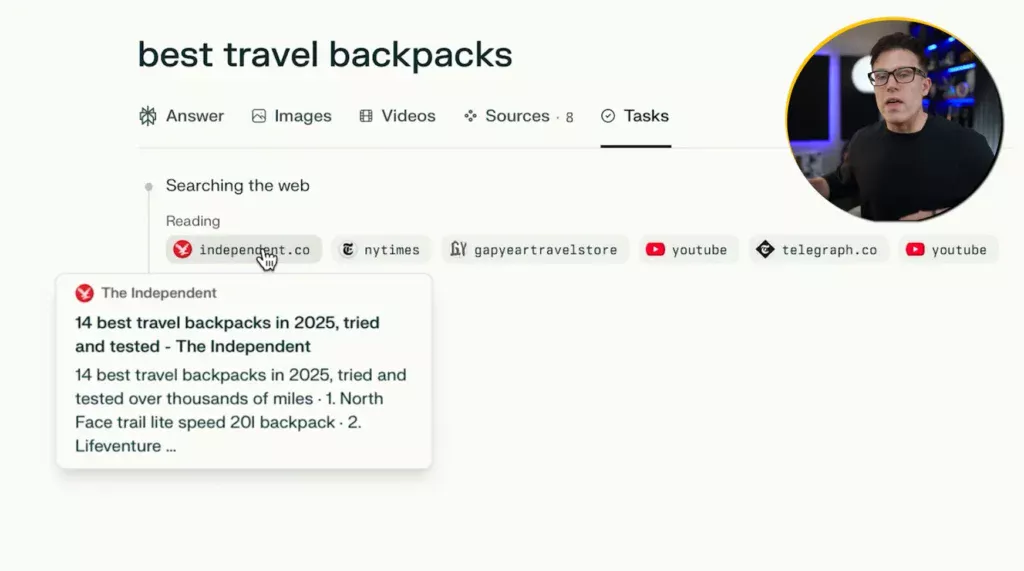
AI tools don’t operate in a vacuum. When Perplexity answers “best travel backpack,” it’s conducting background web searches using proprietary algorithms that often overlap significantly with traditional search engines. If you’re invisible in regular search results, AI tools simply won’t know you exist.
The mechanics work like this:
- The user asks the AI tool a question
- The tool breaks the question into multiple search queries
- Searches are run against web indexes (often similar to Google’s)
- Results are analysed and synthesised into recommendations
Google’s Gemini still shows its “thinking” process, revealing search phrases like:
- “Best travel backpacks for kids search“
- “Kids travel backpack reviews“
- “Carry-on backpacks for kids“
This means your traditional SEO keyword strategy remains crucial — it’s just become the foundation rather than the end goal.
Here are your next steps:
- Audit your current search visibility for core product/service terms
- Identify the long-tail variations AI tools might use
- Ensure you’re ranking competitively across the full search landscape
- Focus on authoritative, well-structured content that search engines trust
Pillar 2: Optimise Content for AI Clarity and Authority
AI tools have distinct preferences for content structure and format. Since the early days of testing Google’s AI Search products, certain content patterns have consistently been referenced while others have been ignored.
What AI tools love:
- Clear, scannable structure: Short paragraphs, bullet points, logical headings
- Direct answers: Concise responses to specific questions
- Factual snippets: Information that can be easily extracted and cited
- First-hand experience: Content showing genuine expertise and testing
Take the New York Times’ Wirecutter as a masterclass example. Their “Best Carry-On Travel Backpacks” article demonstrates everything AI tools favour:
- Immediate credibility: Photos showing they actually tested the products
- Expert byline: “Kit Dillon has worked for Wirecutter for a decade and lost count of the number of bags he’s tested“
- Structured recommendations: Clear summary at the top with detailed analysis below
- Comprehensive research: 5,000+ words covering every angle
- Transparent methodology: “How we picked and tested” section
This isn’t generic, AI-generated content that any tool could reproduce. It’s human expertise and experience that provides genuine value, exactly what Google’s expanded E-E-A-T guidelines (adding Experience) were designed to promote.
Here’s your content optimisation checklist:
- Add clear summaries at the top of detailed articles
- Include first-hand experience and testing where relevant
- Structure content with descriptive headings and short paragraphs
- Provide direct answers to common questions
- Show your methodology and credentials
- Use bullet points and numbered lists for key information

Pillar 3: Master Mentions and Sentiment
This is where most businesses fall behind, yet it’s becoming the biggest battleground for AI Search visibility.
AI tools don’t just look at your website — they analyse sentiment across the entire internet to understand how your brand is perceived. This includes:
High-authority publications: Traditional media, industry publications, respected review sites
User-generated content: Reddit discussions, YouTube reviews, forum posts, Amazon reviews
Social proof: Customer testimonials, case studies, expert endorsements
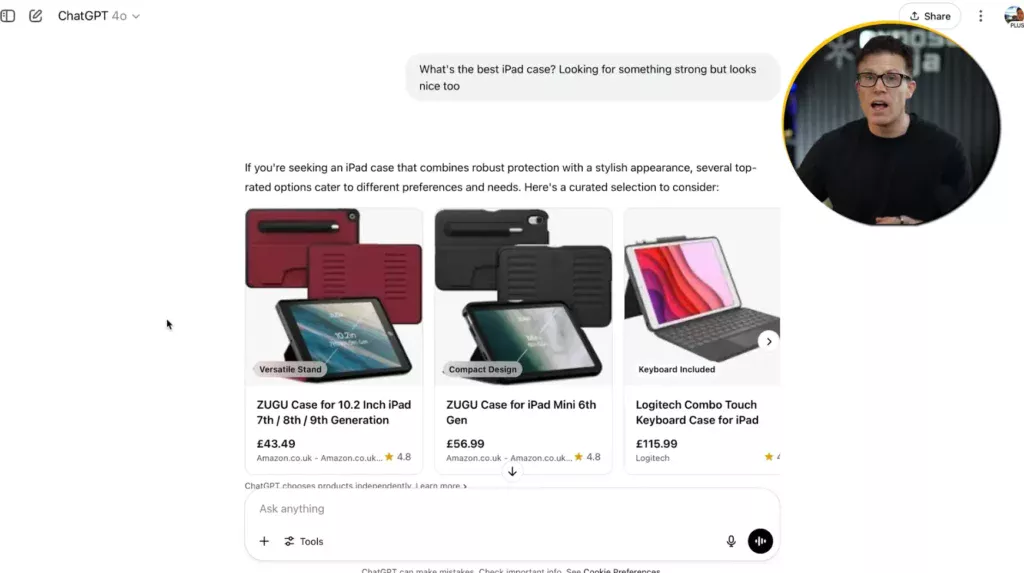
Consider how ChatGPT recommended Zugu Case when asked about “the best iPad case, looking for something strong but looks nice too.” The AI tool cited multiple source types:
- High-authority sites (Wired, Laptop Mag)
- User forums and Reddit discussions
- Amazon reviews and ratings
- The company’s own well-optimised website
This created a consistent signal across multiple content types that Zugu Case delivers both strength and aesthetic appeal, exactly what the user requested.
Here’s your sentiment strategy:
- Map your market position: Understand what characteristics you want to be known for
- Audit current sentiment: Use tools like Profound or Semrush* to track AI mentions
- Build authority mentions: Secure coverage in high-authority publications
- Encourage user-generated content: Foster genuine reviews and discussions
- Monitor and respond: Track sentiment changes and address negative perceptions
Real-World Results: What’s Possible
The speed of AI Search Optimisation often surprises clients. Unlike traditional SEO, which can take months to show results, AI Search visibility can improve rapidly because answers are generated dynamically rather than served from cached results.
Case study results from a large enterprise client:
United States market:
- Q2: 98 AI mentions
- Q3: 203 AI mentions
- Increase: 107%
United Kingdom market:
- Q2: 7 AI mentions
- Q3: 29 AI mentions
- Increase: 314%
India market:
- Q2: 81 AI mentions
- Q3: 174 AI mentions
- Increase: 115%
These results were achieved within a single quarter by implementing the three-pillar framework systematically across multiple markets.
The Tracking and Optimisation Imperative
AI Search visibility is more dynamic than traditional SEO. You can gain visibility quickly, but you can also lose it just as fast. This requires constant monitoring and optimisation.
Modern AI sentiment tracking tools like Profound provide insights that were impossible with traditional analytics:
Sentiment analysis example (Vanguard on Perplexity):
- Positive sentiment: 75.5% (up 1% this month)
- Positive mentions: “Top-tier provider,” “Attractive for long-term investors“
- Negative mentions: “Basic trading platform,” “High mutual fund minimums“
This data creates actionable insights. If AI tools consistently mention your “basic trading platform,” you can:
- Prioritise platform improvements with your product team
- Launch digital PR campaigns highlighting upgrades
- Provide enhanced platforms to influencers for review
- Monitor sentiment changes over time
This represents a fundamental shift for digital marketers. You’re no longer just optimising for rankings and traffic — you’re actively shaping how AI tools position your brand relative to competitors.
You need to have a clear position in the market. You need to understand what the sentiment is that’s attached to your brand and what sentiment you want to be attached to your brand so that when these AI tools are recommending you to the customer, you’re happy with the reasons that they’re recommending you.”
 Tim Cameron-Kitchen
Founder
Tim Cameron-Kitchen
Founder
Implementation Roadmap
Phase 1: Foundation Assessment (Weeks 1-2):
- Audit current search visibility for primary terms
- Evaluate website content structure and authority signals
- Baseline AI mention tracking across key tools
- Identify current sentiment themes and perceptions
Phase 2: Content Optimisation (Weeks 3-6):
- Restructure key pages for AI-friendly scanning
- Add clear summaries and direct answers
- Enhance first-hand experience and expertise signals
- Implement structured data markup
Phase 3: Authority Building (Weeks 6-12):
- Launch digital PR campaigns for high-authority mentions
- Encourage user-generated content and reviews
- Engage with relevant forums and communities
- Monitor and respond to sentiment changes
Phase 4: Scale and Systematise (Month 4+):
- Expand successful tactics across more keywords/topics
- Develop ongoing content creation processes
- Build systematic sentiment monitoring
- Optimise based on performance data
Next Steps
The AI Search revolution isn’t coming — it’s here.
While your competitors remain focused solely on traditional SEO, you have a limited window to establish dominance in this new landscape.
Your immediate action plan:
- Conduct an AI visibility audit: Search for your main products/services in ChatGPT, Perplexity, and Google’s AI Overviews. Are you being recommended? What’s being said about you?
- Assess your content structure: Review your key pages through an AI lens. Would these tools find clear, citable information, or generic content they could generate themselves?
- Map your sentiment landscape: Understand how your brand is currently perceived across different content types and platforms.
- Choose your competitive positioning: Decide what characteristics you want AI tools to associate with your brand when making recommendations.
- Begin systematic implementation: Start with your highest-value products/services and work through the three-pillar framework methodically.
The businesses that master AI Search Optimisation now will build insurmountable advantages as this technology continues expanding. The same customers are still making purchases — they’re just getting recommendations from different sources.
Make sure those sources are recommending you.
Resources Mentioned
- Profound: AI sentiment tracking and analysis platform
- Semrush’s AI Toolkit*: Comprehensive AI search visibility tools
- Google Gemini: Shows AI “thinking” process for search queries
- Wirecutter by the New York Times: Example of AI-friendly content structure
- Perplexity AI: Leading AI search platform with high-value user base
In Conclusion
AI Search Optimisation represents the biggest shift in digital marketing since the rise of Google. The fundamental change from “ranking in results” to “being recommended by AI” requires a completely new approach to content, authority, and sentiment management.
The three-pillar framework — strong SEO foundations, AI-optimised content, and strategic sentiment management — provides the roadmap for success. Early adopters are already seeing dramatic increases in AI mentions and recommendations, often within months of implementation.
This isn’t about replacing your current marketing strategy; it’s about evolving it for a world where AI assistants increasingly influence purchasing decisions. The businesses that act now, while their competitors remain focused on yesterday’s tactics, will capture the lion’s share of tomorrow’s customers.
The revolution has begun. The question is: Will you lead it or watch from the sidelines?
Watch This Next
Now that you’re aware of the importance of ranking in Google’s AI Mode, in ChatGPT, and in Perplexity; start learning how to do it using these previous podcast recordings where we dive into the strategy and tactics for getting your brand featured in AI search results.
Alternatively, you can listen to them as audio podcasts instead:
- How To Rank in Google’s AI Mode (with Examples)
- How To Rank in ChatGPT (with Client Examples)
- How To Rank in Perplexity AI (with Client Examples)
*Disclaimer: Exposure Ninja may get a commission through the marked links above, at no cost to you