How to Optimise Your Website for AI Search in 3 Steps


Search behaviour has changed, and your website needs to keep up. We cover how to optimise your website for AI Search, so it captures visibility across AI platforms like ChatGPT, Google AI Overviews, Perplexity, and Gemini.
Website optimisation used to focus only on traditional Search Engine Optimisation (SEO). This included implementing on-page SEO best practices, securing backlinks, and ensuring top technical performance. With the right SEO strategy in place, your website was well-positioned to rank at the top of Google or Bing.
This SEO foundation still holds value. Search engines continue to reward fast, well-structured websites with relevant content and established authority.
But search behaviour has changed.
Today, AI-driven platforms like Google’s AI Overviews and ChatGPT shape how users discover, evaluate, and engage with information and brands. These AI systems don’t just list pages — they summarise content, cite sources, and deliver conversational answers directly within the AI platform.
This shift means your website is no longer competing solely for traditional rankings. It’s competing to be the source behind AI-generated answers, securing visibility with users during a critical stage of their decision-making journey. This is where AI Search Optimisation comes in.
As a leading AI Search Optimisation agency, we’ll cover how to optimise your website for AI Search in three expert-level steps. If you’re ready to secure your place in the future of search, this is where to start.
What Is Optimising for AI Search?
AI Search refers to search experiences powered by artificial intelligence (AI), where systems like ChatGPT and AI Overviews retrieve, interpret, and summarise content to answer user queries quickly.
Charlie Marchant, CEO of Exposure Ninja, explains it further: “Unlike a traditional Google search, which primarily relies on keywords and matching them to content using a fixed algorithm, AI understands far more context, natural language, and user intent. This allows it to provide much more relevant and personalised answers. Essentially, it’s a far more advanced type of search, using AI in the background to deliver better results.”
Optimising for AI Search is the practice of structuring, refining, and positioning your website and content so that AI platforms can easily discover, understand, and cite it as part of their generated answers. It goes beyond keyword rankings — you’re optimising to be the authority AI chooses to represent in its response.
AI Search Optimisation applies across a growing range of AI-driven platforms, including:
Generative AI Platforms
Optimising your website for AI Search, also known as Generative Engine Optimisation (GEO), means going beyond Google and considering how your brand appears across generative AI platforms like:
- ChatGPT
- Perplexity
- Gemini
- Claude
- Grok
Consumers are increasingly using these platforms for discovery, product research, and even decision-making, just like traditional search engines. Just look at ChatGPT, whose weekly users have climbed from 1 million in November 2022 to 800 million as of July 2025. That’s a 79,900% increase in users asking for information and recommendations on what to buy or who to trust.
You need to understand how these platforms generate answers to optimise your website effectively. These tools will perform real-time web searches behind the scenes for certain queries. They find high-quality sources, summarise content, and often cite their references with links back to the original websites. Here’s what this looks like in Perplexity:
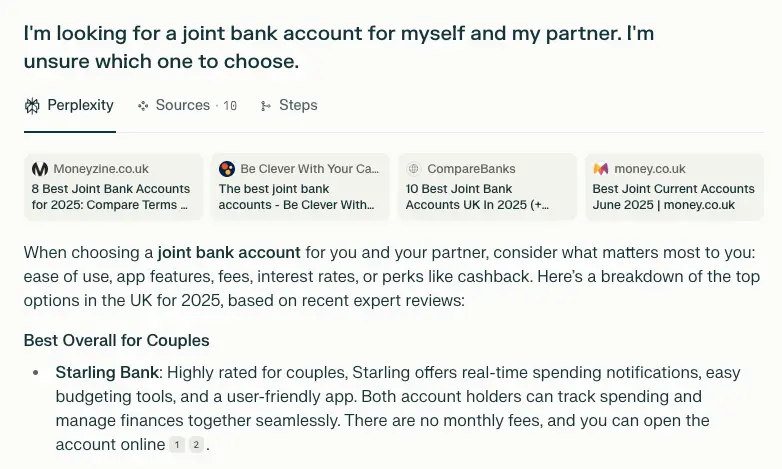
But they don’t always perform a search. For certain queries, they will answer questions using only the information they’ve already been trained on. For example, ChatGPT provided a list of recommended brands without performing a search:
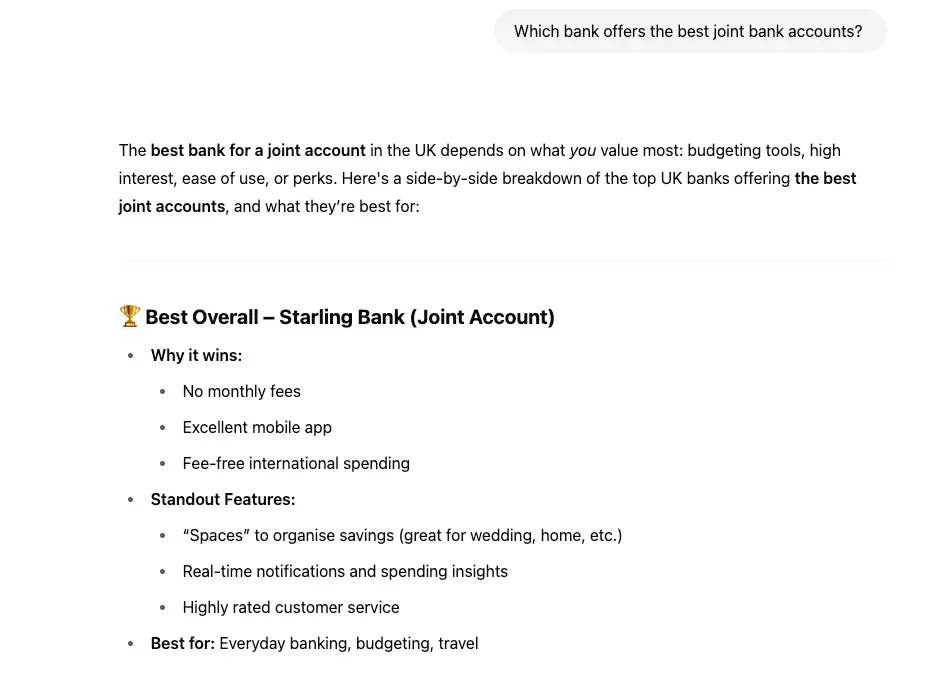
To appear across these platforms, your brand and website need to be optimised in two key ways:
- Be a reliable, citable source that AI tools can reference in real-time during web-connected searches.
- Build enough online authority to become part of the underlying knowledge base.
Google’s AI Overviews
AI Search isn’t just happening in tools like ChatGPT and Perplexity — it’s already embedded in Google through AI Overviews. These overviews are powered by generative AI and appear at the very top of the search results page, above organic listings and traditional Featured Snippets.
When a user enters a query, AI Overviews generate a summary-style response that pulls information from multiple web sources and cites the sources it used via clickable links. This content is presented in a conversational, digestible format that’s designed to give users a complete answer without needing to click through to individual pages.
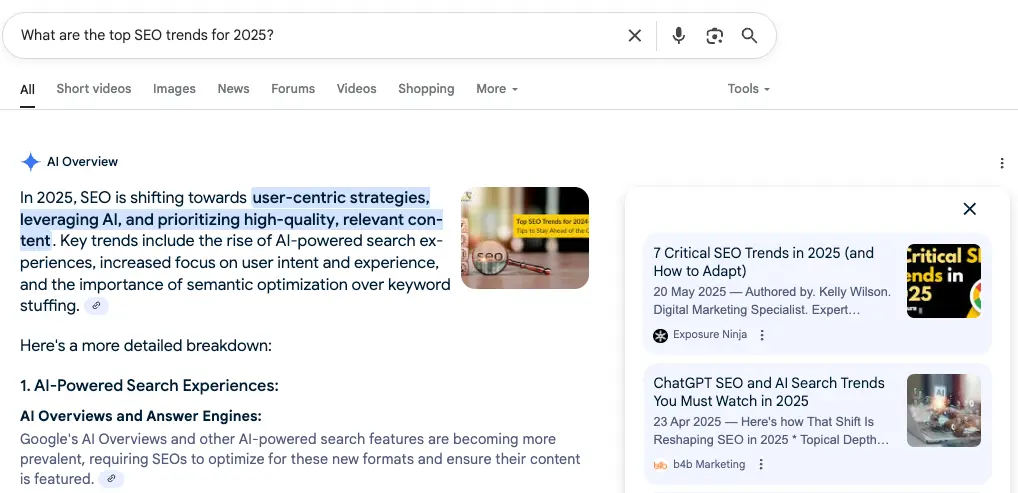
If your website contains structured, authoritative, and context-rich content, it could rank in the AI Overview (or, in other words, be selected as one of the sources Google’s AI uses to build its answer).
Google’s New AI Mode
To compete with AI-native tools like ChatGPT and Perplexity, Google has introduced a new AI search feature: AI Mode.
Currently available in the U.S., AI Mode reimagines how search results are presented. Instead of simply returning a list of links, it uses generative AI to produce rich, narrative-style answers. These responses are often multi-paragraph summaries that draw on multiple sources, include visuals, and cover not just the user’s query but also related subtopics through a process called query fan-out.
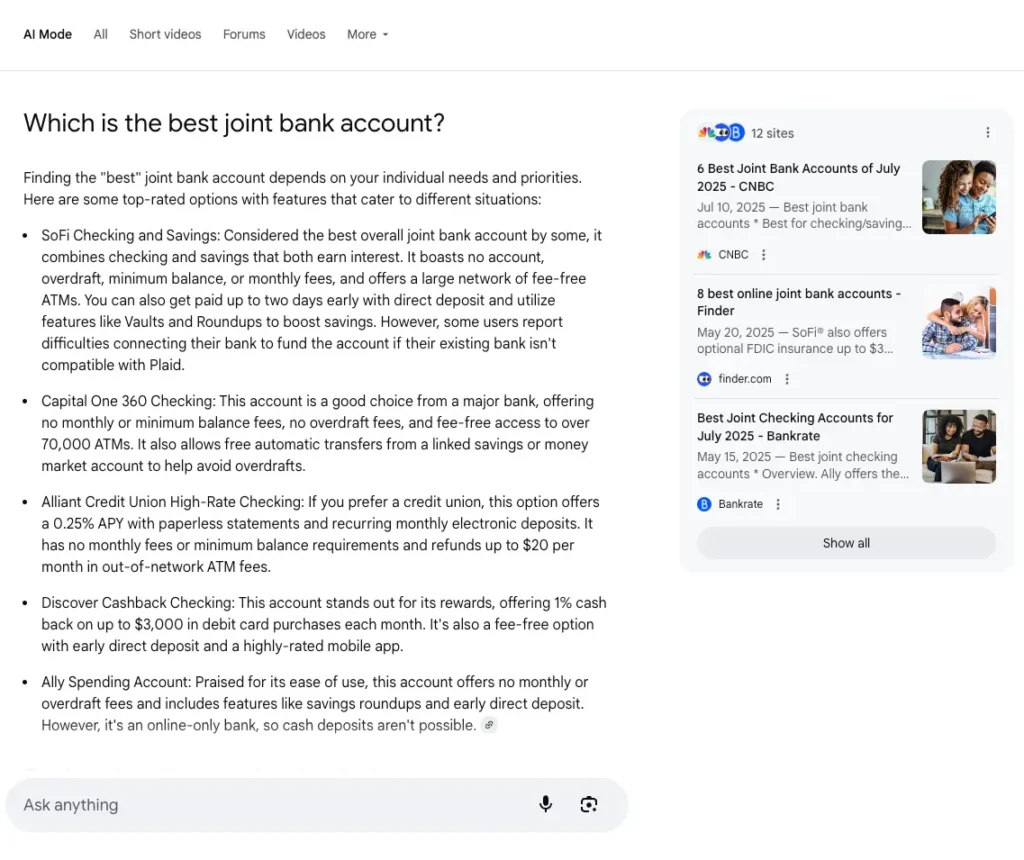
As AI Mode rolls out more widely, visibility in this new environment will become a battleground for organic traffic, especially as clicks from traditional listings decline.
Why Rank in AI Search?
AI Search Optimisation is facing pushback. Some dismiss it as nothing more than standard SEO. Others feel overwhelmed by the pace of change and are choosing to ignore it altogether.
But Tim Cameron-Kitchen, Founder of Exposure Ninja, sees it differently: “Just like in the early 2000s when SEO first emerged, we saw businesses boom, and others fall behind depending on how quickly they adapted. We believe we’re seeing that same pattern again. As users shift to AI-powered search, brands that move early will win.”
This isn’t traditional SEO; it’s not a passing trend, and it’s definitely not something you can afford to ignore in 2026 and beyond.
Here’s why:
Stay Visible as Search Behaviour Changes
Before AI-powered search, users relied on traditional search engines like Google to find answers, discover new brands, compare options, and ultimately make decisions.
Consider this example: you’re looking to open a business bank account. A few years ago, you’d likely have searched “How to open a business bank account” on Google, clicked through to a few well-optimised articles, answered follow-up questions like “What documents do I need?” or “How long does it take?,” compared providers, and eventually chosen the one that felt right.
Now, when you search that same query on Google, you’re met with an AI Overview that outlines the process in seconds. You can skip past the basic research and head straight into comparing providers.

Or you might bypass Google entirely and start in ChatGPT. There, you get conversational, personalised responses and recommendations, often including a shortlist of banks that meet your needs. You might even select a provider on the spot.
What hasn’t changed is that users still have problems to solve and purchases to make. But with AI now stepping into the discovery phase, the research journey is faster and more focused.
That means if your content doesn’t appear in AI-generated responses, you’re missing from the conversation altogether before users ever reach the point of comparison or purchase.
Own Your Niche Before Your Competition
We mentioned that AI Search Optimisation is getting pushback, but make no mistake: many business owners and marketing leaders aren’t ignoring it. They’re leaning in.
Our CEO, Charlie Marchant, has been an invited speaker at numerous AI Search webinars this year, like Moz’s How to Appear in Generative AI Searches. After presenting, she’s regularly asked serious questions, such as:
- “How do I structure my site for AI visibility without compromising UX?”
- “Do smaller businesses stand a chance, or will big brands dominate AI Search?”
- “Will social media influence AI visibility?”
- “How do we prioritise what to optimise first to perform in AI Search?”
These aren’t “Should I bother with this?” questions. These are action-driven questions by real businesses wanting to know precisely how to get their business in front of their customers in this new AI landscape.
If your competitors are already thinking about and developing their AI Search Strategy and you’re not, you should be worried. They’re laying the groundwork to dominate visibility in your niche while your brand risks being left behind.
Step 1: Understand How Your Website Is Performing in AI Search
Before improving your brand’s presence in AI Search, you need to know where you stand today.
To do this, you need to track your brand’s visibility across AI platforms. This is how often and in what context your brand is directly mentioned, cited as a source, or included in a recommendations list across platforms like ChatGPT, Perplexity, Gemini, and Google’s AI Overviews and AI Mode.
But here’s the challenge: AI platforms don’t work like traditional search engines. There are no fixed rankings to monitor. Instead, results are dynamically generated based on training data, real-time web content, user intent, and prompt phrasing.
Responses vary from platform to platform and from person to person. The same question can produce completely different answers depending on how it’s phrased, who’s asking, or which AI tool is being used. That makes tracking visibility unpredictable but not impossible.
Manually Check Visibility in AI Summaries
Perform manual checks to see how AI tools interpret and present your brand first-hand. These involve prompting AI tools like ChatGPT, Perplexity, Gemini, and Google’s AI Overviews with a mix of brand-specific and category-level questions. Use prompts like:
- “What do you know about [your brand name]?”
- “Best [your service/product] providers in [your industry]”
- “Top-rated [your service/product] for [your target audience].”
As you review results, assess both visibility and sentiment. Are you mentioned at all? If so, are you portrayed accurately and positively? Does the description align with your brand positioning?
You’ll also want to check whether your content is being cited. Prompt AI platforms with topics you’ve covered, particularly recent or high-performing pieces, to see if your resources influence the AI-generated responses.
For example, after updating our guide on the latest SEO trends, we tested prompts across multiple platforms to assess its visibility. Sure enough, our guide appeared as a cited source in several AI-generated answers, proof that the content is being picked up and trusted.
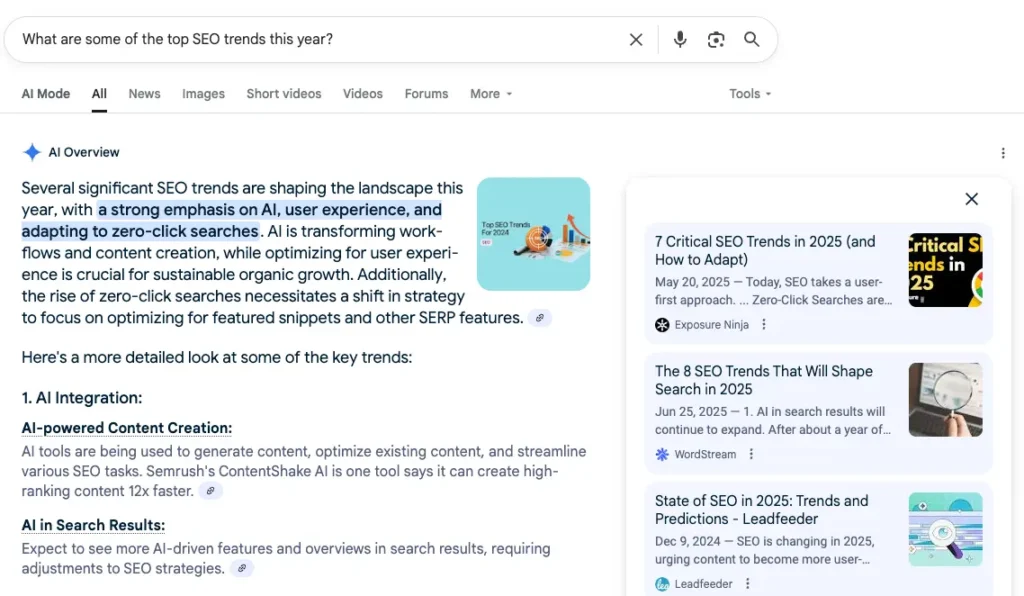
Record everything using our AI Visibility Tracker (or your own spreadsheet). Log the platform, prompt, brand mention type, sentiment, citation details, and competitor mentions.
Because AI results shift frequently based on model updates, phrasing, and user behaviour, we recommend running checks monthly. Over time, this will help you spot patterns, like which platforms favour your brand, which prompts get results, and where your reputation may need improvement.
Step 2: Rank Higher in AI Search Results
Now that you know where your brand stands in AI Search, are you where you want to be?
Here’s the truth: even if your content is cited in AI-generated answers today, there’s no guarantee it will be tomorrow. AI results are dynamic. They shift based on new content, prompt variations, user behaviour, and ongoing model updates.
You need a proactive, adaptable AI Search Optimisation strategy that keeps your brand visible, relevant, and competitive across platforms.
The tactics below work whether you already appear in AI answers or start from zero. In both cases, your goal is to be the brand and website that AI trusts to recommend.
1. Build Strong Brand Mentions With Digital PR
AI platforms are trained to recognise authority, and one of the strongest signals of authority is how often and where your brand is mentioned across the web.
The more your business is referenced on reputable, high-quality websites, the more likely it is that AI platforms will perceive you as a credible source of information. These mentions act as digital endorsements, helping AI systems determine which brands to feature or which websites to cite in generated responses.
To strengthen your brand’s footprint, invest in strategic digital PR:
- Earn media placements in respected industry publications, news outlets, and niche websites.
- Contribute guest posts that showcase your expertise and link back to relevant content on your site.
- Build relationships with journalists, editors, and influencers who cover your sector and can help amplify your brand’s presence.
- Leverage data, case studies, or proprietary insights that give others a reason to reference your content.
This approach doesn’t just increase your authority in the eyes of AI. It also improves your SEO performance and builds broader brand recognition with your target audience, helping your business stay top of mind and top of search.
You need to prioritise building your authority across the web. These AI tools don’t rely on just one site. They scan dozens, sometimes hundreds, of sources before making a recommendation. The more your product, service, or brand is mentioned across trusted websites, the greater your chances of being featured in AI-generated answers.
 Tim Cameron-Kitchen
Founder
Tim Cameron-Kitchen
Founder
2. Create Authoritative, High-Quality Content
It’s no longer enough to optimise your content for a single keyword to earn visibility in AI-generated results. You need to become the topical authority in your niche if you want AI platforms to surface your website as a trusted source.
Topical authority is built by covering your subject area comprehensively and consistently. The deeper and more interconnected your content is, the more AI models recognise your expertise within that niche.
This matters because AI platforms like AI Mode use a method called query fan-out, a powerful search process that goes far beyond the initial user query.
Here’s how it works:
- When a user types in a query, Google’s AI analyses it to understand the intent and related concepts.
- Instead of running just that one background search, the system generates multiple synthetic queries (related sub-questions or supporting topics) and retrieves answers for all of them in parallel.
- It then synthesises those results into a comprehensive, high-value response.
If you want your content to be included in these responses, you need to create pages that address the core topic and answer all the connected questions AI may retrieve.
Let’s look at an example. Say you want to create a blog on how to open a business bank account. Historically, that content might have covered the basic steps: choosing a bank, preparing documents, and making the first deposit.
To perform in AI Search, you now need to expand that scope and proactively cover the kinds of follow-up questions AI models (and your target audience) are likely to ask, such as these recommended questions in AI Mode:
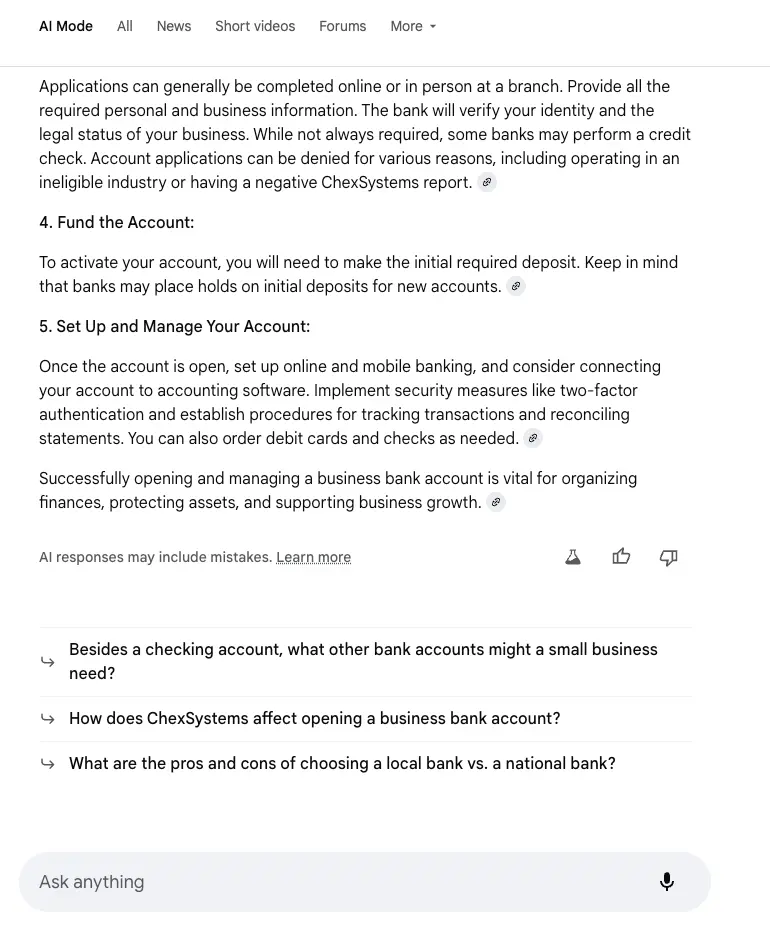
You could integrate these into the original blog or, if each question is substantial enough, build out a content cluster. This will strengthen your authority around the core topic and help your website rank in more AI searches.
But, it’s not enough to simply cover a topic and its related questions. If you want AI platforms to surface your content in search responses, the quality of that content matters just as much its scope.
AI systems are increasingly aligned with Google’s E-E-A-T framework, which prioritises content that demonstrates Experience, Expertise, Authoritativeness, and Trustworthiness. While all four factors contribute to AI visibility, first-hand experience is especially influential in shaping which sources are selected and cited.
To reflect genuine experience in your content:
- Include expert commentary from professionals within your team. Showcase real examples or case studies.
- Offer detailed walkthroughs either in written or visual format, such as videos.
- Clearly attribute content to named authors with relevant qualifications or industry experience.
By incorporating these elements, your content signals credibility to AI models parsing the web for reliable information. And the more your content reflects practical, first-hand knowledge, the more likely it is to be surfaced in AI-generated results.
3. Structure Your Content for AI and Humans
Creating valuable content is only half the battle. How you structure that content impacts whether it’s surfaced by AI systems or easily digested by human readers.
“From our first-hand experience, we find that AI tools like ChatGPT and Google’s AI Overviews tend to favour content that is formatted in a particular way,” says Tim Cameron-Kitchen. If your page is poorly organised or overly dense, even the most insightful content may be overlooked or misinterpreted. Just as importantly, users scanning your site expect clarity, flow, and readability.
Here’s how to structure for both audiences:
- Use clear, hierarchical headings (H1, H2, H3) to signal the topic and subtopics on the page. This helps AI understand the layout of your content and where key information sits.
- Break up long paragraphs into smaller, digestible chunks. Large blocks of text are harder for readers to scan and for AI to process effectively.
- Incorporate bullet points and numbered lists to present information succinctly. This is ideal for step-by-step guides, comparisons, or feature breakdowns.
- Include a table of contents (especially for longer content) to aid navigation and help AI understand the page’s structure holistically.
- Use descriptive subheadings, not just “Step 1” or “Tip #3”, but specific phrases. This provides more context and relevance to both AI platforms and users.
- Leverage schema markup (such as FAQPage, HowTo, and Article) to reinforce the structure and improve how your content is interpreted by AI crawlers and search engines.
We’ve put together an AI-optimised blog post template that you can easily follow to ensure every piece you create is ready to rank in AI Search. Or, if you’re specifically targeting Google’s AI, follow our step-by-step guide to create content that ranks in AI Mode.
4. Target Search Intent, Not Just Keywords
In traditional SEO, success often comes down to choosing the right keywords and weaving them into your content. But AI search works differently. It’s built to understand the why behind a search and deliver comprehensive, contextual answers matching the user’s underlying intent.
This means that keyword matching alone is no longer enough. To earn visibility in AI-generated responses, your content must reflect a deep understanding of what the user is trying to achieve.
Here’s how to align your content with user intent:
- Segment your content by funnel stage. Top-of-funnel queries may seek definitions or general overviews. Mid-funnel users might want comparisons or use cases. Bottom-funnel content should support purchasing decisions with testimonials, pricing, or feature breakdowns.
- Incorporate long-tail and conversational queries. These better reflect how users phrase questions in AI platforms.
- Anticipate the next steps. Think beyond the immediate query.
- Provide actionable takeaways. AI platforms prefer content that doesn’t just inform but helps users move forward with clarity and confidence.
By shifting your focus from keywords to intent, you position your content to align more closely with how AI models evaluate relevance. This results in a higher likelihood of your content being cited, summarised, or linked to in AI-generated responses right at the moment your audience seeks guidance.
5. Ensure Your Technical SEO Is Sound
While AI-driven platforms are transforming how content is discovered and presented, they still rely on the foundational infrastructure of traditional search engines to access and assess your website. This means if your technical SEO is lacking, it’s unlikely that AI systems will even encounter your content, let alone feature it.
Focus on these areas:
- Site Speed: Slow-loading pages hurt user experience and reduce crawl efficiency. Optimise images, scripts, and server response times.
- Mobile Optimisation: With mobile-first indexing now standard, your site must perform seamlessly across all devices.
- Crawlability: Ensure that your robots.txt file and internal linking structure allow AI platforms to fully explore and understand your content.
- Indexing: Regularly audit which pages are indexed in Google Search Console and fix any noindex errors or canonical tag misconfigurations.
- HTTPS Security: Use SSL certificates to protect user data and signal trustworthiness to both users and AI systems.
- Structured Data: Implement schema markup to help AI platforms interpret your content and enhance visibility in results.
Step 3: Measure AI Optimisation Success
Optimising your website for AI Search is an ongoing process. And like any smart marketing strategy, it needs to be measured and refined over time.
Unlike traditional SEO, where you can track performance through keyword rankings and organic traffic, AI Search Optimisation requires a more nuanced approach. AI results are dynamic and often personalised, meaning you won’t see a fixed position in a traditional SERP. Instead, visibility can vary by platform, query phrasing, and user intent.
To understand whether your AI Search Strategy is working, you need to monitor where and how your brand appears in AI-generated responses, how users interact with your content, and what conversions those interactions drive.
Use Tools to Check AI Placements
Tools like Semrush’s AI Toolkit* (try the free interactive demo** with us) and Profound can help you understand how you’re performing in AI Search.
These platforms track where your brand is cited in AI-generated results, how often it’s mentioned, and what the sentiment of those mentions is. They also provide competitor comparisons, keyword trends, and opportunities to improve visibility in specific categories or platforms.
Crucially, these tools help surface early signals that may not be obvious in manual checks. This includes emerging competitor mentions, shifts in sentiment, or loss of visibility in AI summaries.
Use this data to identify where your brand is gaining traction, where it’s being ignored, and where targeted content marketing or digital PR could make a measurable impact.
Monitor Referral Traffic
AI tools will cite their sources and link back to the original content when generating responses. These outbound links present a valuable (and growing) opportunity for referral traffic.
Use Google Analytics 4 (GA4) to track traffic from these AI sources. Check your referral reports for domains such as:
- chatgpt.com
- perplexity.ai
- gemini.google.com
- Other emerging AI platforms or browser-based AI extensions.
Although initial traffic volumes may be modest, these visits are highly valuable. They indicate that your content is being surfaced by AI systems and that users are actively engaging with your brand through these new channels.
Tracking this data over time helps you understand which platforms are sending traffic, which pages are attracting clicks, and how users behave once they arrive on your site. This insight can inform future optimisation efforts, helping you refine content and strengthen visibility where it matters most.
Track Conversions, Not Clicks
It’s no secret that AI platforms are driving up zero-click searches.
- A SimilarWeb report found that organic visits to top U.S. news websites dropped from 2.3 billion in mid‑2024 to under 1.7 billion by May 2025 following Google’s AI Overviews rollout.
- According to Bain & Company, 80% of consumers use zero-click answers in 40% of their searches, contributing to a 15 – 25% decline in organic website traffic.
- SparkToro found nearly 60% of U.S. Google searches ended without a click in 2024, compared to just 26% in 2022.
As AI Search grows, traditional performance metrics like pageviews and click-through rates are declining. To keep up, your measurement strategy needs to evolve.
Instead of focusing solely on traffic volume, prioritise the metrics that directly support business growth: conversions and meaningful engagement.
Here’s what to track:
- High-intent actions such as contact form submissions, demo requests, whitepaper downloads, or newsletter sign-ups.
- On-site behaviour, including time on page, scroll depth, and bounce rates, to evaluate how AI-referred visitors engage with your content.
Although you may see fewer total visits from traditional search, the quality of those visits often improves. Users who arrive via AI-generated answers typically have higher intent because they’ve already had some of their questions answered and are closer to making a decision.
AI Search Is Here: Is Your Website Ready?
AI-powered search is already changing how people discover and engage with content, products, and services. The question is: will your website be the one AI platforms (and users) turn to for answers?
To compete in this new era of search, you need to:
- Audit your current visibility across AI platforms like ChatGPT, Gemini, Perplexity, and Google’s AI Overviews and AI Mode.
- Create expert, experience-driven content that builds trust and topical authority.
- Earn brand mentions and backlinks through digital PR to strengthen your authority across the web.
- Optimise your site structure and technical SEO so AI systems can find, understand, and surface your content.
- Monitor AI citations, sentiment, and assisted conversions to measure impact and adjust your strategy.
At Exposure Ninja, we’ve been at the forefront of AI Search Optimisation, helping future-focused brands stay visible in AI Search. Request your website review today, and we’ll show you exactly how to prepare your site for AI Search.
FAQs
Will AI SEO replace traditional SEO?
AI Search Optimisation, also known as AI SEO, won’t replace traditional SEO. Traditional search engines are still the primary way people discover content online. AI search is becoming an additional channel that requires its own optimisation approach.
Does your website still need to rank in traditional search engines?
Absolutely. Traditional search engines like Google still drive the majority of web traffic. AI Search is an additional opportunity, not a replacement for traditional SEO. Focus on both to maximise your visibility across all search channels.
How do I optimise my website for Google’s new AI Mode?
Focus on creating comprehensive, well-structured content that answers user questions thoroughly. Use clear headings, implement structured data, and ensure your content demonstrates expertise and authority. Google’s AI Mode favours content that provides complete, accurate answers to user queries.
What content performs best in AI Search?
Authoritative, well-researched content that directly answers user questions performs best. This includes comprehensive guides, expert analysis, and factual information from credible sources. AI systems prioritise accuracy, depth, and clear structure over keyword density.
How can I check if my website appears in AI-generated results?
Manually search for your target search terms in AI platforms like ChatGPT and Google’s AI Overviews to see if your content appears. Then, use emerging tools like Semrush and Profound to track AI Search visibility. You can also monitor your Google Analytics account for referral traffic from AI platforms.
*Some links in this article are affiliate links that Exposure Ninja receives a fee for promoting (these links are not sponsored). Exposure Ninja only promotes services we already use within our marketing stack.
**Disclaimer: Exposure Ninja may get a commission through the marked links above at no cost to you.