How to Get MORE Website Sales and Leads


Getting website traffic is only half the battle. The real growth comes from turning that traffic into more website sales and leads. We break down the fundamentals of a high-conversion website and share advanced strategies to help you scale website revenue.
Is your website getting traffic but not enough sales or leads?
You’re not the only one. We regularly hear from businesses investing in Search Engine Optimisation (SEO), content marketing, and Google Ads, but are still seeing poor conversion rates.
But some businesses are getting it right. They’re driving high-quality traffic and turning it into consistent revenue through sales or leads.
Tim Cameron-Kitchen, Founder of Exposure Ninja, explains: “The companies seeing explosive growth understand that conversion isn’t about tricks or tactics. It’s about creating genuine value at every touchpoint and making it ridiculously easy for people to buy from you.”
We’ll take you through the fundamentals of a high-converting website and then move beyond the basics with our top 4 tips on how to get more website sales and leads.
The Essentials of a High-Converting Website
It’s not simply a case of getting more website traffic. It’s about improving your website conversion rate so you can turn that traffic into more sales or leads. And for that, your website design must have the right elements in place.
Optimised, Customer-Focused Copy
Your website copy should do one job: convince the right visitors to take action.
Getting this right starts with SEO. You attract qualified visitors by targeting keywords that match buying intent, not just search volume. That means focusing on commercial terms for your core pages, or the searches people type when they’re ready to act.
Once they land on your homepage, service page, or product page, your copy must do the heavy lifting. A page that converts includes:
- A headline that instantly confirms they’re in the right place.
- Clear, benefit-driven copy written in the customer’s language.
- Social proof, like reviews or case studies to build trust.
Optimised, customer-focused copy bridges the gap between traffic and action. It speaks to the customer’s intent, reinforces trust, and makes taking the next step the easiest choice on the page.
The challenge is knowing what to say and how to say it so your brand stands out for the right reasons. That’s why we created our Branding and Positioning Accelerator. In just 6–8 weeks, we combine customer research, competitor analysis, and conversion insights to develop a messaging framework that resonates with your audience and sets you apart.
We used this process for Transparent, a high-ticket B2B SaaS firm, and carried the refreshed positioning through every word on their new website. Within four months of launch, the site delivered 51 qualified leads (each worth five to six figures), proving how the right words, backed by the correct positioning can turn a website into a revenue driver.
Calls to Action (CTAs) That Convert
A good call to action (CTA) doesn’t just tell people what to do. It makes them want to do it.
Your visitors are busy, distracted, and sceptical. If your CTA blends into the page or uses generic copy like “Submit” or “Learn More,” you’re wasting traffic. Strong CTAs stand out visually and promise a clear benefit.
Every page should have one main action. Use a primary CTA for people ready to convert, like “Book a Free Consultation.” Add a secondary CTA for visitors who need a softer step, like “Download the Brochure” or “Watch the Demo.” This way, you capture different intent levels without losing momentum.
Placement matters too. CTAs should appear where users naturally pause, including above the fold, mid-page, and at the bottom. Use contrasting colours, action-driven copy, and surrounding trust signals to remove hesitation.
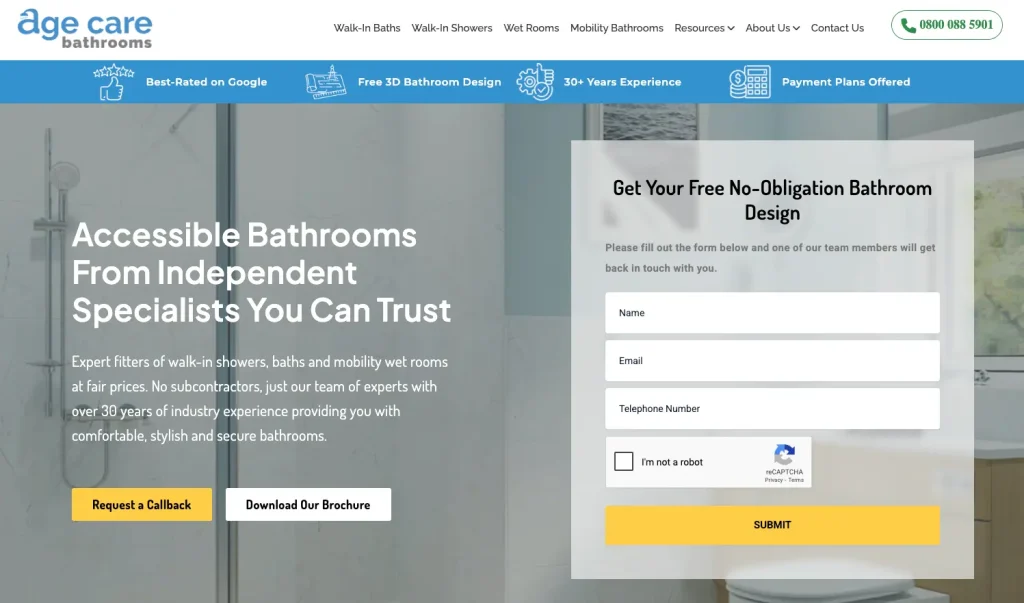
We created two CTAs for our client Age Care Bathrooms, including the primary “Request a Callback” and secondary “Download Our Brochure.” This gave high-intent users a direct path to speak with sales while offering less committed visitors a valuable resource. The combination widened the funnel, captured more leads, and supported a 137% increase in total lead generation across the campaign.
Simple, Intuitive Navigation
Visitors won’t stick around if they can’t find what they need. Navigation should feel effortless, guiding people from landing on your site to taking action without confusion or wasted clicks.
Clean menus and clear labels are key. Instead of clever wording that leaves people guessing, use straightforward terms like Services, Projects, or Contact. If you serve multiple audiences, split their journeys so each group has a tailored route to the information they care about.
For our client, Elite Renewables, their old menu forced homeowners and businesses to use the same options, creating friction and drop-offs. We rebuilt the navigation with a segmented mega menu that separated customer journeys. This made it easy for each audience to find the right service page in seconds, removing barriers and accelerating the path to enquiry.
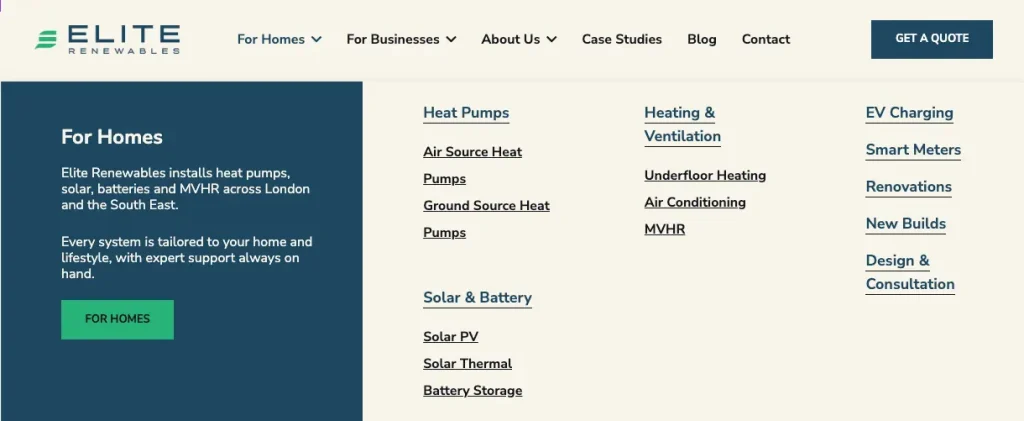
This change boosted conversions. The new site kept visitors engaged and doubled qualified leads within two weeks of launch by simplifying navigation and matching it to user intent.
Trust Signals in the Right Places
Without trust signals, even the slickest website will lose conversions. Your visitors want proof that you’re credible, reliable, and worth their investment, and they want that reassurance at the exact moment they’re deciding whether to act.
Trust-building features include:
- Customer testimonials that speak to results.
- Reviews and star ratings from platforms like Google or Trustpilot.
- Accreditation logos, certifications, and industry awards.
- Case studies that highlight real-world outcomes.
- Security or trust badges on enquiry forms and checkout pages.
It’s not enough to scatter testimonials or reviews on your “About” page. To really drive conversions, trust elements need to be built into the customer journey. That means placing them next to enquiry forms, beside CTAs, and on high-intent service pages where visitors are weighing up their options.
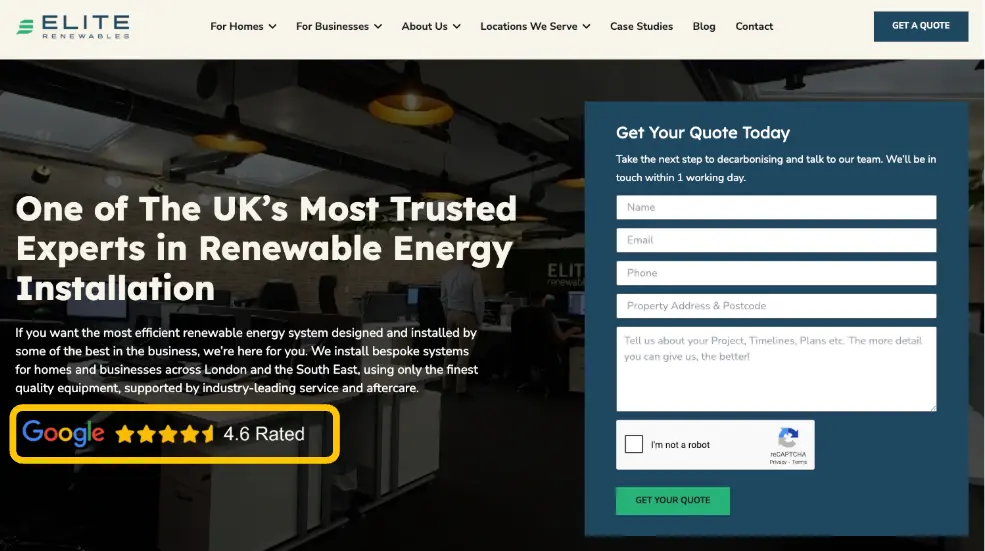
This approach worked for renewable energy installer Elite Renewables. We rebuilt their site to include Google review stars alongside their lead form, giving prospects a reason to feel confident before clicking “Get a Quote.” We also included customer testimonials and industry accreditations throughout their service pages, providing proof of expertise and satisfied customers at every decision stage.
Lead Magnets and Nurturing
Not every visitor is ready to book a consultation or request a callback. That leap can feel too big, especially for B2B buyers or customers considering a high-ticket service.
Lead magnets fill this gap by offering valuable information in exchange for contact details. They reduce commitment and build trust, whether through a brochure that explains pricing or a guide that simplifies complex services. You capture leads who might otherwise leave without engaging by answering real concerns.
But capturing the lead is just the start. A lead magnet is only effective when it’s paired with a nurturing strategy that keeps prospects engaged and steadily builds confidence until they’re ready to convert.
This was our approach for Age Care Bathrooms. Alongside their primary “Request a Callback” CTA, we introduced a brochure download as a secondary option.
Once in the funnel, we nurtured them with segmented email campaigns that educated, reassured, and moved them closer to purchase. This strategy helped generate 529 email-sourced leads and a 127% increase in email-driven revenue.
Fast, Frictionless User Experience
A website that loads slowly or feels clunky will frustrate visitors and cost you conversions.
NitroPack and Google partnered to put this statement to the test. Their 2024 study found that 50% of visitors will leave a website if the load speed is 3 seconds, versus the expected 2 seconds or less. They also showed that improving page speed by as little as 0.1 seconds resulted in an 8.4% increase in conversions in eCommerce — proof that even small gains have a measurable impact on revenue.
But speed is only the starting point. A site designed for conversions must also eliminate friction at every step. That means making it effortless for visitors to navigate, enquire, or buy without hitting unnecessary obstacles.
A high-performing, conversion-focused site should include:
- Sub-2 second load times across all devices.
- Minimal form fields that only ask for essentials.
- Streamlined enquiry or checkout flows.
- Mobile-first design that ensures seamless interactions.
- Clear error handling so users never get stuck.
Continuous Optimisation
The best websites improve constantly.
Data is your starting point. Use Google Analytics 4 (GA4) to track conversion funnels and spot where visitors drop off. Pair this with behaviour tools like Hotjar or Microsoft Clarity to see heatmaps, scroll depth, and user recordings. These insights will help you optimise each website page to ensure no leads or sales are lost.
From there, run A/B tests on headlines, CTAs, and layouts. Sometimes the biggest wins come from the smallest tweaks, like a clearer CTA button, a shorter form, or a trust signal added near the enquiry point.
This is exactly what happened when we worked on DSLD Mortgage’s homepage. Their original site was underperforming, but by studying heatmaps, we discovered weak CTAs and poor use of above-the-fold space. After redesigning with stronger positioning, clearer CTAs, and more visible trust signals, their homepage conversion rate jumped by 194%. That change turned a struggling homepage into a reliable growth driver.
4 Advanced Ways to Increase Website Sales and Leads
AI Search Optimisation
AI Search is changing how people find and choose businesses. Platforms like ChatGPT and Perplexity don’t just show links; they recommend solutions. You’re becoming invisible in this new search era if your business isn’t being mentioned.
AI Search Optimisation isn’t just about rankings. It’s about being the trusted answer when someone asks, “Who’s the best company for [your service or product]?” If the AI recommends you over a competitor, that’s a direct lead source you didn’t have before.
With an AI Search Optimisation strategy in place, you gain more visibility in high-intent searches, more trust built upfront, and more qualified AI traffic coming through your website.
For The Ordinary, we included an AI Audit alongside their SEO and content marketing campaign to stay ahead of the changing search landscape. We recommended restructuring key pages for clarity, stronger authority signals, and complete intent coverage. This work helped The Ordinary appear in Google’s AI Overviews and ChatGPT answers for high-value queries such as “can I use niacinamide with hyaluronic acid?” and “best hyaluronic acid serum.”
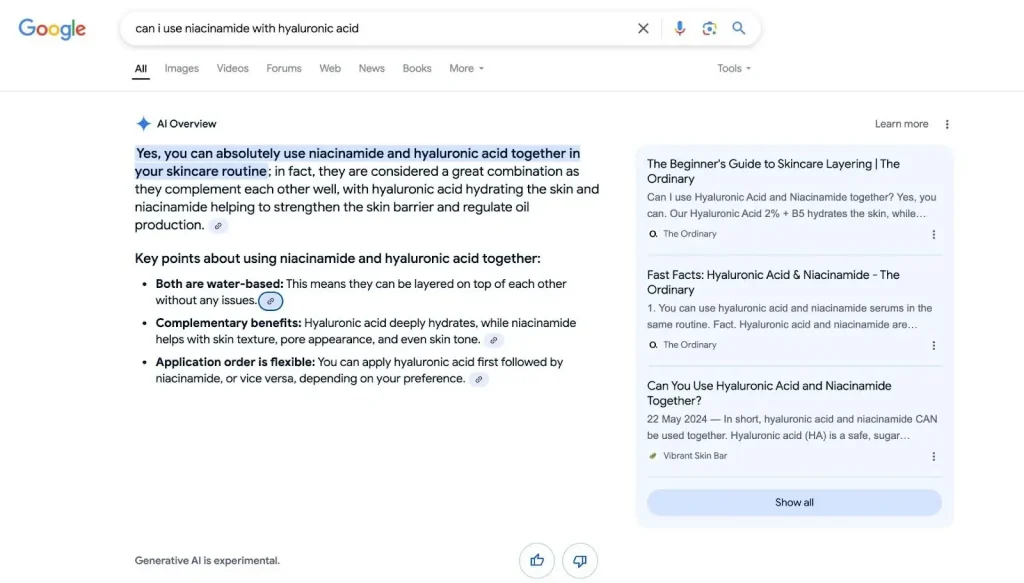
By adapting early, The Ordinary secured visibility in AI Search, built trust with potential customers, and gained a competitive edge in channels influencing buying decisions.
Tactical PPC
Running PPC ads alone won’t guarantee leads or sales. To make your Microsoft Ads or Google Ads profitable, your paid campaigns must work hand-in-hand with high-conversion landing pages.
This isn’t just sending your traffic to your optimised homepage. A landing page that delivers more leads and sales includes:
- A strong CTA centred around one conversion goal.
- It aligns with the promise of your ad, helping to prevent confusion and bounces.
- Persuasive copy and trust-building elements that encourage the user to take action.
This approach worked for MCS Cleaning. We aligned tightly targeted Google Ads with localised landing pages, making every click count. Instead of wasting budget on low-intent traffic, we used clear CTAs and service-specific messaging to filter out the noise and capture qualified enquiries.
This resulted in 319 leads from Google Ads (more than double the original target), plus multiple six-figure contracts that gave the business the confidence and budget to expand into a new region.
Tactical PPC is about efficiency. It maximises every click by sending traffic to purpose-built pages and keeping your brand in front of prospects until they’re ready to act. Done right, it turns ad spend into a steady stream of qualified leads or sales.
Conversion Optimisation for Humans and AI Agents
Our CEO, Charlie Marchant, tested ChatGPT’s new Agent Mode with a simple request: buy and deliver a 1kg bag of locally roasted coffee. The agent spun up its own virtual browser, ran live searches, compared options, checked freshness and availability, and had the exact product sitting in the cart in less than three minutes.
That’s the future of search in action. But it also revealed a problem. One coffee roaster’s site returned a 404 error when the agent tried to navigate.
Here’s what happened: The agent dropped it and moved on to a competitor without hesitation. That brand lost the sale because a conversion blocker was hidden in the website experience.
Whether your visitors are human or AI agents, both want a clear, frictionless path to purchase. That means:
- Fast-loading pages that don’t break or redirect to errors.
- Clean product structures with clear categories, attributes, and drop-downs.
- Descriptive, benefit-led product copy that highlights the exact details buyers (or agents) are searching for.
- Simple checkout flows with minimal steps and no forced account creation.
- Prominent trust signals like reviews, testimonials, and secure payment badges.
Humans can sometimes forgive clunky UX, but AI agents won’t. If your website isn’t structured and accessible, the agent will skip you for a competitor who is. Conversion optimisation has always been about making buying easier, but now it’s also about making it effortless for machines that decide on behalf of your customers.
Blogs That Drive Leads and Sales
Publishing blogs for awareness isn’t enough. Blogs need to be built with conversion in mind to generate sales and leads. That means focusing on:
- Choosing topics that match high-intent searches and real customer questions.
- Structuring content to be easy to scan, with clear takeaways.
- Adding persuasive elements like testimonials and case studies to remove hesitation.
- Placing CTAs throughout the post so readers always know the next step.
- Embedding enquiry forms, sticky buttons, or add-to-cart features that make conversion frictionless.
Done right, your blog stops being a passive traffic driver and becomes an active part of your sales funnel.
For Personal Injury Law Firm, this approach turned their blog into a reliable conversion channel. By rewriting posts around search intent, adding standout CTAs, and introducing sidebar forms and sticky buttons, we gave readers clear paths to enquiry. The result was a 144% increase in blog-driven conversions, proving that when blogs are optimised for action, they generate leads.
Scale Your Website’s Revenue
Getting more website sales and leads starts with nailing the fundamentals:
- Your copy needs to speak directly to customers.
- Your CTAs should make taking the next step irresistible.
- Navigation must be simple.
- Trust signals should sit in the right places.
- The whole experience needs to feel fast and frictionless.
- Continuous optimisation is non-negotiable.
But to compete, you need to go further. The most successful websites are scaling revenue by:
- Adopting an AI Search Strategy to earn recommendations in ChatGPT, Perplexity, and Google AI Overviews.
- Running tactical PPC campaigns that align high-intent ads with conversion-focused landing pages.
- Optimising for both human visitors and agentic AI, ensuring frictionless flows no matter who’s making the decision.
- Publishing blogs designed to convert, with CTAs, trust elements, and enquiry forms built in.
At Exposure Ninja, we’ve applied these principles across industries, from law firms to high-ticket healthcare to consumer brands. We’ve helped businesses double leads in weeks with website redesigns, generate six-figure contracts from PPC, and win visibility in AI-driven search results.
If you want to see what this looks like for your business, request a website and marketing review and get a personalised plan for turning your existing traffic into more leads and sales.
FAQs
Which single change could boost my website conversion rate today?
One of the quickest wins is improving your CTA buttons. Replace generic copy like “Submit” with clear, benefit-driven text such as “Get My Free Quote” or “Book a Free Consultation.” Ensure the button stands out visually and appears in key places like above the fold and near decision points.
Which trust signals are proven to increase website sales and leads?
The most effective trust signals reduce hesitation at the exact moment of decision. Customer testimonials with photos or videos add authenticity, while reviews and star ratings from platforms like Google or Trustpilot provide independent validation. Accreditation logos, case studies, and secure payment badges placed near CTAs or checkout areas all reinforce credibility and make taking the next step feel safe.
What does my site need to be ready for agentic AI buyers?
Your site must be structured so machines can quickly parse and act on information to be ready for agentic AI buyers. That means fast-loading pages, clear product data, and consistent categories that AI can navigate without confusion.