Why CMOs are RIPPING UP Their Marketing Strategies

Are you watching your marketing performance decline whilst competitors seemingly gain ground from nowhere? If you’re spending five and six figures monthly on traditional marketing channels and seeing diminishing returns, you’re not imagining it.
The CMOs of brands like Expedia, HubSpot, and L’Oreal aren’t just tweaking their strategies — they’re completely rewriting them. This isn’t a trend. This is a survival plan.
Your customers are using tools like ChatGPT, Gemini, Google’s AI Overviews, and Perplexity to find new products and brands to buy from. And these tools are making recommendations about where to spend money — recommendations that may or may not include your brand.
Executive Summary
The marketing landscape is experiencing its most dramatic shift since Google’s dominance began. AI search tools are fundamentally changing how customers discover and choose products, creating a two-tier division among marketing leaders.
Tier 1 CMOs are already adapting strategies, tracking AI visibility, and securing first-mover advantage.
Tier 2 CMOs use ChatGPT daily but have yet to realise how disruptive this will be for their brands.
The businesses that will dominate are implementing three critical strategies:
- Visibility tracking across multiple AI platforms
- Strategic prompt optimisation for conversational queries
- Source citation strategy spanning user-generated content, authority publications, and brand-owned assets
Tim Cameron-Kitchen, Exposure Ninja’s founder, explains in his latest podcast: “We’re still early enough that there is first mover advantage here, and this is a land grab opportunity, and we see it day in and day out with our clients.”
Why Are Industry Leaders Abandoning Traditional Marketing Playbooks?
HubSpot’s marketing leadership team recently called the traffic pattern changes from Google’s AI Overviews a “traffic apocalypse.” When organic click-through rates drop as AI answers become more prominent, traditional SEO strategies alone become insufficient.
The shift isn’t theoretical. After conducting AI Search audits for FTSE 250 companies, $50 million software firms, and German DAX top 30 brands, we’re seeing consistent patterns:
User behaviour is fundamentally changing. People are asking conversational questions like “What’s the best sales and marketing software for SaaS businesses?” rather than typing keyword-focused queries.
AI tools are becoming recommendation engines. They don’t just return search results — they actively recommend specific brands and products based on their analysis of available information.
Traditional traffic sources are declining. When AI provides comprehensive answers directly in search results, fewer users click through to individual websites.
As Tim explains: “This is a big enough shift in user behaviour that it’s worth marketers and even company leadership spending time to understand how the space works.”
The companies ignoring this shift are experiencing what we call a gradual then sudden decline — steady erosion followed by dramatic drops as AI adoption accelerates.
What Are Leading CMOs Doing Differently?
Forward-thinking marketing leaders are implementing systematic approaches to AI Search Optimisation. Based on our work with industry leaders, successful strategies focus on three critical areas.
Building AI Search Plans
Rather than hoping for the best, leading CMOs are creating structured, step-by-step plans specifically for AI Search visibility. These aren’t add-ons to existing SEO strategies — they’re comprehensive approaches addressing the unique mechanics of AI recommendation systems.
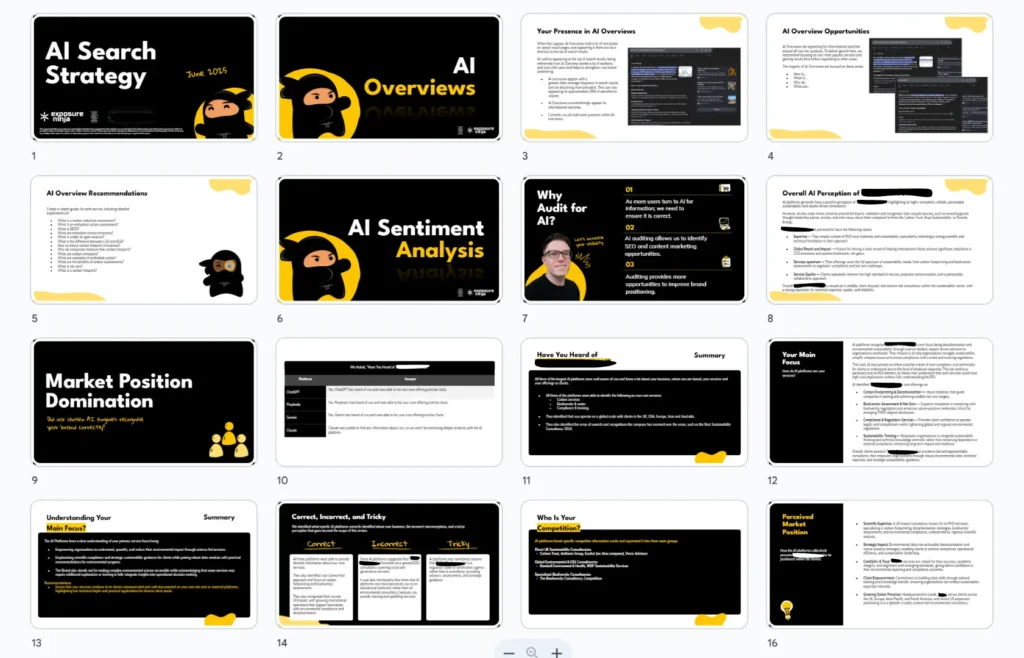
At Exposure Ninja, we’ve developed AI Search Audits that analyse:
- Current brand visibility across AI platforms
- Competitor positioning in AI responses
- Content gaps affecting AI recommendations
- Strategic implementation roadmaps
Investing in AI Search Tools
The most proactive marketing teams use platforms like Peec AI* to monitor their brand’s AI search performance. These tools provide visibility scores, sentiment analysis, and competitor benchmarking across multiple AI platforms.
Unlike traditional SEO tools that track keyword rankings, AI search tools monitor prompt responses — tracking how often your brand appears in AI answers to conversational queries relevant to your business.
Coordinating Cross-Platform Presence
Leading CMOs understand that AI tools compile information from multiple sources. Success requires coordinated presence across:
User-generated content platforms like Reddit and YouTube, where real users discuss products and experiences.
Authority publications, including industry websites, expert reviews, and specialist publications, are sources that AI tools consider trustworthy.
Brand-owned content optimised specifically for AI consumption, featuring clear structure, factual data, and comprehensive information.

Who Is Already Winning This Transition?
The brands securing early advantages share specific characteristics. They’re treating AI search as a strategic priority rather than a tactical experiment.
HubSpot’s Strategic Approach
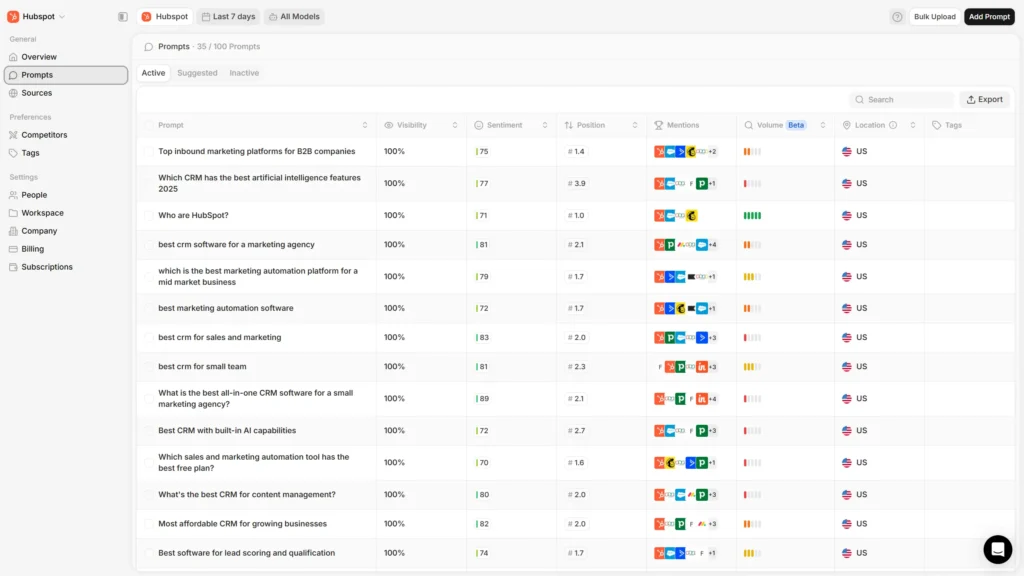
HubSpot exemplifies successful AI Search positioning. Analysis using Peec AI shows they maintain 100% visibility for prompts like “best CRM software for a marketing agency” — appearing in every AI response across tracked platforms.
Their success stems from a comprehensive presence across multiple source categories. When AI tools analyse CRM software recommendations, they find HubSpot mentioned in:
- Industry authority sites
- User discussions on platforms like Reddit
- Their own optimised content
- Third-party reviews and comparisons
This creates consistent signals that influence AI recommendations.
Walmart’s Infrastructure Evolution
Walmart is adapting its entire infrastructure to support AI personal shopping agents. It’s not just optimising content — it’s evolving its systems to interface directly with AI recommendation engines.
This forward-thinking approach positions them to benefit as AI shopping assistants become more prevalent among consumers.
Where Should Smart Marketers Focus Their AI Search Efforts?
AI search success requires understanding three critical areas: visibility tracking, prompt optimisation, and source citation strategies.
Visibility Tracking Across Platforms
Your AI search performance varies significantly across platforms. ChatGPT, Google’s AI Overviews, and Perplexity each have different algorithms and source preferences.
Monitor sentiment alongside visibility. Being mentioned negatively is worse than not being mentioned at all. AI search tools provide sentiment scoring to ensure your brand appears in positive contexts.
Track competitor positioning. Understanding who dominates AI responses in your category reveals opportunities and threats. If competitors consistently appear in AI recommendations whilst you don’t, you’re losing potential customers.
Strategic Prompt Optimisation
Think of prompts as keywords for the AI search era. Instead of optimising for “CRM software,” you need visibility for conversational queries like “What’s the best sales and marketing software for SaaS businesses?”
Choose prompts strategically. Focus on queries your ideal customers actually ask AI tools. These often differ significantly from traditional keyword searches.
Track individual prompt performance. Your visibility varies dramatically between different prompts. You might dominate responses for one query whilst being invisible for closely related questions.
Source Citation Analysis
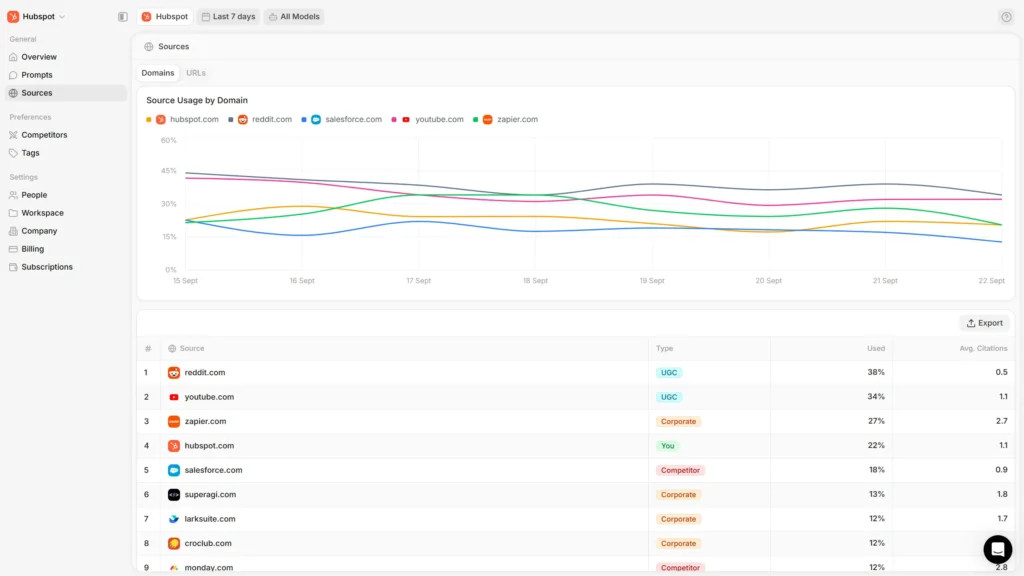
AI tools don’t invent recommendations — they compile information from existing sources. Understanding which websites AI platforms prioritise reveals your content strategy roadmap.
Analyse source categories systematically. Our research shows AI tools typically reference three categories: user-generated content (Reddit, YouTube), authority publications (industry sites, expert reviews), and brand-owned websites.
Identify specific URLs being cited. Going deeper than domain-level analysis, you can see exactly which articles and pages AI tools reference most frequently. This provides your content and digital PR teams with specific targets.
Develop surgical outreach strategies. Rather than broad content marketing, you can focus efforts on getting featured in the specific articles AI tools cite regularly.
When Do You Need to Make This Shift?
“The good news, of course, is that it’s not too late. We’re still relatively early in AI search.”, Tim explains.
However, the window for first-mover advantage is closing. We’re seeing two distinct groups emerge:
The Early Adopters
These CMOs understand the implications and are actively implementing AI search strategies. They’re securing competitive advantages that become increasingly difficult to overcome as the technology matures.
The Unaware
“There is the other group who don’t even know that this stuff is happening. They’re using ChatGPT all day themselves. They can see that their own user behaviour is shifting. They even know that their friends and family are using AI way more than traditional search, but they haven’t yet put two and two together and figured out how disruptive this is going to be for the brand.”
The critical timeline is now. Every month you delay implementation is market share potentially lost to competitors who are already optimising for AI search.
Start with understanding. Even if you’re using external agencies, you need to grasp the fundamentals to analyse responses and make informed decisions.
Build gradually, but start immediately. You don’t need to revolutionise everything overnight, but you do need to begin tracking your current AI search performance and identifying opportunities.
How Do You Build Your AI Search Strategy?
Successful AI Search implementation follows a systematic approach. Based on our work with leading brands, here’s the framework that delivers results.
Step 1: Audit Your Current AI Search Performance
Before optimising anything, understand where you currently stand. Use tools like Peec AI to analyse:
- Your visibility scores across different AI platforms for queries relevant to your business.
- Competitor positioning to identify gaps and opportunities in your market.
- Current source citations to see which websites AI tools reference when discussing your category.
- Sentiment analysis to ensure existing mentions are positive rather than neutral or negative.
Step 2: Develop Your Prompt Strategy
Create a comprehensive list of conversational queries your ideal customers ask AI tools. These should include:
- Direct product/service queries like “best marketing automation tool for e-commerce”
- Problem-solution queries like “how to increase website conversions for SaaS companies”
- Comparison queries like “HubSpot vs Salesforce for small businesses”
- Implementation queries like “how to set up email marketing automation”
Step 3: Implement Source Citation Strategies
AI tools prioritise different source categories. Your strategy must address all three:
- Optimise your owned content with clear structure, factual data, and comprehensive information that AI tools can easily parse and reference.
- Secure authority publication mentions through strategic digital PR and content partnerships with industry websites that AI tools frequently cite.
- Build user-generated content presence on platforms like Reddit and YouTube, where real users discuss products and share experiences.
Step 4: Track and Optimise Performance
AI search requires ongoing monitoring and adaptation. Implement systems to:
- Monitor visibility changes across different AI platforms and prompts.
- Analyse new source citations to identify emerging content opportunities.
- Track sentiment shifts to address any negative mentions quickly.
- Benchmark competitor performance to maintain competitive positioning.
Next Steps
Your immediate priority should align with your current AI search maturity:
This week: Audit your brand’s current AI search performance using tools like Peec AI*. Ask ChatGPT, Google’s AI overviews, and Perplexity direct questions about your category and note which brands they recommend.
Next 30 days: Develop your prompt strategy by identifying 10-20 conversational queries your ideal customers ask AI tools. Begin tracking your visibility for these specific prompts across multiple platforms.
Next 90 days: Implement source citation strategies focusing on the websites AI tools cite most frequently in your category. This includes both optimising your owned content and securing mentions on authority publications.
The businesses that will dominate tomorrow are making these strategic shifts today. Every week you delay is potential market share lost to competitors already implementing AI search optimisation.
Resources Mentioned
• Peec AI – AI search visibility tracking and competitor analysis tool
• AI Search Audits – Comprehensive analysis and strategic planning for AI Search Optimisation
Would you like an AI Search Audit for your brand? Then contact our team to join the waitlist.
In Conclusion
The marketing landscape is experiencing its most significant shift since Google’s early dominance. CMOs from industry-leading brands aren’t just tweaking their strategies — they’re fundamentally reimagining how to reach and influence customers in an AI-driven world.
As Tim Cameron-Kitchen, Exposure Ninja’s founder, explains: “This is an amazing time in digital marketing. We’re looking at the dawn of a totally new era of search.”
The opportunity for first-mover advantage remains, but the window is narrowing. The marketing teams that adapt now will establish competitive moats that become increasingly difficult to overcome as AI search adoption accelerates.
Your customers are already using AI tools to discover products and make purchasing decisions. The question isn’t whether this shift will affect your business — it’s whether you’ll be positioned to benefit from it or become another casualty of changing user behaviour.
The businesses that will thrive are those implementing systematic AI search strategies today, not waiting for perfect clarity tomorrow.
Watch This Next
There are many ways to create an AI Search strategy for 2026, and we’ve gathered the very best ideas together so that you can pick the perfect one for your business or brand. You can watch our “Best AI Search Strategies for 2026” video below, or you can listen to the audio podcast instead.
*Disclaimer: Exposure Ninja may get a commission through the marked links above, at no cost to you