Everything Marketers Need to Know About AI Max for Search

Marketing leaders are asking the same question: How do we harness AI automation without losing campaign control? Google’s answer comes in the form of AI Max for Search, a new Google Ads feature that’s transforming how sophisticated businesses approach paid advertising, yet many marketing teams haven’t even heard of it or have started preparing for its release in the summer of 2025.
The technology isn’t revolutionary in concept, but, according to Google’s announcement at Google Marketing Live 2025, it’s proving revolutionary in results. The few businesses Google has been working directly with to test AI Max report conversion increases of 100% alongside cost reductions exceeding 30%. More importantly, these gains come without the campaign complexity that typically accompanies new Google features.
This represents a fundamental shift in paid search strategy. Marketing leaders who understand AI Max’s true potential — and implement it correctly — are establishing market positions that competitors will struggle to replicate.
Executive Summary
AI Max for Search builds upon what Google’s Performance Max ads feature promised: intelligent campaign automation that enhances a human’s PPC strategy rather than replacing it. The system operates as an enhancement layer within existing search campaigns, combining broad match intelligence, dynamic ad creation, and landing page integration into a cohesive automation framework.
Three critical advantages differentiate AI Max from previous automation attempts:
• Contextual intelligence that interprets user intent across semantic variations, capturing profitable traffic that manual keyword research consistently misses
• Content-driven personalisation that dynamically adjusts messaging based on landing page analysis and search context
• Strategic transparency through enhanced reporting that reveals AI decision-making processes and performance drivers
The competitive advantage emerges from understanding that AI Max for Search amplifies existing marketing strengths while exposing weaknesses. Companies with strong SEO foundations, quality content, and robust conversion tracking see exponential benefits. Those lacking these elements often experience disappointing results.
Understanding the AI Max Difference
AI Max for Search operates through three interconnected Google Ads systems that work simultaneously:
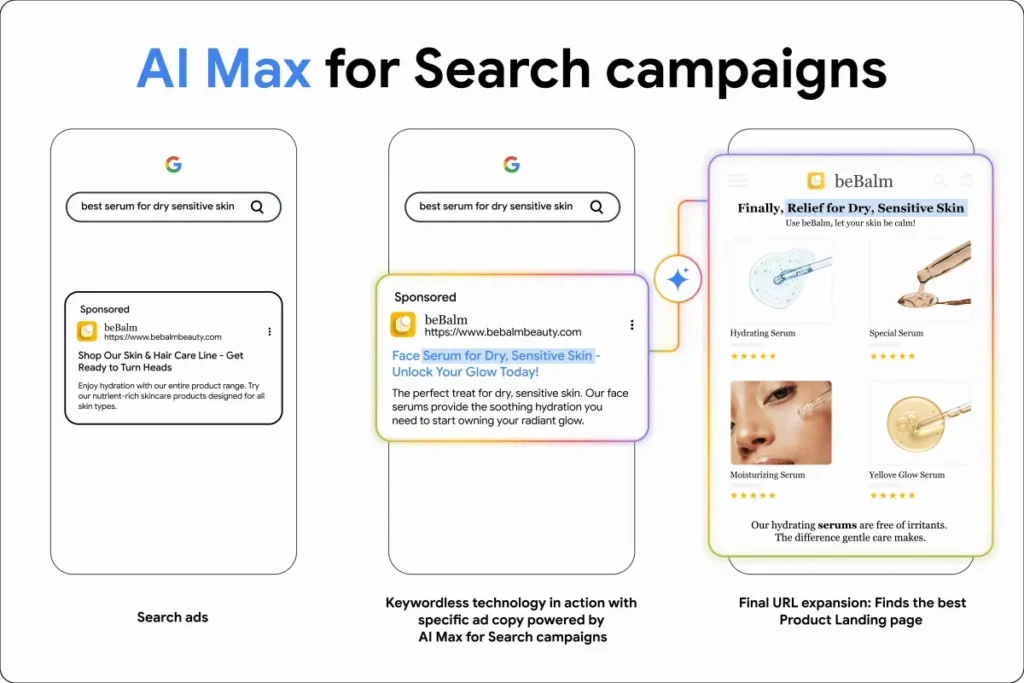
Semantic query expansion analyses user search intent to identify related queries that share commercial value.
A campaign targeting “accounting software” might capture queries about:
• “Bookkeeping solutions”
• “Financial management tools”
• “Small business invoicing platforms”
This happens through intent similarity rather than simple keyword matching.
Dynamic content synthesis creates personalised ad copy by analysing your landing page content and matching it to specific user queries. Rather than serving generic ads, the system crafts messaging that addresses the specific problem the user is trying to solve.
Behavioural optimisation continuously adjusts campaign elements based on user response patterns. The system identifies which combinations produce the highest-value conversions and amplifies these while reducing exposure to underperforming variations.
The Strategic Implementation Blueprint
Successful AI Max for Search deployments require addressing three foundational elements before activation.
Establish Content Authority
AI Max for Search performance correlates directly with content quality across your entire digital ecosystem. The system draws from multiple sources to create ad messaging:
• Website content and structure
• Third-party mentions and reviews
• User-generated discussions across platforms
Marketing teams should audit their content distribution strategy across industry publications, review platforms, and professional forums. The most effective approach involves securing placement in list articles and comparison pieces published by industry authorities.
Optimise Technical Foundations
AI Max’s success depends on the technical infrastructure that many marketing teams take for granted. Several elements directly impact campaign performance:
• Comprehensive conversion tracking across the customer journey
• Page speed and mobile responsiveness optimisation
• CRM integration and data alignment
• Marketing automation system preparation
Landing page optimisation becomes critically important because AI Max for Search pulls content directly from destination pages to create personalised messaging. Pages lacking clear value propositions and structured headings significantly limit campaign effectiveness.
Design Testing Frameworks
Enterprise businesses can implement parallel testing structures running AI Max alongside traditional campaigns. Mid-market businesses should select specific product lines for initial testing. Small businesses require conservative frameworks that begin with lower-performing campaign segments whilst maintaining sufficient conversion volume.
%E2%80%9CYou can’t just sit back and let the ads run. You need a human element. It’s like the self-checkouts at Asda. They always break. You’ve got to have somebody looking over them and making sure they’re working correctly, and that is more of the advertising role moving forward.”
 Rebecca Pilkington
Head of PPC
Rebecca Pilkington
Head of PPC
Business-Specific Implementation Strategies
B2B Lead Generation Approach
B2B businesses face unique challenges due to longer sales cycles and complex decision-making processes. The key lies in aligning AI Max campaigns with comprehensive lead-nurturing strategies that can handle:
• Increased prospect volume across awareness stages
• Multiple decision-makers in the purchase process
• Extended evaluation periods requiring sustained engagement
B2B implementations benefit significantly from thought leadership content that AI Max can reference when creating personalised messaging.
eCommerce Optimisation Strategy
eCommerce businesses can leverage AI Max for Search’s product discovery capabilities to capture traffic across the entire consideration spectrum. Product feed optimisation becomes crucial:
• Detailed descriptions and technical specifications
• Use cases and compatibility information
• Customer reviews and rating data
The strategy should emphasise content that helps users understand product applications rather than focusing solely on product features.
Local Business Applications
Local businesses can use AI Max to capture “near me” searches that traditional targeting often misses. The approach should emphasise local authority building:
• Local SEO integration and Google Business Profile optimisation
• Community presence across review platforms and local directories
• Service area content addressing regional needs
%E2%80%9CMy recommendation would be just to set up a test environment. With the Performance Max campaigns, if you have a search campaign or a shopping campaign, you can set up a dedicated experiment within the experiment tab. So I recommend you can do that for AI Max for Search as well.”
Rebecca Pilkington
Head of PPC
Measuring Performance
AI Max for Search ads campaigns require different measurement approaches compared to traditional search campaigns. Standard conversion attribution often fails to capture true impact because the system influences user behaviour across multiple touchpoints.
The analysis should examine how AI Max for Search campaigns interact with other marketing channels. Users exposed to AI Max ads often convert through different channels, requiring cross-channel attribution to measure actual campaign value.
Content optimisation provides the highest impact opportunities for AI Max improvement. Updating landing pages with clearer value propositions and structured information typically produces more significant performance gains than campaign setting adjustments.
Next Steps
AI Max for Search represents a strategic inflexion point in paid advertising evolution. Marketing leaders who implement systematically will establish competitive positions that become increasingly difficult to replicate.
Immediate implementation priorities:
- Conduct a comprehensive conversion tracking audit to ensure AI Max has access to complete performance data
- Assess content distribution across third-party platforms to identify authoritative placement opportunities
- Optimise landing page content structure for AI consumption through clear headings and structured information
- Establish baseline performance metrics across current search campaigns for accurate impact measurement
- Design risk-appropriate testing protocols that protect core campaign performance whilst enabling experimentation
The businesses implementing AI Max strategically during this early adoption phase will establish market advantages that compound over time.
In Conclusion
AI Max for Search represents the most sophisticated implementation of intelligent automation that Google has yet released. Success requires understanding that it’s about providing AI systems with better strategic direction rather than surrendering control.
The technology rewards preparation and systematic implementation, while exposing weaknesses in campaign foundations. Marketing leaders who invest time in understanding AI Max’s true capabilities will position their organisations for success in an increasingly AI-driven advertising ecosystem.
The opportunity for early adoption advantages remains available, but the window for maximum impact is narrowing as market awareness grows.
Watch This Next
AI Max for Search will help businesses to feature in AI Mode and AI Overviews, but appearing organically in both will be a key skillset that every marketer will need to know how to do. But how? What are the ranking factors for ranking in Google’s AI Overviews? Are they the same as traditional Google? Or is there something new that the LLM part of both generative AI features needs to see?
That’s what’s discussed in one of our most recent episodes entitled, Have Google’s AI Overview Ranking Factors Been Revealed? Click the link or watch the episode below.