How to Learn SEO for Free: 50 Expert Resources


Want to know how to learn SEO for free without wasting time on outdated advice? This guide pulls together 50 of the best free resources to help you go from SEO beginner to confident SEO expert.
We’ve covered guides, blogs, news sites, tools, videos, courses, and in-person events. There’s also a vocabulary cheat sheet to get you started, a step-by-step learning roadmap, and answers to the most common questions beginners ask.
One of the great things about the SEO community is how well we share knowledge with one another. Thanks to the hard work of many generous SEOs, you can learn how to do Search Engine Optimisation for free. All you need are strong resources written or created by SEO experts.
Here’s how to learn SEO for free with our list of the best 50 SEO blogs, news sites, courses, videos, conferences, and tools. We’ve also included a cheat sheet of SEO vocabulary to get you started.
How to Learn SEO: A Step-by-Step Roadmap
Before diving into the 50 resources, here’s the learning path we recommend. Follow these steps in order and you’ll build a solid, practical foundation much faster than hopping between topics at random.
- Understand how search engines work. Before optimising anything, you need to know what you’re optimising for. Learn how Google crawls, indexes, and ranks content. Google’s own How Search Works guide is the best starting point.
- Learn keyword research. Keywords are the foundation of every SEO campaign. Learn how to identify what your audience is searching for, assess search volume and competition, and match keywords to the right pages.
- Master on-page SEO. Understand how to structure pages, write effective title tags and meta descriptions, use headings correctly, and optimise your content for both users and search engines.
- Get to grips with technical SEO. Page speed, crawlability, site structure, Core Web Vitals, and structured data are all technical factors that affect your ability to rank. You don’t need to be a developer, but you do need to understand the basics.
- Learn off-page SEO and link building. Links from other websites are still one of Google’s most important ranking signals. Learn how backlinks work, what makes a good link, and how to earn them legitimately.
- Practise on a real site. Theory only goes so far. Set up a WordPress blog or use a real project and start applying what you’ve learned. Hands-on experience is where the real learning happens.
- Track, measure, and iterate. Use Google Search Console and Google Analytics to monitor your results. SEO is a long game. Learn to read the data, identify what’s working, and adjust your approach accordingly.
- Stay current. Search engines change constantly. Follow reputable news sources and keep up with algorithm updates so your knowledge doesn’t go stale.
How long does it take to learn SEO? You can get to grips with the basics in 2 to 4 weeks of dedicated study. Becoming genuinely proficient takes around 3 to 6 months of hands-on practice. Mastering SEO is an ongoing process that continues throughout your career, because the landscape keeps evolving.
SEO Vocabulary Cheat Sheet
| Term | Definition |
| Search Engine Optimisation | Search Engine Optimisation (SEO) is the practice of improving a website to rank higher in search engine results, like Google, to increase organic (non-paid) traffic and conversions. |
| On-site SEO | On-site SEO, also known as on-page SEO, is the optimisation of elements on your website, such as meta tags and content, to improve rankings. |
| Off-site SEO | Off-site SEO, also called off-page SEO, are the activities done outside of your website, like link building, to boost website authority and rankings. |
| Technical SEO | Technical SEO involves optimising the technical elements of your website, such as site structure and speed, to help search engines crawl, index, and rank your pages effectively. |
| White-hat SEO | White-Hat SEO are practices that follow search engine guidelines. |
| Black-hat SEO | Black-Hat SEO are risky tactics that try to cheat search engines, such as keyword stuffing or bulk buying backlinks. |
| E-E-A-T | Experience, Expertise, Authoritativeness, and Trustworthiness (E-E-A-T) is Google’s Search Quality Rating Guidelines used to assess content quality. |
| Keywords | Keywords are words or phrases that people search for online and are used to optimise pages for visibility in search engine results. |
| Keyword Research | Keyword research is the process of finding and analysing search terms people use to discover content online. |
| Keyword Intent | Keyword intent is the reason behind a user’s search, divided into informational, commercial, transactional, or navigational intent. |
| Backlinks | Backlinks are links from other websites to your website. |
| SERPs | Search Engine Results Pages (SERP) are the pages of listings shown after you search for something on a search engine like Google. |
| Schema Markup | Schema markup is code added to a website to help search engines better understand the content and show rich results, like FAQs. |
| Local SEO | Local SEO is optimisations focused on improving visibility for location-based searches, helping local businesses show up in Google Maps and nearby results. |
| Zero-Click Searches | Zero-click searches are when the answer appears directly on the results page, so users don’t click any website links. |
50 FREE Ways to Learn SEO
The Best SEO Guides
These comprehensive guides will get you up to speed on the basics of SEO:
- Google’s SEO Starter Guide: What better place to start than Google’s very own starter guide to SEO? While search engines and SEOs tend to have different goals in mind, there’s no doubt that it’s worth listening to what Google has to say about making websites rank.
- Digital Marketing Institute’s What is SEO Guide: A clear, beginner-friendly breakdown of what SEO is, how it works, and why it matters. It’s a solid intro for marketers and business owners who want the bigger picture before diving into the details.
- Moz’s Beginner’s Guide to SEO: Moz creates useful tools for both web marketers and SEOs. Its Beginner’s Guide to SEO is one of the most authoritative pieces of content on the subject and a must-read for newbies.
- WordStream’s Guide on SEO Basics: WordStream provides a data-driven approach to explaining the fundamentals of SEO.
- Search Engine Land’s SEO Guide: Great piece that covers the difference between SEO and PPC.
- Exposure Ninja’s SEO Strategy Guide: Exposure Ninja’s complete guide to building an effective SEO strategy in 2025, covering everything from keyword research to technical optimisation to optimising for AI Search.
Go-To SEO News Sites:
Here are some of the top news sources to keep you informed about the latest SEO developments and best practices:
- Search Engine Land: Breaking news on Google, Bing, and Yahoo updates, plus in-depth analysis of algorithm changes and industry trends.
- Search Engine Journal: Comprehensive coverage of SEO news, strategies, and insights with content for marketers at all levels.
- Search Engine Roundtable: Daily summaries of the best SEO forum discussions and breaking news from Barry Schwartz.
- Google Search Central Blog: Official guidance directly from Google’s search team about algorithm updates, best practices, and new features.
- MarTech: MarTech’s dedicated Search Marketing news section provides the latest updates on how AI Search is impacting traditional search.
The 10 Very Best SEO Blogs
Follow these expert SEO bloggers for cutting-edge insights and proven strategies:
- Backlinko Blog: Brian Dean contributes in-depth studies and guides that consistently rank for competitive keywords, with a focus on link building and content marketing strategies. He’s most well-known for popularising the Skyscraper Technique for building quality backlinks.
- Ahrefs Blog: Regular content from the Ahrefs team covering keyword research, technical SEO, and marketing experiments with clear, actionable advice.
- Exposure Ninja’s SEO Knowledge Base: Find everything you need to know about SEO all in one place, filled with expert insights, helpful videos, and the most up-to-date SEO trends.
- Neil Patel’s Blog: Neil Patel is someone you can’t go far in SEO without hearing of. He offers comprehensive guides on SEO, content marketing, and digital strategy.
- Exposure Ninja Podcast: Tune in to the Exposure Ninja Podcast for expert insights on SEO, digital marketing, and business growth, or read the show notes if you prefer to read the highlights.
- Moz Blog: Home to the famous Whiteboard Friday series and in-depth articles from the SEO community’s thought leaders.
- Content Marketing Institute: Focuses on the content strategy side of SEO with guides on creating and optimising content that ranks.
- Yoast SEO Blog: This blog is brought to you by Yoast, the creators of the popular SEO plugin for WordPress sites. The top recommendation for new SEOs is to read the Yoast blogs on page titles and meta descriptions, which are key to ranking successfully on Google and securing organic traffic.
- Keywords Everywhere Blog: Statistics, guides, and actionable tips for SEO professionals and beginners alike.
- Semrush Blog: Daily updates on SEO trends, original research, and step-by-step tutorials written by experienced SEO practitioners.
The Best Free Tools for Learning SEO
These free SEO tools will help you practice what you’re learning and analyse real websites:
- WordPress: There’s no substitute for getting out there and trying to do some SEO for yourself, and you can’t really do SEO without your own website. WordPress allows you to quickly build your own website and start messing around with some of the techniques you’ve learned so far.
- Google Analytics: Once you’ve got yourself a website, it’s time to dive into the data using Google Analytics 4. Use Google Analytics to review your traffic sources, explore your user demographic information and more. You can then use this valuable data to improve your website’s performance.
- Google Search Console: As per the Google site, “Google Search Console helps you monitor, maintain, and troubleshoot your site’s presence in Google Search results.” Everyone who wants to learn SEO should take a look at a Google Search Console account and understand how to submit pages to Google, as well as review any warnings at a minimum.
- Google Keyword Planner: Free keyword research tool providing search volume data and keyword ideas directly from Google.
- Yoast SEO: Yoast is a WordPress plugin designed to make SEO easy for WordPress websites. While dedicated SEO students will quickly outgrow Yoast’s recommendations, the tool does help people start to think about SEO.
- Majestic: Majestic is a powerful backlink profiler that gives free users a limited number of tries per day.
- Ahrefs Webmaster Tools: Free access to Ahrefs’ Site Audit and Site Explorer for your own website, revealing technical issues and backlink data.
- Ubersuggest: Neil Patel’s freemium keyword research tool is a good, quick alternative to some of the more complex (and paid) tools out there.
- Screaming Frog SEO Spider: Desktop crawler that simulates how search engines crawl your site, with a free version allowing 500 URL crawls.
The Best Videos for Learning about SEO
Visual SEO learners will benefit from these excellent YouTube channels and videos:
- Google Search Central on YouTube: It surprises me that more people don’t rave about the Google Search Central YouTube channel. These completely free videos, which include some of the most technical SEO videos I’ve ever seen, are recorded by Google’s very own webmaster team.
- The Exposure Ninja YouTube Channel: We’ve added ourselves here for good reason. Six of our ten most popular videos are about SEO. We share at least one new video a week about all things marketing, and, more often than not, our videos include an SEO element. We upload every Monday, so don’t forget to subscribe and turn on notifications to stay up-to-date with our latest videos.
- Moz’s Whiteboard Fridays: Although founder Rand Fishkin has since moved on, the Moz team continues to create or source an SEO-related video every week. The videos range from beginner-friendly to deceptively advanced.
- Crawling Mondays on YouTube: This video series from technical SEO mastermind Aleyda Solis is well worth checking out! Aleyda’s channel combines instructional deep dives into technical SEO with interviews featuring SEO professionals.
- Ahrefs YouTube Channel: Clear, concise tutorials covering SEO fundamentals and advanced strategies, featuring Sam Oh’s excellent teaching style.
- Ranking Academy on YouTube: Run by Luc Durand, Ranking Academy shares weekly videos on all things SEO, with a focus on small businesses.
The Best Places to Learn SEO in Person
Network with other SEO professionals and learn from the best at these conferences:
- BrightonSEO: The world’s largest search marketing conference with events in Brighton, UK and San Diego, USA, featuring practical training and a welcoming community atmosphere. BrightonSEO gives away thousands of free single-day tickets through a ballot each year.
- MeetUp: There are 100s of groups dedicated to SEO on MeetUp, a social networking platform designed to facilitate face-to-face meetings. If you live in a major city, there’s probably already one near you.
Social Media Accounts to Follow to Learn About SEO
Connect with these SEO experts or follow these channels on social media for daily tips and industry insights:
- Reddit SEO: With 90,000 subscribers, the SEO community on Reddit actively discusses all things search, from algorithm updates to the fine line between white and black-hat practices.
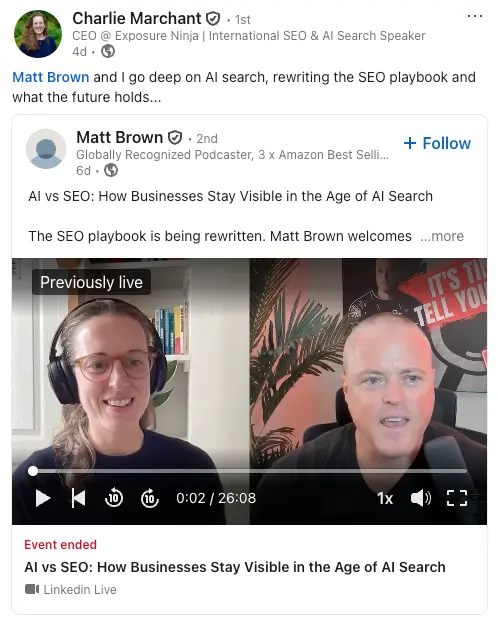
- Charlie Marchant on LinkedIn: Exposure Ninja’s CEO, Charlie Marchant, shares regular posts on how to dominate in both traditional and AI Search.
- Lily Ray on LinkedIn: Lily Ray regularly reshares helpful articles and posts around the latest trends in search marketing.
- Andy Crestodina on LinkedIn: Andy Crestodina’s posts, as well as his newsletter, are filled with SEO and content marketing tips.
- Slideshare: Got your eyes on a big SEO conference but can’t convince your boss to buy you a ticket? Many SEO speakers upload their slides to Slideshare after a speaking event, making it yet another key resource for learning about SEO.
Free SEO Courses with Certification
Want formal recognition for your SEO learning? These free SEO courses offer certificates upon completion:
- Google Skillshop: Feeling intimidated by Google Analytics? Google Skillshop offers an extensive online course that explains how to make the most of this powerful tool. You’ll even earn a qualification once you complete all the modules!
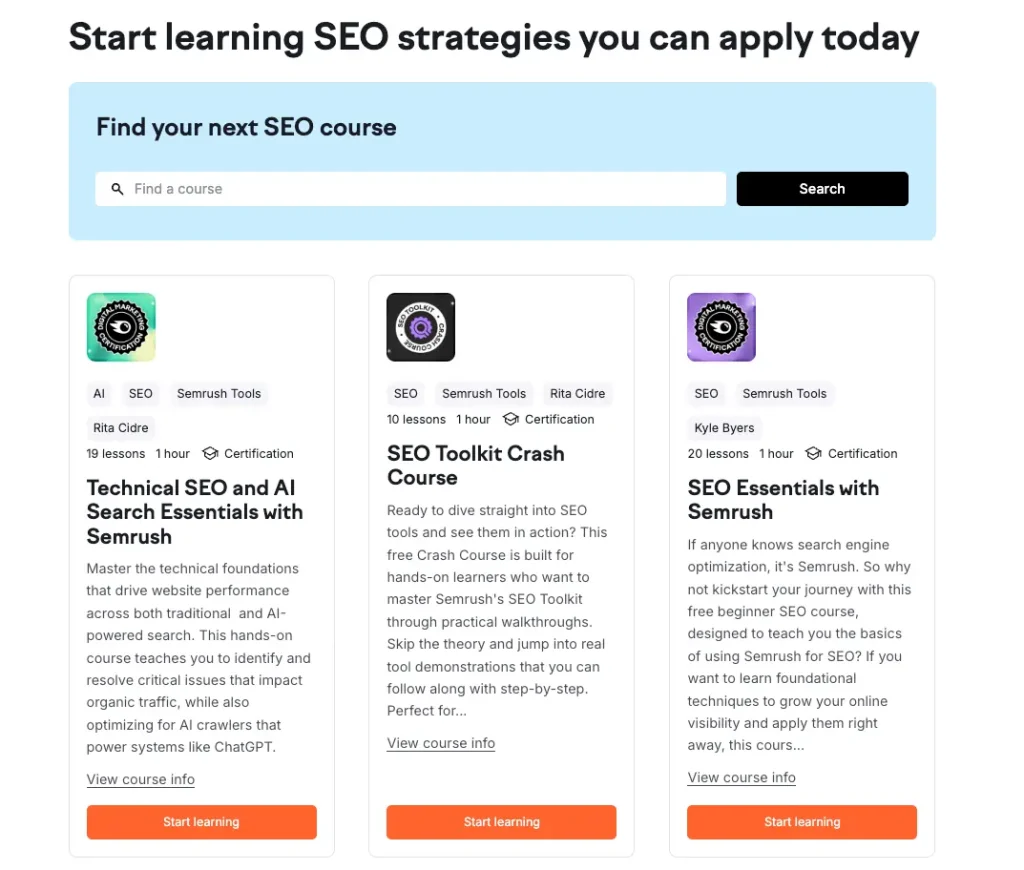
- Semrush Academy SEO Courses: Multiple free courses covering everything from SEO fundamentals to advanced technical optimisation, with certificates for each completed course.
- HubSpot SEO Training Course: Comprehensive free course covering SEO basics with eight lessons and five quizzes, taking approximately 3.5 hours to complete.
- eMarketing Institute SEO Certification: Free 150+ page ebook course with certification exam, requiring a 50% pass rate with unlimited retakes.
- Coursera SEO: Amazingly, Coursera still offers courses from top universities for free, including “Introduction to Search Engine Optimisation” from the University of California, Davis.
- Udemy SEO: One of the kings of online courses, Udemy has a substantial library of free SEO courses. To find them, head on over to the Udemy site and filter by price (selecting free)!
- Ahrefs SEO Course for Beginners: Free two-hour course with 14 lessons covering keyword research, on-page SEO, and link building.
How to Practise SEO for Free
One of the most-searched questions in this topic is “how to practise SEO for free,” and it’s the right question to be asking. Learning theory without applying it is one of the most common reasons people plateau early.
Here is how to build real experience without spending anything:
- Start a WordPress blog. WordPress is free to use and gives you complete control over your SEO settings. Set one up on any topic you genuinely know about and use it as your testing ground.
- Set up Google Search Console from day one. Even if your site is brand new and has no traffic yet, connect it to GSC. You’ll start building a baseline of data immediately and learn how to read it as you go.
- Conduct keyword research before writing anything. Use Google Keyword Planner or Ubersuggest to find keywords your content could realistically target. This disciplines you to think about search intent before putting words on a page.
- Audit your own site with Screaming Frog. Run a crawl of your site and work through the issues it surfaces. Technical SEO is best learned by fixing real problems, not reading about hypothetical ones.
- Analyse what ranks. Search for your target keyword and study the top-ranking pages. What is their structure? How long are they? What headings do they use? What questions do they answer that you haven’t? This is competitive analysis at its most practical.
- Track a handful of pages over time. Pick two or three pages on your site, optimise them, and monitor their performance in Google Search Console over the following weeks. Seeing ranking movement, even small amounts, makes every concept click.
- Build your first links. Reach out to sites that mention your topic and suggest your content as a resource. Even one or two genuine backlinks will teach you more about off-page SEO than any guide.
Tip: Treat every piece of content you publish as an experiment with a hypothesis. “I think this page will rank for [keyword] because [reason].” Then track what happens and learn from the outcome.
Tips to Master SEO
Learning SEO is one thing. Mastering it requires practice, patience, and the right approach. Here’s how to accelerate your learning:
- Start with a real project. Theory only takes you so far. Whether it’s your own blog, a friend’s business website, or a test site, hands-on practice consistently outperforms passive learning every time. You’ll encounter real challenges and learn how to solve them.
- Focus on fundamentals first. Before chasing advanced tactics, nail the basics. Master keyword research, understand user intent, learn proper on-page optimisation, and grasp how technical SEO works. Advanced strategies mean nothing if your foundation is shaky.
- Stay curious about algorithm updates. Search engines evolve constantly. Follow reputable news sources, understand why updates happen, and adapt your strategy accordingly.
- Learn from your competitors’ wins. Use tools like Ahrefs or Semrush to analyse what’s working for sites ranking above you. Which keywords are they targeting? What’s their content strategy? How are they building links? Competitive analysis accelerates learning dramatically.
- Be patient with results. SEO takes time. Expect to wait 3-6 months before seeing significant improvements in your ranking. Use this time to keep learning, testing, and refining your approach rather than obsessively checking rankings daily.
FAQs
Can I learn SEO on my own?
Absolutely. Thousands of successful SEO professionals are self-taught. With the wealth of free resources available today, you have everything needed to master SEO independently. The key ingredients are consistent practice, willingness to experiment on real websites, and enough patience to let results develop over time.
Can I learn SEO for free?
Yes, and this guide is the proof. While paid courses and tools exist and can be useful, you can learn comprehensive SEO without spending anything. Google provides essential free tools, expert blogs share knowledge generously, and numerous free courses offer structured learning paths with recognised certifications.
How quickly can I learn SEO?
You can grasp basic SEO concepts in 2-4 weeks of dedicated study. Becoming genuinely proficient takes 3 to 6 months of hands-on practice alongside that learning. Mastering SEO is an ongoing journey that continues throughout a career, because the landscape changes constantly. The timeline depends on your starting knowledge, how much time you invest, and whether you are learning alongside practical implementation rather than just reading.
Is SEO hard for beginners?
SEO has a learning curve, but it isn’t inherently difficult. The basics are straightforward: help search engines understand your content and make it genuinely useful for visitors. Complexity increases with technical aspects and advanced strategies, but start simple and build gradually. Most beginners find it more manageable than they initially expect.
How should I start learning SEO?
Follow the roadmap at the top of this guide. Begin with Google’s SEO Starter Guide and Moz’s Beginner’s Guide to SEO to build your conceptual foundation. Then set up a free website on WordPress and start applying what you’re learning. Enrol in a free course like Semrush Academy or Google Skillshop to add structure. From there, focus on one area at a time, keyword research, then on-page, then technical, then off-page, and build progressively.
Do I need a website to practise SEO?
You do not need one to learn theory, but having a website dramatically accelerates your development. A test site or personal blog lets you experiment without risking real business outcomes. The fastest learners we have seen are the ones who apply every concept they read about to something real, even if that something is a blog about their hobby.
What is GEO and should I learn it alongside SEO?
Generative Engine Optimisation (GEO) refers to the practice of optimising content to appear in AI-generated search responses, such as those produced by Google AI Overviews, ChatGPT, Perplexity, and other AI-powered platforms. As AI search continues to grow, GEO is becoming an increasingly important extension of traditional SEO. If you are starting your SEO learning journey now, it is worth familiarising yourself with GEO principles from the outset rather than treating it as something to come back to later.