5 Proven Content Marketing Lead Generation Strategies


Content marketing can be your most reliable lead generation engine. Our five content marketing strategies for lead generation will turn your content from traffic drivers into revenue generators, delivering a steady stream of high-quality prospects to your sales team.
Looking to generate more leads? Content marketing remains one of the most cost-effective and high-converting strategies available. In fact, it generates three times more leads than outbound marketing while costing 62% less.
But it’s not just about capturing leads; it’s about converting them. The true ROI of content marketing comes when your content assets drive qualified traffic and convert those leads into revenue.
We’re sharing five proven content marketing strategies with our clients to generate high-quality leads. We’ve also included expert insights from Abigail Daunton-Johns, our Head of Content and Email Marketing, on:
- How to turn leads into paying customers.
- Why your content marketing lead generation is failing (and what to do about it).
- The smartest lead generation content assets to invest in for 2026.
Why Content Remains the Most Reliable Lead Engine
Content creation remains the most adaptable, measurable, and scalable lead generation tool available.
Evergreen content, such as blogs, guides, videos, and lead magnets, can continue to attract qualified traffic without ongoing expenditure. One solid piece can bring in hundreds of leads over time, making it a far more sustainable and cost-effective strategy.
It’s also incredibly versatile. One asset can power your entire multi-channel strategy. Post it to your blog for SEO, share snippets on LinkedIn, include it in your email flows, build ads around it, and pitch it to journalists through digital PR.
As Abigail Daunton-Johns says, “Content marketing generates valuable, reusable assets. When optimised for SEO or AI Search, those assets can reach potential customers at every stage of their journey.”
That brings us to its biggest strength: full-funnel coverage. Content meets your audience where they are, whether they’re just becoming problem-aware or comparing providers. A top-of-funnel blog introduces your solution. A mid-funnel lead magnet nurtures interest. A bottom-funnel case study video seals the deal.
Content marketing generates valuable, reusable assets that can work across multiple channels and support every stage of the customer journey. From top-of-funnel awareness to bottom-of-funnel conversion, great content attracts, nurtures, and converts leads efficiently.
 Abigail Daunton-Johns
Head of Content and Email Marketing
Abigail Daunton-Johns
Head of Content and Email Marketing
5 Content Marketing Strategies for High-Quality Leads
High-Value Lead Magnets
A lead magnet is a piece of content or resource your audience wants badly enough to exchange their email address for it. It could be a report, checklist, calculator, or video.
The point of a lead magnet is to capture contact details from people who are already interested. That way, you can continue the conversation via email, move them through your funnel, and eventually convert them into paying customers.
The outdated approach offers a generic PDF that gets buried in inboxes and never opened. These are “Ultimate Guides” with no real insights.
In 2026, a better approach is to offer highly specific, genuinely helpful resources tailored to your audience’s real-life needs. They should answer pressing questions, help with a decision, or solve a pain point.
Age Care Bathrooms, one of our healthcare clients, already had a strong brochure when they came to us. Instead of starting from scratch, we turned that existing asset into a strategic, site-wide lead magnet.
Here’s what made it work:
- We built a dedicated landing page with clear, low-friction calls to action (CTAs) and strong trust signals.
- It was promoted across Google Ads, Meta Ads, and content, becoming a cornerstone of their multi-channel lead gen strategy.
- It was paired with automated email nurturing sequences, turning brochure downloads into real enquiries.
The brochure became one of the site’s highest-converting assets, directly increasing monthly leads from 60 to over 300.
Webinars and Virtual Events
Webinars are among the most effective lead generation formats because they combine education, engagement, and lead capture in a single experience. Whether live or recorded, they give prospects a front-row seat to your expertise while allowing you to collect valuable lead information through the registration process.
Unlike written content, webinars showcase your team’s personality and problem-solving skills in real time. Attendees get to see how you think and approach challenges and ask their own questions. This human connection builds trust and significantly improves the likelihood of moving attendees into sales conversations.
At Exposure Ninja, our CEO Charlie Marchant regularly hosts webinars with leading industry experts, such as a recent session with Profound‘s Josh Blyskal on how Fortune 500 brands dominate AI Search results. These events deliver actionable insights while consistently generating qualified leads for our business.
Gated Video Content
Video is one of the most engaging content formats, and placing it behind a lead capture form can generate higher-quality leads than ungated alternatives.
Gated video works especially well for complex topics that benefit from visual explanation, such as:
- Product demonstrations
- Customer success stories
- Detailed process walkthroughs
- Expert interviews.
The video format creates an emotional connection, while the form ensures you capture contact details from genuinely engaged prospects.
But you need to ensure your gated video delivers more value than what’s freely available. This might mean exclusive interviews with industry leaders or access to data that cannot be found elsewhere.
There’s an ongoing debate in marketing circles about whether to gate content. Critics argue that gating creates friction, limits reach, and risks losing potential readers who won’t fill out a form. Supporters counter that gated assets deliver higher-quality leads and justify the investment to produce premium content.
Abigail Daunton-Johns offers a balanced perspective: “Whether to gate content depends on your goals. Smaller brands should often keep content free to maximise awareness and reach. Larger brands with enough authority can use their flagship content as gated lead generation tools, especially if the asset is built on original research. I usually recommend a mix: highlight key takeaways publicly to drive visibility and links, but gate the full version to capture leads.”
This hybrid approach gives you the best of both worlds: exposure for brand-building and lead capture for conversion.
Interactive Content
Interactive content, like calculators, quizzes, or maps, is one of the smartest ways to capture leads and convert them in 2026.
Instead of just giving people something to read or watch, interactive content invites them to do something, like answer questions, input data, and explore results. This deeper engagement builds trust faster, delivers real value upfront, and naturally leads users toward conversion.
Interactive content works because:
- It’s useful. Calculators, quizzes, and maps solve real problems instantly.
- It’s memorable. Users get tailored results or insights, which makes your brand stick.
- It converts. Interactive tools are perfect for gated content, CTAs, or nurturing workflows.
For DSLD Mortgage, one of our legal clients, we put interactive content to the test. We created a range of useful tools, including the USDA Eligibility Map. Each tool answered a high-intent query and led directly into an optimised lead capture form. These interactive assets contributed to the 11,000+ leads we delivered across a 12-month multi-channel campaign.
AI Search Optimised Content
AI Search is changing how people discover solutions. Instead of typing short keywords into Google, users now ask full, complex questions in platforms like ChatGPT, Perplexity, and AI Mode.
These AI platforms don’t return a page of links and ads (yet) for users to sift through. Instead, they deliver a personalised answer that cites sources, mentions brands directly, or generates recommendation lists of products and services.
This shift is accelerating the buyer journey. A user can move from an AI-generated answer straight to your blog, product page, or branded search on Google. If your business is not cited here, you lose visibility at the most critical stage, and your competitors capture the AI traffic and the lead.
This is where creating AI-friendly content becomes essential. Abigail Daunton-Johns explains: “Longer, more specific search queries are influencing the way we create content. We’re still using strategies like the pillar and cluster model, but now we adapt content to match how people actually ask questions, especially for comparison and objection handling.”
To capture leads in this new landscape, your content must match how people actually phrase their longer, more complex queries. That means:
- Reframing H2s as questions that mirror real search queries.
- Writing detailed, specific answers that address objections and comparisons.
- Adding FAQ sections to capture multiple long-tail, high-intent queries.
By adapting to AI Search Optimisation, your onsite content is more likely to be cited directly in AI summaries, which puts your brand in front of potential customers.
But AI platforms don’t just rely on your website. They pull recommendations from trusted external sources, too. That’s why digital PR and authoritative brand mentions are now just as critical for lead generation as keyword rankings.
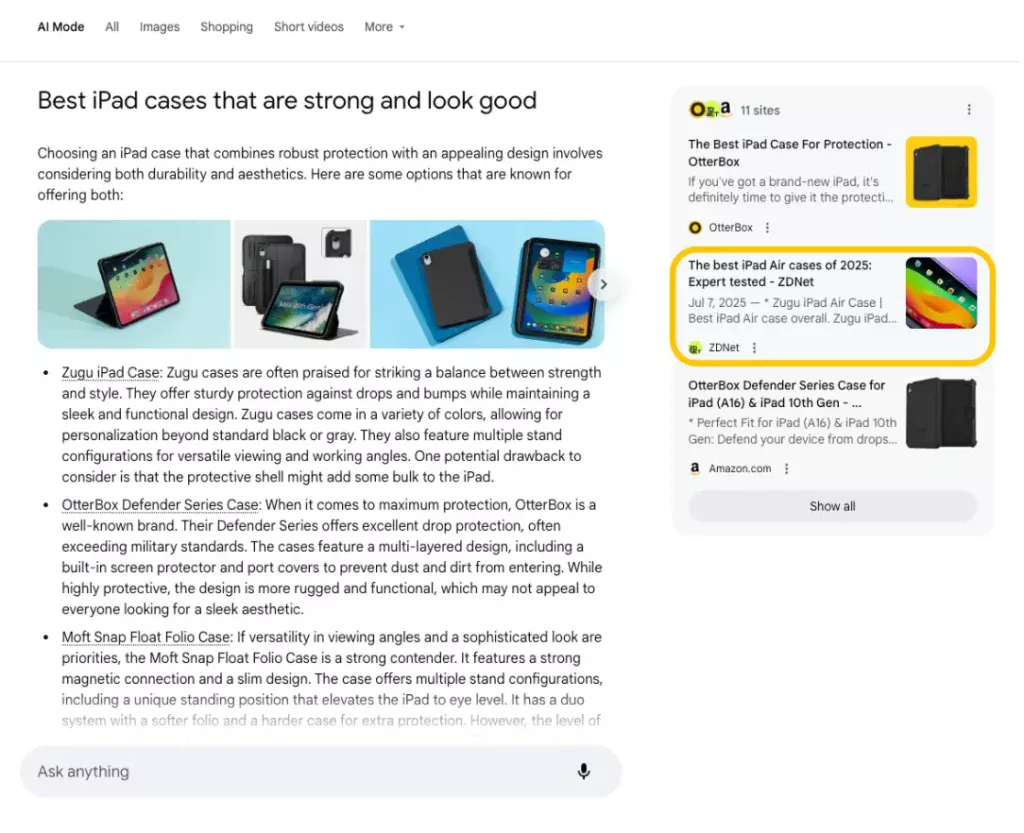
Take our client ZUGU, for example. When users searched for iPad cases in the past, they’d type it into Google, check reviews, and compare brands. Now they ask AI tools directly, and those tools recommend brands based on web-wide authority and reviews.
We helped ZUGU secure coverage in high-authority outlets like WIRED and ZDNet. These mentions positioned the brand as a go-to source, so ZUGU shows up at the top of the list when AI platforms generate recommendations.
Turning Content Marketing Leads into Revenue
Knowing how to generate leads through content marketing is only the beginning. The real ROI comes when those leads are nurtured into paying customers. That requires strategy, patience, and a funnel designed to keep you front-of-mind until the prospect is ready to buy.
Abigail Daunton-Johns puts it simply: “Your funnel must feed leads a steady stream of helpful information, whether that’s through email sequences or guiding them to related content. And in B2B especially, there should always be a clear and easy way for leads to connect with a real person at any stage of their journey.”
Here’s how to make this happen:
- Segment by intent. Someone downloading a free checklist is earlier in the journey than someone requesting a demo. Match your nurturing to their stage in the funnel.
- Start nurturing immediately. Send a welcome email, remind them of the resource they downloaded, and guide them to the next logical step, such as a blog, webinar, or case study.
- Build trust with proof. Follow up with testimonials, case studies, or comparison content that addresses objections and reassures them they’re on the right track.
- Keep it human. Ensure every email and landing page includes a low-friction path to a real person, whether that’s a book-a-call link, live chat, or even a reply-to-email option.
- Nudge, don’t shove. Your goal isn’t to force a quick sale. It’s to stay helpful and visible until the timing is right, so the prospect naturally chooses you when ready.
When Your Content Isn’t Generating Leads (and How to Fix it)
“The number one reason content fails to generate leads is intent mismatch,” says Abigail Daunton-Johns. “If you’re presenting the wrong message, at the wrong time, to the wrong audience, the content is doomed from the start.”
- Top-of-funnel (ToFu) visitors are only problem-aware. They don’t want pricing breakdowns or product pitches; they need simple introductions to solutions, with soft CTAs leading them to learn more.
- Middle-of-funnel (MoFu) leads are evaluating options. Pushy tactics won’t work here. They need reassurance through use cases, comparison content, or “product-in-action” examples.
- Bottom-of-funnel (BoFu) prospects are ready to buy. They’re seeking trust signals like testimonials, case studies, and clear, actionable CTAs.
Sometimes it’s possible to address all three stages in a single asset, particularly for short sales cycles or single-offer businesses. But most of the time, success depends on aligning your content to where the buyer actually is in their journey.
We saw this in action with Personal Injury Law Firm, a Texas-based personal injury practice competing in a saturated market. Our first step was to design a content strategy built around localised, client-focused questions (ToFu) to capture qualified traffic.
Once traffic was flowing, we introduced Conversion Rate Optimisation (CRO) tactics. That included standout enquiry CTAs and interactive tools like a personal injury calculator, which helped prospects understand their situation and built trust with the firm.
To move visitors from interest to action, we reinforced content with strong contact prompts, giving high-intent leads the reassurance they needed to book a consultation. This content alignment to the funnel stage paid off: blog conversions increased by 144%, and overall monthly leads grew by 727%.
Where to Invest for 2026
If you want to generate high-quality leads in 2026, invest in digital PR paired with thought leadership content. This combination earns attention with leads and builds long-term authority in your niche.
Abigail Daunton-Johns explains: “The most effective lead generation content strategies rely on taking valuable insights or proprietary data and sharing it with as wide an audience as possible within a given niche. It’s particularly powerful for sector-specific marketing, such as a SaaS business selling into construction, hospitality, education, or pharma.”
Creating original reports, research-led articles, or expert commentary and then promoting them through targeted digital PR puts your brand at the centre of industry conversations. The result is content that doesn’t just attract leads but earns the credibility that makes those leads easier to convert.
Content Marketing that Supercharges Lead Generation
To turn content into a predictable source of high-quality leads, focus on these five strategies:
- High-value lead magnets that solve real problems and capture emails.
- Webinars and virtual events that showcase expertise and build trust in real time.
- Gated video content that delivers premium insights while capturing qualified leads.
- Interactive tools like calculators, quizzes, or maps that engage users and drive conversions.
- AI Search Optimised content that positions your brand where modern buyers are asking questions.
Ready to transform your content into a lead generation engine? Request a marketing review to discover which lead generation strategies will deliver the highest ROI for your business.
FAQs
Which type of content is best for lead generation?
“Reports, white papers, checklists, and eBooks are some of the best-performing content types for lead generation. They position your brand as a thought leader and deliver genuine value to a highly targeted audience. When paired with digital PR for smart distribution, they become powerful assets for attracting and converting qualified leads,” says Abigail Daunton-Johns.
How is AI Search changing content marketing lead generation?
AI search is driving longer, more specific search queries that require content creators to adapt their strategies accordingly. Instead of targeting broad keywords, successful businesses now create content addressing detailed, conversational queries. This includes reframing headlines as questions and adding comprehensive FAQ sections to capture multiple related queries with high purchase intent.
What’s the fastest way to get leads with content?
“There’s no silver bullet for instant leads, but there is a proven formula: content production multiplied by content promotion. The more you distribute your content across channels like email, paid social, SEO, and digital PR, the faster you’ll see it generate high-quality leads,” recommends Abigail Daunton-Johns.