How to Do AI Search Brand Sentiment Analysis


Brand sentiment analysis for AI Search is the process of understanding how AI platforms like ChatGPT, Perplexity, and Gemini describe your brand and whether that sentiment is helping or hurting you. We’ll cover how to check your brand’s sentiment across AI tools, interpret the results, and take action to improve how your business is portrayed.
Brand sentiment analysis isn’t new.
For years, businesses have tracked what customers say on social media, in reviews, and across forums to understand how people feel about their brand, product, or service. It’s useful for spotting problems, uncovering strengths, and guiding messaging.
But now, there’s a new source shaping public perception: AI Search platforms.
AI platforms like ChatGPT, Perplexity, and Gemini are being used to compare products, assess companies, and recommend services. So if AI tools are calling you “expensive” or “outdated,” that’s what potential customers see first. This can directly influence whether someone chooses you or your competitor.
We’ll show you how to do brand sentiment analysis for AI Search, and what to do if it’s not where it should be.
What Is Brand Sentiment Analysis in AI Search?
Brand sentiment analysis in AI Search is the process of understanding how AI tools describe your brand, product, or service and whether that description leans positive, negative, or neutral.
Let’s look at Hargreaves Lansdown as an example. When asked, “What are the pros and cons of Hargreaves Lansdown for a first-time investor?” Perplexity generated a table of strengths and weaknesses, and a closing recommendation.
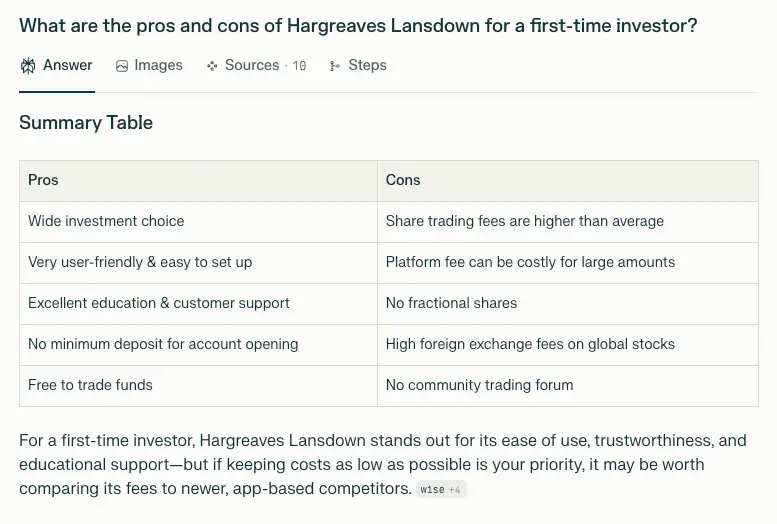
That summary wasn’t pulled from thin air. It was built from various sources, including news sites, comparison platforms, expert reviews, Reddit threads, and YouTube videos. These varied inputs gave Perplexity a clear, consistent sentiment: Hargreaves is easy to use and trustworthy, but pricier than newer, app-based competitors.
That insight shaped its final sentence: “If keeping costs as low as possible is your priority, it may be worth comparing its fees to newer, app-based competitors.”
If you’re Hargreaves Lansdown, that’s a problem. A potential customer is researching your offering, and the AI platform recommends they look elsewhere.
That’s the power of sentiment in AI Search. It’s not just describing your brand; it’s influencing decisions in real time, based on everything the internet says about you.
Brand sentiment analysis is the use of AI research tools and manual research to determine the positive versus negative sentiments in the responses of AI platforms.
 Nicola Tuxford
Marketing Strategy Manager
Nicola Tuxford
Marketing Strategy Manager
Why Brand Sentiment Matters for AI Search
Before AI tools, customers researched a business by reading reviews, comparing website products, and scanning forums or articles. It took time, but it gave them a well-rounded view of a brand before deciding to buy or inquire.
That process is now much faster.
People use AI platforms like ChatGPT and Perplexity to do the same research, but in seconds. These tools pull information from across the web and summarise it into a single, easy-to-read response. In many cases, that summary is all a potential customer will see.
What’s more, trust in AI answers is growing. A recent YouGov survey on U.S. adults found that people who use AI regularly are much more likely to trust the accuracy and fairness of its responses. And with increasing AI use, that trust level is only expected to grow.
For businesses, this matters.
If AI tools describe your brand positively, you’re more likely to win attention and enquiries. But if those same tools present your brand as expensive, outdated, or unreliable (even if it’s not true), that perception can turn customers away before they ever visit your website.
That’s why you need to know how AI is talking about your brand so you can fix what’s wrong, amplify what’s right, and make sure customers get the full picture.
How to Do AI Search Brand Sentiment Analysis Manually
Nicola Tuxford, Strategy Manager at Exposure Ninja, recommends this four-step process to check brand sentiment in AI answers manually:
- Open an Incognito Window: Start with private browsing or a fresh chat session so the AI results are more neutral and realistic.
- Ask Questions: Use targeted prompts to understand how your brand is positioned and whether the sentiment is positive, negative, or neutral.
- Record the Sentiment: Use a simple spreadsheet to track your findings across platforms and prompts. To make this easier, we’ve created an AI Visibility Tracker to help monitor your brand visibility in AI tools. It also includes a sentiment column to help you track tone over time.
- Analyse the Responses: Look closely at the tone of the answer. Is your brand described positively, negatively, or somewhere in between? Are you positioned as a leader, a budget option, or a risky choice? If the platform includes sources, follow them to understand where the sentiment is coming from.
The prompts you use will need to be tailored to your brand, product or service, and industry. To help you get started, here are some prompts to try:
- “What are the pros and cons of [Your Brand]?”
- “Is [Your Brand] a good company?”
- “Who are the best companies for [industry keyword]?”
- “What are the risks of using [Your Brand]?”
- “Compare [Your Brand] to [Competitor].”
- “Why do customers choose [Your Brand]?”
- “What is [Your Brand] known for?”
- “What’s the best [product type] for [target audience]?”
- “Is [Your Brand] worth the money for [product or service]?”
Best Tools for AI Search Brand Sentiment Analysis
You can manually track your brand sentiment in AI Search, but as our founder Tim Cameron-Kitchen puts it, that’s “the crazy way.”
Checking how your brand is described across different AI platforms means using multiple prompts on multiple tools. Since AI-generated answers change frequently, you’ll need to repeat the process regularly. “Pretty soon you’re going to see that you won’t have time for any other hobbies because this will become your new obsession,” adds Tim Cameron-Kitchen.
You’ll also need to monitor more than just your brand. You should check if your competitors are described positively, negatively, or neutrally to get meaningful insights.
“The most effective way to do this is to use one of the emerging AI Search visibility tools,” Tim Cameron-Kitchen recommends.
We’ve been testing several of these tools, and here are our top picks for tracking brand sentiment in AI Search quickly, consistently, and without losing your weekends to it.
Profound
Profound is an AI visibility tool that helps brands monitor how they appear across major AI platforms, including ChatGPT, Perplexity, Gemini, Google’s AI Overviews and AI Mode, and more.
One of its standout features is sentiment analysis. Profound assigns a sentiment score to your brand based on how it’s being described across different AI tools. It categorises mentions as positive or negative, and highlights trending themes tied to your brand, product, or service.

This is incredibly useful for spotting reputation risks early, identifying areas of strength, and understanding how AI platforms frame your business so you can take action before potential customers make up their minds.
Semrush AI Visibility Toolkit
The Semrush AI Visibility Toolkit* shows how your brand is mentioned across major AI platforms and how those mentions are framed in terms of sentiment and positioning.
Within the Brand Performance section, you’ll see an overall sentiment breakdown, classified as either favourable or general. It also highlights key sentiment drivers as well as areas for improvement, based on recurring criticisms or customer concerns.

What’s most useful is the AI Strategic Opportunities section, which gives actionable recommendations with urgency timelines on what to change to impact your sentiment. If you want to give it a try, you can try the free interactive demo** with us!

How to Improve Neutral or Negative Brand Sentiment
You can’t “optimise” your way out of negative sentiment in AI Search. If your brand is consistently described as expensive, slow, or outdated, it’s likely because that’s what the available data reflects.
The most effective way to improve how your brand is portrayed is to make a meaningful, verifiable change.
“It’s very difficult to change brand sentiment in AI platforms without first resolving the issues being raised,” says Nicola Tuxford. “If AI tools say your delivery is slow or pricing is too high, the solution isn’t to rewrite content; it’s to improve delivery times or update your pricing structure. And once that change is made, it should be clearly communicated across your website, social media, and trusted third-party sources.”
Marketers play a central role in this process. Beyond promoting the brand, marketing teams are uniquely positioned to gather customer insights, identify recurring pain points, and push for internal changes that improve how the business is perceived and how AI platforms report on it.
We’ve seen this in action.
In one AI Audit, a client was repeatedly flagged in AI-generated answers as “overpriced.” Our team raised this insight, and the business responded by restructuring its pricing model.
Within weeks, the AI responses updated. The negative label disappeared, not because we changed the messaging, but because the underlying issue had been addressed. When the data changes, so does the sentiment, and pretty quickly.
Once improvements have been made, you can help AI tools reflect that progress faster by taking the following steps:
- Audit and Respond to Reviews: Look for common complaints in customer reviews. Resolve the root causes and respond publicly where appropriate. This demonstrates accountability and signals improvement both to potential customers and AI platforms.
- Implement Review and Rating Schema: Structured data allows search engines and AI tools to read and display your review ratings properly. This gives them clearer context on how your customers feel and can tip sentiment in your favour when the data supports it.
- Earn Positive Third-Party Coverage: Use digital PR to get mentioned on credible news sites, industry blogs, or trusted review platforms. This helps reinforce a more accurate, balanced view of your brand.
- Update On-Site Content: Refresh your service pages, product descriptions, FAQs, and About page to reflect any changes you’ve made — whether it’s faster delivery times, updated pricing, or enhanced support.
- Announce Updates Publicly: Use social media, press releases, and email updates to communicate what’s changed and why. This gives AI tools more recent, reliable content to reference.
Boost Your Brand Sentiment in AI Search
Improving brand sentiment in AI Search isn’t just a marketing task; it’s a business-wide priority.
AI tools influence customer perception before they ever land on your website. If your brand is being flagged negatively, it’s often a reflection of real issues. The only way to shift that perception is to fix the root cause and make sure the improvements are visible and well-communicated.
Here’s a quick-start action plan:
- Manually check your brand sentiment across AI platforms.
- Identify common complaints or negative themes.
- Collaborate internally to resolve the real issues.
- Update your content, respond to reviews, and create clear messaging about the changes made.
- Monitor sentiment changes manually or with tools like Profound, Semrush, or Peec.
We’ve helped businesses shift negative sentiment and optimise their presence across AI platforms through our AI Search Optimisation service.
If you want to see how your brand is being described, request a website and marketing review, and we’ll show you exactly where you stand and how to improve.
To see how brand sentiment analysis falls into your wider AI Search Strategy, read:
FAQs
What affects brand sentiment in AI platforms?
AI platforms pull from a mix of trusted websites, customer reviews, social media, your own website, and third-party articles. If the data they find is outdated or negative, that’s how they’ll describe you.
Can I change my brand sentiment in AI Search results?
Yes, but it takes real change. You need to improve the underlying product or service issues, update your online presence, and actively collect positive feedback. AI will pick up on those signals over time.
How often should I check my brand sentiment in ChatGPT or Perplexity?
If you’re actively working on brand or product improvements, check every 30 – 60 days. Otherwise, a quarterly check-in is fine to stay on top of potential issues.
What should I do if a competitor has a better brand sentiment?
Analyse what the AI says they do well and what it says you lack. Close the gap by improving the areas your audience (and the AI) clearly care about.
*Some links in this article are affiliate links that Exposure Ninja receives a fee for promoting (these links are not sponsored). Exposure Ninja only promotes services we already use within our marketing stack.
**Disclaimer: Exposure Ninja may get a commission through the marked links above at no cost to you.