How to Measure and Grow Your Share of Voice in AI Search


AI Share of Voice tracks how often your brand is mentioned or cited in AI-generated answers across platforms like ChatGPT and Google’s AI Overviews. This guide shows you how to measure and improve it to stay ahead of competitors in AI Search.
As platforms like ChatGPT, Claude, Perplexity, Gemini and Google’s AI Overviews and AI Mode change the way people search, the brands getting mentioned in AI responses are the ones winning visibility, clicks and trust.
This shift is what we call AI Search Optimisation: the strategy behind making your brand visible, credible and quotable in AI-powered search. At its heart is one crucial metric: AI Share of Voice.
AI Share of Voice measures how often your brand is mentioned, cited or recommended in AI-generated answers compared to your competitors. The higher your share, the more control you have over the narrative and the more likely customers are to discover and choose you.
We’re going to show you how to measure, track and grow your Share of Voice in AI Search so you can lead the conversation before your competitors even realise it’s happening.
What Is Share of Voice in AI Search?
Share of Voice (SoV) is a marketing metric that reflects how much of the market conversation your brand owns compared to your competitors. It spans multiple channels, including:
- Paid Media
- Search Engine Optimisation (SEO)
- Social Media
- Digital PR and News
- Online Reviews
- Influencer Mentions
- Branded Content.
The more visibility your brand earns across these channels, the greater your traditional SoV.
AI SoV builds on this concept, but instead of looking at visibility across traditional channels, it measures how often your brand is mentioned, recommended or cited in AI-generated responses. That includes platforms like ChatGPT, Perplexity, Claude, and Google’s AI Mode.
The more frequently your brand shows up in those AI-generated answers, especially in comparison to your direct competitors, the more dominant your position becomes in AI Search.
Why AI Share of Voice Deserves Your Attention
AI Search is only growing:
- ChatGPT now attracts nearly 800 million weekly active users, doubling from 400 million in early 2025, with over 1 billion queries processed daily.
- Perplexity hit 780 million queries in May 2025, with usage growing about 20% month on month.
As more people lean on AI platforms for answers, recommendations and product advice, your brand needs to be there.
A strong AI SoV ensures you:
- Stay visible in AI-generated answers across ChatGPT, Perplexity, Google’s AI Overviews and more.
- Build trust through consistent direct mentions and citations.
- Outpace competitors that haven’t optimised their content for AI responses yet.
Most brands are still catching up. If you act now, you’ll own the prime real estate in AI-generated results.
How to Measure Your Share of Voice in AI Search
How do you know if AI is talking about you (or not)? We’ve outlined the steps below:
Build a Bank of Relevant Prompts
The first step to measuring your SoV in AI Search is understanding what your audience is asking and how AI platforms answer.
To do this, you need to build a bank of targeted prompts that reflect real-world user queries. These should mirror the kinds of questions your ideal customers would naturally type into Google or ask tools like ChatGPT, Perplexity and Gemini.
Start with prompts like:
- “What’s the best [your product or service] for [specific pain point]?”
- “Top [your industry] companies in the UK”
- “How to [achieve result or solve problem] as a [target audience]”
These open-ended research-based queries are exactly the types of prompts AI tools are designed to answer. They also tend to be solution-focused and brand-agnostic, giving you a perfect opportunity to track your brand visibility and how you’re positioned compared to competitors.
You should aim to build a diverse and comprehensive list of prompts across the entire customer journey:
- Awareness: “What is [topic or service]?”
- Consideration: “Best [product/service] providers in [region]”
- Decision: “Is [your brand] a good [solution] for [specific need]?”
Track When and How You’re Mentioned
Once you’ve built a list of relevant prompts, it’s time to test them across multiple AI platforms. These include ChatGPT, Perplexity, Claude, Gemini, and Google’s AI Overviews and AI Mode.
Here’s what you should be looking for when evaluating responses:
- Direct Brand Mentions: Is your brand named in the AI answer?
- Product or Service Recommendations: Are your offerings included in “best of” or “top-rated” lists? Are they compared favourably to others?
- Citations or Content Links: Does the AI platform reference your blog, website or landing page? Even if your brand isn’t named, a citation still boosts your influence.
You should also track your competitors’ visibility. Who is being recommended in your place? Are they cited more often? Is the sentiment of their mentions more positive? Answering these questions gives you valuable insight into how your brand stacks up and where you need to improve.
To make this process easier and repeatable, use our AI Visibility Tracker. This tool allows you to log:
- The prompts you tested
- The platforms you tested them on
- Whether your brand was mentioned and how
- The tone and sentiment of the mention (positive, neutral or negative)
- Whether competitors were referenced and how prominently.
This structured approach gives you a clear picture of your AI SoV today and provides a baseline for you to measure improvements against over time.

Calculate Your Share (and Compare Against Competitors)
Once you’ve collected data across your chosen prompts and platforms, it’s time to calculate your AI Share of Voice. This is a simple but powerful metric showing how often your brand appears in AI-generated responses relative to others.
Use this formula:
(Number of AI responses mentioning your brand ÷ Total number of prompts or responses scanned) × 100
For example, if you tested 20 prompts and your brand was mentioned in 10 of the AI answers, your AI SoV would be:
(10 ÷ 20) × 100 = 50%
Now, run the same analysis for your key competitors.
This benchmarking exercise allows you to see not just how well you’re performing but also where you can gain ground. If competitors dominate across certain prompts or platforms, those become opportunity areas to optimise your content for AI Search or improve brand positioning.

Tools to Help You Track AI Share of Voice
While you can track your AI SoV manually using prompt testing and spreadsheets, there are now emerging tools designed to give you deeper, faster insights.
Here are a few worth exploring:
1. Profound
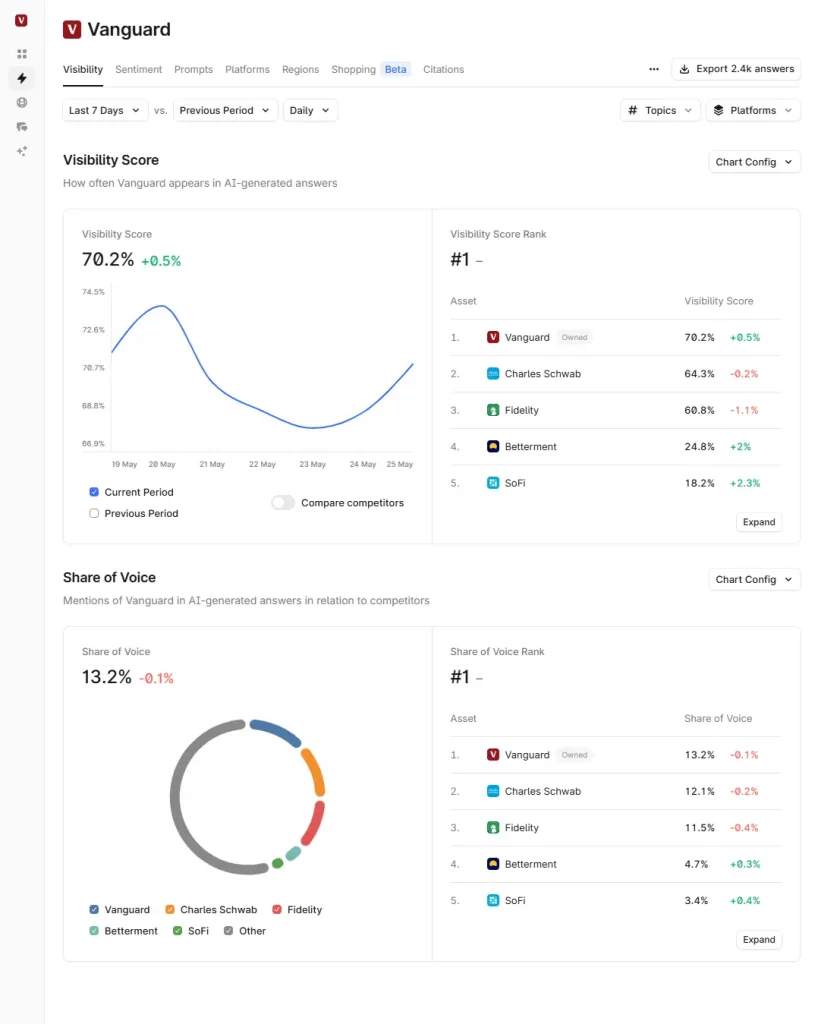
Profound is a platform built specifically for tracking brand visibility in AI-generated search results. It monitors how often your brand is mentioned, cited or recommended across AI platforms like ChatGPT, Perplexity and Anthropic (Claude).
It provides a number of useful insights, like:
- AI referral traffic to your website
- The sentiment AI platforms associate with your brand
- Top queries powering AI mentions in your niche
- Visibility comparison against your competitors
- Recommended actions to improve your AI visibility.
One of the most valuable features is the Share of Voice report, which visualises how your brand stacks up against key competitors in terms of AI-generated mentions. It gives you a clear, data-backed view of your current AI presence and where there’s room to grow.
2. Semrush
The Semrush AI Visibility Toolkit is a powerful new addition to one of the most trusted SEO platforms on the market, and it’s built to help marketers and SEOs track, understand and grow their visibility in AI Search.
It shows:
- Which AI platforms are mentioning your brand
- The sentiment of those mentions
- Strategic opportunities to improve your positioning in AI Search, including content, messaging, and product focus
- How your brand stacks up against competitors in AI-generated answers
- Which topics and query intents (e.g. education, comparison, purchase) your brand is cited for.
One standout feature is the Market Share vs. Sentiment analysis. This not only shows what percentage of AI mentions your brand is capturing, but it also compares that percentage against how positively or negatively your brand is perceived by AI. For example, you might lead in visibility (high market share) but still be losing ground to competitors with better sentiment scores.
If you want to give it a try, you can try the free interactive demo** with us!
How to Optimise Your Share of Voice in AI Search
Whether you’ve manually tracked your AI Share of Voice using our AI Visibility Tracker or used a platform like Profound, you should now have a clear picture of where your brand stands in AI-driven search.
If your current AI SoV is low, inconsistent, or being outpaced by competitors, this is your opportunity to improve. With AI Search still in its early stages, brands that act now can earn lasting visibility and authority.
To boost your presence and outperform your rivals, you’ll need a long-term AI Search Optimisation strategy. But to get started, here are three ways to increase your SoV in AI-generated responses.
Get Your Brand Positioning Right
Strong and consistent brand positioning is essential to increasing your Share of Voice in AI Search.
AI platforms like ChatGPT, Perplexity and Google’s AI Overviews need structured, reliable data to determine which businesses are credible, relevant, and worth recommending. If your messaging is unclear or inconsistent, you’re far less likely to be surfaced in AI responses, especially compared to competitors that have nailed their positioning.
Here’s how to ensure AI understands your brand:
- Make your value proposition crystal clear. Communicate what you do, who you serve, and why it matters.
- Use consistent branding across your site and assets. Reference your brand name alongside your niche, sector or core offering throughout your site content. This helps AI tools associate your name with your area of expertise.
- Add credibility through trust signals. Include testimonials, case studies, client logos, partnerships, certifications, press features and awards. These reinforce your authority and legitimacy.
Let’s take Gymshark as an example. Gymshark has built a strong brand position in the UK’s lifting and fitness apparel industry, which translates into impressive visibility in AI-driven search.
Its value proposition is unmistakable: stylish, functional, community-driven gymwear. This speaks directly to Gymshark’s audience and clearly defines what the brand does and what it stands for.
Traditionally, Gymshark earned Share of Voice through:
- Influencer marketing at scale. They dominate on Instagram and YouTube through collaborations with sponsored fitness influencers and micro-creators (not just the big names that fitness apparel brands typically target).
- Hyper-engaged social media. They’ve built a loyal community around fitness, lifestyle and motivation.
- Strong content strategy. With searchable content ranging from training guides to motivational videos, they’ve built a valuable content library.
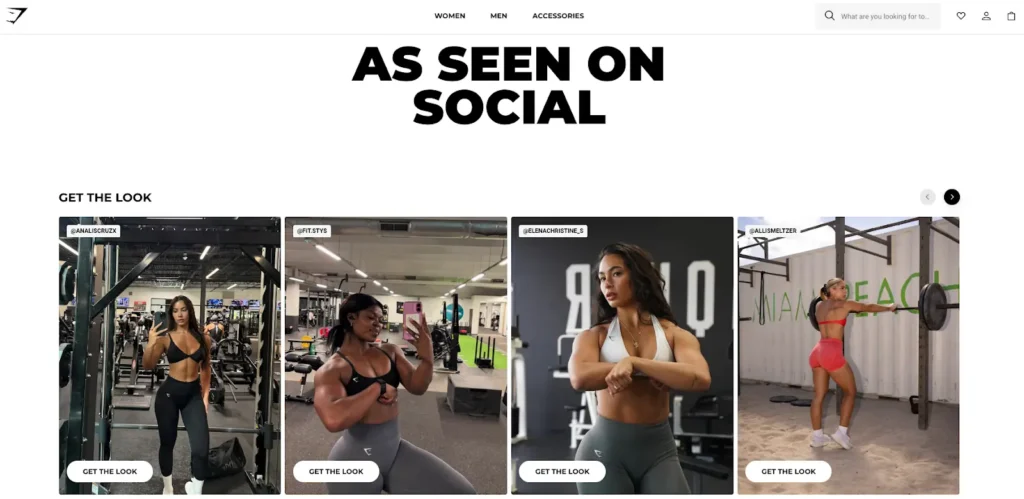
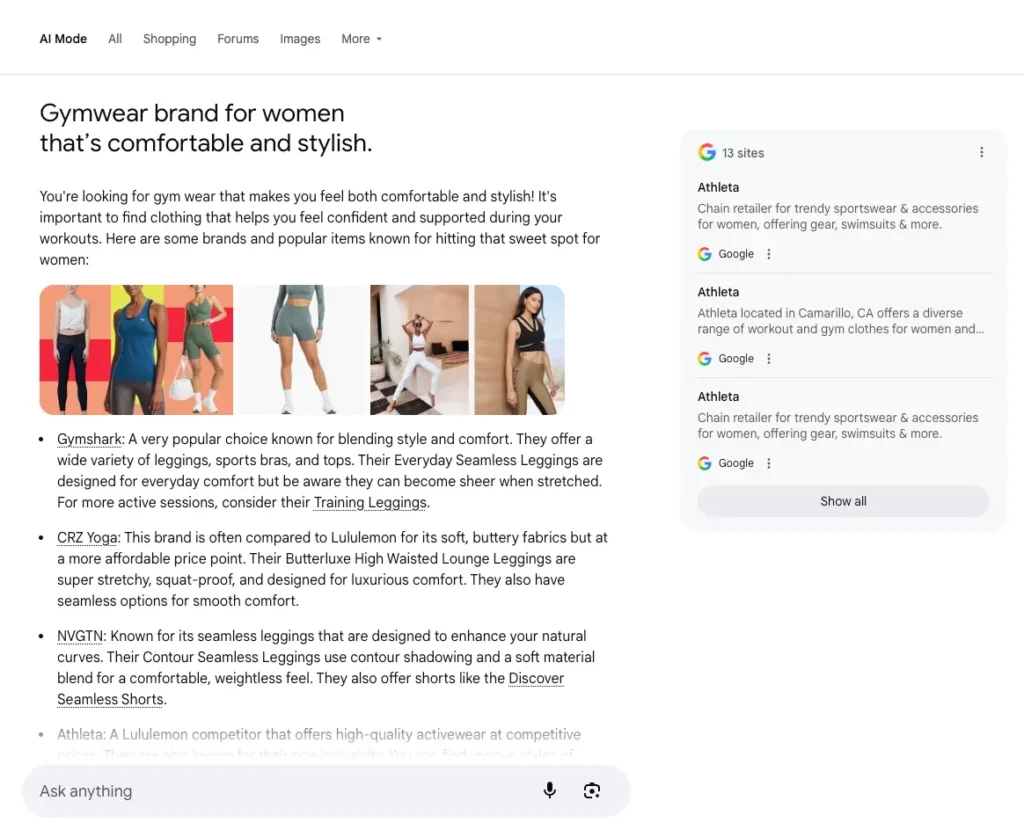
Now, their positioning strength is helping them show up in AI Search. Gymshark frequently appears in AI responses related to stylish, functional and community-driven gymwear queries, thanks to their consistent messaging, brand relevance and widespread authority.
Create High-Quality, AI-Friendly Content
If you want to increase your Share of Voice in AI Search, you need to create content that’s optimised for AI and genuinely useful to humans. This is how you become a credible, citable source in AI-generated answers.
Optimising for AI and humans means:
- Using clear headings, short paragraphs and bullet points to make information easy to scan and extract.
- Hitting Google’s E-E-A-T quality standards, with a particular focus on first-hand experience.
- Building topical authority through in-depth coverage of your niche across pillar pages and supporting content.
- Using schema markup to help AI tools understand the purpose and structure of your page.
- Moving beyond keywords and covering real, related questions using the “fan-out query” approach to rank for related user prompts.
When you nail these tactics, you create content that ranks in AI Mode, ChatGPT, Perplexity and other AI platforms.
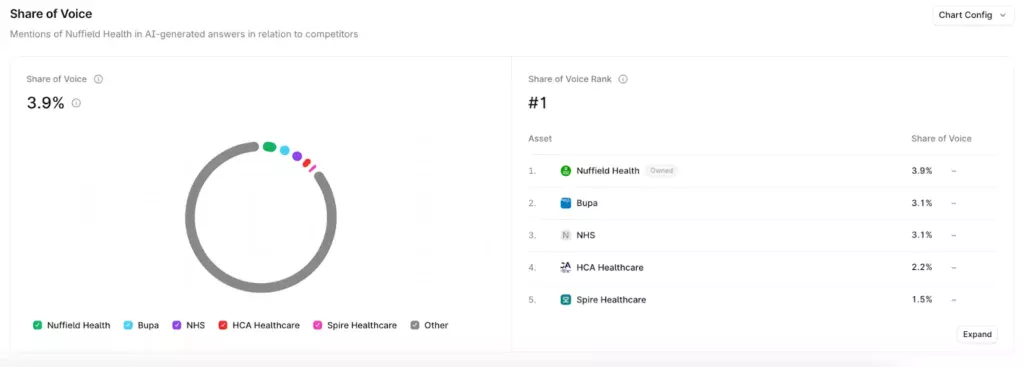
Take Nuffield Health as an example. Nuffield Health is the UK’s largest healthcare charity, offering a combination of private hospitals, fitness and wellbeing centres, diagnostics, physiotherapy and mental health services.
What sets Nuffield Health apart in AI Search is the depth and clarity of their content. Their comprehensive Advice Hubs cover a wide range of health and wellbeing topics in a user-first, AI-friendly format.
This contributes to Nuffield Health’s current #1 position in AI SoV for healthcare-related prompts, outperforming not only private providers like Bupa and Spire Healthcare but also the NHS.
Get Featured on Trusted Sites That AI Platforms Pull From
AI platforms don’t rely solely on your website to understand your brand. They also reference third-party sources to assess credibility, expertise and relevance when generating responses to user questions.
News publications, industry directories, review platforms and high-authority blogs are often used as sources by ChatGPT, Perplexity, Claude, Google’s AI Overviews and more.
Getting featured on these trusted platforms helps you in two major ways:
- It strengthens your off-site authority, signalling to AI that your brand is recognised and reliable.
- It increases your chances of being cited, especially when AI pulls content or references from those external sources.
To boost your AI SoV, aim to:
- Contribute expert insights to high-authority publications in your niche
- Get listed in credible directories and independent review platforms
- Secure coverage through Digital PR or guest posts on respected blogs.
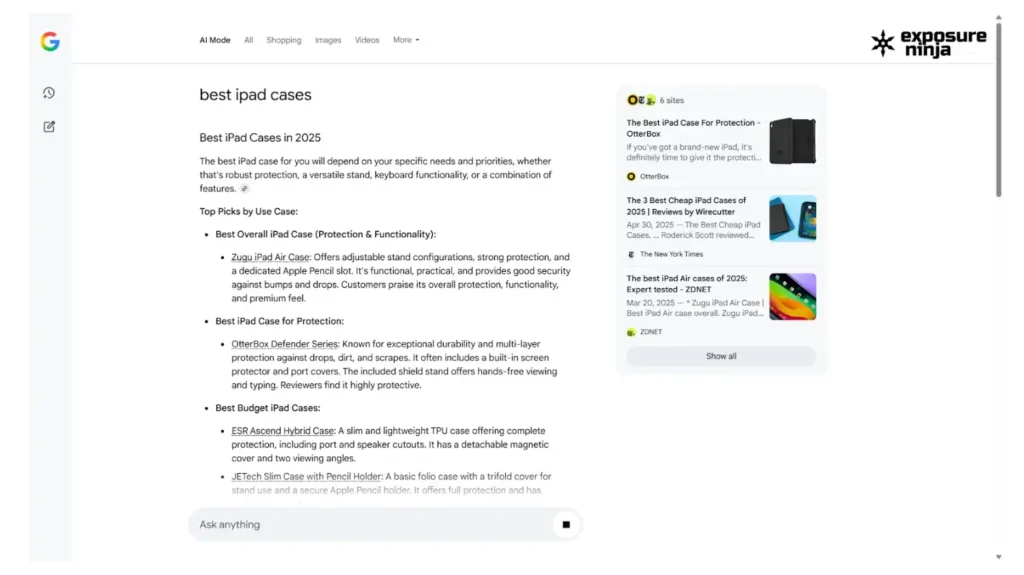
Our client ZUGU is a great example here. Ask Perplexity or Google’s AI Mode to recommend the best iPad cases, and you’ll often find ZUGU at the top. A big part of this success is the number of mentions for ZUGU across various sites like WIRED, ZDNet, MacRumors and Reddit.
Amplify Your AI Share of Voice
AI Share of Voice measures how often your brand is mentioned, recommended or cited by AI platforms like ChatGPT, Perplexity and Google’s AI Overviews.
To grow it, you need to:
- Build strong brand positioning
- Create AI-friendly content that’s structured, clear, and helpful
- Get featured on trusted third-party sites.
The earlier you act, the easier it is to outrank competitors that haven’t caught on yet.
At Exposure Ninja, we’ve built an AI Search Strategy designed to boost your Share of Voice. Request a callback and we’ll show you how we can help you outrank your competitors in AI Search..
Want to learn how to build your own strategy? Read our guide:
FAQs
What’s the difference between traditional Share of Voice and AI Share of Voice?
Traditional Share of Voice measures how much visibility your brand has across channels like paid ads, SEO, and social media compared to competitors. AI Share of Voice looks at how often your brand is mentioned or cited in AI-generated responses across platforms like ChatGPT and Google’s AI Overviews. It reflects your brand’s authority in AI-driven search.
Is AI Share of Voice the same as SEO Share of Voice?
Not quite. SEO Share of Voice measures how often your website appears in organic search results for target keywords. AI Share of Voice tracks how often your brand is mentioned or cited in AI-generated answers.
What’s the quickest way to improve Share of Voice in AI Search?
The quickest way to improve your Share of Voice in AI Search is to create clear, well-structured content that directly answers real user questions. Focus on building topical authority and getting your brand mentioned on trusted third-party sites. Combine that with strong brand positioning, and you’ll start showing up in AI-generated answers faster.
*Some links in this article are affiliate links that Exposure Ninja receives a fee for promoting (these links are not sponsored). Exposure Ninja only promotes services we already use within our marketing stack.
**Disclaimer: Exposure Ninja may get a commission through the marked links above at no cost to you.