Why Is Still Content Marketing Important?


Is content marketing still worth it in 2026? If you want to rank in traditional and AI searches, drive high-quality leads, and build a brand people genuinely trust, then it’s not just worth it; it’s essential.
In 2026, content marketing isn’t optional.
Content is how you get found, earn trust, nurture your audience, and drive sales. It powers your Search Engine Optimisation (SEO), fuels your lead generation, and keeps your brand front of mind across every stage of the buyer journey.
And it can deliver serious long-term returns. When done right, the content marketing ROI compounds — turning every blog, guide, and landing page into a lead-generating, revenue-driving asset that works around the clock.
To dig deeper into why content remains such a powerhouse and how to do it right this year, we spoke to Abigail Daunton-Johns, Head of Content and Email Marketing at Exposure Ninja.
Key Takeaways: Why Is Content Marketing Important?
If done right, a content marketing strategy in 2026 will help brands grow smarter, rank higher, and convert faster.
- It powers both traditional SEO and AI-driven search visibility
- It attracts qualified leads by solving real customer pain points
- It supports users throughout the entire buyer journey
- It builds authority and trust in crowded, competitive markets
- It delivers measurable, compounding returns over time
- It helps brands stand out from generic AI content by offering human-led insights and value
- It works across multiple formats, from long-form blogs to email, video, and interactive tools
- It turns your website into a lead-generating asset that works 24/7
Content marketing is thriving because it connects businesses with their audience in a way that drives trust, engagement, expertise, and long-term loyalty. With consumers wanting value and authenticity, content is the tool that builds relationships, boosts brand awareness, and fuels conversions.
 Abigail Daunton-Johns
Head of Content and Email Marketing
Abigail Daunton-Johns
Head of Content and Email Marketing
5 Reasons Why Every Business Needs Content Marketing in 2026 [+ Examples]
Improve Rankings and Organic Visibility
If you want to rank at the top of Google and capture organic visibility, content is what gets you there. It’s the backbone of your SEO strategy, bringing in traffic, building trust, and converting clicks into customers.
But creating rank-worthy content isn’t about cramming in keywords and hoping for the best. To earn top spots on Google or Bing in 2026, you need to do three things:
- Provide genuine value
- Match search intent
- Structure content for humans and search engines (both traditional and AI)
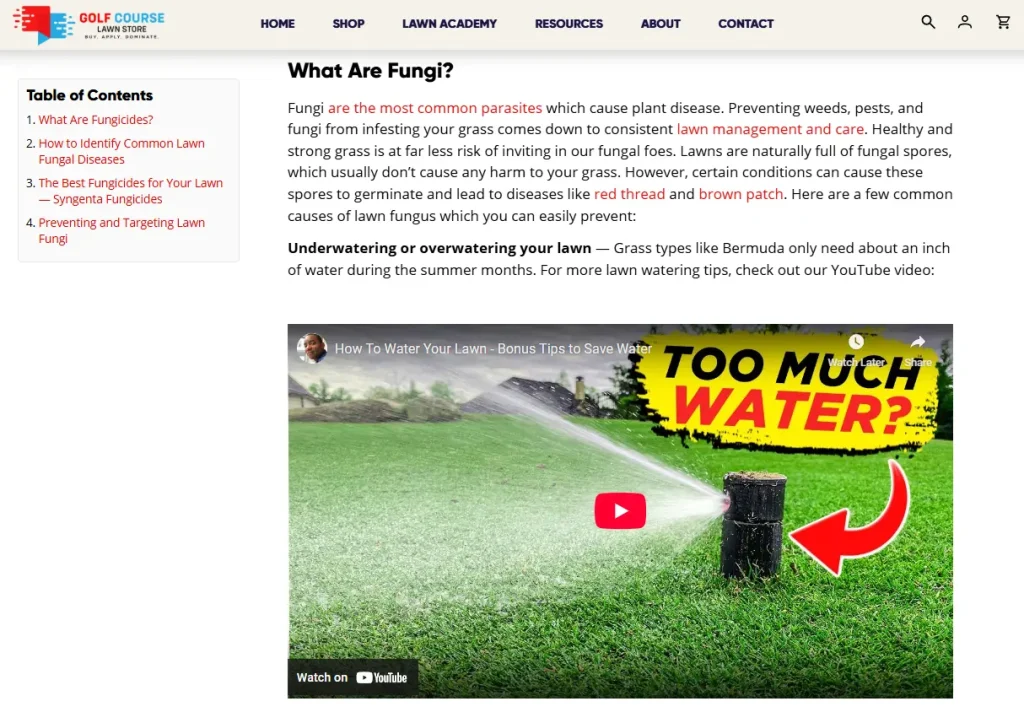
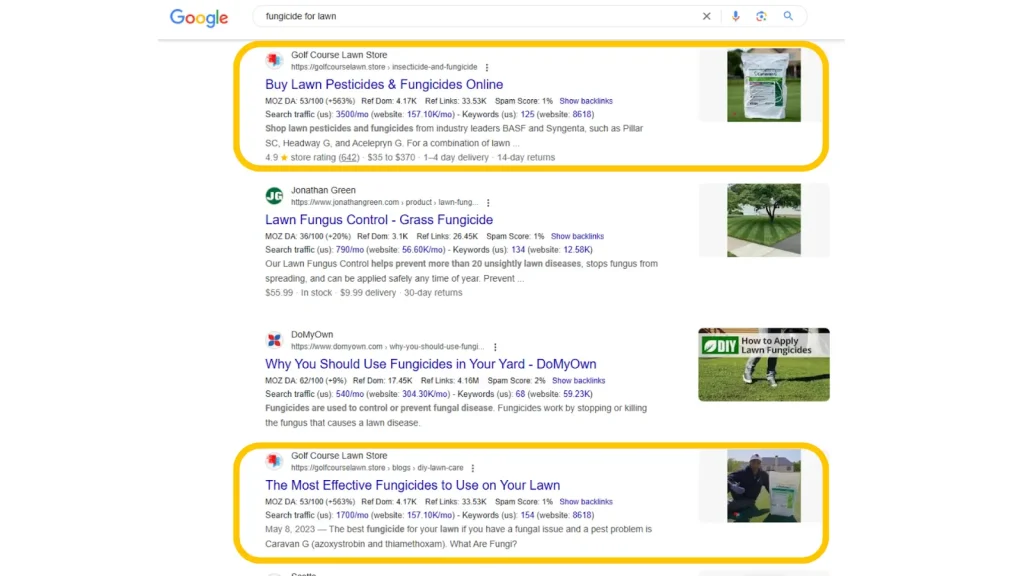
We did exactly that for our client, Golf Course Lawn Store, a US-based lawncare eCommerce business, with the blog The Most Effective Fungicides to Use on Your Lawn. Yes, we integrated relevant keywords like “best fungicides for your lawn,” which helped get it to rank:

But it wasn’t just the keywords that did the heavy lifting. We created a piece of content that answered real questions lawn enthusiasts were Googling, included visuals and product links for clarity, and embedded the founder’s expert-led YouTube content to boost engagement and authority. It was comprehensive, scannable, and genuinely helpful.
That’s what got us the number one spot — not just keyword usage but the depth, structure, and usefulness of the content itself.
Capture Positions in AI Search
Ranking in position one on Google is great. But in 2026, you should also be aiming for position 0.
That’s where Google’s AI Overviews sit, generating answers to queries and corroborating the response with website citations. If you’re not showing up there, you’re missing out on some high-visibility search real estate.
But it’s not just about ranking on Google’s AI Overviews. Users are also turning to generative AI tools like ChatGPT, Gemini, and Perplexity to research products, compare services, and make decisions.
To earn a spot in these AI search results, you first need to rank organically with solid SEO foundations. Then, you need to layer on Generative Engine Optimisation (GEO) practices by creating content that AI can easily interpret and cite.
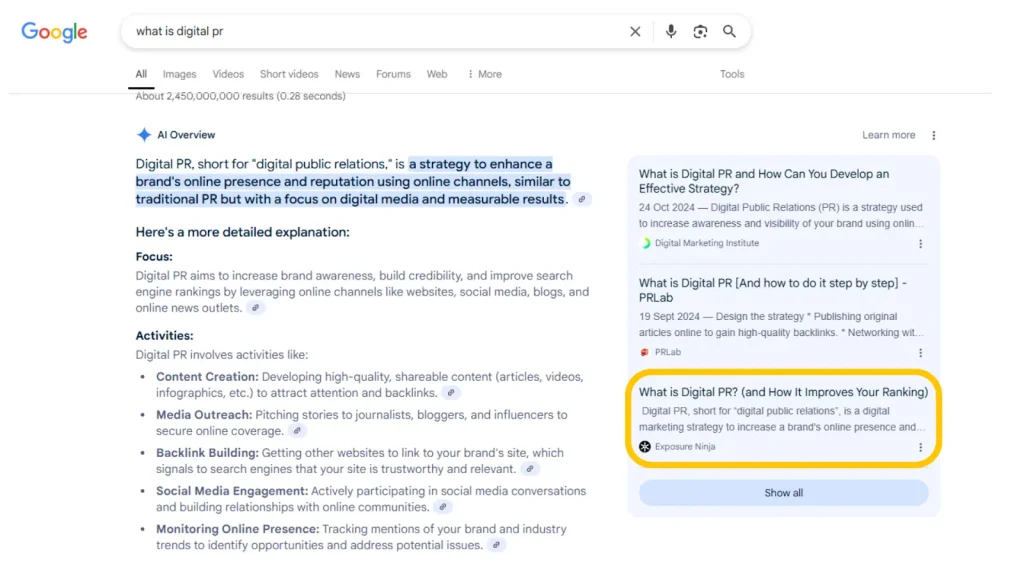
We practice what we preach. We recently refreshed our comprehensive Digital PR guide to include AI-focused practices, like front-loading answers and tightening the structure. Soon, it started showing up in AI Overviews for PR-related informational queries.
AI-friendly content isn’t about checking boxes; it’s about writing clear, relevant, and well-structured information that speaks directly to the user’s query. It’s about using natural language that resonates with the audience and optimising with relevant, semantically-linked terms. When your content is easy for both humans and AI to understand, you improve its chances of being featured in search results, helping you rank higher and get noticed by the right people.
Abigail Daunton-Johns
Head of Content and Email Marketing
Generate High-Quality Leads
Content creation isn’t just about driving traffic; it’s about attracting the right kind of traffic—the kind that turns into leads and, eventually, loyal customers.
It starts with understanding exactly who you’re targeting. “Businesses need to focus on delivering content that speaks to the needs and pain points of their target audience,” says Abigail Daunton-Johns. “That’s how you attract individuals who are genuinely interested and ready to take action.”
What keeps your audience up at night? What problems are they actively trying to solve? When your content speaks directly to these pain points and positions your product or service as the solution, you start to get qualified leads.
But to truly turn your content into a lead generator, you need to give your reader a clear next step to take. Every piece of content should have a strategic call to action (CTA) — whether that’s a downloadable resource, an email sign-up, or a service enquiry. It’s the difference between content that informs and content that converts.
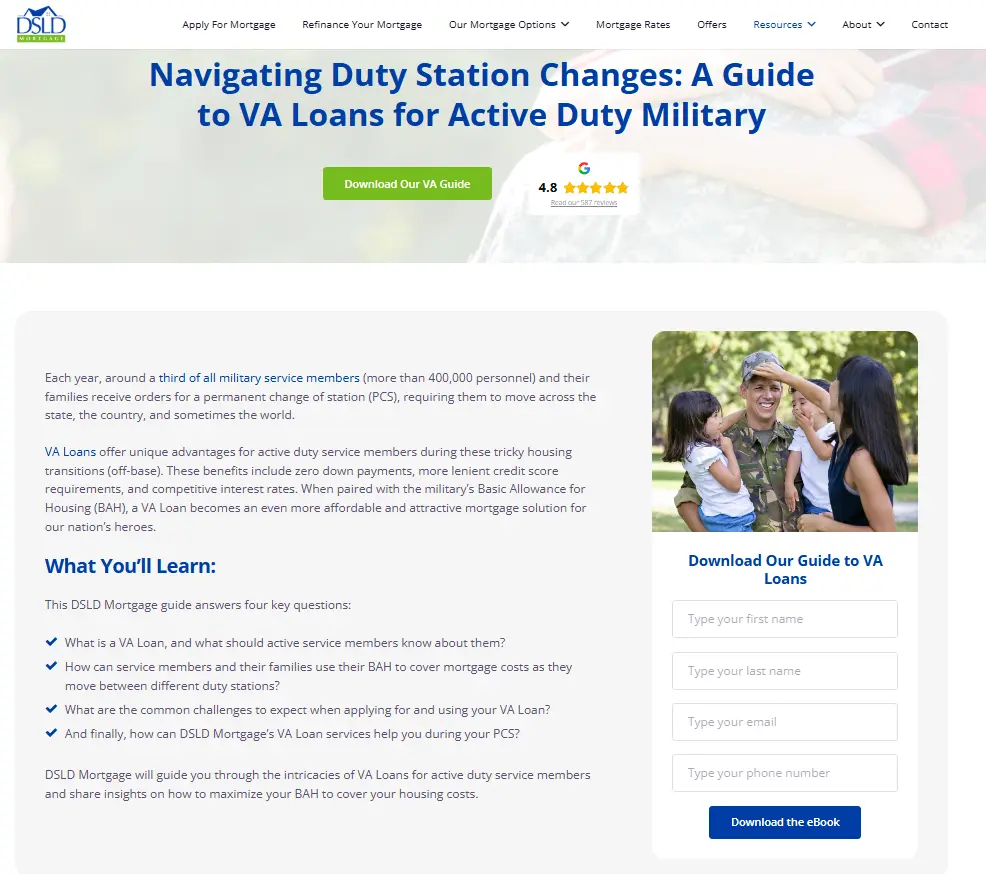
We put this into practice with DSLD Mortgage, a US-based mortgage lender. Instead of writing general blog content, we created downloadable resources tailored to their exact audience—like this VA loans eBook for active-duty military.
These gated assets captured email leads and segmented the audience by interest and stage of the funnel. With targeted follow-ups and nurture flows, DSLD turned readers into sales-ready leads.
Move Users to Conversion
As Abigail Duanton-Johns puts it, “Content isn’t just about getting eyeballs on your site; it’s about creating meaningful experiences that convert visitors into customers.”
That means guiding users through every stage of the buyer journey with the right content at the right time. To do this, you need a mix of:
- Awareness content, like blogs and how-to guides
- Consideration content, like comparison pages and case studies
- Decision content, like service pages and landing pages
Each piece should naturally lead to the next, which is where internal links and smart product showcases come in. They connect the dots, helping users explore your offering without friction.
We did this with Golf Course Lawn Store, which faced some serious search engine results page (SERP) competition. Instead of going head-to-head on bottom-funnel pages alone, we leaned into top-of-funnel educational blog posts that established their expertise and genuinely helped their audience. We embedded product links immediately at the top and CTAs where they made sense, so readers could move seamlessly from learning to buying.
This resulted in pages that ranked for both informational and commercial keywords and content that didn’t just attract users but converted them.
Build a Trustworthy, Recognisable Brand
People buy from brands they know and trust. One of the biggest benefits of content marketing is that content is still the most effective way to earn that trust at scale.
With AI-generated fluff flooding the internet, original, human-led content cuts through the noise. It’s how you show your expertise, communicate your values, and stay top of mind.
Consistent content builds familiarity, whether it’s thought leadership on your blog, real client results, or useful how-to content across email and video. Familiarity builds trust. And trust drives conversions.
We achieved this for one of our clients, a UK-based SaaS company in the HR space. When we started, their product and site were brand new, with no traffic, trust, or presence in the market.
To build authority from the ground up, we created a content strategy focused entirely on solving their audience’s most pressing challenges. Through niche blog posts, tailored landing pages, and expert-led guides designed specifically for HR managers and business leaders, we positioned them as a credible voice in a competitive space.
Over time, they went from zero visibility to thousands of targeted website visitors and demo requests, driven by content that showed they understood their audience better than anyone else.
Which Types Of Content Are the Most Important in 2026?
Long-Form, High-Value Blog Content
“Long-form content is making a major comeback,” says Abigail Daunton-Johns. “In an age where consumers crave more in-depth insights and AI is becoming ever more prevalent, long-form content does the heavy lifting.”
Longer content pieces give you the space to explore a topic fully, answer multiple related questions, and demonstrate real expertise.
But this isn’t about padding your word count to hit 2,000 words. For long-form content to be high-performing, it must provide real value. This means anticipating user intent, including original insights, and supporting the reader through their whole journey — all while ticking the boxes for AI and search engines.
Unique experiences and data will separate high-performing long-form content from the generic, so it’s very important to consider both of these elements. When done right, it boosts SEO, drives engagement, and delivers real value to readers, making it a powerful asset in any Content Marketing strategy.
Abigail Daunton-Johns
Head of Content and Email Marketing
AI-Friendly, Structured Content
To land a spot in Google’s AI Overviews or get cited by tools like ChatGPT, Claude, or Gemini, you’ll need AI-ready content.
Luckily, creating AI-friendly content and human-friendly content isn’t too dissimilar. Generative AI, like humans, wants information that is easy to read and understand. That means creating content that:
- Uses clear, descriptive headers that match real search queries
- Answers questions directly, ideally in the first sentence or two under a header
- Keeps formatting clean and structured with bullet points, short paragraphs, and logical flow
- Includes semantically related keywords and variations to show depth
- Uses internal links to build topical authority and support navigation
- Optimises for E-E-A-T to show you’re a trustworthy, experience-led source
Video and Interactive Content
In 2026, “video and interactive content are no longer optional,” says Abigail Daunton-Johns.
“They’re essential for grabbing attention in your target market in a very crowded digital world. Whether through engaging explainer videos, interactive quizzes, or live streams, businesses can use these formats to connect with their audience in a more dynamic and interactive way.”
Adding visual content, like YouTube video embeds, animated explainers, or short-form social clips, breaks up text-based content and holds attention. Interactive elements like ROI calculators, product selectors, or step-by-step quizzes help turn passive readers into active participants.
When integrated properly, these formats don’t just entertain — they educate, personalise the experience, and move users closer to conversion.
Data-Driven Reports and Case Studies
Users, search engines, and AI platforms are all looking for one thing in 2026: proof.
They want original data, real performance results, and genuine case studies that show your solution works in the real world. This kind of content builds authority, earns trust, and gives your brand a competitive edge in both organic search and AI-driven results.
Well-structured reports and case studies are also backlink magnets. Publishers, bloggers, and industry writers are far more likely to reference content that includes proprietary data, tangible results, or in-depth analysis. It gives their audience something new, and it gives you the kind of links that boost rankings and visibility.
Email and Newsletter Content
Email marketing should still be a core part of your content strategy in 2026.
People choose to sign up for your email marketing, which means they’re already interested in your product, service, or newsletter. That gives you a direct line to a warm, engaged audience.
It also gives you the perfect opportunity to deliver high-value content, like interactive tools or personalised insights, straight to their inbox while subtly moving them along the funnel.
Automation is what makes email especially powerful now. With behaviour-based triggers and smart segmentation, you can send the right message at the right time — whether that’s a lead nurture sequence, abandoned cart email, or monthly update. It’s targeted, scalable, and still one of the most cost-effective ways to turn interest into action.
FAQs
Why is content marketing growing in importance?
With the prevalence of thin, generic AI-generated content, users are craving real, authentic value. They want expertise, human insight, and content that genuinely helps, not just fills space. Content marketing that delivers this is what builds trust, drives engagement, and keeps your brand relevant in 2026.
Why is content marketing important for B2B companies?
Abigail Daunton-Johns explains: “For B2B companies, content marketing is essential because it helps break down complex services and establishes credibility and knowledge in the business’s industry. With longer decision-making processes and multiple stakeholders involved, B2B buyers need solid, educational content that builds trust, is tailored to each stage of the sales funnel and addresses their pain points.”
What is the most important part of content marketing?
Strategy. A strong content marketing strategy ensures every piece has a purpose — attracting the right audience, answering the right questions, and driving measurable results over time.