
How to Plan a Revenue-Driving Marketing Budget in 2026


Throwing money at more marketing channels rarely works. This guide shows you how to plan a marketing budget using a five-step framework that focuses investment where it drives real growth while still leaving room to test what’s next.
Most digital marketing budgets don’t fail because they’re too small. They fail because the money goes to the wrong places.
We’re going to walk you through a proven five-step framework for how to plan a marketing budget that actually drives revenue. We’ll cover:
- How to audit what’s working in your digital marketing strategy.
- Where to concentrate your spending.
- How much to set aside for smart experimentation.
- How to keep your budget effective as conditions shift throughout the year.
What Does a Marketing Budget Look Like in 2026?
Before you can allocate your marketing budget intelligently, it helps to know what “normal” looks like.
According to Gartner’s 2025 CMO Spend Survey, the average marketing budget sits at 7.7% of overall company revenue. This is flat from 2024, but well below previous peaks of 11%.
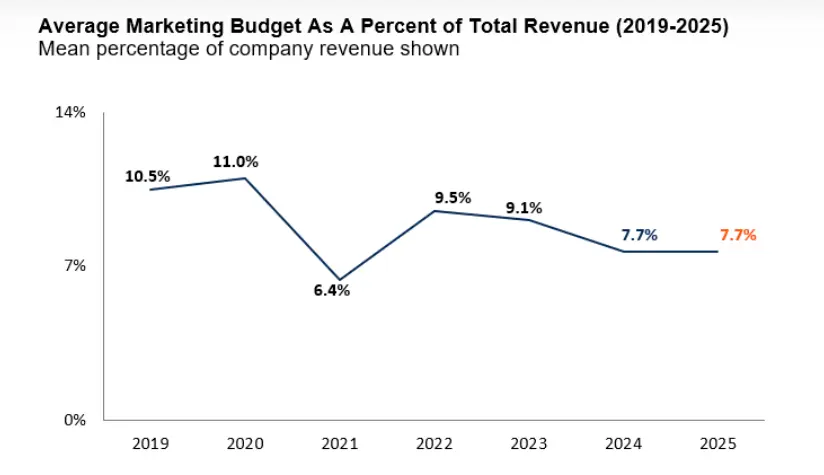
But benchmarks only tell part of the story. Marketing spend varies significantly by:
- Industry: Finance companies spend 11.18% on average, while healthcare typically spends 9.31% and energy spends 3.21%.
- Business Model: B2B companies typically allocate between 8% and 11% of revenue to marketing budget, while B2C companies allocate between 9% and 12%.
- Growth Stage: Early-stage businesses with aggressive growth strategies tend to spend way more, with examples like Salesforce spending 46% of revenue in 2018 and Asana spending 78% of revenue in 2022.
But how much you spend matters far less than how you allocate it. We’ve worked with clients who had modest budgets and consistently outperformed competitors spending five or ten times more purely because of how we structured their investment across channels.
How To Plan a Marketing Budget
Set Your Goals
Before you touch your marketing budget allocation, you need to be crystal clear on what you’re actually trying to achieve.
Choose one main goal, typically revenue growth, then define the supporting goals that will get you there. That might be increasing qualified traffic, improving conversion rates, or growing a specific channel.
Here’s what this looks like in practice. Our client, Value Capital Funding, came to us with a specific target: increase revenue by 25% month-on-month (MoM), exceeding $200k per month. To make that happen, we set three supporting goals:
- Increase monthly conversions from 53 to 100
- Grow website traffic from 789 to 1,400 visits per month
- Increase AI referral traffic from 20 to 150 visits per month
The reason this step matters isn’t just accountability. It’s that without specific targets, you can’t tell whether your budget allocation is working. And that means you can’t make the decisions that follow in the next four steps.
Audit What Works
Before you allocate a single pound of your marketing budget, look at the last 6 to 12 months of data to understand what’s actually performing.
This step is critical because marketing budgets are often influenced by internal opinions, trends, or assumptions about which channels “should” be working. Instead, the data should determine where the investment goes.
For each channel, review:
- Customer Lifetime Value (LTV): The revenue generated by customers acquired through a specific channel.
- Customer Acquisition Cost (CAC): The average cost to acquire a new customer.
- MQL to SQL Conversion Rate: How effectively Marketing Qualified Leads (MQLs) progress to Sales Qualified Leads (SQLs) and opportunities.
- Lead-to-Sale Conversion Rate: The percentage of leads that ultimately become paying customers.
- Lead Volumes and Trends: Whether lead generation from the channel is stable, increasing, or declining over time.
Prioritise channels where LTV is strong, CAC is sustainable, results are consistent over time, and your sales team can actually convert the leads being generated.
One important caveat is that low volume doesn’t automatically mean a channel should be cut. One of our clients recently started investing in AI Search Optimisation to appear across platforms like ChatGPT. Their AI referral traffic was initially low, but their conversion rate from that traffic was remarkably high. In just one month, they generated $66,000 in sales from ChatGPT traffic alone.
Allocate 80% to Core Channels
This is the single biggest mistake we see businesses make with their marketing budget: spreading spend across seven, eight, sometimes ten different channels, and giving none of them enough investment to actually perform.
Based on your audit, choose two to four channels where the data already shows strong commercial returns. Then allocate 80% of your total marketing budget to those channels, split based on their relative performance.
It’s better to do a few channels properly than many channels poorly. Very few brands are genuinely excellent everywhere, and those that are almost always got there by mastering a small number of channels first.
Here’s what this looks like for a real U.S.-based client:
| Channel | Monthly Budget | Purpose |
| Search Engine Optimisation (SEO) | $15,000 | Long-term visibility, authority, and sustainable lead generation |
| Google Ads | $25,000 – $35,000 | Primary demand-capture for high-intent searches |
| Meta Ads | $3,000 | Top-of-funnel awareness and retargeting |
| Email Marketing | $4,600 | Nurturing leads and improving conversion across channels |
Notice that there are four channels, each with a clear job to do.
Allocate 20% to Experimentation
Here’s where most marketing budget plans fall short: they allocate 100% of their spend to what’s worked before, leaving nothing over for what might work next.
In 2026, this is a particularly risky move. Traditional search is changing fast. Zero-click search is reducing organic traffic. AI platforms like ChatGPT and Perplexity are becoming part of the buyer journey and, in some cases, preventing potential customers from ever landing on your website.
We recommend allocating 20% of your marketing budget to controlled experimentation with new channels or approaches.
In 2026, the most valuable areas to test include:
- AI Search Optimisation to appear in AI-generated answers across AI platforms.
- New content formats, such as video, podcasts, and interactive tools.
- New paid formats or placements, especially those emerging in AI Search.
- Creator or influencer partnerships, particularly in sectors where trust and authority matter.
Every experiment needs a defined goal, a fixed test period, and a clear decision point: scale, improve, or stop.
When we first started working with The Ordinary, AI Search Optimisation wasn’t part of the plan. But after identifying it as a growing risk as users turned to Google’s AI Overviews for ingredient research and product comparisons, we adapted the strategy. The brand began appearing in AI Overviews for priority informational queries, reducing its reliance on traditional organic traffic and future-proofing the campaign.
Embed Quote: Tim Cameron-Kitchen, Founder: “In 2026, experimentation is more important than ever because there is so much change in digital marketing. We recommend allocating 20% of your marketing budget to new channels or experimental approaches. But limit the number of experiments you carry out, so that you can allocate enough budget and resources to make sure that they produce a clear result.”
Review Your Marketing Budget
Your budget allocation isn’t a set-it-and-forget-it decision. Markets shift, results change, and your budget needs to keep pace.
Monthly reviews should cover:
- Channel performance vs. targets
- Changes in CAC or lead quality
- Any sudden spikes or drops in volume
Quarterly reviews should address:
- Whether core channels are still delivering
- What your experiments have taught you
- Whether it’s time to reallocate.
And sometimes, budget changes happen to you, not because of performance, but because of internal constraints.
Our client Renew & Sustain joined us in 2023 after a difficult experience with a previous agency. In the first year, we exceeded their lead target, proving the strategy was working. Then, in 2024, internal pressures forced a significant budget cut, reducing the lead target from 600 to just 24.
Rather than abandoning the strategy, we reviewed the budget, shifted focus to the highest-impact activities, and continued to deliver. We exceeded the revised target despite the reduction in spend.
A well-structured marketing budget should scale up and down without breaking. When budgets shrink, a good framework helps you protect what matters most and rebuild quickly when conditions improve.
How to Defend Your Marketing Budget Plan
At some point, someone in leadership is going to push back on your marketing budget.
When that moment comes, anchor your defence on these four things:
- What you prioritised and why.
- What you deprioritised and why.
- What you tested and what you learned.
- What you’re scaling next.
If you can walk a CFO or CEO through your budget in under five minutes using that structure, you’re in a strong position.
The businesses that win budget battles aren’t necessarily the ones with the most data. They’re the ones who can connect marketing activity to business outcomes, simply and confidently.
Common Marketing Budget Mistakes To Avoid
Even experienced marketing leaders make errors with the marketing budget. Here’s what to keep an eye out for:
- Spreading spending too thin. Running eight channels on half budgets means none of them performs well.
- Ignoring low-volume, high-value channels. Volume isn’t everything. A channel generating 50 leads with a 40% conversion rate often beats one generating 500 leads that never close.
- Skipping the audit. Allocating next year’s budget based on gut feel rather than last year’s data is one of the most expensive mistakes you can make.
- Treating the budget as fixed. A rigid budget that can’t flex mid-year will cost you opportunities.
- No experimentation pot. If 100% of your budget goes to proven channels, you’ll be behind the moment those channels shift.
- Measuring the wrong things. Impressions and reach feel good. Revenue, CAC, and LTV tell you whether your budget is actually working.
Maximise Your Marketing Budget
The businesses that will dominate in 2026 aren’t necessarily the ones with the largest marketing budgets. They’re the ones making the smartest allocation decisions: concentrating spend on what works, testing what’s coming, and reviewing often enough to stay ahead.
If you’d like us to review your current marketing strategy and identify where your budget could be working harder, we offer a website and marketing review.
FAQs
What percentage of revenue should be spent on marketing?
According to Gartner’s CMO Spend Survey, the average marketing budget sits at 7.7% of overall company revenue. But this varies significantly by industry, business model, and growth stage. Use the average as a benchmark, then calibrate based on your specific goals and competitive environment.
What is the 70/20/10 rule for marketing budget?
The 70/20/10 rule recommends allocating 70% of your budget to proven channels, 20% to emerging opportunities, and 10% to high-risk, high-reward experiments. Our recommended 80/20 split follows a similar philosophy, prioritising strong core channel investment alongside a meaningful experimentation pot.
Should marketing budgets be fixed or flexible?
Marketing budgets should have a clear structure but remain flexible enough to adapt to performance data throughout the year. Build in scheduled quarterly reviews and give yourself permission to reallocate based on evidence.
How do you justify increasing a marketing budget?
The most effective way to justify a budget increase is to connect marketing spend directly to revenue outcomes. Show leadership what your current channels are returning, what an increased investment would unlock, and what you’d test with additional resources. A clear, commercially framed argument almost always outperforms a request backed by activity data alone.