The New AI Threat Terrifying Every Global Brand

Picture this: you’re sitting across from the marketing director of a household name brand — one you’d recognise instantly. Their company has built an empire on organic search traffic, generating millions in revenue from customers who find them through Google every single day.
But now? They’re terrified.
Not because of economic uncertainty or supply chain issues. They’re terrified because their customers have fundamentally changed how they search for information, research products, and make purchasing decisions. And their entire digital marketing strategy — the one that’s worked brilliantly for over a decade — is suddenly looking like yesterday’s playbook.
Sound familiar? If you’ve felt that nagging worry about how AI is disrupting search, you’re not alone. The statistics we’re about to share will explain exactly why major brands are scrambling to adapt, and more importantly, what you can do about it.
Executive Summary
The search landscape has undergone a seismic shift that most businesses haven’t fully grasped yet. AI platforms now process over 2 billion queries daily, with Google’s market share dropping below 90% for the first time in a decade. More critically, 58.5% of searches now result in zero clicks to websites, and ChatGPT shows higher commercial intent than Google itself.
Key findings:
- Traditional SEO alone is no longer sufficient for visibility
- AI tools are fundamentally changing customer research behaviour
- Being “included in the conversation” matters more than driving traffic
- Early adopters are establishing insurmountable competitive advantages
The solution: A five-pillar framework combining strong SEO foundations with AI-optimised content, web-wide authority building, continuous monitoring, and crystal-clear positioning.
This isn’t about throwing out your existing strategy — it’s about evolving it for the AI-first search era.
The Shocking Numbers That Changed Everything
May 2025 will be remembered as a pivotal moment in digital marketing history. For the first time in about a decade, Google’s market share dropped below 90%.
Now, let’s be honest — 89% is still pretty dominant. But this represents something much more significant than a simple percentage point decline. It signals a fundamental shift in user behaviour that’s accelerating faster than most businesses realise.
The numbers tell the real story:
- AI platforms process over 2 billion queries per day
- ChatGPT alone handles 1.1 billion of those searches
- Commercial intent on ChatGPT exceeds Google’s percentage
That last point deserves emphasis. According to Semrush data, ChatGPT actually shows a higher percentage of commercially focused searches than Google. This means people aren’t just asking AI tools random questions — they’re using them to research what to buy.
Your customers are turning to ChatGPT, Google Gemini, Perplexity, and other AI platforms for purchase decisions. They’re asking specific questions like “What’s the best project management software for a 50-person marketing team?” or “Which accounting firm should a £10 million tech company choose?”
And here’s the kicker: these AI tools don’t just provide general information. They make specific brand recommendations.
Why 58.5% of Searches Now Lead Nowhere
Here’s perhaps the most alarming statistic for anyone whose business relies on organic traffic: 58.5% of searches in the US now result in no clicks to websites.
Think about what this means. More than half of all searches end with the user getting their answer directly from the search results page, never visiting a single website.
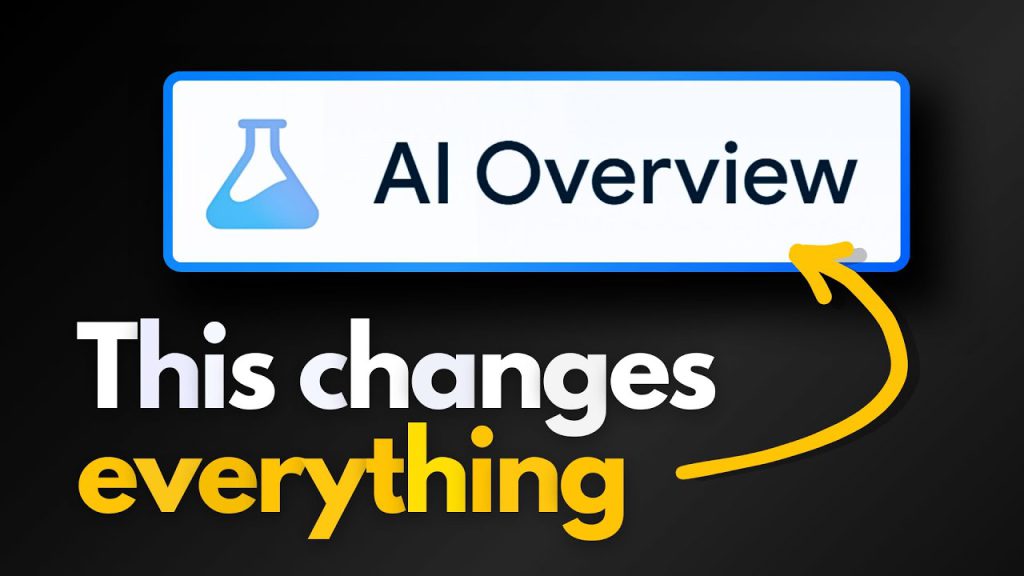
This data comes from 2024 — before Google significantly increased the number of AI Overviews in its search results. The trend is only accelerating.
You can now ask Google incredibly long, specific queries and receive tailored answers that recommend particular products or services. Because these answers appear directly in the search results, users often don’t need to click through to any websites.
The fundamental shift: The game has moved from getting clicks to your website to being the brand that gets recommended in the answer.
If your current strategy focuses entirely on driving traffic to your site, you’re optimising for a shrinking piece of the pie. Meanwhile, smart businesses are adapting their approach to ensure they’re the ones being recommended when AI tools answer purchase-related queries.
This doesn’t mean website traffic is dead — far from it. What’s happening is more nuanced:
- Informational traffic may decrease as AI tools provide direct answers
- Branded traffic often increases as customers research through AI, identify their preferred option, then search specifically for that company
- Purchase intent traffic becomes more qualified as visitors arrive after AI-assisted research
Some of our clients optimising for AI Search are seeing exactly this pattern: less total organic traffic, but more branded searches and higher-quality leads.
The Two Mindset Shifts That Separate Winners from Losers
Adapting to the AI search era requires two fundamental mindset shifts. Miss either one, and you’ll struggle to compete effectively.
Shift 1: From Traffic-Focused to Recommendation-Focused
Old mindset: Get ranked on Google → Drive traffic to your website → Convert visitors into customers
New mindset: Be included in AI recommendations → Customers research through AI tools → Direct/branded traffic from qualified prospects
This shift can feel uncomfortable initially, especially if you’ve spent years perfecting traffic acquisition. You might see a drop in total organic traffic for informational queries, and that’s actually normal in this transition.
But here’s what successful businesses are discovering: when AI tools recommend your brand during the research phase, customers often go straight to Google, type in your company name, and visit your website with much higher purchase intent.
The quality of traffic often improves dramatically, even if the quantity initially decreases.
Shift 2: From Human-Optimised to AI-Optimised Content
Old model: Human searches → Reviews search results → Clicks on multiple sites → Makes purchase decision
New model: Human asks AI tool → AI researches dozens of sources → AI presents curated recommendations → Human chooses from options
This might sound dystopian, but it’s simply the new reality. You’re no longer always communicating directly with your customers through your website. Instead, you’re often communicating via an AI intermediary.
This has profound implications for your content strategy and brand messaging. You need to be crystal clear about your positioning and key marketing messages because AI tools will extract and summarise information about your brand from multiple sources across the web.
If consistent messages about your unique value proposition appear repeatedly when your brand is mentioned online, AI tools are more likely to include those messages in their recommendations.
Your Five-Pillar AI Search Domination Framework
After working with clients across multiple industries to navigate this transition, we’ve developed a systematic approach that consistently delivers results. Here’s your complete playbook:
Pillar 1: Build an Unshakeable SEO Foundation
Let’s address the elephant in the room: SEO isn’t dead.
Search engines are still (very much) in use. In fact, AI tools are essentially sophisticated search engines themselves. When you ask ChatGPT “What’s the best jacket for climbing Mount Everest?“, watch what happens behind the scenes — it searches the web, finds relevant pages, extracts information, and synthesises recommendations.
If you want to be recommended in AI answers, your brand needs to be found in those background web searches. This means you still need solid SEO fundamentals:
- Technical SEO to ensure AI tools can crawl and understand your content
- Keyword optimisation for the queries your customers ask AI tools
- Content depth that provides comprehensive information AI tools can extract
- Authority signals that help AI tools trust your information
Websites being cited in AI answers are typically those already doing excellent SEO. Your existing SEO work isn’t wasted — it’s the foundation everything else builds upon.
Pillar 2: Optimise Your Content for AI Consumption
AI tools prefer content formatted in specific ways. From our firsthand experience with ChatGPT, Google AI Overviews, and other platforms, certain content structures dramatically increase citation likelihood:
Structural elements that work:
- Descriptive headings that match natural language queries
- Summary sections at the top of pages
- FAQ formats that directly answer common questions
- Statistical data points (increases citation probability by over 40%)
- Clear, factual snippets rather than narrative content
Content that struggles:
- Long-form narrative without clear structure
- Overly creative writing that obscures key facts
- Dense paragraphs without scannable elements
- Information buried deep within pages
Think about how an AI tool would extract information from your content. Can it easily identify your key messages, unique selling points, and factual claims? If not, restructure accordingly.
Pillar 3: Establish Authority Across the Entire Web
AI tools don’t rely on single sources. They often analyse dozens or even hundreds of websites before making recommendations. This creates a massive opportunity for authority building beyond your own website.
Strategic third-party placements:
- Industry publications that AI tools frequently cite
- Review websites in your sector
- High-authority magazines and news sites
- Comparison and “best of” lists on trusted platforms
We’ve seen incredible results with digital PR strategies specifically designed for AI visibility. When we secured a client’s mention in Modern Dog Magazine’s article on “best online dog training courses,” that placement directly influenced AI recommendations across multiple platforms.
The publication’s article became a source that AI tools cited when answering related queries. Suddenly, our client wasn’t just visible through their own website — they were being recommended because a trusted third-party source included them.
Multi-platform presence strategy:
- Your own website content (foundation)
- High-authority third-party publications (credibility)
- User-generated content platforms like Reddit and YouTube (diverse perspectives)
This distributed approach creates consistent signals that AI tools recognise as authoritative consensus.
Pillar 4: Monitor and Adapt in Real-Time
AI recommendations aren’t static. They’re generated fresh each time, and the underlying AI models update frequently. What gets recommended today might not get recommended tomorrow.
This creates both challenges and opportunities:
Monitoring requirements:
- Track your brand’s appearance in AI tool responses
- Test different query variations regularly
- Monitor competitor mentions and positioning
- Identify new sources being cited in your industry
Adaptation strategies:
- Update content based on changing AI preferences
- Pursue new third-party placements when gaps emerge
- Refine messaging based on how AI tools interpret your brand
- Experiment with different content formats and structures
We run continuous tests with our clients to understand what content formats these tools prefer and what signals increase recommendation likelihood. The landscape evolves rapidly, requiring an agile approach.
Pillar 5: Craft Crystal-Clear Positioning Messages
In the traditional search world, you could sometimes win simply by being found first. If someone searched for “dog training courses” and you ranked number one, many people would click and buy whatever they found.
AI tools are more sophisticated. They research extensively before making recommendations, looking for specific differentiators to highlight.
Essential positioning clarity:
- What specific problem do you solve better than anyone else?
- What tangible benefits do you offer that competitors don’t?
- What proof points support your claims?
- How do you want to be known in the market?
Look at how AI tools describe different options in their recommendations:
- “This provider offers hybrid face-to-face sessions focused on owner education to address real behavioural issues“
- “These courses feature globally recognised trainers“
- “Great for socialisation and group skills development“
The more consistently these tools see specific messages about your brand across different websites, the more likely they are to include those messages in recommendations.
This is why we work closely with clients through our Brand Accelerator process, identifying what made existing customers choose them, then amplifying those differentiators across all content — both on their website and in third-party mentions.
Next Steps
The AI disruption of search is massive, but it’s also a tremendous opportunity for businesses that act decisively. Just as traditional search disrupted markets in the 2000s, AI search will create clear winners and losers.
Your immediate action plan:
- Audit your current visibility in AI search tools by testing relevant queries
- Assess your content structure for AI optimisation opportunities
- Identify high-authority publications in your industry for potential placements
- Clarify your positioning messages and ensure consistency across all content
- Implement monitoring to track changes in AI recommendations
What success looks like:
- Consistent mentions in AI tool recommendations for relevant queries
- Increased branded search traffic as customers discover you through AI research
- Higher-quality leads arriving with clearer purchase intent
- Competitive advantage as rivals struggle with traditional SEO alone
The businesses optimising for AI Search now will establish advantages that become increasingly difficult to overcome as this technology matures.
Remember: everybody is new to this. The technology is only 2.5 years old, and most of your competitors haven’t even started thinking about AI Search Optimisation yet.
If you can master this transition, you’ll have a fantastic next couple of years while others scramble to catch up.
Resources Mentioned
- Semrush — You can try Semrush’s SEO Toolkit for free using our link, thankyouninjas.com*, or you can try an interactive demo of Semrush’s AI Tookit by visiting exposure.ninja/ai-toolkit*
In Conclusion
The search landscape has fundamentally changed, and there’s no going back. With AI tools processing over 2 billion queries daily and most searches resulting in no website clicks, traditional SEO alone is no longer sufficient.
The brands thriving now aren’t just getting found — they’re being actively recommended by AI tools to high-intent customers. They’ve shifted from traffic-focused to recommendation-focused thinking.
The question isn’t whether AI will continue disrupting search — it’s whether you’ll be among the winners or the displaced.
Watch This Next
This is the era of AI Search Optimisation. To continue learning about what it is and how it works in more detail, watch the following video or listen to the audio post via this link: What is AI Search Optimisation (and How To Do It)
*Disclaimer: Exposure Ninja may get a commission through the marked links above, at no cost to you