Google’s 2026 Search Shifts: UCP, Personal Intelligence, and Apple-Gemini


This guide explains what Gemini Personal Intelligence, Universal Commerce Protocol (UCP), and the Apple partnership mean for your digital marketing strategy in 2026.
Google just dropped three massive updates in the first few weeks of 2026 that have fundamentally changed how people discover and buy from businesses online. These include:
- Gemini Personal Intelligence.
- Universal Commerce Protocol (UCP).
- Apple-Google AI partnership.
Here’s what’s changed, why it matters, and what you need to do about it, with insights from Charlie Marchant, Exposure Ninja’s CEO and AI Search thought leader.
1. Gemini Personalisation: “Personal Intelligence”
“The first, and the biggest Google update, is Gemini’s personalisation,” says Charlie Marchant.
Google’s Gemini has just launched Personal Intelligence as a beta in the U.S. as a step towards “making Gemini more personal, proactive, and powerful.”
Personal Intelligence connects Gmail, YouTube, Google Search, Photos, and Maps directly to Gemini, using this data for specific, personalised answers or to do things for you.
“This is huge,” says Charlie Marchant. “It basically means that Google’s Gemini will be able to read your emails, check your past purchases, see your order confirmations in there, see what videos you’ve been watching on YouTube, where you went on Google Maps, if you reviewed somewhere, where you liked, and then personalise the answers with all of your data.”
What makes this such a big deal is not just the feature itself, but the depth of data Google already has. Google has been collecting personal, behavioural, and contextual data on users for decades across Search, Gmail, Maps, Android, YouTube, and Chrome. Compared to platforms like ChatGPT, which only know what users explicitly tell them, Gemini is starting this race with a massive historical data advantage.
That’s what makes this version of personalisation fundamentally different. It’s not just responding to a conversation. It’s responding to years of observed behaviour, preferences, purchases, locations, and intent signals.
There will inevitably be privacy concerns at first. But Charlie Marchant predicts: “Once this is rolled out globally, I think it will just become the new normal. We’ve already seen billions of people use ChatGPT, which personalises based on conversations, without much resistance. This is simply the next step in an even more personalised search experience.”
Why This Matters
Gemini’s Personal Intelligence changes how recommendations are formed.
Gemini will increasingly shape its responses based on what it already knows about the individual user. Over time, this means two people asking the same question can receive very different recommendations, based on their history, preferences, and past behaviour.
“This is likely to be big for repeat purchases,” says Charlie Marchant. “If Google knows you usually buy from Patagonia, it’s more likely to show you Patagonia and similar brands when you search. That’s great for businesses that depend on long-term customer relationships.”
This shift also has strategic implications for the AI platform race. As Charlie Marchant explains: “This is a really aggressive bite back from Google against OpenAI and other AI chatbot competitors that have been focusing on getting this personal context and personalised answers.” Google is not just improving Gemini as a product. It is turning its entire data ecosystem into a competitive advantage that other platforms simply cannot replicate.
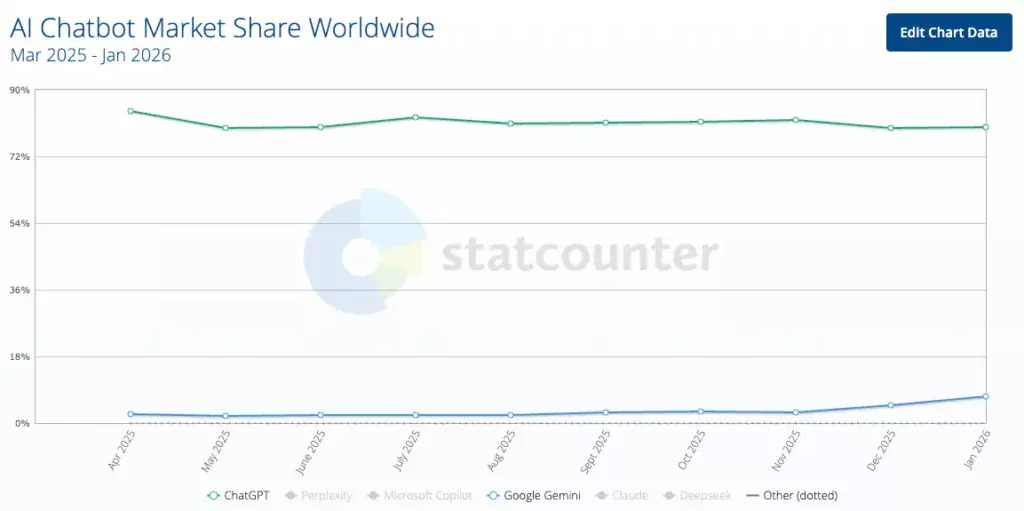
We are already seeing early signs of this in the global AI chatbot market. While ChatGPT still leads, Gemini’s share has climbed past 7% for the first time.
2. Universal Commerce Protocol (UCP)
Google has also announced Universal Commerce Protocol (UCP) as a beta in the U.S, designed for the era of agentic commerce.
UCP is a new open standard and commerce framework built by Google with major partners (Shopify, Target, Walmart, Etsy, Wayfair), designed to enable seamless product discovery, checkout, and post-purchase support directly within Gemini and AI Mode.
This allows users to complete purchases directly within Google’s AI experiences, using Google Pay or saved payment methods, without needing to visit a retailer’s website. Retailers remain the seller of record, but the transaction happens inside the AI interface.
While UCP sounds technical and boring, it’s not. It’s the next step in agentic AI.
Charlie Marchant explains: “This UCP is a new standard that pretty much allows AI agents to understand products, manage checkouts, and then complete purchases on the user’s behalf. It’s kind of the next level of agentic AI that we were expecting to get to.”
Alongside this, Google is also launching:
- Business Agent: Branded AI assistants that let shoppers chat directly with retailers.
- Direct Offers: A new Google Ads format that surfaces exclusive discounts directly inside AI conversations.
- Merchant Centre: New data attributes designed for discovery in conversational AI, not just keyword search.
Why This Matters
For eCommerce businesses, this is a platform shift.
Google is moving checkout from your website into AI Mode or Gemini. This means if Google recommends your product:
- You get the sale with zero friction.
- The buyer journey is shorter and easier.
- Conversion rates could improve.
But if your products don’t appear in those recommendations, you are no longer just losing rankings. You are being removed from the buying journey entirely.
It also changes what actually drives performance:
- Product feeds and structured data become strategic assets.
- Google Ads and Shopping placements move into AI conversations, not just search results.
- How your products are described, categorised, and connected starts to influence whether the AI platforms consider you.
As Rebecca Pilkington, Head of PPC at Exposure Ninja, notes, shopping ads are already coming to AI Mode, which means advertisers will be able to leverage personalised targeting through product feeds inside AI-driven journeys, not just traditional SERPs.
It is also important to see this as a direction of travel, not a one-off experiment. As Charlie Marchant notes: “Google haven’t said that it’s happening in classic Google search, the 10 blue links, yet. That doesn’t mean that it won’t. In my opinion, it definitely will. AI Mode is pretty much always the testing ground.”
3. Google’s Gemini Models Power Apple
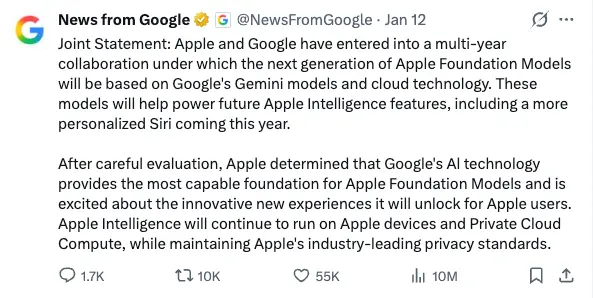
Apple and Google have entered a multi-year AI partnership in which Apple’s next-generation foundation models, including a more personalised Siri and Apple Intelligence features, will be powered by Google’s Gemini and cloud technology.
This is an extraordinary strategic admission from Apple. Rather than competing head-on in foundation models, Apple has decided to standardise its AI layer on Google’s technology.
As Charlie Marchant puts it: “This partnership pretty much has publicly said that Apple thinks Google has the best version, that Gemini is the most powerful AI, that they are essentially backing Google over any other AI competitor.”
In practical terms, this means that when Apple users talk to Siri, use Apple Intelligence, or interact with AI-powered features across iOS, they will increasingly be interacting with Google’s models.
Why This Matters
Until now, Google’s AI reach was strongest on Android. Apple users were a separate ecosystem. This partnership collapses that distinction. iPhones and Android phones alike will now be powered by Gemini in core AI experiences.
That has two major consequences.
First, it massively accelerates user adoption of Google’s AI Search and assistant experiences. Hundreds of millions of users who may never have chosen Gemini or AI Mode explicitly will now be using Google-powered AI by default, simply through Siri and Apple Intelligence.
Second, it further consolidates Google’s position as a monopoly. This is happening while antitrust cases move slowly through the courts. In the meantime, Google is expanding its control over how people search, decide, and buy in real time.
There are legitimate concerns in the industry about what this level of concentration means. Expert SEO speakers like Chima Mmeje from Moz have warned that monopolisation at this scale risks stifling innovation.
Charlie Marchant is more cautiously optimistic: “My hope is that there will still be a push for innovation because there are competitors like OpenAI actively trying to do something. And arguably, Google has been forced into making a lot of these big changes that we’re seeing, like personalisation and partnerships with Apple, because there are now new AI chatbot competitors.”
What All This Means for Your Marketing Strategy in 2026
Taken together, these three updates show a clear direction of travel for Google and for search more broadly.
- Gemini’s Personal Intelligence decides what to recommend.
- UCP lets those recommendations turn into purchases.
- The Apple partnership puts Google’s AI in front of users by default.
These changes point to one simple shift: AI Search is becoming where people discover brands, make decisions, and buy.
For marketing leaders, this means your strategy can no longer focus only on driving traffic. It has to focus on being the brand that AI platforms like Gemini choose to recommend.
That is what AI Search Optimisation actually means in practice.
In 2026, this means your digital marketing strategy must:
- Build brand authority and trust, because AI systems prefer to recommend known, credible brands.
- Structure your content, products, and services so that AI platforms can understand, compare, and select them.
- Invest in retention and customer relationships, because past behaviour increasingly shapes future recommendations.
- Treat AI platforms as a new distribution channel, where your content, offers, and ads appear directly inside AI answers.
Win Visibility in AI Search With the Right Partner
Google’s 2026 updates make it clear that AI is no longer just influencing search. It is becoming the interface where discovery, evaluation, and decisions happen.
The fundamental digital marketing channels have not disappeared. Search Engine Optimisation (SEO), strong content marketing, and digital PR still matter. What has changed is what they are optimised for. The goal is no longer just rankings. It is being selected, cited, and recommended inside AI answers.
If your team is unsure how to create a strategy for AI Search Optimisation, we can help.
Request a marketing review, and we’ll show you exactly where the opportunities are for your business in AI Search.
FAQs
What is Google’s Universal Commerce Protocol (UCP)?
Google’s Universal Commerce Protocol (UCP) is the technology allowing product purchases directly in AI Mode and Gemini without visiting a website to check out. It’s currently in a beta in the U.S., but will likely expand globally.
What is Gemini Personal Intelligence?
Personal Intelligence connects your Google apps, such as Gmail, YouTube, Search, Photos, and Maps, directly to Gemini for personalised answers. It’s currently an opt-in beta for U.S. users. Google can read your emails, check past purchases, and personalise recommendations based on your complete behavioural history.
How does the Apple-Google Gemini partnership affect search?
Apple’s next-generation foundation models, including a more personalised Siri, will be powered by Google’s Gemini technology. This means nearly all smartphones (Android and iPhone) will run on Google’s AI. It massively increases Google’s monopoly and makes optimising for Google’s ecosystem unavoidable for businesses.
Will brands still get traffic if purchases happen inside Google’s AI?
No. With Google’s Universal Commerce Protocol (UCP), users can complete purchases directly inside Gemini and AI Mode without visiting a retailer’s website. Retailers still fulfil the order, but the discovery, decision, and checkout can all happen within Google’s AI interface, so no clicks are required.
Are these updates more important for eCommerce or lead generation businesses?
Both are profoundly affected, but differently. eCommerce businesses face immediate disruption from in-AI purchasing through UCP and need to urgently optimise product feeds and ads for AI Mode and Gemini. Lead generation businesses must focus on appearing in AI-generated answers to top-of-funnel questions and on maintaining visibility through content, PR, and email. Cross-channel strategy matters for both.