AI Is DECIMATING This Industry’s Marketing

Picture this: you’re reviewing your Google Analytics, and organic traffic has dropped 15% again this quarter.
Sound familiar? You’re not imagining it, and you’re definitely not alone.
Here’s the stark reality: 58% of Google searches now end in no clicks.
ChatGPT serves 5.5 billion monthly active users.
Google Gemini reaches 350 million people.
These AI tools are answering questions about your products and recommending your competitors 24/7, all without anyone stepping foot on your website.
We’ve just completed an analysis of 7 million finance keywords, and what we discovered will fundamentally change how you think about digital marketing. Even industries built on trust, expertise, and heavy regulation aren’t immune to AI disruption. In fact, they’re being hit harder than anyone expected.
Executive Summary
Our comprehensive analysis of 7 million finance keywords reveals that AI Overviews are appearing in:
- 38% of mortgage-related searches
- 52% of financial advisory queries
- 34% of commercial investment searches
The impact? An average 15.49% drop in click-through rates when AI Overviews appear.
But here’s the twist that changes everything: while content publishers are losing traffic, businesses that sell products directly are discovering unprecedented opportunities. The middleman is dying, and AI tools are creating a direct path from customer question to product purchase.
The bottom line: Companies adapting to AI-first marketing are capturing customers while their competitors watch organic traffic evaporate.
This is relevant to marketers in every industry, not just finance, because it's a glimpse of the future of digital marketing, and just how much AI is impacting the pillars of digital marketing that we have become so used to relying on.”
 Tim Cameron-Kitchen
Founder
Tim Cameron-Kitchen
Founder
What 7 Million Keywords Revealed
Finance seemed like the last industry you’d expect to see AI disruption. After all, it’s built on personal trust, regulatory compliance, and expertise. It’s classified as “Your Money or Your Life” content — the type Google traditionally handles with extreme caution.
Yet our research team’s analysis of 7 million finance keywords paints a dramatically different picture.
Money and finance questions dominate what people ask AI tools. These platforms have become financial advisors, mortgage brokers, and investment consultants rolled into one. Despite heavy regulation and the sensitive nature of financial advice, AI Overviews are appearing at unprecedented rates.
The numbers don’t lie:
- Mortgage informational keywords: 38% trigger AI Overviews
- Financial advisory searches: 52% show AI-generated answers
- Investment commercial queries: 34% display AI responses
Remember, this data only covers Google traffic. When you factor in ChatGPT’s 5.5 billion monthly active users getting AI answers to their financial questions, the scale becomes staggering.
If you’d like a copy of the white paper the data is in, you can access it here: How AI Overviews Are Disrupting Finance Marketing
Finance Gets Hit by AI Overviews
When AI Overviews appear on search results pages, we documented an average 15.49% reduction in click-through rates. This isn’t surprising — if an AI provides the answer you’re seeking, why click through to individual websites?
Our research identified clear winners in AI Overview visibility. In UK mortgages, NatWest leads the pack. For investment topics, Investopedia dominates globally.
This makes perfect sense when you examine what these businesses do well:
NatWest leverages institutional authority and produces structured, factual content about mortgage processes.
Investopedia has spent years creating exceptional educational content. Their articles feature human authors, cite credible sources, and break down complex investment concepts into digestible explanations. They’re practically a textbook example of content that AI systems love to reference.
You’d assume Investopedia would be celebrating their AI success, right?
The Investopedia Paradox
Here’s where our research gets truly frightening for traditional content marketers.
According to Semrush data, Investopedia’s organic traffic has halved over the last 12 months — dropping from more than 36 million monthly visits to fewer than 18 million.
Read that again. They’re winning at AI visibility but losing half their website traffic.
Why? Because people no longer need to visit Investopedia to get investment advice.
They’re asking ChatGPT directly:
“ChatGPT, where should I invest my life savings?”
“ChatGPT, should I sell my house and put everything into cryptocurrency?”
Previously, people researching financial topics often felt overwhelmed about who to trust. Investopedia became their go-to resource. Now, AI tools have assumed that trusted advisor role.
Previously, people researching finance topics often didn't really know who to trust. So they'd go to Investopedia for recommendations. But now… ChatGPT, where should I invest my life savings? ChatGPT, should I sell my house and invest it all into Dogecoin?”
Tim Cameron-Kitchen
Founder
Why This Is Great News for Product Sellers
If you’re feeling grim about Investopedia’s traffic collapse, don’t. This represents fantastic news if your business sells products or services.
Investopedia’s business model works like this:
Attract organic traffic from Google → Show visitors advertisements and affiliate recommendations → Earn commissions when people click through to purchase products.
With their traffic halving, the brands paying Investopedia for placement are receiving half the clicks and half the customers.
But people aren’t buying fewer financial products. They’re simply changing how they discover and evaluate options.
Instead of this traditional flow:
Customer searches → visits Investopedia → sees affiliate recommendation → purchases from brand
The new reality looks like:
Customer asks AI tool → receives direct brand recommendation → purchases from brand
The middleman is being eliminated. Rather than paying affiliate commissions or advertising fees to content publishers, smart businesses are getting AI tools to recommend them directly.
And unlike traditional affiliate relationships, AI recommendations don’t require ongoing fees — as long as you understand how to influence these systems.
The Death of the Middleman
AI tools like ChatGPT and Google’s AI Overviews are becoming the new intermediaries, but they operate fundamentally differently from traditional publishers.
With Investopedia, you paid for placement and hoped for traffic. With AI tools, you get recommendations based on factors you can control and optimise.
We’re helping clients capture this opportunity right now. Here’s one example from a financial training company we work with:
Their AI Overview appearances increased dramatically in just one quarter:
- US market: 72% increase
- UK market: 600% increase (smaller base)
- India market: 125% increase
Most of their competitors remain focused on declining organic traffic, completely missing this AI opportunity. Because our client sells directly to customers, when AI tools recommend or link to them, buyers can purchase immediately without any intermediary taking a commission.
Client Results in AI Search
The results speak for themselves when you implement AI-first marketing strategies correctly.
Take our client ZUGU Case, which manufactures iPad accessories. When someone asks ChatGPT to recommend an iPad Air case, our client consistently appears in the recommendations.
This isn’t a coincidence. We’ve helped them achieve “omnipresence” across the internet — appearing on their own website, high-authority third-party publications, and user-generated content platforms like Reddit and YouTube.
ChatGPT conducts background research before making recommendations, reading multiple websites and sources. Because Zugu Case appears consistently across these various touchpoints, the AI system views it as a credible, popular choice.
The results can be relatively rapid if you apply sufficient resources. Our financial training client saw their AI visibility increase significantly within a single quarter, while competitors remained focused on traditional SEO metrics.
Three-Pillar Framework for AI Success
Based on our client work and research, successful AI marketing requires three foundational elements:
Build a Strong SEO Foundation
AI tools often reference websites that rank well on Google’s first page. ChatGPT frequently performs background web searches, essentially “googling” topics using its own search engine before formulating responses.
If you’re not ranking for relevant keywords, you’re unlikely to be included in AI answers. Your traditional SEO efforts remain crucial — they’re simply the starting point now.
Create AI-Friendly Content
AI systems prefer specific content characteristics:
- Concise, factual statements that can be easily extracted
- Clear structure with headings and bullet points
- Statistical data and concrete numbers
- FAQ sections that directly answer common questions
Long-form narrative content without these elements gets overlooked, regardless of quality.
Achieve Strategic Omnipresence
This means being visible across the entire internet ecosystem:
- Your own website with optimised content
- High-authority publications through digital PR and guest content
- User-generated platforms like Reddit, YouTube, and review sites
AI tools prefer citing multiple source types when making recommendations. This distributed presence creates consistent signals that influence AI decision-making.
Fair warning: achieving omnipresence requires significant manual effort and investment. It’s neither easy nor cheap. But the payoff — having AI tools recommend you directly to customers — provides a shortcut straight into your customer’s decision-making process.
Next Steps
AI tools are being trusted to research and recommend solutions for sensitive topics like finance and investing. If you can position your business to receive those recommendations, you’re set to win in this new era.
Marketers face a choice: pretend this shift isn’t happening and cling to declining organic traffic, or reorient your strategy to capture customers where they’re actually going.
We all observe increasing AI tool usage in our daily habits. The question becomes: does your digital marketing strategy align with this behavioural change?
For most brands, it doesn’t yet.
Your immediate action steps:
- Audit your current AI visibility — search for your products/services in ChatGPT and Google’s AI Overviews
- Assess your SEO foundation — ensure you’re ranking for relevant keywords
- Review your content structure — optimise for AI consumption with clear, factual formatting
- Develop an omnipresence strategy — identify high-authority sites and platforms for strategic placement
Marketers now have a choice. We can either pretend that this isn't happening, and we can hang on to the remaining dregs of the old world, or we can reorient our marketing strategy to take advantage of this and move to where users are going.”
Tim Cameron-Kitchen
Founder
In Conclusion
The finance industry’s experience with AI disruption provides a preview of what’s coming for every sector. Even heavily regulated, trust-based industries aren’t immune to AI transformation.
But this disruption creates unprecedented opportunities for businesses willing to adapt. While content publishers watch their traffic evaporate, product sellers can capture customers more directly than ever before.
The companies implementing AI-first marketing strategies now will establish insurmountable advantages as this technology continues expanding. And it’s expanding rapidly.
The future belongs to businesses that embrace this shift rather than resist it. The question isn’t whether AI will impact your industry — it’s whether you’ll be ready when it does.
Watch This Next
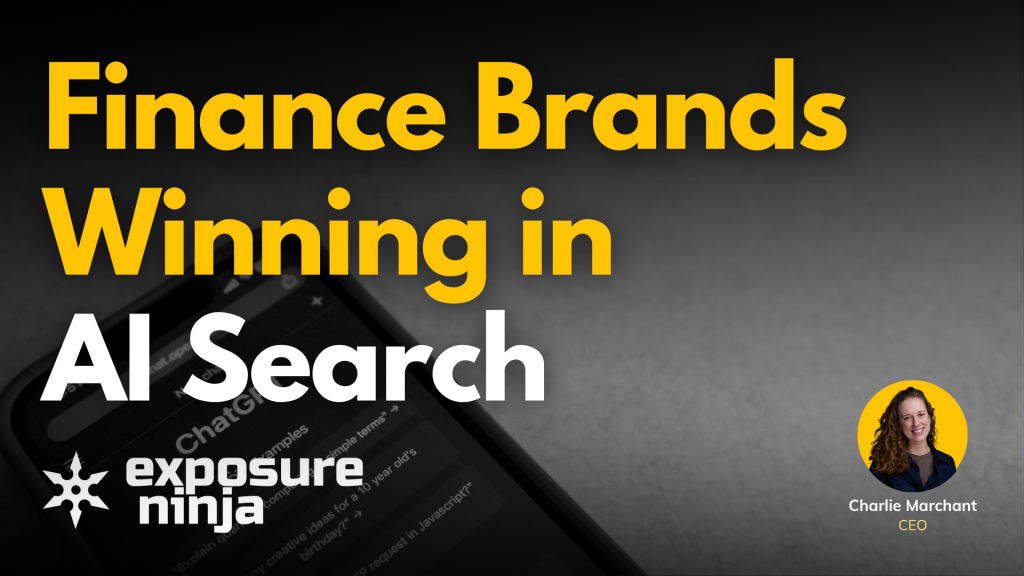
Ready to dive deeper into AI marketing strategies? Watch our latest breakdown of exactly how to dominate AI search results and capture high-value customers before your competitors catch on. Check out the embedded video above or listen to the full podcast episode here.