AI‑Optimised (and Human‑Friendly) Blog Post Template


Use our high-performing AI-optimised blog post template to create content that ranks in AI Search and still feels natural for human readers. Complete with real examples and a downloadable template.
AI Search is changing how people find information online.
Before, users turned to traditional search engines, browsed the results, and clicked through to find answers. If your blog ranked at the top of Google, you could capture that traffic.
But now, they’re asking ChatGPT, Perplexity, or Gemini to get instant, summarised answers. If they’re on Google, they’re likely skimming the AI Overview or using AI Mode, not scrolling for links.
To stay visible, your content needs to be cited as a trusted source within these AI-generated answers. That means writing and structuring your blog posts in a way that AI systems can easily scan, interpret, and surface.
AI-optimised content doesn’t mean writing like a robot. It means being smart about structure, clear with intent, and strategic with formatting to make your content easier for AI to index and more compelling for human readers.
Want to get it right every time? Download our AI-optimised blog post format template and follow the step-by-step framework below to create content that ranks in AI Search.
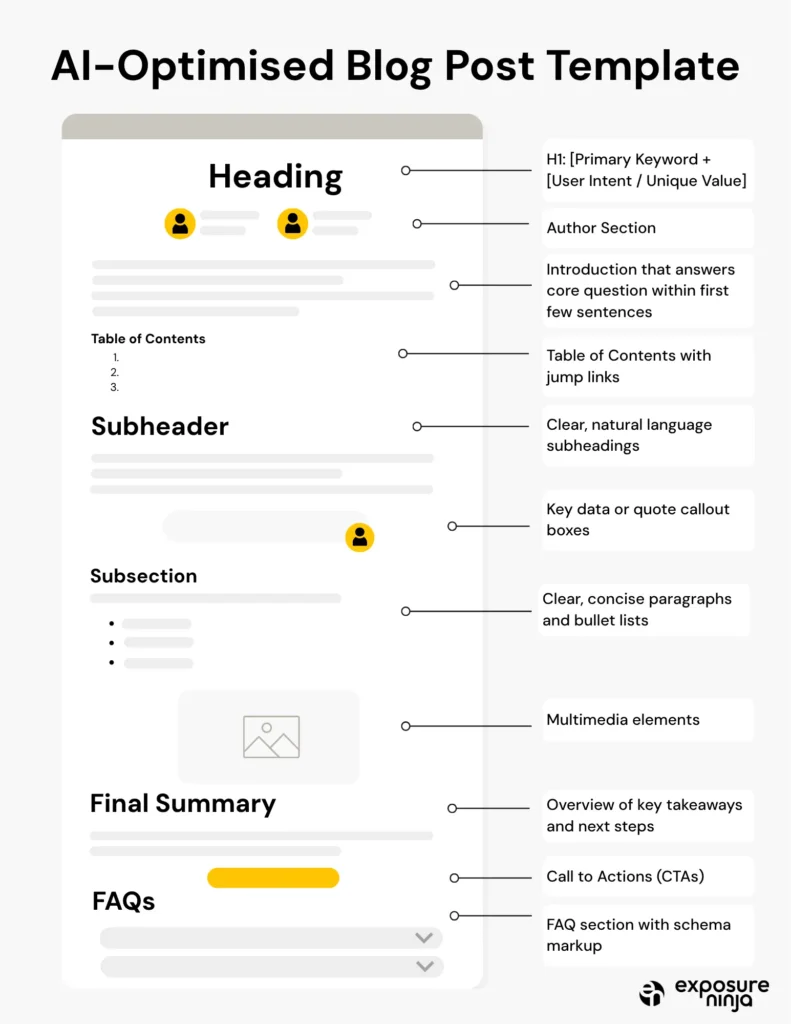
Why You Need AI‑Optimised Blog Posts
AI Search has introduced a new level of complexity to content marketing by changing how content is discovered and displayed online.
Traditionally, optimising a blog post for search engines meant using target keywords, producing high-quality content that demonstrates Experience, Expertise, Authoritativeness, and Trustworthiness (E-E-A-T), and building backlinks. These elements helped your content rank and reach your intended audience through Google or Bing.
Having this strong Search Engine Optimisation (SEO) foundation is still critical. Well-optimised content is what allows your blog to rank in traditional search results and be sourced by AI platforms when they generate answers. AI systems like Google’s AI Overviews or ChatGPT rely on search engine indexes to pull citations, prioritising content already seen as relevant, trustworthy, and technically sound.
But visibility in AI Search requires more than just SEO — it needs AI Search Optimisation. AI platforms extract data from content that is clearly structured and easy to parse (understand). This means using consistent formatting, meaningful subheadings, summarised key points, and schema markup where appropriate. The goal is to make your blog post simple for AI to interpret and credible enough to cite.
Of course, ranking or being cited is only part of the picture. The real purpose of your content is to inform, engage, and convert your human readers. An AI‑optimised blog format helps achieve this by making your content more accessible, easier to digest, and more aligned with how users consume information today, whether through AI platforms or traditional search.
Balancing both machines and humans is now essential in your content strategy. With the right structure, you can ensure your content is not only found, but also trusted and acted upon.
Downloadable AI-Optimised Blog Post Template
Want content that ranks in AI Search and converts real readers? Download the template we use to optimise blogs for AI visibility and human engagement.
1. Start With Structured Meta Tags That Hook Readers
Your meta title and meta description help AI systems quickly understand the focus and value of your content while also influencing whether a user decides to click through.
Your meta title should include your primary keyword and a compelling hook — something that speaks directly to user intent and adds a practical or emotional reason to engage. Your meta description should summarise the core benefit of the blog in plain, accessible language and include a soft call to action (CTA).
For example:
- Meta Title: “Copy This Blog Post Template for AI Search.” This includes the primary keyword (blog post template) and clearly signals value by showing users they can copy and apply a proven format that performs in AI Search.
- Meta Description: “Rank in Google’s AI Overviews and AI Mode with our AI‑optimised (and human‑friendly) blog post format template.” It highlights the outcome (ranking in AI results), reassures users it’s built for humans and machines and encourages action with a subtle CTA.
This setup supports traditional SEO performance and improves your chances of being cited or featured in generative AI results.
Tips:
- Keep meta titles under 60 characters to avoid truncation in search results.
- Limit meta descriptions to 155 characters for maximum visibility.
- Include the primary keyword as close to the start of the title as possible.
- Use plain, action-oriented language.
- Add Article, FAQ, Product, or HowTo schema markup.
2. Write a Winning H1 Title
Your H1 is the most important headline on the page for readers, search engines, and AI systems. It should clearly communicate what the content is about, include your primary keyword, and align closely with user intent. This is the first thing users and AI systems see, so it needs to be informative, relevant, and inviting to continue reading.
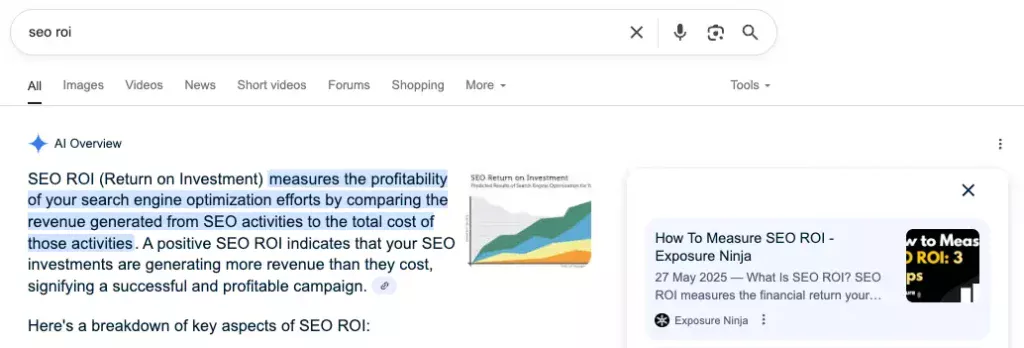
Let’s take one of our own blog posts as an example: Prove Your SEO ROI in 3 Simple[-ish] Steps. This H1 title includes the target keyword (“SEO ROI”) and speaks directly to what the reader wants: a straightforward, actionable way to measure and communicate SEO returns. The tone is friendly, the structure is clear, and it sets a strong expectation for what’s inside — which is one of the reasons it’s currently ranking in Google’s AI Overviews.
Tips:
- Formula: [Primary Keyword + [User Intent / Unique Value]
- Keep it under 60 characters for search clarity.
- Only have one H1 per page.
- Use plain language with strong intent signals like “How to,” “Best,” “Guide,” or “Tips for.”
3. Boost Credibility with an Author Section
AI platforms prioritise content written by real experts with firsthand experience. One of the simplest ways to signal credibility to AI systems and human readers is to include an author section.
An author section builds trust. It shows that the content was created by someone with relevant expertise, helping your blog meet Google’s E-E-A-T standards. This not only enhances your content’s authority but also improves its chances of being cited in AI-generated summaries.

For added credibility, you can also include an expert reviewer alongside the primary author. This is valuable if the writer isn’t a subject-matter expert themselves. Including a reviewer with proven, real-world experience strengthens your content’s accuracy and signals to AI and search engines that your information is vetted and reliable.
Tips:
- Include the author’s and reviewer’s full names, roles, headshots, and links to credentials in the author section.
- Always use a real person with credible credentials.
- Include a “Last Updated” date to show the content is current and actively maintained.
4. Nail the Introduction with a Quick Answer
AI Search tools prioritise content that delivers clear, immediate value. That means your introduction needs to do two things:
- Answer the user’s core question within the first few sentences.
- Outline what the rest of the article will cover.
This upfront clarity helps AI systems extract concise summaries for answer boxes or overviews. It also hooks your readers by showing them they’re in the right place.
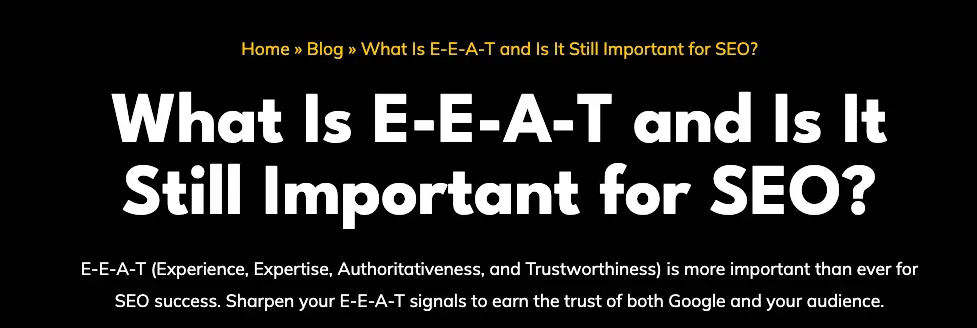
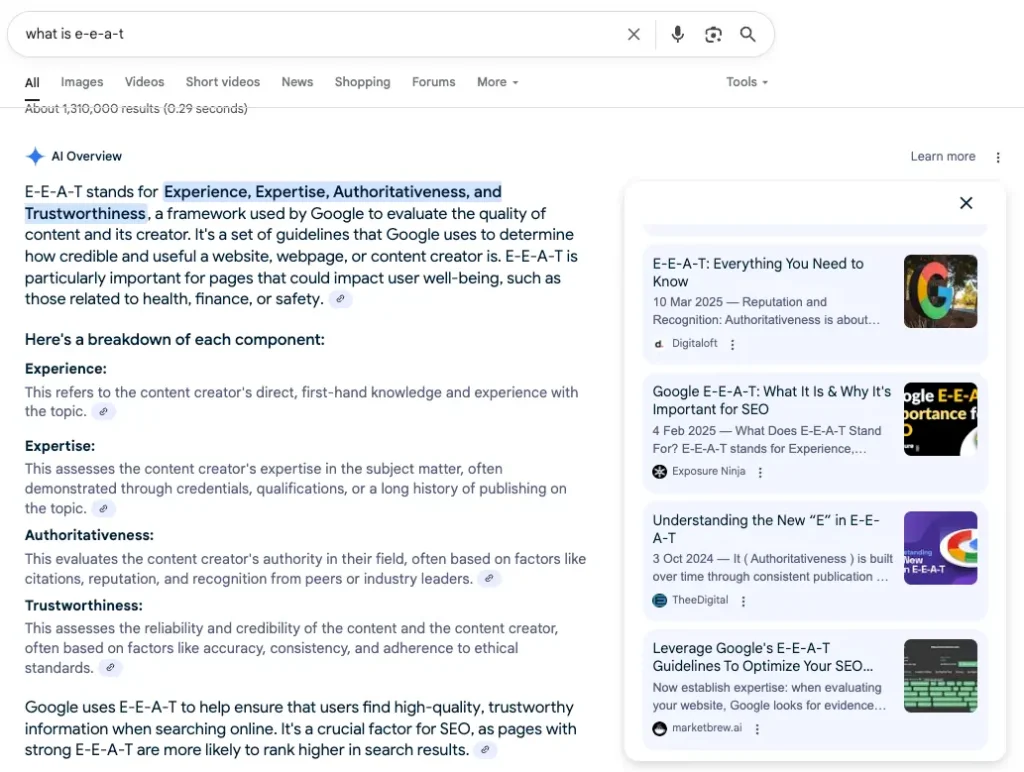
For example, our blog “What is E-E-A-T and Is It Still Important for SEO?“ opens with a question-based H1 that mirrors exactly what users are likely to search. It’s immediately followed by a clear definition of E-E-A-T and a direct answer to the question (spoiler: yes, it’s still crucial!). Right after that, readers get a concise overview of what the post will cover, setting clear expectations for human visitors and AI crawlers.
This is one of the contributing factors behind its ranking in AI Overviews:
Tips:
- Write a clear, specific answer to the user’s search intent within the first 2 – 3 sentences.
- Have a bolded or italicised TL;DR or quick summary line to improve scannability.
5. Use a Table of Contents for Easy Navigation
A well-structured Table of Contents helps readers navigate your blog. By providing anchor links to each major section (typically H2s and H3s), you allow users to jump straight to the content that matters most to them, improving usability and engagement.
For AI platforms, a TOC offers a clear outline of your blog’s structure, making it easier to extract specific answers for summaries.

6. Core Content Sections That Engage and Convert
The main body of content is where your blog delivers its real value by answering user queries, building authority, and driving action. It’s also the section most likely to be cited in AI-generated summaries, so structure and clarity are non-negotiable.
Clear Subheadings
Strong subheadings are essential for both AI comprehension and human readability. They break your content into logical sections, help users navigate quickly, and guide search engines and AI models through your content hierarchy.
Use subheadings that include long-tail keywords and user-focused questions to maximise AI visibility. For example, our post about “SEO ROI” includes various subheadings, such as:
- How to measure SEO ROI.
- Challenges with measuring the ROI of SEO.
- How long does it take to see SEO ROI?
This structure mirrors how AI tools break down and interpret topics (the query fan-out technique) — and it’s exactly what they look for when selecting content to cite.
An example of this is our SEO Trends which is currently featured in Google’s AI Mode. When users search for the biggest trends in SEO, our blog appears in the AI-generated answer panel.
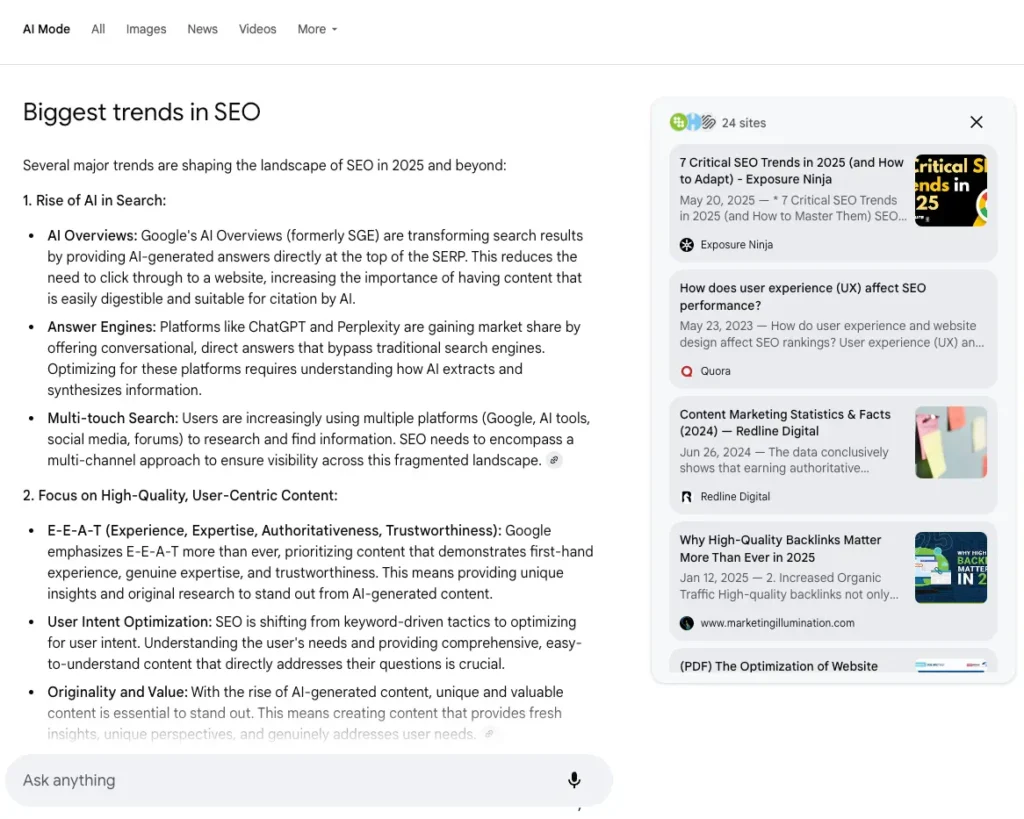
AI Mode doesn’t just link to the article in general. It references a specific section from the post, clearly highlighting the structured subheading and content beneath it.
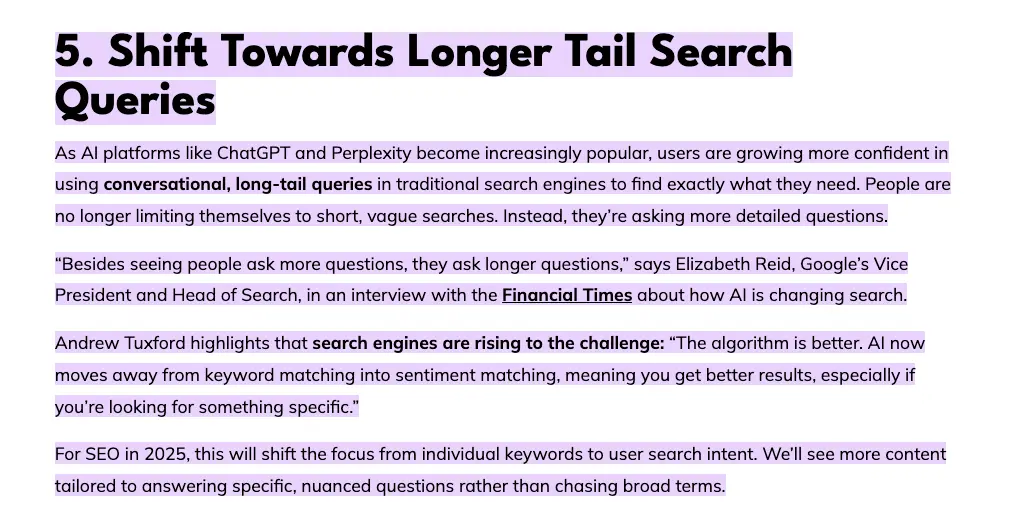
This is exactly how AI search works today: it looks for well-defined sections, aligned with natural queries, and cites the portion that best answers the user’s question. Having these well-optimised subheadings don’t just improve readability — they increase your visibility, authority, and likelihood of being surfaced in AI-driven search.
Short Paragraphs and Strong Points
Clear, concise writing is exactly what AI platforms and your users are looking for. Keep your paragraphs short and focused, ideally between two and four sentences. Lead with the main point, then follow up with supporting context, a relevant example, or a quick statistic.
This structure helps readers absorb information quickly and signals to AI that your content is well-organised and answer-ready.
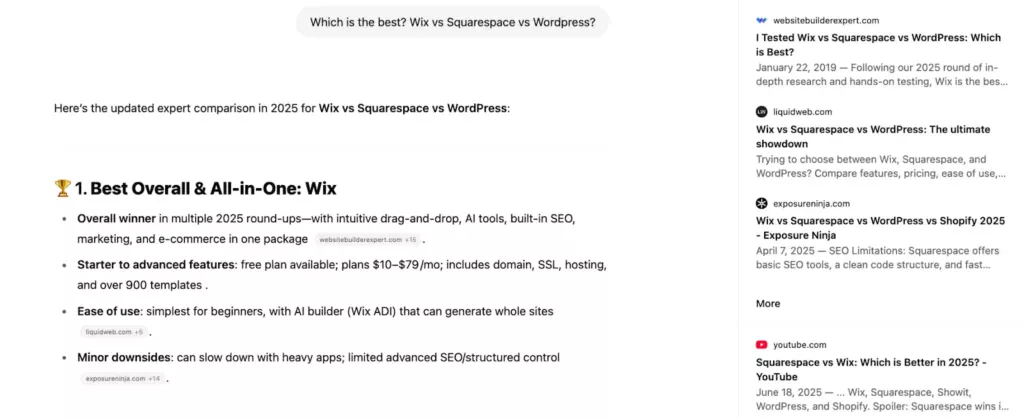
We use this approach consistently across our content — and it works. For example, our blog comparing Wix, Squarespace, WordPress, and Shopify was cited by ChatGPT as a source multiple times in its AI-generated answer. That post was intentionally structured with tight paragraphs, bullet points, and a visual comparison table to make it easy for readers and AI to scan and extract value.
Tips:
- Use short paragraphs (2–4 sentences).
- Start with a clear answer or key point.
- Follow with context, examples, or expert tips.
Add Multimedia Elements
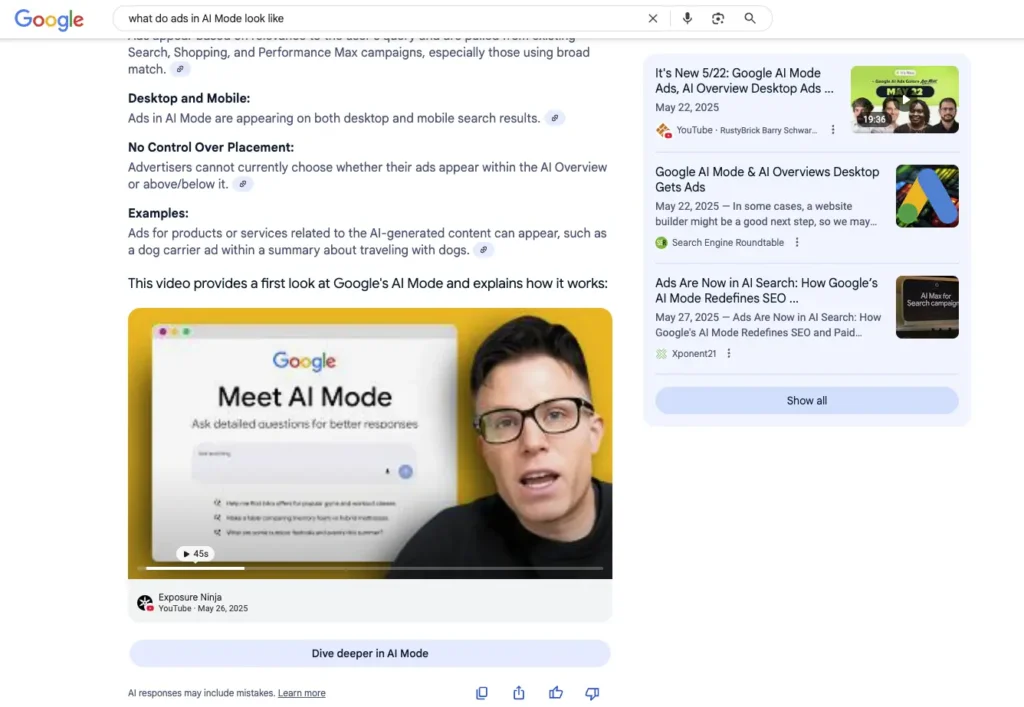
Search engines and AI platforms use images, videos, and embedded media as signals of content quality and relevance. Visuals with clear ALT text, captions, and proper context help AI understand your page and improve its chances of being cited or featured.
YouTube videos, in particular, are increasingly being pulled into AI Overviews and AI Mode results. Embedding relevant, high-quality videos can increase your visibility across Google’s AI search experiences.
Tips:
- Embed relevant images with descriptive ALT text.
- Add short explainer videos or GIFs to demonstrate key points.
- Use YouTube embeds, as Google often surfaces these in AI-generated answers.
- Embed Google Maps for location-specific content.
- Use captions to improve accessibility and reinforce your message.
Highlight Key Data or Quotes with Callout Boxes
Vital stats, expert insights, and standout takeaways shouldn’t get lost in the body of your text — they should command attention. Using callout boxes, HTML tables, or other styled elements makes key information easier for readers to absorb and significantly easier for AI to extract and cite.
Visual emphasis helps with scannability for human readers. Bold quotes, summarised stats, and boxed callouts draw the eye, reinforce critical points, and make your content more accessible — especially for skim readers.
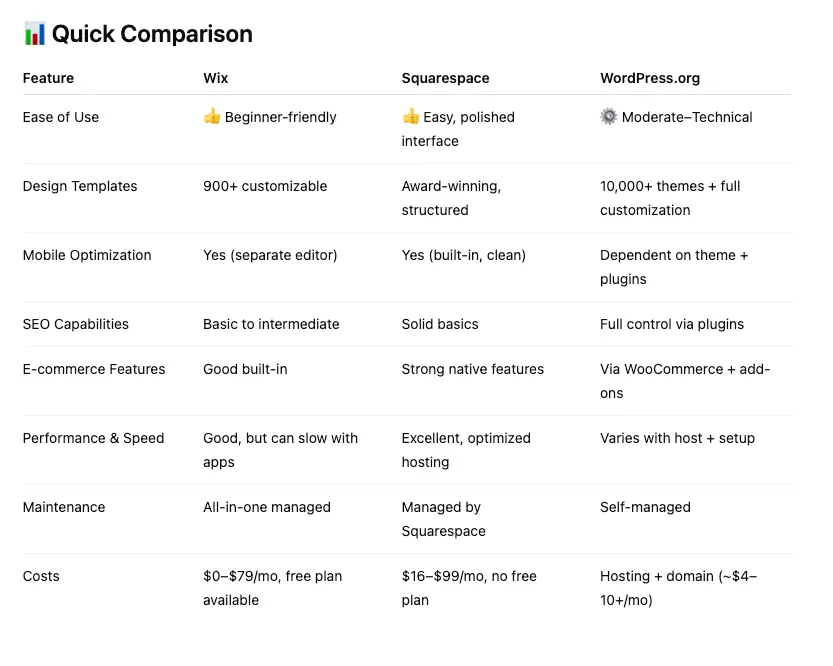
For AI, structured elements like tables are particularly powerful. They help search engines and AI tools quickly parse comparisons, timelines, and summarised data. These formats are more likely to be featured in AI-generated answers or cited in tools like ChatGPT and AI Overviews.
When ChatGPT cited our Wix, Squarespace, WordPress, and Shopify blog, the answer included a comparison table — almost identical to the one we used in the post. The structure made it easy for the AI to extract and present the information clearly, increasing our visibility and authority in that space.
7. Drive Action with Internal Links and CTAs
A high-performing blog post doesn’t just deliver information — it moves the reader closer to action. Whether that action is reading a related article, booking a consultation, or exploring your services, well-placed internal links and compelling CTAs are key to turning interest into intent.
Internal linking helps guide users deeper into your site, improves engagement, and strengthens your site’s SEO. But your anchor text is just as important as the link itself. Use clear, descriptive phrases that reflect the destination page’s value and offer context to users and AI crawlers.
CTAs should be benefit-driven and aligned with the reader’s intent at that stage of the journey. Mid-article CTAs can prompt action while attention is high, while end-of-article CTAs serve as a natural next step after delivering value.
One standout example is our client, Golf Course Lawn Store, whose blog about mowing wet grass ranks in both AI Overviews and at the top of traditional search results. Once users land on the page, they’re guided by internal links to related topics (like managing winter lawn disease) and prompted with CTAs to “add to cart” the exact products that solve the problem. It’s a perfect example of turning AI visibility into real, measurable revenue.

8. Boost Engagement with Interactive Tools or Widgets
While not essential for every blog, interactive elements can significantly enhance user engagement — and increase your chances of being cited in AI-powered search results. These features offer immediate, practical value to users while signalling content depth and usefulness to AI systems. These can include:
- Calculators
- Custom forms
- Product configurators or try-on tools
- Live chat widgets or embedded AI assistants.
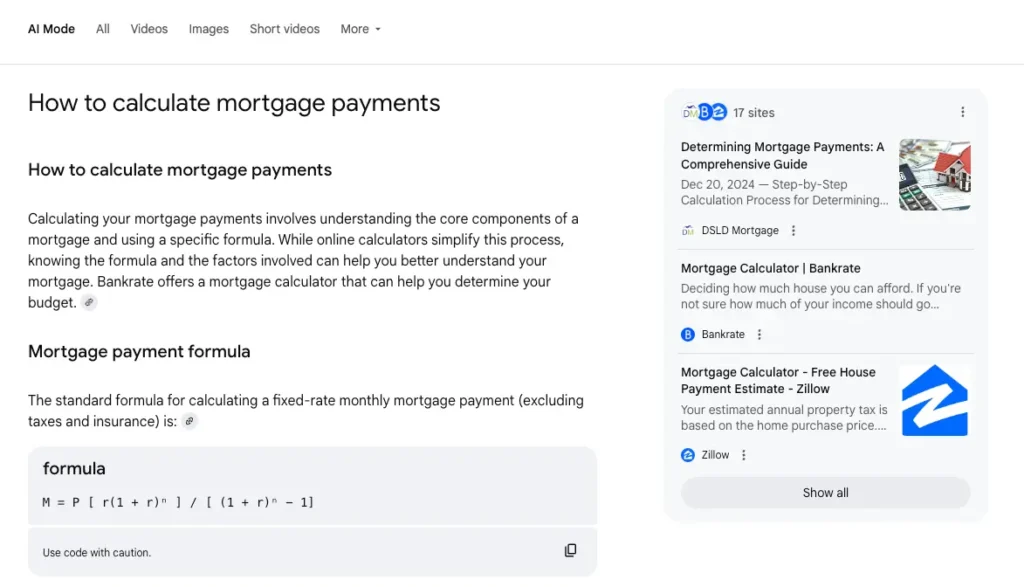
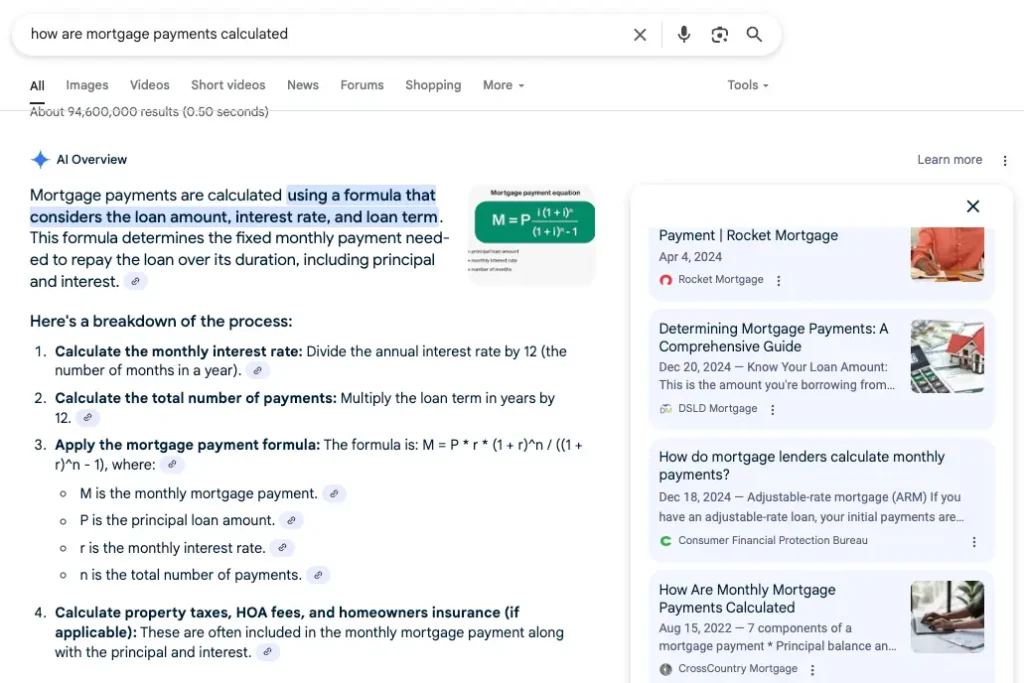
In their mortgage payments guide, our client DSLD Mortgage includes a mortgage affordability calculator. It’s a simple yet powerful tool that adds real value for readers — and it’s a key reason the guide is now being referenced across multiple related queries in AI Mode and AI Overviews.
9. Write Conversational FAQs for Search and Users
FAQs are a core component of AI-optimised content. As users increasingly search in a more conversational tone, your FAQ section should mirror that natural language to improve relevance and reach.
AI models like ChatGPT and AI Overviews are trained to surface clear, concise answers to real-world questions. By writing FAQs using full, natural-sounding sentences, you improve your chances of being selected as a featured result.
This format also benefits human readers. FAQs provide immediate clarity, reinforce your authority, and make your content more accessible for those scanning for quick answers.
Tips:
- Include 3-5 common questions.
- Use natural, complete sentences in both the question and answer.
- Add FAQPage schema markup.
10. Final Summary
A well-crafted final summary at the end of your blog gives readers a quick recap of the key takeaways, reinforces the value of your content, and offers a natural transition into your final CTA.
This section is especially useful for readers who skim or scroll quickly. It also improves your chances of being featured in AI-generated answers, which tend to feature clear, concise summaries pulled from the page.
Keep it simple, benefit-led, and focused on the value you’ve delivered — then invite the reader to take the next step, like how DSLD Mortgage does it in their mortgage payment guide:

Don’t Forget Technical SEO
Technical SEO ensures your blog is properly structured, fast, and accessible — all critical factors for both traditional search engines and AI systems parsing your content.
Start with semantic HTML tags. Use elements like <article>, <section>, <header>, and <figure> to clearly define your content’s structure. These tags help search engines and AI models understand the layout and relationships between different parts of your blog — improving how your content is indexed and cited.
Incorporate schema markup to provide additional context about your content. Adding structured data using JSON-LD helps AI tools extract and display relevant information, such as FAQs, author details, publish dates, and more. Implement schema types like:
- Article or Blog Posting for standard blogs.
- FAQ Page for frequently asked questions.
- How To if your post includes step-by-step instructions.
- Person or Organisation for author or brand credibility.
Beyond structure, ensure your blog loads quickly and performs well on all devices:
- Lazy-load images and embedded videos to reduce initial load times.
- Optimise for mobile-first performance, as most searches and AI outputs are served on mobile devices.
- Ensure your site uses HTTPS, clean URLs, and is included in an up-to-date sitemap.xml and robots.txt file.
Together, these technical elements make your blog faster, cleaner, and easier for AI and search engines to understand, which translates directly into better visibility and performance.
Content That Ranks in AI Search
Ranking in AI Search isn’t just about keyword use. Blogs that perform well in AI Overviews, AI Mode, and tools like ChatGPT are clearly formatted, expertly written, and built for both human clarity and machine interpretation.
If you’re ready to turn your blog content into a lead-generating, AI-optimised asset, we can help. At Exposure Ninja, we create and optimise content that’s built to rank in traditional search and AI-powered results. Request a callback, and we’ll show you how to make your content visible, valuable, and AI-ready.
FAQs
How does blog post structure impact AI-friendliness?
A clear, consistent structure makes it easier for AI to parse your content. It allows AI systems to identify sections that answer specific queries, which increases your chances of appearing in the AI-generated answers.
What role does schema markup play in AI understanding?
Schema markup provides context about your content to traditional search and AI engines. By tagging FAQs, how-tos, or articles properly, you help AI better categorise and surface your content in relevant queries.
How can I make my headings AI-friendly?
To make your headings AI-friendly, use natural, question-based phrasing that aligns with how users search and helps AI models easily identify relevant sections. Apply the query fan-out technique by breaking your main topic into subtopics or related questions. Use H2s for main sections and H3s for supporting points to create a clear, scannable hierarchy for both users and AI systems.
Is AI-friendly and human-friendly blog content the same?
Yes, but with important differences. AI-friendly blog content prioritises structure, schema markup, and clear formatting that helps machines parse and cite information. Human-friendly content relies on tone, storytelling, and clarity to connect with readers. The highest-performing blogs are optimised for AI discovery and designed to engage and convert real people.