Why Your PPC Isn’t Converting (and How To Fix It)


Find out the seven most common reasons why your PPC isn’t converting, and what you can do to improve results.
Pay-per-Click (PPC) campaigns are one of the fastest ways to drive targeted traffic to your website.
But if those clicks aren’t turning into leads or sales, you’re just burning budget.
We’ll run through the seven most common reasons why your PPC isn’t converting, and how to fix them. To show these strategies in action, we’ll reference our award-winning PPC work with Age Care Bathrooms, where we helped deliver over 6,000 leads and scale ad spend profitably.
Whether you’re running Google Ads or Microsoft Ads, these insights will help you get more clicks and turn those clicks into customers.
7 Common Reasons Your PPC Campaign Isn’t Converting
Your Landing Page Is Letting You Down
When we analyse low-converting PPC campaigns, two landing page issues show up again and again.
The first is simple: you’re sending traffic to the wrong landing page.
Let’s say you’re looking for a mobility bathroom specialist, like Age Care Bathrooms, that can install a walk-in shower. If you were to click on the Search ad below and find yourself on a generic landing page unrelated to walk-in showers, you would immediately leave and proceed to the next option.
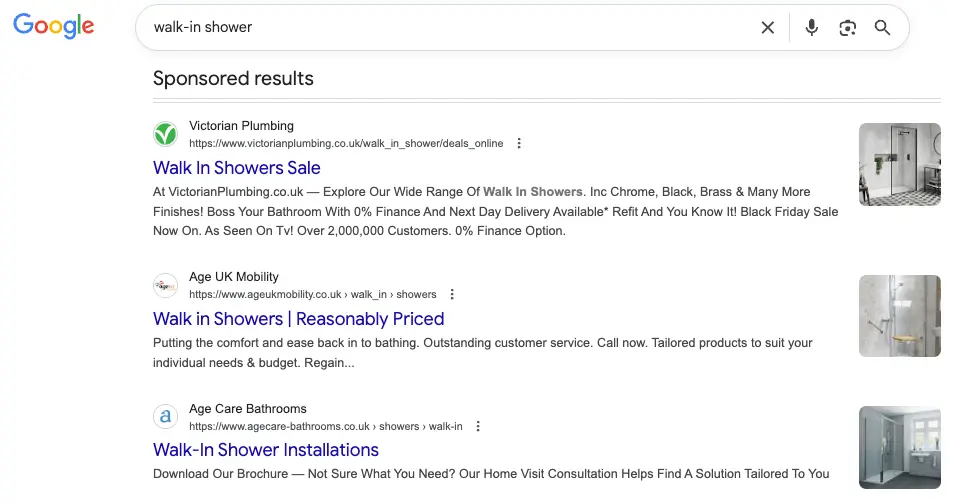
To avoid wasting high-intent clicks, your landing page must match the promise of your ad.
- If you’re advertising a product, link directly to the exact product page.
- If you’re promoting a service, link to a dedicated service page that clearly outlines what’s included, the benefits, and how to get started.
- If your ad features a limited-time offer, send users to a page where the offer is immediately visible and easy to claim.
To make sure we drove leads for Age Care Bathrooms, we developed bespoke landing pages tailored to each campaign. This ensured we could maximise relevance and conversions, and it worked.
The second issue we see is this: the landing page simply isn’t good enough.
Strong ads can drive traffic, but the landing page is what turns that traffic into leads or customers. Most low-converting pages fail because they overlook the fundamentals of what makes a page perform effectively.
Let’s look at an example of an underoptimised landing page for a Search ad targeting “walk-in showers.”
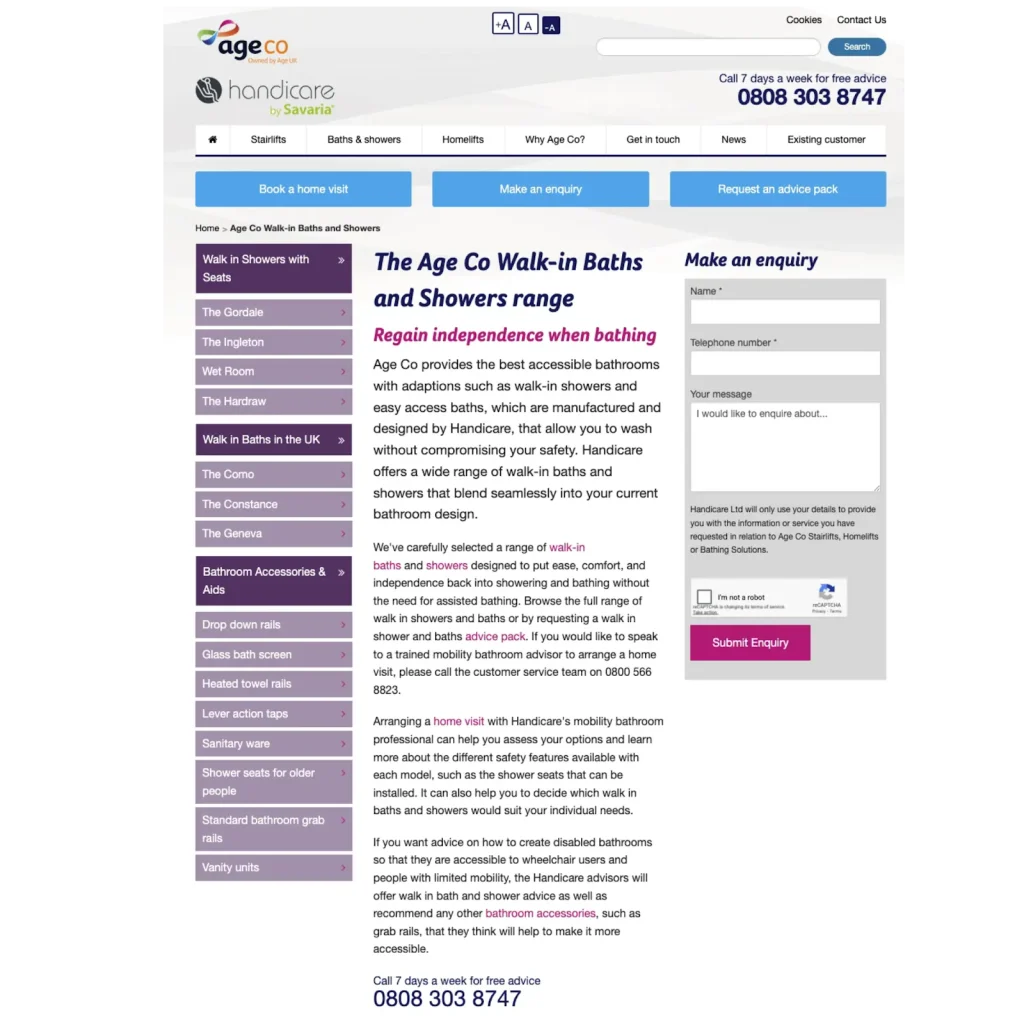
This landing page design immediately feels outdated and cluttered. There are mentions of walk-in showers, walk-in baths, and bathroom accessories, which can make it confusing for users who are looking for just walk-in showers. There are also four calls to action (CTAs), leaving the user unsure whether to book a home visit, make an enquiry, call, or request an advice pack. This page doesn’t drive trust or confidence, thanks to the missing images, testimonials, or reviews.
To avoid these mistakes, use this checklist to create a high-converting landing page:
- Set one clear objective. Focus the page on a single outcome to reduce distractions.
- Deliver on the ad’s promise. The content must reflect exactly what the user clicked for.
- Lead with a strong, benefit-focused headline. Explain what the visitor gains from engaging.
- Use a single, clear primary CTA. The button should stand out and clearly state what happens next.
- Include a secondary CTA. If your offer requires high commitment, support hesitant visitors with an alternative next step.
- Keep the design clean and simple. Avoid clutter and make the page easy to scan and navigate.
- Build trust with social proof. Include reviews, testimonials, certifications, or well-known clients.
- Write clearly. Use plain language to communicate value without jargon.
- Address potential objections. Add information that reassures users and removes uncertainty.
- Offer a genuine incentive. Free trials, limited-time offers, or added bonuses help drive action.
- Include visuals. Use high-quality photos of your product or service in action to help users understand your offer and build credibility.
- Test every key element. Use A/B testing on headlines, CTAs, and layouts to improve performance over time.
Your Website Isn’t Mobile-Friendly
Another reason why your PPC isn’t converting might be due to mobile-friendliness.
As of Q2 2025, mobile devices account for more than 60% of all web traffic. That means the majority of your PPC clicks are likely coming from mobile users. If your site isn’t built for small screens, you’re probably losing conversions.
But “mobile-friendly” means more than having a responsive layout.
It means:
- Text is easy to read without zooming.
- Buttons are large enough to tap without frustration.
- Pages load quickly and reliably.
- Forms are short, simple, and thumb-friendly.
Here are some quick checks and fixes:
- Test your site on real mobile devices, not just by shrinking your browser window.
- Use Google’s Mobile-Friendly Test to spot usability issues.
- Check load speed with Google PageSpeed Insights.
- Simplify mobile forms with fewer fields and larger input areas.
- Make key actions easy to tap, like phone numbers or CTAs.
Budget or Bidding is Too Low
Too many campaigns underperform not because the ads are bad, but because the budget or bidding strategy isn’t strong enough to compete. This is one of the most common issues we see, particularly when campaigns are launched without a well-thought-out PPC strategy.
Without a clear paid search strategy, budgets are often set randomly. Marketers guess how much to bid on keywords or how much to spend daily without first understanding keyword competitiveness, industry benchmarks, or realistic cost-per-click (CPC) ranges.
This leads to two key problems:
- Underbidding on competitive terms. Your ads won’t show often enough (or at all) if you’re bidding below market rates.
- Wasted spend on low-intent or irrelevant keywords. Without proper research, you might be funding traffic that doesn’t convert.
On social platforms, success depends heavily on the algorithm. A weak budget doesn’t give the platform enough data to learn, optimise, and improve performance. Without a structured paid social strategy, you risk spreading your budget too thin across too many audiences, creatives, or objectives.
This causes:
- “Learning Limited” warnings on Meta Ads, which means your ad set isn’t generating enough results to exit the learning phase.
- Stalled performance where your ads don’t get seen by the right people, or don’t collect enough conversions to optimise delivery.
To avoid underfunding your campaigns and set a PPC budget that works as hard as possible:
- Research before setting bids. Use tools like Google Keyword Planner or platform benchmarks to understand average CPCs in your niche.
- Set daily budgets based on realistic outcomes. Work backwards from your target. For example, if you aim for 30 leads per month and your average cost per lead is £25, you’ll need a monthly budget of £750 (or approximately £25 per day).
- Start with enough data volume. Ensure your budget can generate enough clicks or conversions to train the platform’s algorithm.
- Don’t underfund new campaigns. Test with enough spend to collect meaningful performance data.
Audience Targeting Issues
A prevalent problem with paid social campaigns is audience targeting that is too broad or too narrow.
- Too broad targeting: Broad targeting removes most restrictions, leaving the algorithm to determine who is most likely to convert. This can work well only if you have a large enough budget, strong creative, and a clear offer that appeals to the right people.
- Too narrow targeting: This happens when your targeting is overly specific. For example, combining multiple interest filters, tight age ranges, limited locations, or niche job titles.
Getting audience targeting right on paid social is a balancing act. You need enough volume for the platform to optimise, but enough relevance to attract the right people. Here are some tips to get the balance right:
- Start broad, but stay relevant. Use interest, behavioural, or demographic signals to steer the algorithm toward your ideal audience without over-restricting reach.
- Leverage first-party data. Build high-performing segments using custom audiences from website visitors, customer lists, or engagement data.
- Consolidate where possible. Avoid spreading the budget thin across multiple small ad sets. Fewer, well-funded ad sets give algorithms more room to learn and optimise.
- Review audience size estimates. Most platforms provide guidance on whether your audience is too small to deliver or exit the learning phase. Use this to shape your targeting approach.
Poor Account Structure
One of the most common reasons PPC campaigns underperform, especially on Google Ads, is a poorly structured account. When your campaigns aren’t organised around clear themes or customer intent, even great keywords and ad copy can struggle to deliver results.
This was a key challenge when we started working with Age Care Bathrooms. Their previous campaign structure was broad and generic, with keywords, ads, and landing pages grouped inconsistently. We rebuilt the entire Google Ads account from the ground up, applying a tightly segmented, high-intent structure designed for performance.
This structure helped Age Care scale its PPC performance significantly, ultimately driving over 6,000 leads. It also set the stage for a campaign that won us the Best UK PPC Campaign at the Global Search Awards 2025.
Here’s how you can build a better PPC account structure that converts:
- Group campaigns by core product, service, or funnel stage.
- Use ad groups to target specific themes within those campaigns.
- Match keywords, ads, and landing pages closely.
- Avoid keyword overload.
- Use the data to guide structure.
Your Ad Copy is Bland
Low click-through rates (CTRs) are often a sign that your ad copy isn’t resonating with your audience.
Here are the most common ad copy mistakes:
- Using vague, generic language that fails to communicate real value.
- Excluding relevant keywords, which reduces ad relevance and lowers Quality Score.
- Trying to appeal to everyone, instead of focusing on the right-fit users.
- Omitting clear calls to action or failing to guide the next step.
In our campaign for Age Care Bathrooms, we rewrote their ad copy to focus on high-conversion ad copy elements, including:
- Highlighting unique selling points (USPs) such as “trust family-run company.”
- Including specific product-related phrases like walk-in showers and mobility bathrooms to match search queries.
- Leading with outcomes that mattered to users, such as “enjoy bathing again.”
- Using straightforward CTAs like “download a free brochure.”
Beyond manual ad copy improvements, we also piloted Google’s new AI-generated Search campaign feature. This builds full campaigns, including keywords and ad copy, based on a landing page. We selected one of Age Care Bathrooms’ top-performing landing pages and let the AI generate a campaign from scratch.
This resulted in 610 additional conversions from a previously untapped keyword group. This AI-generated campaign uncovered new high-intent search terms and allowed us to scale without sacrificing relevance or lead quality.
This feature isn’t a guaranteed win for every brand, but when paired with a strong, conversion-optimised landing page, it’s worth testing.
To strengthen your own ad copy, follow these proven principles:
- Include target keywords in both headlines and descriptions to improve visibility and alignment.
- Focus on user benefits by including what they gain by clicking your ad.
- Use qualifiers to filter out poor-fit traffic.
- Give a single, clear CTA that sets the expectation for what happens next.
- Match the tone and intent of your audience by speaking directly to their needs and stage in the journey.
Your Ad Creative Doesn’t Stand Out
If your paid social, display, or YouTube PPC isn’t converting, the issue is often your ad creative.
Most users scroll past ads within seconds. That means your creative has to do three things, fast: capture attention, build trust, and drive clicks.
Poor performance often stems from a lack of creative quality. The visuals might look outdated, overly generic, or mismatched with the platform. If you’re trying to sell a high-ticket product using low-resolution images or vague messaging, your conversion rate will reflect that.
Use these tips to create high-performing, scroll-stopping ad creatives:
- Use people and real-life visuals. Lifestyle imagery, customer testimonials, and in-situ product use tend to outperform plain pack shots or abstract graphics.
- Match the creative to the platform. This makes your ad feel more native to the environment, which can improve engagement and reduce ad fatigue.
- Use motion when possible. Video, animation, or subtle movement (like animated text or transitions) naturally draws attention in a crowded feed.
- Focus on outcomes. Instead of just showing what the product is, show what it does for the user.
- Test multiple versions. Run different formats (video, static, carousel) and test messaging angles (emotional, practical, urgency-led). Use data to find what resonates with your audience and optimise from there.
Don’t Forget External Factors
The reason why your PPC isn’t converting might not have anything to do with your PPC campaign.
Sometimes, the reason your campaigns aren’t converting has to do with timing, seasonality, or external market conditions.
This is a common pattern in many industries:
- Seasonality: Products like air conditioners, lawn care, snow gear, or back-to-school supplies all have narrow windows of peak demand.
- Holidays or national events: Campaign performance can shift drastically around key holidays, school breaks, or national sporting events.
- Economic factors: Rising costs, market uncertainty, or changes in disposable income can affect buying behaviour.
- Weather: For local services or seasonal goods, weather fluctuations can directly impact sales volume and the quality of leads.
Take our client Golf Course Lawn Store, for example. They sell lawn care products in the U.S., where seasonal trends heavily influence demand. As a result, their PPC campaigns may perform exceptionally well in the spring and early summer, when homeowners are actively treating and maintaining their lawns. But in the winter months, even the best-optimised campaigns can see a natural dip in conversion rates because fewer people are in the market.
If your campaigns seem to underperform at certain times of year, here’s what to do:
- Analyse year-on-year data. Compare the same months from previous years to identify consistent seasonal trends.
- Adjust forecasts and budgets accordingly. Don’t expect peak-season performance year-round. Use quieter months to test, build audiences, or prepare assets.
- Consider changing campaign goals. Shift from sales to lead generation, education, or awareness when conversions are likely to be low.
Is It the Ad, or the Offer?
Sometimes, your PPC campaign is doing everything right. The ad is engaging, the targeting is solid, and the landing page is well-optimised. But conversions still don’t come. Often, that means the problem isn’t with the campaign, but with the offer.
Customer expectations in 2025 are higher than ever. Whether you’re B2B or B2C, selling products or services, your offer must be compelling, competitive, and clearly communicated. If it doesn’t meet what buyers expect for the price, performance will suffer.
You also can’t rely on price alone to win. In most industries, there are dozens of competitors offering similar products or services. If you’re priced higher and can’t explain why, customers will scroll past you without a second thought.
If you can’t win on price, win on value. Emphasise what sets you apart, like:
- Faster, more flexible delivery.
- Exceptional customer service and support.
- Clear, no-risk guarantees or warranties.
- Industry experience or specialist expertise.
- Brand values, such as sustainability or being locally sourced.
What High-Converting PPC Campaigns Get Right
We’ve covered the most common reasons why PPC isn’t converting.
Let’s put it all together to show what a high-converting PPC campaign includes:
- Starts with a clear strategy that includes defined goals, realistic budgets, and a channel-specific approach.
- Budgets and bidding strategies are planned based on audience size, CPC benchmarks, and real performance data to maximise efficiency.
- Audience targeting begins with broad yet relevant segments and is refined over time using first-party data, lookalikes, and exclusions.
- Campaign and ad group structures are built around specific product or service themes, never lumped together into catch-all campaigns.
- Ad copy is written to match user intent, incorporates relevant keywords, and communicates clear benefits and next steps.
- Creative assets are visually engaging, optimised for mobile, and tailored to the format and tone of each advertising platform.
- Landing pages tightly align with ad messaging, reinforcing trust and guiding users toward conversion with a clear user journey.
- Campaign performance is assessed in the context of external factors, such as seasonality, industry trends, or market conditions.
- The offer being promoted is relevant, compelling, and aligned with what customers expect and need at the time of clicking.
If you’re still not sure what’s holding your campaigns back, request a marketing review from our team. We’ll audit your PPC accounts and show you exactly where your campaigns are losing conversions and how to fix them.
This blog is an updated version of a live webinar. You can watch the full session here:
FAQs
Why am I getting clicks but no conversions?
Clicks without conversions usually indicate a disconnect between your ad and your landing page or offer. Your ad is attracting the right attention, but something is breaking down when visitors arrive. Check your landing page experience, ensure your offer matches what the ad promises, and verify your site loads quickly on mobile devices.
Should I pause my PPC if it’s not converting?
Don’t pause immediately unless you’re getting zero qualified traffic. First, diagnose the issue using the checklist above. If you’ve optimised your landing page, adjusted targeting, and improved ad copy but still see no results with adequate budget, then consider pausing while you reassess your strategy.
How do I know if the ad or the landing page is the problem?
Look at your click-through rate (CTR) and conversion rate separately. A low CTR suggests your ad isn’t compelling enough. A decent CTR but low conversion rate points to landing page issues.