Google’s Helpful Content Update: The Complete History and What It Means Now

Google's helpful content update was an algorithm change launched in August 2022 to demote content written mainly for search engines rather than people. It worked as a sitewide signal until 5 March 2024, when Google folded it into its core ranking systems. There's no longer a separate helpful content update. Helpfulness is now assessed by Google's core ranking systems, which Google refines through regular core updates.
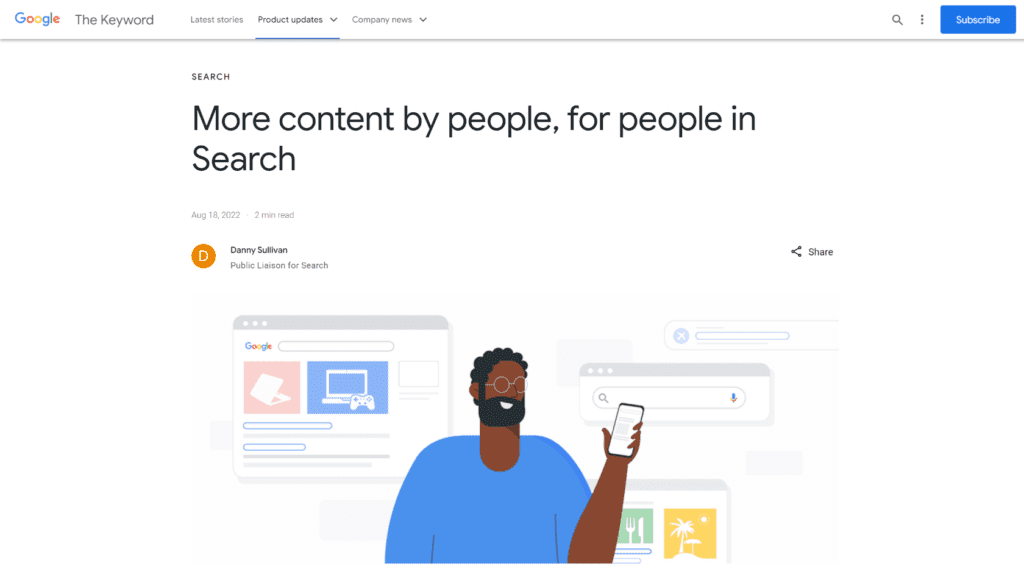
Google announced the helpful content update on 18 August 2022, and it started rolling out on 25 August. For the next 18 months, it was one of the most talked-about changes in SEO. Then, in March 2024, it stopped existing as a separate system.
This guide covers what the update was, what happened to it, how to tell whether it affected your site, and how to recover. Our original 2022 to 2023 analysis is still here further down, because Google’s guidance on helpful content has changed very little, but it’s now written as history.
Sidenote: The irony of writing helpful content about the Helpful Content Update hasn’t escaped me.
Does the Helpful Content Update Still Exist?
No. On 5 March 2024, Google announced its March 2024 core update and new spam policies. As part of that update, the helpful content system stopped being a separate classifier and became part of Google’s core ranking systems. Google’s guide to its ranking systems now lists the helpful content system under “retired systems”. The spam update completed on 20 March 2024, and the core update rollout finished on 19 April 2024.
This matters for two reasons. First, the underlying principles this guide describes below ( people-first content, first-hand expertise and avoiding content written mainly for search engines ) didn’t disappear. Google has said they’re now assessed by multiple systems within its core ranking algorithm rather than one dedicated classifier. Second, Google says the changes worked. It reported seeing 45% less low-quality, unoriginal content in search results following the March 2024 changes, ahead of its own initial 40% target.
In practical terms: everything in this guide about what counts as helpful, people-first content is still accurate and worth following. What’s changed is that there’s no longer a single “Helpful Content Update” classification to recover from . It’s simply part of how Google’s core ranking systems evaluate every page, all the time.
Helpful Content Update Timeline
| Date | Update | What changed |
| 18 August 2022 | Announcement | Google announced the “helpful content update” to tackle content created mainly to rank well rather than to help people |
| 25 August to 9 September 2022 | August 2022 helpful content update | Introduced a new sitewide signal, applied by an automated classifier |
| 5 December 2022 to 12 January 2023 | December 2022 helpful content update | Improved the classifier and extended it to content globally, in all languages |
| December 2022 | Quality rater guidelines update | E-A-T became E-E-A-T, adding Experience |
| 14 to 28 September 2023 | September 2023 helpful content update | Further improved the classifier |
| 5 March 2024 | March 2024 core update and spam update | The helpful content system became part of Google’s core ranking systems. New spam policies covered scaled content abuse, site reputation abuse and expired domain abuse |
| 19 April 2024 | Core update rollout complete | Google reported 45% less low-quality, unoriginal content in search results, against the 40% it expected |
Were You Affected? A Quick Checklist
If your traffic dropped and you’re wondering whether the helpful content update was the cause, work through these checks:
- Compare dates. In Google Search Console, look for drops that started during one of the rollout windows above, or during a core update since. Google’s Search Status Dashboard lists every confirmed ranking update.
- Check whether the drop was sitewide. The helpful content signal applied across a whole site, so a drop across most pages fits that pattern better than a drop on a handful.
- Look at what lost the most. Google suggests auditing the pages and searches that dropped most, then assessing them against its self-assessment questions, which we cover below.
- Rule out other causes. Check for technical problems, manual actions in Search Console and tracking changes before you start rewriting content.
What Was the Google Helpful Content Update? (August 2022–March 2024)
The Helpful Content Update is was a Google search algorithm update that aims aimed to improve the quality of the search results and reduce the volume of “low-quality content”.
Sounds simple.
But what is low-quality content?
According to Google, low-quality content is:
- Unoriginal
- Thin and lacking depth
- Written to rank, rather than to help people
They want Google wanted to reduce the number of times that a searcher finds a page in the search results, decides it’s unhelpful and returns to the search results again to find a better one.
In particular, they want it wanted to limit the ranking potential of websites that have a lot of unhelpful content, especially if the content on that website is deemed to be unrelated to the website’s core topicality.
In fact, the Helpful Content Update is going to be was applied sitewide, according to a conversation algorithm expert Glenn Gabe had with Google’s Search Liaison:
During our call, Google’s [Search Liaison] Danny Sullivan explained to me that the new ranking signal is a classifier.
If your site is deemed to have a lot of what Google considers “unhelpful content”, then the site will be classified that way (and that can negatively impact your rankings at a site-level).
If you had 100 blog posts on your website and 10 of them were extremely “unhelpful”, the other 90 pages could have found it harder to rank.
Google explained more in its announcement and supporting documentation, which we dig into below.
Why Google Created the Helpful Content Update
Google released the Helpful Content Update to increase customer satisfaction.
You want your customers to be satisfied so that they come back and use your services or eCommerce store again.
Google wants people to keep coming back to its search results again and again too.
To do so, the first result people click on has to be:
- The perfect answer to their query
- Detailed enough (without going overboard)
- Trustworthy
- Useful
How the Helpful Content Update Compared to Panda
Google has a long history of releasing algorithm updates aimed directly at devaluing low-quality content.
Panda, an algorithm update released in 2011, was an attack on “content farms”.
Content farms were websites which posted 100s or 1000s of pages (using mostly scraped or thin content) to rank for as many keyword queries as possible , with the aim of getting people onto the site and showing them ads and affiliate links.
Panda was a heavy-hitting algorithm update that affected 11.8% of search queries (at the time) and it significantly changed the way the SEO industry worked.
Websites had the option to either:
- Re-write all of their low-value content (or just remove it)
- Give up on the website entirely and start a new one.
Panda became part of Google’s core ranking systems in 2015, and Google now lists it as a retired system.
It used to be updated pretty regularly before then becoming part of the core algorithm and, presumably, updated during Broad Core Updates.
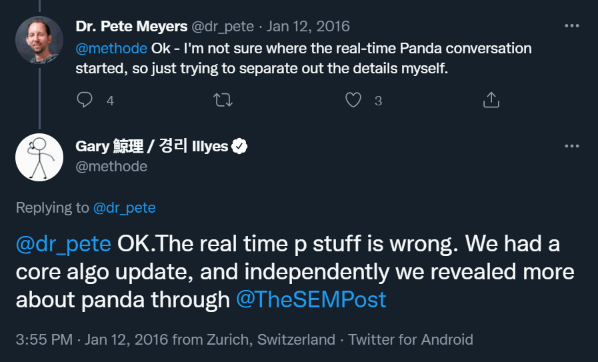
It is not a real-time algorithm running independently of the core (as was made clear by Gary Illyes, a Webmaster Trends Analyst at Google).
Panda cleaned up the search results. Websites adapted and the search results are better as a consequence. Unfortunately for Google, content farm owners found new ways to circumvent the system and low-quality content still made it through to the search results.
The Helpful Content Update could be viewed as an expansion of Panda.
The announcement post was pretty simple.
We continually update Search to make sure we’re helping you find high-quality content.
Next week, we’ll launch the “helpful content update” to tackle content that seems to have been primarily created for ranking well in search engines rather than to help or inform people
Great.
This ranking update will help make sure that unoriginal, low-quality content doesn’t rank highly in Search
It even included a clear example of how the update should improve the quality of the results when a user searches for a new film:
For example, if you search for information about a new movie, you might have previously seen articles that aggregated reviews from other sites without adding perspectives beyond what’s available elsewhere.
This isn’t very helpful if you’re expecting to read something new.
With this update, you’ll see more results with unique, authentic information, so you’re more likely to read something you haven’t seen before.

How It Built on the Product Reviews Update
At the end of the post, writer Danny Sullivan explained that the Helpful Content Update was tied to another update from the previous twelve months, called the “Product Review Update“.
Like the Helpful Content Update, the Product Review Update focused on promoting originality and devaluing unoriginal, aggregated, and lightweight review pages.
Affiliate marketers make money by convincing people to click their links and visit the products they reviewed. But buying every review item is expensive, so some default to “borrowing” reviews from elsewhere.
It’s far simpler to fill up your Top Ten list if 50% of the copy in your review is “borrowed” from other review sites. Even if they’ve credited the original writer authentically, the reader still gets a low-quality reading experience.
“Hey, I just read the exact same viewpoint on three other websites. How am I supposed to really know what [the product] is like?”
To stop this happening, and promote greater review authenticity, Google released the Product Review Update and review websites got toasted, with some losing more than 50% of their total search traffic.
The Helpful Content Update was designed to do the same for other topics.
What Google’s Guidance Actually Says
Linked from the update was a post on Google’s Search Central blog.
That post is where things became clearer.
It focused on two areas:
Each section had a bullet point list of things to consider when creating content for your website, with the red flag your-ranking-could-drop-like-a-stone warning that “Answering yes to some or all of the questions is a warning sign that you should reevaluate how you’re creating content across your site“.
Google has since moved these questions into a permanent guide, Creating helpful, reliable, people-first content, and added a few more. One new question asks whether you’re changing the dates on pages to make them seem fresh when the content hasn’t substantially changed.
Let’s break each bullet point down:
Focus on people-first content
This is the first section of two in the linked blog. It covers the kinds of questions you should be asking about your website and the content you publish on it.

Do you have an existing or intended audience for your business or site that would find the content useful if they came directly to you?
Are you writing about sports performance and you’re selling sportswear?
Are you writing about human resources and you’re selling performance management software?
Are you writing about workplace compliance and you’re selling risk management solutions?
Then you should be fine.
If people are in the awareness stage of the buyer funnel (see video below) and they’re looking for informational content about the thing that you sell, then you should be absolutely fine.
You can learn more about creating content for every stage in your buyer funnel in this video:
What Google is trying to avoid is businesses straying “out of their lane”.
Glenn Gabe put it best when he recommended that businesses should “stay in their lane“. Websites shouldn’t start posting content about subjects that aren’t directly related to their business offering and expertise.
If the subject doesn’t directly (or very closely) influence the learning journey a buyer may go through before committing to a product or service, then your website might not need to publish anything about it.
Helping people to learn more about your industry or vertical is a noble thing to do, but only when you can do so from a position of deep knowledge and expertise.
Yes, you can write about indirect subjects, but keep in mind that there are two possible outcomes from doing so:
- Google won’t rank the content
- Google won’t rank the content AND your entire site will have a lower classification because of it
We’ll discuss website classifications shortly.

Does your content clearly demonstrate first-hand expertise and a depth of knowledge (for example, expertise that comes from having actually used a product or service, or visiting a place)?
As with Google’s Product Review Update, content writers must be able to write from a position of expertise and/or knowledge gained from first-hand experience.
In the case of the Product Review Update:
- You shouldn’t review a product you haven’t used
- You shouldn’t review a book you haven’t read
- You shouldn’t review a movie you haven’t seen
With the Helpful Content Update:
- You shouldn’t write about a subject you aren’t qualified to write about
- You shouldn’t write about a subject you aren’t directly experienced with
- You shouldn’t write about a subject you aren’t deeply knowledgeable about
Right.
You may be asking yourself:
What if I’m not writing the content for my website?
I have the expertise and qualifications required to write about it. But, I don’t have the time to do it, so I outsource it instead.
Outsourcing content is completely fine when you find the right writer. The right writer who fits into that third category of “deeply knowledgeable”.
The best writers are those who get deeply passionate about what they’re writing about. They get hyper-fixated on the subject, read everything they can about it, and get involved with the subject as best as much as they can.
I’m fortunate to work with loads of incredible writers who, on more than one occasion, have made clients speechless with the level of insight they have into their industry.
I’ve seen our writers attending their client’s industry conferences, mostly to learn, but sometimes to speak as well.
To quote Google:
Is this content written by an expert or enthusiast who demonstrably knows the topic well?
If your writer is a genuine enthusiast about the subject matter, then by default the content should be filled with knowledge and insights.
Google isn’t trying to shut down outsourced writing. It’s trying to shut down badly-written generic content that’s devoid of research and not remotely helpful to anyone.
It’s also trying to shut down automated content creation, which we’ll also come onto soon as well.
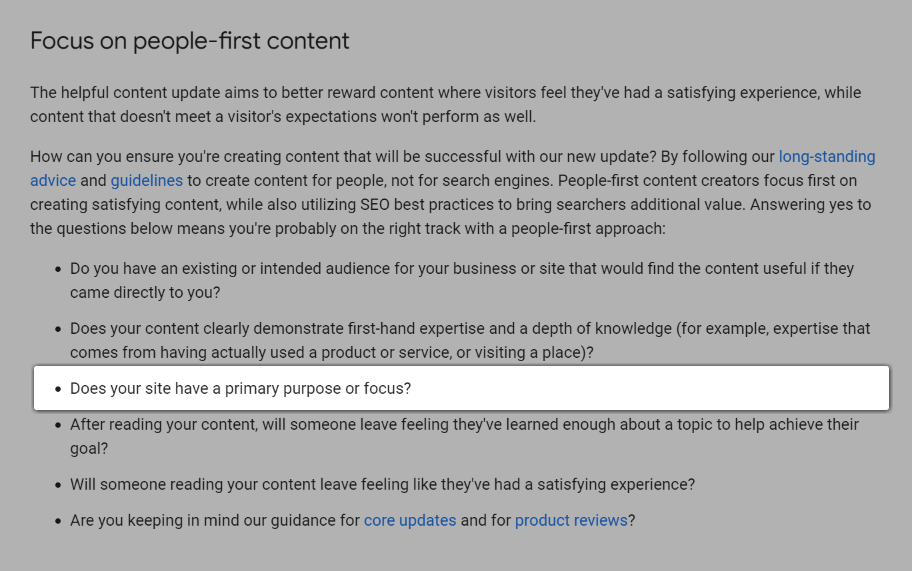
Does your site have a primary purpose or focus?
Do you have a website to advertise your products or services?
Great.
Do you have a website to educate and inform people about something?
Also great.
Do you have a website with the sole purpose of earning advertising revenue from people?
Not so great.
Your website should be there to make the internet a better place, a useful place.
If your website’s focus is getting as many people as possible to your site so you can show ads and affiliate links to them, then (and this is just a guess) you’re probably in for a bad time.
If your website’s focus is getting as many people as possible to your site so that you can promote your loosely-related products or services, then you’re probably in for a bad time too.
Again, if you’re publishing content that’s directly related to what you do or what you sell, then you shouldn’t be concerned.

After reading your content, will someone leave feeling they’ve learned enough about a topic to help achieve their goal?
Google is trying to avoid people doing repeat searches.
You’ll have had this experience yourself.
You search for something, you click the first result, and (annoyingly) it doesn’t even remotely answer your question, so you go back to the search results and either click another page or fine-tune your search.
This experience, called “pogoing“, is something Google has longed to avoid since it first made its search engine public.
After all, if someone can’t find the best result the first time then its search engine has failed.
Google’s customer experience objective has, most likely, been to reduce this to zero.
You google something. The first result is the perfect answer. You’re happy. You continue to use Google because you trust it.
If your content isn’t answering the search query effectively then Google isn’t going to rank it at the top (no matter how well prepared you might be).

Will someone reading your content leave feeling like they’ve had a satisfying experience?
Again, an anti-pogoing evaluation.
Is your content so good that people feel smarter as a result?
Congrats, you’ve won the internet for today.
The better your content is at helping people to know more about a subject, the more likely Google will choose to rank your content at the top of its search results.
By the way, this doesn’t just relate to educational and informational content.
All content, including entertainment content, needs to be equally good at offering a satisfying experience.
Celebrity news content, whilst produced for fast consumption, doesn’t have to be a few short sentences about the person in question. Extend it to be useful to the reader. Could they learn something new about them?
But it shouldn’t feel like padding out either.
In another life, I used to write travel content. Most of the travel content I was competing against would be padded out with useless historical facts and trivia that would be completely useless to anyone looking for:
- The best times of year to visit
- The best areas in a city to stay in
- The best clothes to wear in each season
- and so on.
Instead, the copy would be padded out with Wikipedia factoids that’d only be useful in a pub quiz.
Insightful background information can be great. Padding out, not so much.
Take a knife to anything in your content that the reader would be no worse off without knowing.

Are you keeping in mind our guidance for core updates and for product reviews?
There’s a lot covered in the guidance, so I highly recommend reading them, but I’ll do my best to summarise them:
- Content should be original
- Content should be well researched
- Content should reference supporting material
- Content should be insightful and not just an observation
- Content should feel like a comprehensive answer to a query
- Content should be expert-led, authoritative, and trustworthy, and show first-hand experience where it’s relevant (see: What is E-E-A-T?)
- Content should be well presented and free of grammatical/spelling errors
- Content should be embellished with appropriate multimedia content
- Content should be so good people want to bookmark or share it
- Content should be accessible across any device
There’s a lot more in those two linked guides, so please read them both immediately after finishing this post:
One good theoretical test for content is: would you feel comfortable getting it signed off by your CEO when showing it to them on a smartphone?
If not, return to your draft and start again.
This quote from Matt Cutts, a former Head of Web Spam for Google, summarised this perfectly years ago when asked how to recover from the Panda update:
Take a fresh look and basically ask yourself, ‘How compelling is my site?’ We’re looking for high quality. We’re looking for something where you land on it, you’re really happy, the sort of thing where you wanna tell your friends about it and come back to it, bookmark it. It’s just incredibly useful.
Avoid creating content for search engines first
This is the second of the two sections. This covers the questions you should be asking about the content you produce and who you’re producing it for.

Is the content primarily to attract people from search engines, rather than made for humans?
This one is simple.
Are you:
1. Writing content for a problem your target audience is experiencing (and you can help with)?
Or are you:
2. Writing content for a search query just because it has 1,000s of searches every month?
If it’s the former, great. You’re creating content for the right reasons.
If it’s the latter, take caution.
It’s a very noble thing to be able to help people on the internet and make the internet a deeper resource of knowledge and information. But if you’re writing it without the expertise required to do so knowledgeably, then you’re not writing to help people, you’re writing to earn search traffic.
Next one.

Are you producing lots of content on different topics in hopes that some of it might perform well in search results?
Another simple one.
If you write about finance, don’t write about freehold versus leasehold property. Leave that to an estate agent or mortgage advisor’s website.
If you write about legal affairs, don’t write about performance management techniques. Leave that to a dedicated HR company (unless it’s a legal HR issue, that’s different).
If you’re reporting the local news, you’ve no place doing technology reviews. Leave that to technology review websites (there are plenty).
If about.com were still around today, it’d be a perfect example of a website writing about lots of subjects, not many of them from a position of authority.
Instead, it rebranded and split into a number of verticals of different subject-specific brands, including:
- verywellhealth.com (physical health)
- verywellfit.com (fitness)
- verywellmind.com (mental health)
- lifewire.com (tech news and reviews)
- thebalance.com (finance)
- thespruce.com (homemaking)
- tripsavvy.com (travel)
- thoughtco.com (education)
- and more
Consequently, readers of each site are now getting perfectly related cross-promotions of content from around the same site. And their ranking performance is pretty darn good too.

If you’re considering expanding the topics you cover on your website, ask yourself whether those topics are must-read subjects for your audience.

Are you using extensive automation to produce content on many topics?
This is the question that has a lot of people worried.
There are lots of marketing automation tools available to content creators, but AI copywriting software is probably the one that has been inserted into most content creation processes in recent years.
AI writing tools have become a standard part of many content workflows since this update launched, and for good reason.
Used well, it can significantly help with workloads for time-pressed content creators and digital marketing managers. It can really help when you’ve dozens, if not hundreds, of pieces of copy to write.
What Google is fearful of is an abuse of copywriting software.
We believe Google is far less concerned about copywriting software used as a writing aid.
Let’s look at the question again:
Are you using extensive automation to produce content on many topics?
What Google is looking to curb is the excessive use of AI copywriting tools to create hundreds and hundreds of pages of content across dozens of different topics.
There are websites, especially in the affiliate industry, that are filled with thousands of pages of automatically generated content that offer no additional value to what’s already available in the search results.
It fails to match those earlier simple criteria of being:
- Original*
- Well-researched
- Insightful
- Expert-led
- Authoritative
- Trustworthy
*Arguably, most AI-generated copy is “original” in the sense that it’s almost always new paragraphs that pass 99.9% of all plagiarism checks. It’s just not “original” in the sense that someone created it from scratch (because it’s mostly regurgitating previously-published content).
In our opinion, copywriting software can be incredibly helpful for
- Improving workflows
- Inspiring content creation (it can be fantastic for brainstorming, for example)
- Helping to build a content outline
It should not, however, be used to fully automate the entire content creation process and remove the writer entirely.
Google wants to stop mischievous people from taking other people’s content, passing it through automation software (to reorder words, replace them with synonyms, etc), and publishing it as “original content”.
Google’s current guidance backs this up. Using automation, including AI, isn’t against its guidelines in itself. But using it to produce content mainly to manipulate search rankings breaks its spam policy on scaled content abuse.
Was mass AI-generated content part of what triggered the March 2024 changes? Google hasn’t confirmed a single cause, and it would be inaccurate to claim one. Industry analysis at the time suggested heavy use of AI-generated content was one of several factors among sites seeing the largest ranking declines after March 2024 , alongside thin affiliate content, aggregated reviews, and expired-domain abuse. The safest guidance remains the same as it was in 2022: AI tools are fine for outlining and speeding up workflows, but shouldn’t replace a knowledgeable human writer and reviewer.
What about automatically translated content?
Google provides translation software businesses can use to automatically translate and localise their content.
This is great for when you have a website that you’ve not yet been able to create bespoke localised content in the native language of the reader. But, it’s intended as a stop-gap.
What Google wants people to do is lean on the software at first, but create localised content at the first opportunity.
If you’re using Google’s translation software to create hundreds and hundreds of pages in a dozen languages and never replacing it with bespoke copy, Google is bound to devalue it.
Google is probably quite proud of how strong its translation software is today.
But what they really want is a near-perfect customer experience for people using Google search.
They don’t want people reading badly translated content. They want people to read incredible content in their native language that’s deeply satisfying.
Whilst you may need to depend on automated translation software, for now, we’d highly recommend replacing it with new content as soon as possible.

Are you mainly summarizing what others have to say without adding much value?
Oh, the irony.
This post is kind of a summary of what Google has addressed, but my breakdown of each bullet point in real terms , and the What to Do to Comply With Google’s Content Quality Standards section, are where I’m adding value.
This may have been (and this is an educated guess based on the information provided by Google) a small attempt at curbing the Skyscraper Technique (kinda).
The Skyscraper Technique takes all the content from the top ten ranking pages from the search results, combines them, and publishes it as a “definitive” piece.
It’s actually a process that we love here at Exposure Ninja , when it’s done right.
The problem, in Google’s eyes, is that the reader has nothing to gain from that content unless it’s a substantial improvement on what’s already available.
What users of the technique sometimes miss out on is the expertise and real-life experience required to add new insight to the subject matter.
To reference an earlier bullet point:
- Content should be insightful and not just an observation
When we use the process here at Exposure Ninja, we utilise all the expertise, experience, and thought-leadership of our writers and clients; whereas, that’s not always the case with skyscraper-ed content (especially when only done to satisfy robots, not people).
This also sounds like a replication of the recommendations from the Product Review Update:
- Evaluate the product from a user’s perspective.
- Demonstrate that you are knowledgeable about the products reviewed – show you are an expert.
- Provide evidence such as visuals, audio, or other links of your own experience with the product, to support your expertise and reinforce the authenticity of your review
If you can’t add your own perspective or that of your business, then you may wish to reconsider creating content for the search queries you’ve identified.

Are you writing about things simply because they [seem trending] and not because you’d write about them otherwise for your existing audience?
Hopping on a trend can be great for traffic and increasing brand awareness. But only if it relates to problems or queries your target audience has.
Trend hopping can be great for thought leadership too.
Imagine you work for a family legal firm.
You see that there’s a big news story about a legal fight between a celebrity couple.
You decide to write a blog post about the legal implications for all parties involved, with some good recommendations on the legal options for any reader who might be considering similar legal action with their partner.
This is a perfectly legitimate thing to post about on your website.
You’re writing about an area you have deep expertise in. You have given the same legal advice hundreds of times before and you have the qualifications and time in the courtroom required to speak from a position of authority.
What Google is opposed to is websites publishing content about trending topics solely to exploit the traffic potential, rather than to offer advice or deeper insight.
Jumping on trends to offer a professional perspective is totally fine.
Jumping on trends because “it’s easy traffic” isn’t.

Does your content leave readers feeling like they need to search again to get better information from other sources?
Google is again addressing pogoing.
It wants all the content it ranks to perfectly answer the search query a person has used.
It wants the first page opened to be the only page opened, more or less.
If the content is thin, too short (or too long), or not written from a position of expertise, then the reader is bound to bounce.
But remember, no two users are the same.
One reader might like a short, concise piece of content to read through. They just want the facts. They’ll then decide if they want to read further.
Others might prefer a long-form version with so much depth and detail that they don’t need to read any other pages.
You must know your audience and their most common problems perfectly to know how much detail you need to go into.
Keyword intent is also a large element of whether a piece of content will be satisfactory or not.
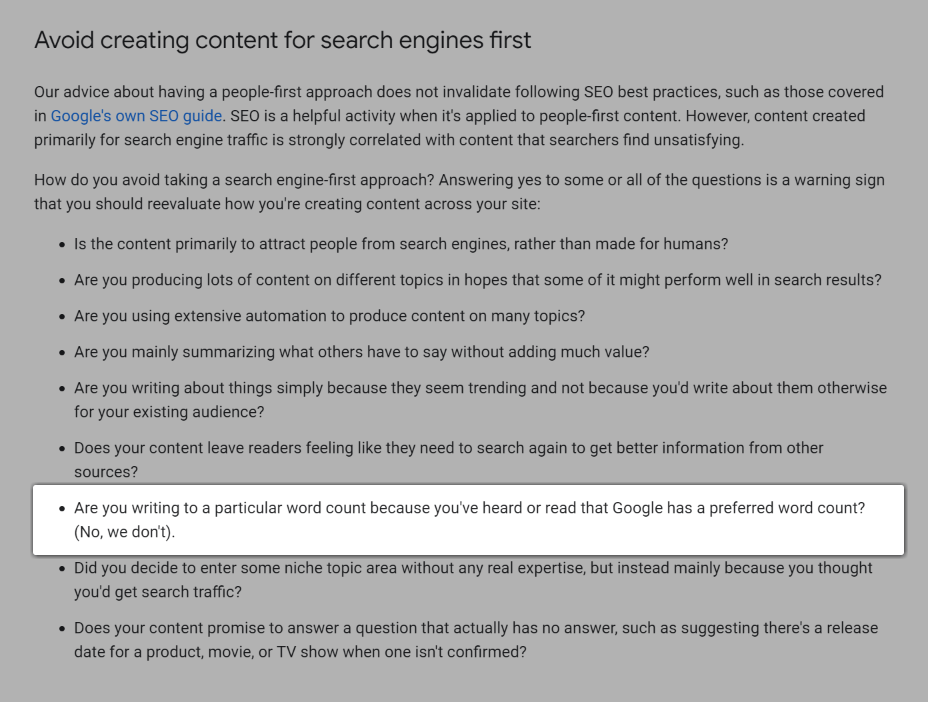
Are you writing to a particular word count because you’ve heard or read that Google has a preferred word count? (No, we don’t).
For years SEOs recommended that you needed a minimum of 500 words for your content.
That then increased to a minimum of 1,000 words.
Studies that looked at the top-ranking pages found that content with the highest word counts had the higher rankings. So, inevitably, the recommendation was to increase the “minimum word count” again to 2,000 words.

Looking at the data, doesn’t it seem like the word count only increases after SEOs recommend a new minimum?
Google doesn’t have such a recommendation.
They don’t set a “minimum word count”.
Google has repeatedly said that content should be as long as needed to answer the query.
John Mueller, a Webmaster Trends Analyst for Google, has long said that word counts aren’t a ranking factor.
During a 2021 SEO office hours session, John summarised how word count should be viewed perfectly:
“From our point of view, the number of words on a page is not a quality factor, not a ranking factor.”
So just blindly adding more and more text to a page doesn’t make it better.”
Thanks to Roger Montti of Search Engine Journal for the transcript.
If the answer should be 100 words long, then the content should be 100 words long.
It’s entirely possible that featured snippets were created because SEOs had fixated on high word counts in order to rank at the top of Google and, as a consequence, search users were finding it hard to locate the answer they were looking for in the 2,000-word text. (Here’s how to win featured snippets.)
It’s likely that the scroll-to-text fragment was created to help with this very same problem too.
If a search query you’ve identified can be answered shortly and concisely, write a short, concise piece.
If the search query is deeply complex, your content should be in-depth as well.

Did you decide to enter some niche topic area without any real expertise, but instead mainly because you thought you’d get search traffic?
Don’t write about something just because the search traffic looks good.
To repeat Glenn’s maxim: Stay in your lane.

Don’t write about subjects you don’t have the expertise, qualifications, experience, knowledge, or deep-rooted topic enthusiasm to do so.

Does your content promise to answer a question that actually has no answer, such as suggesting there’s a release date for a product, movie, or TV show when one isn’t confirmed?
The problem that Google is trying to eradicate here is highly common with newspaper and magazine websites.
Imagine that a new Star Wars film is announced. Disney only announces the title and provides very little detail about the plot or possible cast.
Some entertainment sites will then release a padded-out article with a title along the lines of:
Star Wars: Darth Jar Jar – Release Date CONFIRMED. Actor coming back(?!)
Of course, it’s a fabrication. They don’t know the release date. They have no idea who’s going to be cast in the film. It’s all clickbait.
When you open the article, all you’re greeted with is a very thinly written explanation about:
- The announcement
- What Star Wars is
- When it was bought by Disney
- Which Star Wars films and TV series have been released lately
- How much various Star Wars releases have grossed internationally
- What a few of the actors from the prequel trilogy look like now (you’ll never guess what Jake Lloyd looks like today!)
Overall, there’s very little substance. Just some basic clickbait to get people looking at ads and, maybe, looking at other clickbait content on their website too.
Whilst this question is framed around the entertainment industry, it applies to other industries too.
How the Helpful Content Update Worked
Google gave site owners recommendations and checks to follow for their content.
The next question was: how did the Helpful Content Update work?
The next question was: how did the Helpful Content Update work?
Glenn Gabe was fortunate enough to speak with Google’s Search Liaison (Danny Sullivan) directly.
During their call, Danny explained that:
the new ranking signal is a classifier.
If your site is deemed to have a lot of what Google considers “unhelpful content”, then the site will be classified that way (and that can negatively impact your rankings at a site-level).
This meant that if enough of your content was low-quality, your entire website could be classified as a source of unhelpful content.
The Google Search Central blog confirmed it too:
This update introduces a new site-wide signal that we consider among many other signals for ranking web pages.
In simple terms: your low-quality content limited the ranking potential of your high-quality content.
This is incredibly significant.
Google’s algorithm is split between page-level and domain-level ranking considerations.
An entire website may not perform well in the rankings, but several pages from it may rank at the top of Google if they’re deemed to be the best answer available.
After the Helpful Content Update, some high-quality content could struggle to rank because the domain had been classified as a source of low-quality content.
We can safely presume that Google will not make the classification system public.
They used to publicly share a PageRank scoring system, but that just led SEOs to try and game the system, so they retired it.
Any low-value content you have on your website needs to be dealt with, which we’ll get onto below.
It ran continuously
The classifier, and the classification it applied, ran continuously:
Sites identified by this update may find the signal applied to them over a period of months.
Our classifier for this update runs continuously, allowing it to monitor newly-launched sites and existing ones. As it determines that the unhelpful content has not returned in the long-term, the classification will no longer apply.
This classifier process is entirely automated, using a machine-learning model. It is not a manual action nor a spam action.
Instead, it’s just a new signal and one of many signals Google evaluates to rank content.
In practice, the signal could catch low-value content on new and old websites quickly, but losing the classification (and regaining lost rankings) took much longer.
Recovery was slow
As [the new signal/algorithm] determines that the unhelpful content has not returned in the long-term, the classification will no longer apply.
This was similar to what websites affected by broad core updates are told: they may need to wait until the next broad core update before they see a recovery.
As with any machine-learning system, it wasn’t perfect, and some site owners felt their sites had been flagged by mistake.
We’ve seen the same with the Medic Update and many broad core updates since then.
How Google Assesses Helpful Content Now
Since March 2024, there’s been no single helpful content classifier. Google says the helpful content system “became part of our core ranking systems, as our systems use a variety of signals and systems to present helpful results to users”.
Three things are worth knowing:
- Pages are assessed individually, but sitewide signals still count. Google’s ranking systems guide says its systems work at page level, and that sitewide signals and classifiers also contribute. Having some poor sitewide signals doesn’t mean all of a site’s content will rank poorly.
- The self-assessment questions live on. Google’s guide to creating helpful, reliable, people-first content keeps the 2022 questions and adds more, including whether you’re changing page dates to make content seem fresh when it hasn’t substantially changed.
- Spam policies cover the worst cases. The March 2024 update added spam policies on scaled content abuse (mass-producing content to manipulate rankings, whether by automation, people or both), site reputation abuse (low-value third-party content hosted to borrow a site’s reputation) and expired domain abuse.
Google also suggests asking “Who, How and Why” about your content: who created it, how it was made (including any use of automation) and why it exists. The “why” should be to help people who’d find it useful if they came to your site directly.
What to Do to Comply With Google’s Content Quality Standards in 2026
If your website has lost rankings in a core update, or you want to make sure it doesn’t, follow these steps:
- Review your content creation process
- Review how automation is used within your content
- Review who’s creating your content
- Review where your content is coming from
- Review who’s peer reviewing your content (if anyone)
- Review how your content appears on the search results pages
Before you do so, the first thing you’ll need to check is why you create the content you do.
Helpful vs Unhelpful Content: Do’s and Don’ts
| Do | Don’t |
| Write for an audience who’d find the content useful if they came to you directly | Publish content mainly to attract search traffic |
| Show first-hand experience and expertise | Enter a topic you know little about because the search volume looks good |
| Add original information, analysis or research | Mainly summarise what others have already said |
| Make it clear who wrote the content, with bylines and author pages | Make up author profiles or credentials |
| Make content as long as the topic needs | Write to a set word count |
| Use AI tools to support skilled writers and editors | Mass-produce pages with automation to manipulate rankings |
| Update content when there’s something new to add | Change dates to make pages look fresh when nothing substantial has changed |
Why you’re creating the content you do
Who does your content serve?
You have an audience. They’ll have queries and questions during the awareness, interest, desire, and action stages of the buyer funnel.
Does the content you create serve those people and the questions or problems they may have?
If so, keep creating.
Does your content relate to your business? Or is it only loosely related?
If it’s related, create it.
Would your sales funnel break without the content?
If so, then your business depends on you creating it.
Would the person’s problem or query remain unsolved without it?
If so, not creating it would be an injustice to that person, so create it.
Are you filling a content gap you’ve spotted in the search results?
If so, fill it.
Or are you only replicating what’s already ranking (and not improving on it) just because the average monthly search volume looks decent?
If so, don’t create it.
Once you’ve reviewed those questions it’s time to review your content creation process.
Review your content creation process
Compare your content creation process against the questions Google is asking in its guidelines:
- Is your content original?
- Is your content well researched?
- Does your content reference supporting material? (i.e. are you linking to your research?)
- Is your content insightful (and not just an observation)?
- Does your content feel like a comprehensive answer?
- Is your content expert-led, authoritative, and trustworthy, and does it show first-hand experience?
- Is your content well presented and free of grammatical/spelling errors?
- Is your content embellished with appropriate multimedia?
- Is your content so good that people would want to re-read or share it?
- Is your content easily accessible across any device?
Ask yourself the above questions when you’re creating content.
Search Quality Raters Guidelines
These are the types of checks that Google is asking external Search Quality Raters to complete.
Google uses a third-party team to assess the quality of the search results as it improves the algorithm. As it gets better and determines what is (or isn’t) high-quality content, the Search Quality Raters check whether the search results are better as a consequence.
They have a detailed-page guidebook which takes them through how to do those checks.
Google says rater data isn’t used directly in its ranking algorithms. It helps Google check that its systems are working.
The guidelines have become an SEO bible since it was first uncovered and intensely analysed following the Medic Update in 2018.
In our 2018 analysis, we recommended that every website owner and manager should read them. We stand by that recommendation today too.
If you have multiple people involved in your content creation process, make sure they’re double-checking these questions too.
Enable each person in the process to add their insights, their expertise, and their enthusiasm for the topic at hand.
It also adds an element of peer review.
If you’re using a vendor for your content, make sure they’re following these guidelines within their processes too.
Your vendor or agency should only be providing you with original, well-researched, in-depth content. Good quality content may come at a higher cost, but the cost of not using high-quality and trustworthy content creators could be a poor classification for your website.
Review how automation is used within your content
Automation is great when it’s used correctly.
If you’re using excessive marketing automation software to create entire pieces of content, then be warned that this may be detrimental to your website’s ranking performance.
Google doesn’t demote content just because AI helped create it. But if you’re typing a few words into an AI tool and publishing the results without review, that content is unlikely to meet the standards above, and doing it at scale risks breaching Google’s scaled content abuse policy.As stated earlier in this post, we think that copywriting tools can be incredibly useful for helping to craft the outline of how a final piece of content should look , and for breaking writer’s block too. However, it’s not to be used as the singular “creator” within the content creation process.
Review who’s creating your content
Your content creators need to be either:
- Experts in your field
- Qualified to write about your field
- Deeply knowledgeable and enthusiastic about your field
If your content writers aren’t able to fit into one of the first two categories or aren’t able to rapidly expand their knowledge to fit the third one, then you have to consider replacing that content creator.
You need to audit how they create content.
How do they research it?
Where does their expertise come from?
Employing content creators, internally or externally through a vendor, is absolutely acceptable within the guidelines Google has set out in this update and for ranking in general.
What they’re trying to avoid is deceitful content creation.
What they’re also trying to avoid is cheaply made, low-quality content.
One good rule of thumb to follow, as with any purchase, is that the cheaper your content, the lower quality it probably is.
If you outsource, choose a partner that matches writers to subjects they know well. That’s the basis of our people-first content marketing at Exposure Ninja.
Review where your content is coming from
Is your content automated?
Is a copywriting tool turning the copy from the first 100 pages of Google into a “new” piece of content for you?
Or is your content coming from a content mill where writers are being paid to turn content around quickly and cheaply, with very little attention paid to quality?
This is something you’ll need to check.
Depending on where you source your content, a large percentage of it may be lifted from other websites.
At Exposure Ninja, we use plagiarism detection to make sure our content is bespoke and entirely original. But not every website performs that check.
It’s entirely possible that many businesses are publishing content that hasn’t been checked through or peer-reviewed. Running a website is a time-consuming thing. Marketing is incredibly time-consuming. So, sometimes, some checks get bypassed to save time.
No website can afford to skip those checks anymore.
You need to know who is writing your content and you need to do plagiarism checks too. We use several but highly recommend Grammarly’s Plagiarism Checker.
Review who’s peer reviewing your content (if anyone)
Another easily skipped check.
After the Medic Update and the evolution of E-E-A-T, peer reviewing became more of a focus for many businesses.
Being able to verify that content is authentic and can be trusted as an authoritative source of information not only became a requirement for Your Money, Your Life search queries but for all searches.
One great example of easy-to-validate peer reviewing is on the Healthline website.

Healthline highlights its peer review team and links to its medical team page so that each peer can be verified.
Depending on your industry, you may not need to link to all the peers within your business (or industry) that have validated your content. But, you can certainly have people review it to make sure that it’s:
- Correct
- Authentic
- Well-researched
- Trustworthy
Review how your content appears on the search results pages
Part of this update is focused on making sure that the content isn’t clickbait.
The content of the page has to match the title and description that appears in the search results.
If your title promises something then the body of the content on the page has to match it.
When page titles and meta descriptions are written for your content, it’s entirely right and fair to try and make them as clickable as possible. Just refrain from baiting people with titles that don’t match your content.
Start by updating the title and description guidelines within your content creation process, then double-check your existing content to make sure your metadata passes the same checks.
How to Recover From the Helpful Content Update (and Core Updates)
The painful thing about ranking drops is that, sometimes, perfectly innocent websites that follow the book all the time can get caught in the crossfire between Google and duplicitous website owners.
For some businesses, ranking drops can result in their shutting down entirely because they’re so dependent on Google’s organic search traffic.
Some businesses might be able to shift their marketing budget to paid search ads whilst they’re waiting for their rankings to return, but there’s no guarantee that they will.
It’s a long waiting game, but that might be exactly what’s required.
For a step-by-step process, see how to recover from a Google ranking drop.
Some sites were hit unfairly
“The signal is also weighted; sites with lots of unhelpful content may notice a stronger effect“, says Google’s guidance.
From that, you’d expect that only the worst offenders would be the hardest hit, but the decision on whether a website’s content was low-value or not was made by a machine, not a human.
Machines, however (artificially) intelligent, are not infallible.
When they make mistakes, it costs websites rankings and organic traffic.
“It is not a manual action nor a spam action“. I.e. nobody is pressing a “remove this website from the search results” button.
Option 1 : Be patient
Our top recommendation is to be patient.
It’s hard to be patient when your organic traffic drops.
But, time and time again we’ve seen website rankings drop significantly, only to rebound only a few weeks later.
Most Google core updates take around two to three weeks to roll out. During that time, we often see recoveries.
Unfortunately, sometimes we don’t see recoveries until the next big update.
Websites that lose ranking during broad core updates typically don’t see a rebound until the next update. Google released three core updates in 2025, in March, June and December.
In the meantime, you can work on the following:
- Finding your deranked content and improving it
- Finding your low-value content and improving it
- Finding your deranked/low-value content and removing it
Option 2: Find and improve pages that lost rankings
This should be pretty easy for you to find.
Either your rank tracking software will tell you, or Google Search Console will.
Regardless of the tool you use to check your deranked URLs, gather them all into a simple spreadsheet.
You’ll then need columns for each check covered earlier in this post:
- Is your content original?
- Is your content well researched?
- Does your content reference supporting material? (i.e. are you linking to your research?)
- Is your content insightful (and not just an observation)?
- Does your content feel like a comprehensive answer?
- Is your content expert-led, authoritative, and trustworthy, and does it show first-hand experience?
- Is your content well presented and free of grammatical/spelling errors?
- Is your content embellished with appropriate multimedia?
- Is your content so good that people would want to re-read or share it?
- Is your content easily accessible across any device?
Our expectation is that URLs that lost ranking won’t return positives for all ten checks.
If there’s a negative check, work to turn it positive.
Improve your content so it’s original, well-researched, references supporting material, and so on.
Make sure it’s peer-reviewed, free of ambiguity, and , most importantly of all, that it matches the search intent of the person looking for it.
Check the page title. Check the meta description.
The last mammoth challenge in restoring lost ranking is improving the relationships between content, on and offsite.
- Is the other onsite content that’s linked to the page also high-quality?
- Is the offsite content linked to the page high-quality too?
SEO isn’t just a localised practice. It’s about how well a website interconnects as part of the internet as a whole.
If trustworthy high-quality websites are linked to yours, that tells Google that your content is high-quality too.
If untrustworthy low-quality websites are linked to yours, that tells Google a lot too.
Option 3 : Find your low-value content and improve it
If your website hasn’t (yet) been affected by the a core update, but you’re concerned that it may happen, your best option is to find your low-value content and improve it now.
To do so you’ll need three things:
- Your analytics software
- Your eyes
- Plagiarism software
Start by checking your analytics software. Check which pages have a low viewing time. If people are only staying for a few seconds or less than a minute it means that either:
- You’ve answered their query perfectly, so they’ve left
- Your content isn’t satisfactory enough, so they’ve pogoed back to the search results to try another page
This is where your eyes come into it.
You’ll need to manually check all of your content.
Downloading all your visited pages from your analytics software and sorting them from lowest session duration to highest will help you to prioritise them.
Next, you’ll need to visually check them all, and as best possible, check them against the search queries they’re ranking for (using Search Console) and their intent.
You’ll then need to check all of the same pages through your plagiarism checker of choice.
It won’t be a quick solution.
But, with the update’s classification being sitewide, it’s a necessary one.
When improving your content, don’t forget to follow the same checks covered so far and make sure it’s all peer-reviewed too.
Option 4: Find your deranked or low-value content and remove it
This option should only really be used as a last resort.
You can choose to completely delete the problematic content or noindex it.
Deleting the content, whilst painful, might be a good route, but improving (or replacing it) would be a much better option.
If you have internal links and backlinks to that content then you’ll lose the benefit of them by deleting that content. Replacing it keeps that link equity (i.e. link juice) alive and working in your favour.
Noindexing is the worst of the two options.
By noindexing the content you’re telling Google that it’s not good enough for search users to read, but good enough for people to discover via internal and external links.
Either the content is helpful, or it’s not, and John Mueller agrees:
If the content is helpful, make it public.
If it’s not, make it helpful.
Only if you really, really have to keep unhelpful content should you choose to noindex it.
And only if you really, really must do should you choose to delete it.
Option 5 : All of the above
Well, almost all of the above.
If you have content that would be better off deleted, delete it and ensure it returns a 404 status code.
If you have content that’s better off noindexed, like some filtered navigation pages, by all means, noindex it.
But the best option of all is a combination of them all.
Improve your deranked content (if you have any).
Improve your lowest value content (if you have any).
Review your content and determine whether it passes all the checks with flying colours.
If not, it’s time to get revising.
Looking Long-Term: Content Quality in the Post-HCU Era
Content quality is now assessed all the time by Google’s core ranking systems, and each core update refines how. Since the March 2024 merger, Google has released core updates in August, November and December 2024, March, June and December 2025, and March and May 2026.
The safest long-term approach hasn’t changed: publish content for a clearly defined audience, written by people who know the subject, and keep it accurate and up to date.
Stay updated on all future algorithm updates
There are several ways to keep up with Google’s updates. Google’s Search Status Dashboard lists every confirmed ranking update.
We also share our analysis on our social media channels (LinkedIn, X, Instagram, Facebook and TikTok).
Accounts worth following on X for updates and analysis:
- Google’s Search Liaison
- John Mueller from Google
- Barry Schwartz of Search Engine Roundtable
- Glenn Gabe
- Marie Haynes
You can stay up-to-date with the best SEO strategies via our YouTube channel.
And if you sign up to our mailing list below, we’ll keep you updated on all our analysis as and when we have it.
Google’s Helpful Content Update: The Summary
If you’ve skimmed to this point, here’s everything you need to know:
- Google launched the helpful content update on 25 August 2022.
- In March 2024, Google retired it as a standalone system and made it part of its core ranking systems.
- It aimed to reduce low-quality content in the search results.
- There was a dedicated classification for websites with low-quality content between 2022 and March 2024; content quality is now assessed by multiple systems within the core algorithm instead.
- The classification was sitewide, so lots of unhelpful content on a site could affect the ranking potential of its other pages.
- The classifier ran continuously, picking up low-quality content as it appeared.
- Google reported a 45% reduction in low-quality, unoriginal content in search results following the March 2024 changes.
If you’re concerned about whether your content creation process passes Google’s helpful content guidance, you’ll need to pass the following checks:
- Is your content original?
- Is your content well researched?
- Does your content reference supporting material? (i.e. are you linking to your research?)
- Is your content insightful (and not just an observation)?
- Does your content feel like a comprehensive answer?
- Is your content expert-led, authoritative, and trustworthy, and does it show first-hand experience?
- Is your content well presented and free of grammatical/spelling errors?
- Is your content embellished with appropriate multimedia?
- Is your content so good that people would want to re-read or share it?
- Is your content easily accessible across any device?
And if your website has lost rankings in a core update, consider doing one of the following to reverse the drop:
- Find your deranked content and improve it
- Find your low-value content and improve it
- Find your deranked/low-value content and remove it
In the meantime, we highly recommend reading through the following articles and guides:
- How to Recover From a Google Ranking Drop
- A History of Google Algorithm Updates
- What is E-E-A-T?
- How to Get to the Top of Google.
If your site has lost rankings and you’d like help with a recovery plan, request a free search visibility review. We’ll show you where you stand in Google and AI search, and the opportunities to focus on first.
Google’s Helpful Content Update FAQs
Is the Google Helpful Content Update still active in 2026?
Not as a standalone system. Google merged the Helpful Content Update into its core ranking systems in March 2024. The principles it introduced ( people-first content, first-hand expertise and avoiding mass-produced or AI-generated content ) are now assessed continuously as part of Google’s core ranking systems.
What happened to the Helpful Content Update in March 2024?
Google combined a March Core Update with a March Spam Update and, as part of this, deprecated the standalone Helpful Content classifier. Its signals were folded into Google’s core ranking systems instead, with the rollout completing on 19 April 2024.
What is the difference between the Helpful Content Update and a core update?
The Helpful Content Update (2022–2024) was a dedicated, standalone classifier focused specifically on content quality and helpfulness. Since March 2024, that assessment happens within Google’s broader core ranking systems alongside many other ranking factors, rather than as a separate system.
What is E-E-A-T and how does it relate to the Helpful Content Update?
E-E-A-T (Experience, Expertise, Authoritativeness, Trustworthiness) is Google’s framework for judging content quality, used by its Search Quality Raters. Google says trust is the most important part. The Helpful Content Update’s self-assessment questions and Google’s core ranking systems both draw directly on E-E-A-T principles.
How do I know if my site was affected by the Helpful Content Update?
Look for ranking or traffic drops around known update dates (August 2022, December 2022, September 2023, and the March 2024 core update), then audit your content against Google’s people-first content questions and content quality checklist, both reproduced in full above.
Can a site recover from the Helpful Content Update?
Yes. Recovery generally requires improving or removing low-value content, ensuring all content is original, well-researched, and expert-led, and then waiting for a subsequent core update to reflect those improvements . Recovery isn’t usually immediate.