What Is E-E-A-T and Is It Still Important for SEO?


E-E-A-T (Experience, Expertise, Authoritativeness, and Trustworthiness) is more important than ever for SEO success. Sharpen your E-E-A-T signals to earn the trust of both Google and your audience.
If you’re serious about ranking on Google, you’ve probably heard of E-A-T: Expertise, Authoritativeness, and Trustworthiness. In December 2022, Google shook things up by adding an extra “E” for Experience. Now, we have E-E-A-T.
We break E-E-A-T down and, more importantly, show you how to improve your site’s E-E-A-T signals to boost your search engine optimisation (SEO) performance.
What Does E-E-A-T Stand For?
E-E-A-T stands for Experience, Expertise, Authoritativeness, and Trustworthiness. Google uses these signals to determine how credible and useful a website, webpage, or content creator is. It essentially measures a brand’s right to be considered a leader in their field, no matter what industry or niche they may fall into.
Experience
Google and users want to see first-hand experience in content. Real-world insights make content more engaging, credible, and trustworthy. When an author has actually performed the task they’re writing about, their advice is more actionable and reliable. This builds trust with both Google’s algorithms and human readers.
Experience signals include:
- Personal anecdotes, credible author bios, and “behind-the-scenes” content.
- Original photos and videos showcasing real-world execution.
- Advice and product suggestions based on actual use.
Wirecutter by the New York Times is a great example of this. In their guide on How To Clean a Toaster Oven, they hit the mark on showcasing genuine experience:
✅ Original, authentic photos taken during each step of the process.
✅ Recommended cleaning products based on personal use.
✅ Step-by-step instructions with tips for dealing with potential problems.
✅ Author bio highlighting niche expertise.

Expertise
Google prioritises content written by subject matter experts, people with proven knowledge or qualifications in their field. Accurate, well-researched content builds credibility, helping both users and search engines trust the information.
To demonstrate expertise:
- Ensure all content is factual.
- Back up any claims with data or cite authoritative sources.
- Include quotes from credible experts.
- Include credentials in the author bio.
- Have your content reviewed by a qualified expert.
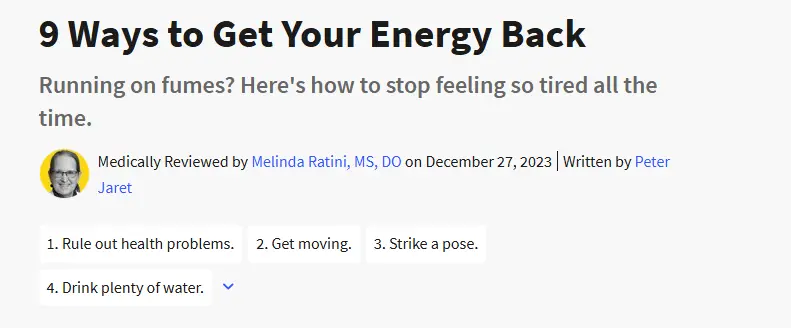
Take WebMD, for example. Their blog post on 9 Ways to Get Your Energy Back is a masterclass in showcasing expertise:
✅ Reviewed by a medical expert alongside the original author.
✅ They include a sources list, allowing readers to check the validity of their information.
✅ There are numerous quotes by experts within the content.
Authoritativeness
Google recognises authoritative sources as industry leaders who provide trustworthy, experience-backed, and expert-driven information. True authority isn’t just about knowledge — it’s about being the most credible source for users in your niche.
Your website can establish authority by:
- Earning high-quality backlinks from reputable websites, news outlets, and industry leaders.
- Securing media mentions in respected publications, interviews, and reports.
- Collaborating with experts through guest posts.
- Publishing valuable content that is relevant to your topical niche.
- Showcasing industry credentials by highlighting certifications, awards, and professional affiliations.
Search Engine Land is viewed as an authority on SEO, and here’s why:
✅ Regularly cited by SEO professionals, marketers, and major digital publications.
✅ Articles are written and reviewed by experienced subject matter experts.
✅ Boasts a strong backlink profile, with 54.5 million backlinks (Semrush).
Trustworthiness
You’ll notice that “trust” is mentioned when discussing experience, expertise, and authoritativeness. This is because trust is the foundation of E-E-A-T. Google explicitly states:
“Trust is the most important member of the E-E-A-T family because untrustworthy pages have low E-E-A-T no matter how Experienced, Expert, or Authoritative they may seem.”
So, how do you ensure your website is truly trustworthy?
- Ensure your website is secure using HTTPS, strong data protection measures, and cybersecurity.
- Make sure your website is easy to navigate, mobile-friendly, and compliant with accessibility standards.
- Represent your reviews fairly; don’t alter, delete, or cherry-pick the reviews you showcase on your website.
- Display your contact details, author bios, and return policies clearly.
- Make sure all information is accurate and up-to-date.
Why Did Google Add “Experience” to E-A-T?
In December 2022, Google added “Experience” to the Search Quality Rater Guidelines. These are the publicly available guidelines used by Search Quality Raters (Google’s quality assurance team).
Google added “Experience” because too much content is written by people (or AI) who have never actually done what they’re writing about. This update complimented Google’s Helpful Content Update, which aimed to reduce the volume of low-quality content in the SERPs.
Including experience, alongside expertise and authoritativeness, ensures that websites are driven by people-first content and not just trying to rank in search engines.
Why E-E-A-T Matters for SEO, Despite Not Being a Direct Ranking Factor
Google’s goal is simple: deliver the best possible experience for searchers. To achieve this, it constantly updates its algorithms, like the Medic Update (2018) and the Helpful Content Update (2022), to ensure only credible, high-quality content ranks.
These algorithms look at many different factors, but E-E-A-T is not a direct ranking factor. Search Quality Raters use E-E-A-T guidelines to evaluate search results, helping Google refine its algorithms.
But that doesn’t mean it doesn’t matter for your SEO. Think of it this way: would you trust medical advice from a random blog or the NHS website? That’s why Google prioritises trustworthy content, even if E-E-A-T isn’t a direct ranking factor.
E-E-A-T and YMYL
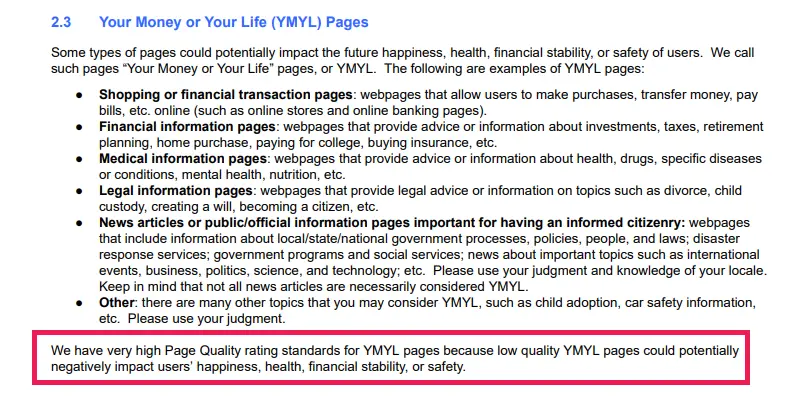
The YMYL acronym stands for Your Money, Your Life. YMYL refers to topics that could impact a person’s health, finances, or safety.
If you are looking for information about your financial, physical, or mental health, and you find bad or malicious advice, this could result in serious consequences. Let’s say you act on bad mortgage advice from an online guide. Not only may this put you in a bad financial situation, but you may also risk losing your home.
These topics are held to higher E-E-A-T standards because misinformation could be dangerous. Google wants to protect people against bad advice and give them the perfect customer experience to keep people returning to its search engine. When it comes to your finances and well-being, Google doesn’t want to take any risks whatsoever.
Why YMYL Guidelines Apply to You Too (Even If You Think They Don’t)
Even if you’re not in finance or healthcare, E-E-A-T must still apply. Google wants to see reliable, accurate content in the top SERPs, no matter the topic or industry.
- If you’re in eCommerce, Google wants to know your products are legit, no matter their price point.
- If your service-based business has a website, it needs more than just a contact page to show it can be trusted by people and Google.
How to Improve Your Website’s E-E-A-T Signals
Abigail Daunton-Johns, Head of Content and Email Marketing here at Exposure Ninja, explains: “E-E-A-T becomes more important every year. Google isn’t just looking for information — it’s looking for expertise, experience, authority, and trust behind that information.”
If your website lacks strong E-E-A-T signals, the good news is that fixing it is simpler than you might think.
Audit Your Brand
Start by auditing your brand. What are people saying about your business and/or your website? Forget what Googlebot is thinking; what are real people out there in the world saying about you?
To do this:
- Get Customer Feedback: Send surveys, make calls, or run social media polls to gather honest insights.
- Check Your Reviews: Monitor platforms like Google Reviews, Trustpilot, and industry-specific sites.
- Analyse Backlinks and Mentions: See who’s talking about your business and how they’re positioning you.
A strong brand audit helps you understand how trustworthy and authoritative your business appears. If your brand isn’t seen as an industry leader, take these actions:
- Strengthen Your Website’s Trust Signals: Update your About Us page and display accreditations, awards, and industry credentials.
- Showcase Your Team: Highlight expertise and experience to build credibility.
- Ensure Easy Contact: Make customer service details and FAQs readily accessible.
- Engage with Feedback: Address negative reviews professionally and use insights to improve.
- Leverage PR and Partnerships: Collaborate with experts, get featured in publications, and earn authoritative backlinks.
By taking these steps, you’ll build a trustworthy brand position with customers and search engines.
Analyse Your Existing Content
You’ll need to audit your existing content and decide, “If I were the customer, would this significantly match my needs?”
If the answer is a resounding “No”, then you have two choices:
- Refresh the Content: Improving your existing content to align with E-E-A-T signals can help boost rankings, engagement, and conversions without starting from scratch. Here’s when to refresh:
- The content is outdated but still relevant to your target audience.
- It could be improved with better structure, updated data, expert quotes, or experience-driven insights.
- Remove the Content: Chances are that some of your older content doesn’t match your current level of expertise or was created with black hat SEO in mind. Here are some signs it’s time to remove old content:
- The content is completely outdated and no longer relevant.
- It’s a low-quality page that could hurt your website’s authority.
- It’s competing with another page that is performing better (but consider consolidating any useful information).
If you’re looking at your old content and thinking, ‘Wow, we really published some weak stuff back in the day,’ don’t let it drag your site down. Clear out the rubbish. Outdated, thin, or duplicate content only confuses search engines and AI algorithms. Remove what’s not adding value and start again with something stronger.
 Charlie Marchant
CEO
Charlie Marchant
CEO
Build a Framework for Content Creation
To future-proof your content for E-E-A-T, you need a structured framework. This will set the standard for publishing high-quality, well-researched, experience-driven content on your website.
Here are some key elements of an E-E-A-T content creation framework:
- Expert Research: Use credible sources, industry reports, and first-hand experience to inform your content.
- High-Quality Writing: Content should be written by (or reviewed by) a subject matter expert.
- Internal and External Links: Connect to relevant pages within your website and link to authoritative sources, studies, and expert insights to validate claims.
- User Intent Alignment: Ensure every piece of content addresses a specific customer need and is not created solely for SEO purposes.
- Regular Content Reviews: Schedule periodic updates to keep content accurate, relevant, and aligned with industry changes.
Hire Experts
Running a business or managing a full-funnel marketing strategy means time is limited, and creating expert, trustworthy content takes effort. If you don’t have the bandwidth to research and write high-quality content yourself, bring in expert writers and researchers who can create content that meets Google’s E-E-A-T standards.
For content to be considered truly “expert,” you’ll need to validate it. You have two options:
- Publish it under your own name after reviewing and verifying the information.
- Credit the original author and add “Expertly Verified by …” to reinforce accuracy and authority.
Promote Onsite
To establish credibility and build trust with both users and search engines, your website needs to showcase expertise and authority. The more transparent and informative you are, the more reliable your brand appears.
- Every blog post should have an author bio demonstrating their expertise and experience. If possible, link to their LinkedIn profile.
- If content is written by a non-expert, include an “Expertly Reviewed by …” tag with a link to showcase their expertise and credentials.
- Showcase customer testimonials and case studies to demonstrate real feedback and results.
- Display industry accreditations or awards to boost credibility.
Promote Offsite
Your authority doesn’t just come from what you say about yourself, but what others say about you. Offsite promotion builds social proof, showing both potential customers and Google that your business is trustworthy.
One of the most powerful offsite trust signals is customer reviews, no matter whether you are B2C or B2B. Genuine feedback can reassure potential buyers and enhance your reputation.
You can increase your online reviews by asking your existing customer base to leave a review of your services or products. Make it easy for them by providing links to your Google My Business, Trustpilot, or Feefo page. Even if you get just a small percentage of respondents, each one will help to build up your credibility.
Asking for reviews can be a double-edged sword. BrightLocal’s survey shows that 96% of consumers are open to writing reviews, including both their positive and negative experiences. What happens if you start having negative reviews published for all to see?
- Acknowledge the review by responding professionally.
- If a mistake was made, take responsibility and explain how you plan to fix it and prevent it from happening again.
Make It Easy to Access and Digest
Google prioritises websites that are user-friendly. Great user experience (UX) leads to higher search rankings and enhanced trust and engagement — key factors in E-E-A-T success.
- Optimise for Mobile: Your site must be fully responsive and easy to use across all screen sizes.
- Remove Distractions: Intrusive pop-ups, cluttered layouts, and excessive or deceptive ads can frustrate users.
- Fast Load Speeds: Slow sites drive users away; optimise images, scripts, and caching to keep it quick.
- Clear Navigation: Keep key pages (About Us, Contact) in the main menu and use logical internal linking to make information easier to find.
Never Stop. Improve by 1% Daily
Don’t. Stop. Improving.
Every day you don’t optimise your E-E-A-T for SEO, you leave the door open for your competition to do so. As with SEO, it can take a long time to see the fruit of your improvements, but it’s worth it when you get there.
Commit to making at least a 1% improvement to your website on a daily basis. Today, you can work on improving your About Us page. Tomorrow, you can improve the visibility of your contact information. The day after that, you can start auditing your content and on the following day, you can start to publish your expertly crafted improvements.
The Future of E-E-A-T in SEO
E-E-A-T is more important than ever. As AI-generated content floods the web, Google will continue prioritising authentic, experience-driven, and trustworthy content. This shift means businesses that invest in real expertise and credibility will have a competitive edge in search rankings.
Holding yourself to higher content standards benefits everyone — not just your audience, but the internet as a whole. The brands that demonstrate expertise, authority, and trust will stand out, while low-quality, generic content will struggle to gain traction.
For long-term SEO success, focus on credibility, showcase real experience, and create content that genuinely helps your audience.
Our SEO experts can audit your site and create a plan to boost your E-E-A-T signals. Get a free marketing review today.
Need help crafting high-quality, E-E-A-T-friendly content? Check out our guides:
Want to stay ahead in? Watch:
FAQs
What does Google E-E-A-T mean?
E-E-A-T stands for Experience, Expertise, Authoritativeness, and Trustworthiness. It is a framework that Google’s Search Quality Raters use to assess content quality.
Is E-E-A-T a ranking factor?
E-E-A-T is not a direct ranking factor, but Google rewards sites that demonstrate strong E-E-A-T with better visibility in search results.
When was the E-E-A-T update?
Google expanded E-A-T to E-E-A-T in December 2022.
Why is E-E-A-T important?
It ensures that high-quality, credible content ranks higher, giving users trustworthy information.
What is experience in E-E-A-T?
“Experience” refers to first-hand knowledge of a topic. Google prefers content created by people with real-world insights.