How to Set and Optimise Your PPC Budget (Without Wasting a Penny)


Learn how to set a PPC budget that drives real profit. This guide shows you how to calculate, optimise, and scale your ad spend for maximum ROI.
Are you overspending on Pay-Per-Click (PPC) or not spending enough to see results?
This is one of the biggest headaches for business owners and marketers running paid ad campaigns. How much do you need to spend to generate ROI? Where should that money go? And how do you avoid pouring budget into campaigns that never convert?
We’ll walk you through how to plan, calculate, and scale a PPC budget built for performance, not just clicks.
What Does a PPC Budget Cover?
A large part of your PPC budget will cover the bidding costs. This is the amount you pay on platforms like Google Ads, Microsoft Ads, and Meta Ads to show your ads. Depending on your selected pricing model, it could be based on:
- Cost Per Click (CPC): You pay when someone clicks your ad.
- Cost Per Thousand Impressions (CPM): You pay per 1,000 views or impressions on the ad.
- Cost Per Acquisition (CPA): You pay when a user completes a specific action.
But your PPC budget isn’t just what you spend on clicks, impressions, or actions. It needs to include everything that goes into generating a profitable PPC campaign, like:
- Creative Production: Strong ad creative grabs attention, while great ad copy drives action. For a high-performing ad, you need a budget for both.
- Landing Pages: Clicks are pointless if your landing page doesn’t convert. Your budget should include the cost of building or optimising high-converting landing pages tailored to each ad group or offer.
- Management Fees: Whether you’re working with a PPC agency or managing in-house, PPC campaigns need daily attention. Your budget should account for campaign setup and testing, keyword and audience research, performance tracking, and ongoing optimisation.
Key Factors That Impact Your PPC Budget
Ad Platforms
The different ad platforms come with different price tags:
| Platform | Average CPC* |
| Google Ads | £0.50 to £5.00 |
| Microsoft Ads | £1.21 |
| Meta Ads | £0.78 |
*It’s crucial to note that average CPCs per platform will vary significantly based on keywords, industry, location, and competition. Use these numbers as a starting point, not a rule.
Each platform has its strengths, but none is universally “better” than the others. Your choice should be guided by your campaign goals, target audience, and available budget.
Rebecca Pilkington, our Head of PPC, explains: “There’s no one-size-fits-all in PPC. You may need a bigger budget to run LinkedIn Ads than Google Ads, but that doesn’t automatically make Google Ads the smarter choice. If your audience isn’t active on a platform, it simply won’t deliver results, no matter how cheap or expensive the clicks are.”
Here’s how the platforms generally stack up:
- Google Ads is worth the investment if you need high-quality leads fast.
- Microsoft Ads can deliver if you want efficient spend in a less saturated space.
- Meta Ads offer reach at a lower cost if you’re focused on brand awareness or social engagement.
For the best results, many businesses run multi-channel PPC campaigns, balancing short-term conversions with long-term brand growth.
When it comes to your PPC budget, nothing’s more expensive than putting money in a platform when your customers just aren’t there or it doesn’t work for your business.
 Sinead O’Brien
Performance Strategy Manager
Sinead O’Brien
Performance Strategy Manager
Competition
Competition refers to how many advertisers are bidding on the same keywords or targeting the same audience as you. Platforms like Google Ads and Microsoft Ads operate on an auction system, meaning the more businesses competing for a keyword, the higher the cost to appear in front of your audience.
If you’re advertising on Google, you can use Google Ads Keyword Planner to check out the competition levels. This free tool categorises competition as Low, Medium, or High based on how many advertisers are bidding on that term. The higher the competition level, the more you’ll likely need to bid to secure ad placements.
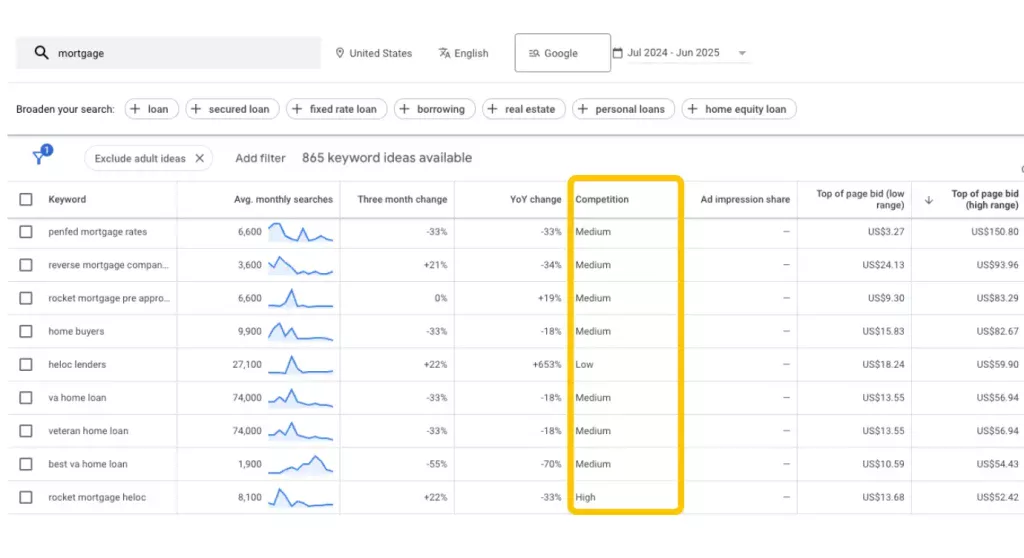
Doing this research before launching a campaign allows you to set a more accurate, data-driven PPC budget.
Industry
Certain sectors come with higher CPCs. If you’re in a high-competition, high-demand industry, you’ll need more budget to stay visible.
Let’s compare finance and legal. If you’re in the finance sector, a quick Google Ads Keyword Planner search shows that a high-intent keyword like “financial advisors near me” in the U.S. sits at $28.21 on the highest range.

However, the legal sector is known for having the most expensive ad keywords. For example, the highest range for a high-intent term like “accident lawyer near me” in the U.S. costs an eye-watering $480.00.

Keywords
The cost of a PPC campaign is heavily influenced by the keywords you target, and not all keywords carry the same price tag.
Let’s compare two commercial keywords from the mortgage sector using Semrush data:
| Keyword | Intent | Monthly Search Volume | CPC |
| First time mortgage buyer | Commercial | 6,600 | £1.03 |
| Mortgage lenders | Commercial | 3,600 | £2.72 |
These highlight how different keyword characteristics can affect your PPC budget strategy:
- “First time mortgage buyer” has a high monthly search volume of 6,600 and a relatively low CPC of £1.03. This makes it a cost-effective keyword for reaching a broader audience earlier in the buying journey.
- “Mortgage lenders” has a lower search volume of 3,600, but a higher CPC of £2.72. This suggests users searching this term are likely further along in the decision-making process and closer to converting. But because it’s more competitive, it requires a larger budget to maintain visibility.
Lower-cost, high-volume keywords can help drive more traffic for less, while higher-cost, high-intent keywords often deliver better conversion potential but require a greater investment. A well-balanced PPC strategy uses both.
Location
Where your ads are shown affects not only who sees your ads, but also how much you pay per click.
Different countries, regions, and even cities can have dramatically different levels of competition, which directly influences keyword costs. High-demand areas with more advertisers bidding on the same terms tend to drive up the CPC, while less competitive regions may offer the same clicks at a fraction of the price.
For example, take the keyword “accident lawyer near me.”
- In the U.S., the top-of-page bid for this term can reach $480.00, making it one of the most expensive legal keywords on the market.
- In the UK, that same keyword maxes out at around £68.51, which is still high, but significantly less than in the U.S.
To maximise efficiency, tailor your bids and budgets by location. Invest more in areas with the highest return, and scale back in regions where CPCs are inflated without proportional value.
How Much Should You Spend on PPC?
The honest answer is that it depends. Your ideal PPC budget will be shaped by your industry, goals, and the level of competition you’re up against.
But if you’re looking for a starting point, our PPC team advises:
- Startups or Testing Accounts: Minimum £5K/month in ad spend to generate useful data.
- Scaling Businesses: Between £20K–£50K/month is typical for seeing meaningful returns.
- Enterprise-Level or PPC-Focused Brands: £50K+ per month isn’t unusual, especially in high-CPC sectors.
Here are some examples that show just how much PPC budgets can vary depending on business goals, strategy, and market position
- A WARC report shows that Temu spent $1.4 million on Google Ads and $2 billion on Meta Ads in the U.S in 2023.
- A Semrush report found that State Farm, American Express, and Chase were the biggest digital advertisers in the finance sector between January 2021 and June 2023, with State Farm spending $668.6 million in 2023.
A bigger budget doesn’t always mean better results, unless it’s aligned with the right strategy and audience. Similarly, small budgets aren’t inherently a problem, but they limit how aggressive or data-driven your campaigns can be.
If you’re testing PPC or using it as an add-on to Search Engine Optimisation (SEO) and Email Marketing, a smaller budget might work. But if you’re relying on paid ads to drive qualified leads or conversions at scale, you’ll need to invest accordingly.
How to Calculate a PPC Budget That Delivers ROI
The most effective way to set a PPC budget is to work backwards from your goals. Rather than asking “How much can we spend?”, the smarter question is: “How much do we need to spend to generate profitable results?”
Here’s how our PPC specialists approach it:
- Start with Keyword Costs: We begin by researching the keywords you want to target and analysing their average CPC. This gives us a realistic view of how competitive the market is and how many clicks your budget can buy.
- Factor in Your Average Order Value (AOV): Knowing how much revenue each conversion generates helps us model potential return. Higher AOVs can support higher CPCs while maintaining profitability.
- Include Your Profit Margin: It’s essential to understand how much profit you make per sale, not just revenue. This ensures we’re building campaigns that deliver net return, not just top-line results.
- Use Your Conversion Rate (or a Benchmark): If you’ve run PPC before, we use actual conversion data. If not, we apply benchmark rates based on your industry and platform. This tells us how many clicks will likely turn into sales or leads.
- Calculate the Required Ad Spend: Using the data above, we apply a formula to determine the budget needed to reach your desired results. This includes the number of clicks you’ll need, their cost, and the number of conversions that will likely result.
- Sense-Check Against Affordability: We then compare the ideal investment against what’s actually feasible for your business. If the budget needed to be competitive exceeds what’s affordable, we revisit the strategy and adjust goals, channels, or targeting to find a sustainable route forward.
This process ensures that you’re not just blindly following PPC trends, but setting a budget that is grounded in data, tailored to your business model, and structured for ROI.
When to Scale Your PPC Budget
Knowing when to scale your PPC budget is just as important as knowing how much to spend in the first place. Too often, businesses either underfund campaigns that are working or overinvest in strategies that haven’t been validated yet. The key is to scale when there’s clear evidence that additional spend will generate profitable growth.
Here’s how our PPC specialists approach the decision to scale:
1. You’re Seeing Consistent Return on Ad Spend (ROAS):
If your campaigns generate a healthy, sustainable ROAS, you’re in a strong position to scale. That doesn’t always mean a 5x or 10x ROAS is required. What’s “good” depends on your business model, margins, and goals.
“Some of our clients need a ROAS of 1,000% to be viable. Others are happy with 200%. It’s not about hitting a magic number, it’s about understanding what profitability looks like for your business,” explains Sinead O’Brien, our Paid Media Strategy Manager.
The goal is to identify what level of return works for you and scale once that benchmark is hit consistently.
2. You’ve Found What Works and You’re Ready to Double Down
Scaling should be built on proof. Once you’ve tested, optimised, and found messaging, keywords, and audiences that drive results, it’s time to put more budget behind those winners.
“Step one is testing. Step two is doubling down on what’s working. Step three is scaling from there, but only once you’ve validated that your spend is driving quality conversions,” explains Rebecca Pilkington.
3. You Have Full-Funnel Support
PPC alone can drive traffic, but scaling requires a full-funnel strategy. If your landing pages are converting, your lead handling process is strong, and you have remarketing or email automation in place, then increased ad spend will amplify results, not waste money.
Maximise ROI On Your PPC Budget
Most agencies optimise for ROAS. Sounds impressive, but it rarely tells the full story. Showing a 5x ROAS on paper is easy while ignoring profit margins, overheads, or customer lifetime value.
At Exposure Ninja, we do things differently. “When working with us, we make sure what you’re spending on ads returns real profits to your business,” explains Rebecca Pilkington, our Head of PPC. We take your average order value, margins, and business goals into account to make sure every pound you spend on ads delivers measurable, profitable results.
If your current PPC strategy isn’t tied to actual growth, request a website and marketing review, and we’ll show you how to make PPC work harder for your business.
Want to make your whole marketing budget work harder? Read these guides next:
Or watch:
FAQs
What is the average PPC budget?
Most small-to-medium businesses spend between £5K and £20K/month on PPC. Scaling brands often invest £50K or more, depending on their industry and goals.
How do you budget for PPC?
To budget for PPC, start by defining your goals, whether that’s leads, sales, or brand awareness, and work backwards from your target cost per acquisition. Research keyword costs, expected conversion rates, and profit margins to estimate how much ad spend you’ll need to reach those goals. Then, assess what’s affordable and adjust the strategy to fit your budget while still delivering meaningful results.
How much does PPC cost in the UK?
How much you spend on PPC in the UK will depend entirely on your goals, platforms, target keywords, competition, and location.
Is PPC cheaper than SEO?
PPC offers quicker wins but requires ongoing spend. SEO takes longer but builds lasting visibility. The best ROI often comes from using both together.