How To Increase ROAS: Top 6 Tips


Looking to get more revenue from your ad spend? Our guide shares six expert-backed strategies to help you increase ROAS across Google Ads, Microsoft Ads, and Meta Ads.
If you’re running PPC campaigns on platforms like Google Ads, Microsoft Ads, or Meta Ads, improving your Return on Ad Spend (ROAS) should be at the heart of your strategy. But boosting ROAS isn’t just about increasing your budget; it’s about making your existing spend deliver more value.
We’ll walk you through how to increase ROAS using six practical, expert-backed tips. They come straight from Rebecca Pilkington, our Head of PPC, and Sinead O’Brien, our Paid Media Strategy Manager, who manage ad spend across numerous B2B and B2C accounts.
What Is ROAS?
ROAS stands for Return on Ad Spend. It tells you how much revenue you’re generating for every pound you spend on ads.
- Spend £1 and make £4? That’s 4x ROAS.
- Spend £1 and make £10? That’s 10x ROAS.
ROAS is often confused with Return on Investment (ROI), but they’re not quite the same. ROAS focuses specifically on the performance of your ad spend. ROI looks at overall profitability and accounts for all costs involved in delivering your product or service, not just advertising.
Both metrics matter. But when you’re investing in paid ads, ROAS gives you a direct measure of how effective those campaigns are at generating revenue.
How to Calculate ROAS
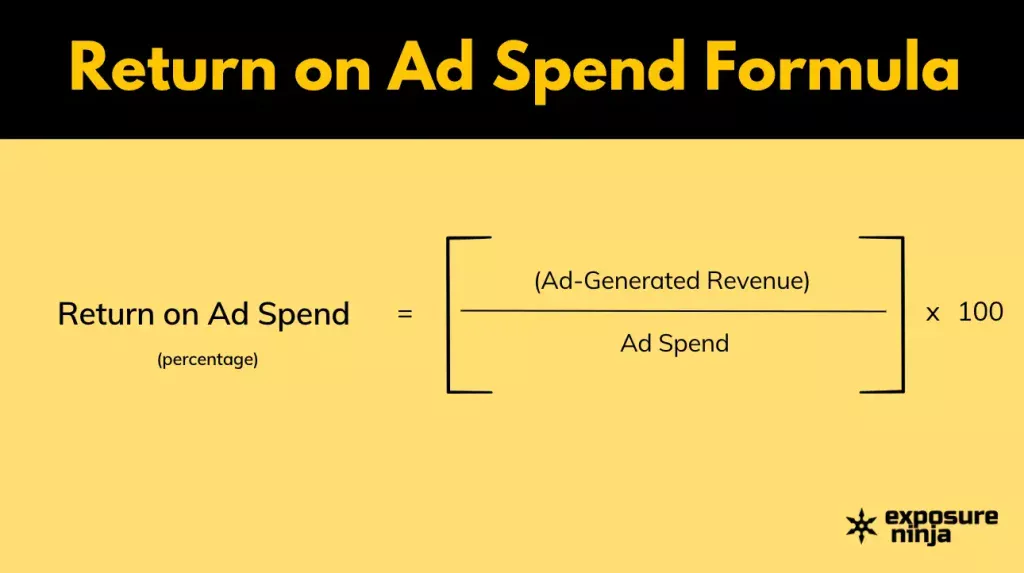
ROAS is calculated using a simple formula:
ROAS = Ad-Generated Revenue ÷ Ad Spend
The result is typically expressed as a ratio, such as 5:1. To convert this into a percentage, just multiply the result by 100:
ROAS (%) = (Ad-Generated Revenue ÷ Ad Spend) × 100
For example, if you spend £1,000 on a campaign and generate £5,000 in sales, your ROAS is:
- 5:1 as a ratio
- 500% as a percentage
Let’s look at examples for different business types:
| Business Type | Ad Spend | Ad-Generated Revenue | ROAS (Ratio) | ROAS (%) |
| Service Business | £4,000 | £9,000 | 2.25:1 | 225% |
| eCommerce Business | £2,000 | £10,000 | 5:1 | 500% |
In the service business example, for every £1 spent, the business earns £2.25. While this may seem modest compared to eCommerce, it could still be highly profitable, especially if the services have strong margins or high customer lifetime value.
What Is a ‘Good’ ROAS?
There’s no single benchmark for what qualifies as a “good” ROAS. Rebecca Pilkington explains: “You’ll often see recommendations suggesting that a 5x ROAS is ideal, but that’s not a one-size-fits-all rule. What’s considered ‘good’ really depends on your operating costs, margins, and how much value a customer brings over time.”
Sinead O’Brien adds: “There isn’t a set number. We’ve worked with clients where a 200% ROAS is excellent and others where anything below 1,000% just isn’t viable. It all comes down to the type of business and what return is needed to stay profitable.”
If you don’t know what a good ROAS looks like for your business, it’s hard to tell whether your ads are actually performing well. Generic benchmarks can be misleading because they don’t account for your unique costs, margins, or customer value. By setting a clear ROAS target based on your own numbers, you can make smarter, data-driven decisions.
Top 6 Tips to Boost Your ROAS
1. Test Relentlessly, Then Double Down on What Works
You can’t optimise what you haven’t tested.
Start with small, controlled tests across different campaign elements, such as:
- Ad copy
- Ad creatives
- Keywords
- Campaign types
- Audience segments
Track performance, identify what delivers the strongest return, then focus your budget and efforts there. Once something is working, optimise it, then scale it. This iterative process is how high-performing campaigns are built and refined.
To increase ROAS, the first step is always testing. You need to identify what works, double down on it, then optimise and scale. Once you’re consistently generating a strong return, that’s when real growth starts. It’s a simple but powerful cycle we apply to every account we manage.
 Rebecca Pilkington
Head of PPC
Rebecca Pilkington
Head of PPC
2. Align Ad Spend with High-Margin, High-Demand Products or Services
Not every product or service deserves equal ad spend, and spreading your budget too thin can hurt your ROAS.
Instead, focus your campaigns on offerings that strike the right balance between profit margin, demand, and average order value. As Sinead O’Brien explains, “It’s not just about picking the highest-margin item on your list. A product might be profitable but sell only once a year, which isn’t going to move the needle. On the flip side, high-demand, lower-margin items might deliver volume but not profit.
The sweet spot is to prioritise products or services that:
- Offer healthy profit margins.
- They are in consistent demand.
- Deliver a strong average order value.
- Convert regularly enough to justify the spend.
This also applies to lead generation campaigns. Focus on services that bring long-term value, not just easy wins. Aligning your ad budget with your most valuable offerings creates a more efficient, results-driven PPC strategy.
It’s tempting to promote everything, but to get better ROAS, you need to be strategic. Look at a mix of margin, demand, and order value, not just high-ticket items. That balance is where you’ll get the best return.
 Sinead O'Brien
Paid Media Strategy Manager
Sinead O'Brien
Paid Media Strategy Manager
3. Build Landing Pages That Convert
Often, the issue with poor ROAS isn’t your ads; it’s where you’re sending the traffic.
You can write the most compelling ad copy, test the perfect audience, and use Google’s latest AI tools like AI Max. But if your landing page doesn’t convert, your ROAS will suffer. That’s why Rebecca Pilkington stresses the importance of making sure your messaging aligns from ad to page.
A strong, high-converting landing page should:
- Clearly match the promise made in the ad.
- Be tailored to a specific audience or segment.
- Guide users to take one clear, valuable action.
- Offer a great user experience, such as fast load speeds and intuitive navigation.
- Include trust-building elements, like testimonials or case studies.
- Handle any objections to encourage conversion.
Generic or underdeveloped landing pages are one of the most common problems our team sees when reviewing underperforming accounts. Rebecca Pilkington explains: “We often see a lack of strong landing pages and creative assets. There’s still a mindset that PPC is just about running search ads, but Google Ads now supports full-funnel strategies. If your landing pages aren’t aligned and converting, it holds everything else back.”
For lead generation campaigns, your landing page becomes even more critical. As Rebecca Pilkington notes, you’re not just looking for leads; you’re looking for the right ones. A well-crafted landing page helps pre-qualify prospects by speaking directly to their needs and expectations.
4. Qualify Leads and Tighten Messaging
High lead volume might look impressive in your dashboard, but if those leads aren’t converting into revenue, your ROAS will quickly decline.
As Rebecca Pilkington explains, “For lead generation, you need to make sure the leads coming through are actually qualified. That means collaborating with your sales team and regularly asking: What happens next? Are leads converting? Do we need to adjust the landing page or change our messaging?”
To improve lead quality and protect your ROAS, follow this approach:
- Define what a qualified lead looks like. Work with your sales team or client to identify key attributes, like budget, authority, urgency, and fit.
- Map the post-click journey. Don’t stop at the form submission. Understand how leads are followed up and whether they’re progressing through the funnel.
- Refine your targeting and messaging. Use feedback from sales to shape ad copy, creative, and audience selection.
- Review lead quality regularly. Campaigns that deliver strong ROAS are refined continuously based on results.
This ongoing feedback loop ensures your campaigns evolve with real-world performance. Or, as Rebecca puts it, “You can apply that knowledge directly to your campaigns, and that’s how you make your ad spend work harder.”
5. Prioritise Quality Creatives (Especially on Meta)
When it comes to your Meta Ads strategy, creative quality is one of the biggest ROAS drivers.
As Sinead O’Brien highlights, “For Meta creative, it always comes back to having high-quality assets. If it looks like it was thrown together in five minutes, it’s not going to perform. Everyone can do that, and that’s exactly why it won’t stand out.”
On Meta, you’re competing for attention in busy, fast-scrolling feeds. Your ad isn’t just up against other businesses; it’s competing with friends, family, influencers, and entertainment. So your creative needs to stand out to drive action.
To boost ROAS with better creative:
- Invest time in design and messaging. Avoid generic stock images or overly templated designs. Strong visuals paired with punchy, relevant copy win.
- Use native formats. Meta rewards ads that look and feel like organic content, particularly vertical videos and reels.
- Test multiple versions. Try different formats, like carousel, video, and static, to see what resonates with your audience.
- Update your ad creative regularly. Even the best-performing creative will eventually stop working, so keep content fresh.
High-performing Meta campaigns don’t rely on one-size-fits-all templates. They’re powered by custom, audience-first creative that speaks directly to the people you’re trying to reach.
6. Maintain Tight Feedback Loops
Staying closely connected with your sales team doesn’t just help you optimise your ad messaging and lead quality — it can also offer the context needed to increase ROAS meaningfully.
Sometimes, a campaign might look like it’s performing well because ROAS is high. But without context, that number can be misleading.
Rebecca Pilkington shares a real example: “We were managing an account where the ROAS was incredibly high, making it look like a huge success. But when we checked in with the client, we found that they were sitting on a lot of stock because we were only moving high-value products.”
This kind of disconnect can only be caught through consistent feedback. Once identified, the strategy was adjusted to rebalance the campaign and overall sales volume. Without that feedback, the campaign would have continued performing well on paper while missing core business goals.
ROAS is only meaningful when it’s aligned with commercial reality. Data can point you in the right direction, but real conversations with your team are what will keep your strategy on track.
Context is everything. You can’t just look at the numbers in a Google Ads account and assume they’re good. You need to understand what’s really happening behind the scenes, like what’s converting, what’s not, and how it’s impacting the business.
Rebecca Pilkington
Head of PPC
Boost ROAS with PPC Experts
There’s no universal strategy (or “good” benchmark) for improving ROAS. What’s considered an ideal ROAS strategy depends entirely on your business model, margins, customer lifetime value, and sales process.
That’s why at Exposure Ninja, we don’t run cookie-cutter campaigns or rely on guesswork. Instead, we:
- Build custom PPC strategies based on your goals, budget, and audience.
- Optimise campaigns continuously using real-time data and sales feedback.
- Align ad performance with real-world outcomes, not just surface-level metrics.
Our goal is to help you generate meaningful, sustainable revenue from your ad spend.
Want to see where your campaigns are underperforming and how to fix them? Request a marketing and website review and get tailored insights from our expert team.
FAQs
What is a healthy ROAS?
A healthy ROAS depends entirely on your business. A 3x ROAS might be excellent for one company but unsustainable for another. As our PPC experts explain, the right ROAS target depends on your margins, average order value, and customer lifetime value.
Can ROAS be too high?
Yes, a very high ROAS can sometimes be a red flag. It may indicate you’re underspending, limiting growth, or only selling a narrow range of high-ticket items. As Rebecca Pilkington notes, “ROAS looked great, but conversions were low, and the client was stuck with unsold stock.” Context always matters.
How do I know if my ROAS is good?
Start by calculating your break-even ROAS, the minimum return needed to cover your ad costs. If your campaigns are consistently exceeding that and driving growth, you’re on the right track. But as Rebecca Pilkington says, “You can’t just look at the numbers and assume they’re good. You need to understand what’s happening behind the scenes.”
What causes low ROAS?
Low ROAS is usually a sign of one (or more) of the following: poor audience targeting, underperforming creative, weak landing pages, or unqualified leads. Regular testing, clear messaging, and collaboration with sales can quickly uncover and fix the problem.
Is 400% ROAS good?
It could be, if it’s delivering enough profit and supporting your business goals. For some brands, 400% is excellent. For others with high overheads or limited product volume, it might not be enough. ROAS is only good when it’s profitable and sustainable for your business.
Is 3X ROAS good?
3x ROAS means you’re getting £3 back for every £1 spent. Many businesses use 3x ROAS as a starting benchmark, but only if costs are low enough to make it profitable.