Could Google Lose 2 BILLION Daily Searches from Apple?

The tech world is buzzing with a potentially seismic shift in the search landscape. During recent testimony in the ongoing Department of Justice antitrust case against Google, Apple’s Senior VP of Services, Eddie Cue, dropped a bombshell suggestion that Apple might be reconsidering Google as the default search engine on Safari.
The implications? Google could potentially lose access to billions of daily searches from Apple users, representing not just an enormous traffic shift but possibly signalling the beginning of a fundamental transformation in how consumers find information online.
For marketing leaders navigating this potential upheaval, understanding what’s actually happening behind the headlines — and preparing your strategy accordingly — has never been more critical.
Executive Summary
Apple’s Senior VP has testified that the company is seeing Safari searches decline for the first time in decades and suggested they might drop Google as their default search engine. This statement comes within the context of:
- A $20 billion annual deal between Apple and Google that makes Google the default search on Apple devices
- The ongoing DOJ antitrust case examining Google’s search dominance
- Rising adoption of AI-powered search alternatives like ChatGPT, Perplexity, and Claude
- Apple’s own AI ambitions with Apple Intelligence and potential partnerships
While some analysts remain sceptical about Apple’s intentions, pointing to financial incentives to maintain their Google partnership, the underlying shift in search behaviour is undeniable. AI-powered search is growing rapidly, with Google itself reporting that AI Overviews now reach 1.5 billion monthly users.
For marketing leaders, this represents both disruption and opportunity. Those who understand how to optimise for AI search tools and maintain strong brand visibility across multiple platforms will be positioned to capture high-value traffic regardless of how the Apple-Google relationship evolves.
What Apple Actually Said — And Why It Matters
During the Department of Justice’s antitrust case against Google, Apple’s Eddie Cue made a statement that sent Google’s stock tumbling 8% overnight: Apple might not keep Google as its default search engine moving forward.
According to Cue, Safari searches are declining for the first time in approximately 20 years. Users appear to be shifting away from traditional search toward other options — potentially including Apple’s own AI assistant and other AI-driven search tools.
While seemingly straightforward, this statement requires context to properly interpret:
- Timing and venue — This was said during antitrust proceedings where Google’s market dominance is under scrutiny
- Financial reality — Google currently pays Apple approximately $20 billion annually for default search positioning
- Competitive landscape — The rise of AI search tools represents the first serious challenge to Google’s search dominance in decades
For marketing leaders, the significance extends beyond the Apple-Google relationship. This moment represents a public acknowledgement from one of tech’s largest players that search behaviour is fundamentally changing, with AI-driven alternatives gaining serious traction.
. @Apple has also talked to @OpenAI. “I certainly would expect that over the coming year that we will add other choices to the search engine choice in the browser, because I think those products are getting better and better.”
— Khushita Vasant (@KhushitaVasant) May 7, 2025
The $20 Billion Question: Will Apple Really Walk Away?
The scepticism surrounding Apple’s testimony is understandable. Google pays Apple approximately $20 billion annually to maintain its position as Safari’s default search engine — representing a substantial revenue stream that Apple would presumably be reluctant to abandon.
Several potential strategies might explain Apple’s positioning:
- Negotiation leverage — By publicly suggesting Google’s value has diminished, Apple could be positioning for more favourable terms in future agreements
- Antitrust mitigation — Apple may be trying to demonstrate that Google’s search dominance is already naturally eroding
- Competitive bidding — By signalling openness to alternatives, Apple could invite competitive offers from Microsoft (Bing), Perplexity, or other players
- Strategic acquisition — Apple may be positioning to acquire an AI search company like Perplexity to build its own competitive offering
As Exposure Ninja’s founder, Tim Cameron-Kitchen, mentioned prior to recording, Microsoft would likely need to offer substantially more than $20 billion to compensate for their lack of two decades of testing, advertising, and behaviour tracking data that makes Google so valuable.
For marketing leaders, the key insight is that, regardless of Apple’s motivation, this public discussion reflects genuine market shifts that will impact how your customers find and evaluate your products or services.
How Search Behaviour Is Already Changing
While the industry speculates about Apple’s next move, the underlying reality is that search behaviour is already transforming dramatically:
- Google reports that AI Overviews (their AI-enhanced search results) now reach 1.5 billion monthly users
- AI-driven queries are approximately twice as long as traditional search queries
- Visual searches with Google Lens have increased by 5 billion since October 2024
- “Circle to search” functionality has increased 40% in a single quarter
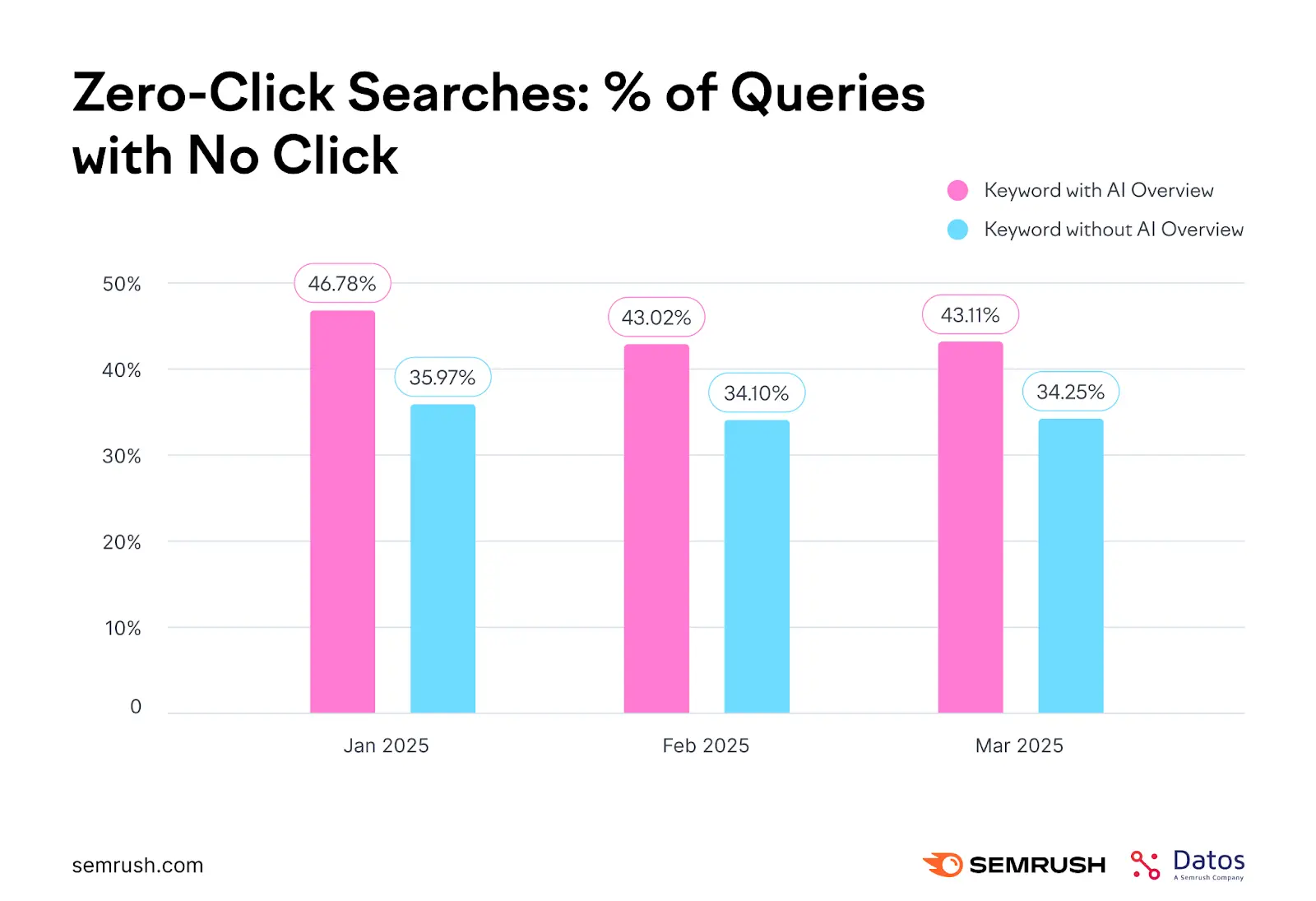
- Semrush reports that AI Overviews appeared on 13% of all monitored queries in March 2025 — up from 6.4% in January
These aren’t speculative future trends — they represent current user behaviour that’s reshaping the search landscape regardless of what Apple decides about its Google partnership.
The shift is particularly pronounced in certain sectors. According to Semrush’s data, science, health, society, and finance queries are seeing the most significant growth in AI Overview appearances. This trend is likely to expand across all sectors as AI search capabilities mature.
The Rise of “Zero-Click” Searches and What It Means for Traffic
One of the most significant impacts of AI-enhanced search is the rise of “zero-click” searches — queries that are answered directly in search results without requiring users to visit a website.
NerdWallet’s recent earnings call highlighted this dynamic perfectly. Despite reporting impressive revenue growth (46% in insurance, 22% in banking, and 12% in loans), the company acknowledged that “organic search took a bit of a haircut” due to AI Overviews.
For marketing leaders, this presents a nuanced challenge:
- Informational queries increasingly result in zero-click experiences as AI provides immediate answers
- Complex decision-making processes still drive users to websites for detailed information, comparisons, and transactions
- The traffic you do receive may be more qualified and further along in the buying journey
As NerdWallet noted: “In areas with simple answers, AI is going to meet that user need really well. But where it’s more complex, what’s important is to offer the best user experience.”
The strategic implication? Your broad informational content may generate less direct traffic, but your detailed, decision-stage content becomes even more valuable as it attracts more qualified visitors.
The New Competitors: Understanding Perplexity, ChatGPT, and AI Search Tools
If Apple does move away from Google, the leading alternatives extend beyond traditional search engines like Bing to include AI-native search tools:
- Perplexity — Often cited as the superior web search experience among AI tools, Perplexity has been gradually building its advertising capabilities and developing its Pro tier
- ChatGPT — Recently launched shopping features that closely mimic Google’s ad experience, signalling OpenAI’s intention to compete in commercial search
- Claude — Though currently without a strong web search implementation, Anthropic’s Claude is positioned to potentially enter this space
- Google’s Gemini — Expected to launch on iOS devices by mid-2024, potentially offering a Google alternative within Apple’s ecosystem
These tools function differently from traditional search engines, with distinct characteristics that affect how and when your brand appears in results:
- They parse user questions into multiple search queries with specific suffixes
- They maintain their own search indices that prioritise authoritative sources
- They prefer to cite multiple types of sources in their responses
- They often favour list-type content from high-authority websites when making recommendations
For marketing leaders, understanding these differences is crucial for maintaining visibility as users shift between traditional and AI-powered search tools.
Measuring Your AI Search Visibility: Tools and Techniques
As AI search grows in importance, traditional SEO metrics provide an incomplete picture of your digital visibility. Fortunately, new tools are emerging to help marketing leaders understand their performance across these new platforms:
- Profound — Tracks visibility across thousands of prompts on platforms like ChatGPT and Perplexity, providing sentiment analysis and competitive insights
- Semrush AI Search — Offers AI search visibility tracking with specific recommendations for improving your positioning
- Google Analytics 4 custom segments — Can be configured to isolate and track traffic from AI search tools
- Looker Studio custom reports — Allow for visualisation of AI search traffic trends and conversion patterns
Case studies from businesses already tracking this data show remarkable growth. One Exposure Ninja client in the mortgage sector saw AI search traffic begin as a tiny percentage of their total but grow dramatically month-over-month, with conversions beginning to appear by February 2025.
Other businesses are reporting even more dramatic shifts, with some seeing AI search platforms grow from 5% to 25% of their total traffic within six months.

Optimising for AI Search: A Three-Pillar Strategy
Maintaining visibility in AI search requires a fundamentally different approach than traditional SEO. Based on our experience working with clients across multiple sectors, we’ve a proven three-pillar strategy:
Pillar 1: Create a Distributed Content Ecosystem
Unlike Google, which primarily indexes your website, AI search tools actively seek multiple sources to verify information and provide comprehensive answers. This means your content strategy must extend beyond your own digital properties:
Success story: Zugu Case became the top-recommended iPad case in Perplexity results after securing placement in an authoritative product roundup on ZDNet. This third-party mention carried more weight in AI systems than Zugu’s own website content.
Action steps:
- Identify high-authority websites in your sector that regularly publish product comparisons and list articles
- Develop relationships with relevant industry publications through PR or content partnerships
- Monitor and encourage user-generated content on platforms like Reddit and YouTube that AI engines frequently cite
- Create a consistent brand story across all platforms to reinforce key messages regardless of which sources AI tools reference
Pillar 2: Optimise Content Structure for AI Extraction
AI search tools don’t just read content like humans do — they extract specific elements that can be easily incorporated into comprehensive answers. Content formatted for AI consumption has a dramatically higher chance of being cited:
Key insight: Semrush data shows content with clear statistical data points is over 40% more likely to be referenced in AI-generated answers compared to narrative-only content.
Action steps:
- Structure key product information in easily extractable formats (tables, bullet points, numbered lists)
- Include specific numerical data points whenever possible (e.g., “Our solution reduces processing time by 37%” rather than “Our solution is faster”)
- Create dedicated FAQ sections addressing the specific questions your customers ask
- Develop comparison tables that position your offering alongside competitors, highlighting key differentiators
Pillar 3: Enhance Trust Signals for Higher-Intent Traffic
As AI search tools filter more top-of-funnel traffic away from websites, the visitors who do click through are typically further along in their buying journey and focused on trust verification:
Evidence: NerdWallet’s experience shows that even with reduced overall traffic, revenue can increase when focusing on high-quality decision-stage content that builds trust.
Action steps:
- Highlight third-party validations prominently (awards, certifications, reviews, testimonials)
- Develop in-depth comparison content that demonstrates domain expertise and product confidence
- Create decision-support tools that help visitors make informed choices (calculators, configurators, assessment tools)
- Optimise conversion paths for visitors who are already educated about your category but seeking reassurance about your specific offering
By implementing this three-pillar approach, businesses can maintain and even increase their visibility across all search platforms — whether Apple continues with Google or shifts to an AI-native alternative.
Next Steps
Whether or not Apple ultimately drops Google as its default search engine, the underlying shift toward AI-powered search is unmistakable. Marketing leaders should take these immediate actions:
- Assess your current AI search visibility
- Analyse your content for AI-friendliness
- Identify which content formats are performing well in AI search tools in your industry
- Evaluate how your brand and products are currently presented in AI search responses
- Assess sentiment around your brand in AI search tools to identify improvement opportunities
- Develop a multi-platform visibility strategy
- Continue traditional SEO efforts while expanding to optimise specifically for AI search
- Build relationships with high-authority publications for strategic third-party mentions
- Create content formats that AI search tools prefer to cite (lists, statistics, clear comparisons)
- Focus on trust signals and conversion optimisation
- As top-of-funnel traffic patterns shift, optimise for higher conversion rates from more qualified traffic
- Emphasise trust signals and decision-stage content to capitalise on visitors further along their buying journey
Resources Mentioned
- Profound — AI search visibility tracking and optimisation platform
- Semrush — Tools for monitoring and improving AI search visibility
- Google Analytics 4 — Can be configured to track AI search traffic with custom segments
- Looker Studio — For creating custom reports to visualise AI search performance
- Moz “Practical Marketer” Webinar — Charlie’s webinar with Moz on ranking in generative AI, like ChatGPT
- Apple Intelligence — Apple’s integrated AI assistant with ChatGPT connectivity
- Perplexity — Leading AI-native search platform
- Google Gemini — Google’s AI platform expected to launch on iOS mid-2024
In Conclusion
The potential for Apple to drop Google as its default search engine represents more than just a corporate negotiation — it’s a reflection of fundamental changes in how people find and consume information online.
While the headline “Google could lose 2 billion daily searches” might be somewhat hyperbolic, the underlying shift toward AI-powered search is very real and accelerating. Marketing leaders who recognise this shift as an evolution rather than an apocalypse will find significant opportunities to connect with more qualified prospects.
As traditional SEO merges with AI Search Optimisation, the businesses that thrive won’t be those clinging to old metrics and methods, but those who adapt their visibility strategies to meet users wherever and however they search.
The question isn’t whether search is changing — it’s whether your marketing strategy is changing with it.
Watch This Next
ChatGPT has quietly revolutionised shopping search with its new update available across all versions. Unlike Google Shopping or Amazon, this isn’t yet an advertising platform — it’s an AI shopping assistant that puts consumer experience first. For marketers, this represents both opportunity and threat; early adopters will gain significant advantage as consumer product research behavior continues to shift.
Watch this episode of The Dojo to learn how the platform works: Everything Marketers Should Know About ChatGPT’s Shopping Update