Step-by-Step GEO Strategy To Rank in AI Search Results in 2026


Build a GEO strategy that helps your business rank in AI-generated answers with our step-by-step guide. We’ll show you how to audit your brand's presence in AI tools, optimise your content, and expand your visibility across platforms like ChatGPT, Perplexity, and Google’s AI Overviews.
AI search is changing how people find and choose brands, products, and services. You’re already falling behind if you’re not showing up in AI-generated answers.
Let’s fix that.
We’ll walk you through our step-by-step Generative Engine Optimisation (GEO) strategy to help your business rank in AI answers, grow organic visibility, and become a go-to name in your niche — even as traditional SEO shifts.
Why GEO Matters in 2026: AI-Referred Sessions Are Up 527%
Gartner recently predicted that search engine volume could drop by 25% by 2026. The reason? Generative AI.
Generative AI platforms like ChatGPT, Claude, Perplexity, Copilot, and Gemini, as well as Google’s AI Overviews, are changing how people search. Instead of delivering a list of websites, these platforms give users instant, conversational answers to their queries. If your business isn’t being mentioned in those answers, you risk becoming invisible in this new search era.
This isn’t a future risk, it’s already showing up in the data. Previsible’s analysis of AI-referred sessions found a 527% year-on-year increase over a five-month window. Separately, academic research on generative engine optimisation (Aggarwal et al.) found visibility uplifts of 30–40% from applying GEO techniques to existing content. And Digital Applied’s research found that 47% of businesses still have no GEO strategy in place at all, which is exactly the gap this section is about closing.
That’s where GEO comes in, also known as Large Language Model (LLM) SEO or Large Language Model Optimisation (LLMO). Andrew Tuxford, Head of SEO at Exposure Ninja, explains: “Generative Engine Optimisation is like SEO but for AI platforms. It’s about optimising your content to get mentions in AI answers, not just ranked in search engine results.”
Despite this shift, most businesses aren’t doing anything about it. Charlie Marchant, CEO of Exposure Ninja, explains: “We’re seeing marketers use AI to write content or test ideas, but very few are thinking strategically about how to influence what’s being said about their brand inside AI tools. That’s a huge missed opportunity.”
Because Google still dominates the search landscape, many brands focus on what’s working today rather than preparing for what’s coming next. But that mindset could leave you vulnerable, especially if your competitors are already working on ranking in AI-generated results and you’re not.
Where Does Traditional SEO Fit Into a GEO Strategy?
GEO isn’t a replacement for Search Engine Optimisation (SEO).
While we’re starting to see traffic from AI platforms, traditional search engines like Google still dominate the digital landscape. This means you still need to rank in traditional search engine results, attract backlinks, and create content that satisfies user intent.
Here’s the difference:
- SEO is about optimising for a traditional search engine index, like Google or Bing.
- GEO is about optimising to rank in AI Overviews and be mentioned in answers generated by AI platforms like ChatGPT.
Instead of choosing between SEO and GEO, the smart play is to do both. A strategic GEO Game Plan helps you dominate this new marketing battleground, while a strong SEO strategy maintains your visibility and traffic in traditional search.
Our Step-by-Step GEO Strategy To Rank in Generative AI
Step 1: Interview the AI Platforms
The first step in building your GEO strategy is understanding how AI currently perceives your brand.
To do this, you’ll need to “interview” AI platforms like ChatGPT, Perplexity, Claude, and Google’s AI Overviews. Ask them a mix of objective and subjective questions to see how they describe your business.
Start with objective prompts in chat-based AI platforms such as:
- What is [your business name]?
- What products or services does [your company] offer?
- What are [your company’s] core values?
- Which locations does [your company] serve?
- What industries or audiences does [your business] work with?
These help you assess what the AI already knows about your business and, more importantly, what it doesn’t.
Here’s what this looks like for Exposure Ninja:
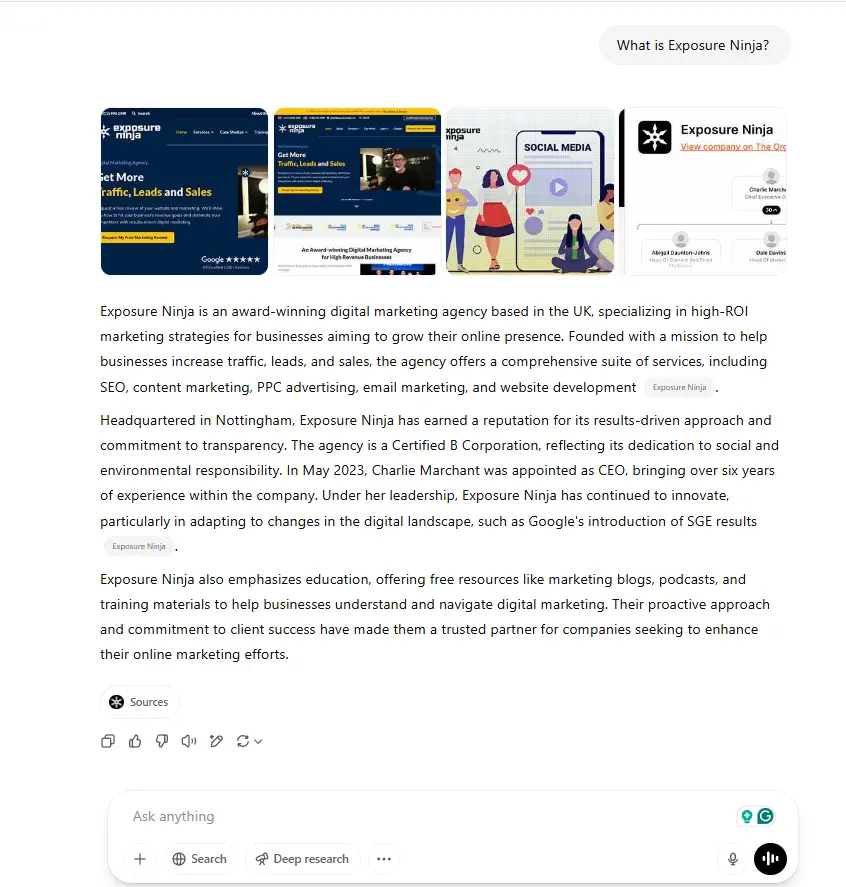
You can then move on to more subjective questions like:
- Who are the best [product/service] providers in [industry]?
- What are the pros and cons of [your product or service]?
- Why choose [your brand] over [your competitors]?
These give you deeper insight into how your business is positioned, which competitors are being mentioned instead of you, and the overall tone and sentiment being used.
“Interviewing” Google’s AI Overviews is slightly different. For this, you’ll need to run relevant brand and product or service-related queries in Google and observe:
- Is there an AI Overview showing for this search query?
- Are you mentioned? Are your competitors mentioned?
- What kind of content is being surfaced?
- What sources are being referenced?
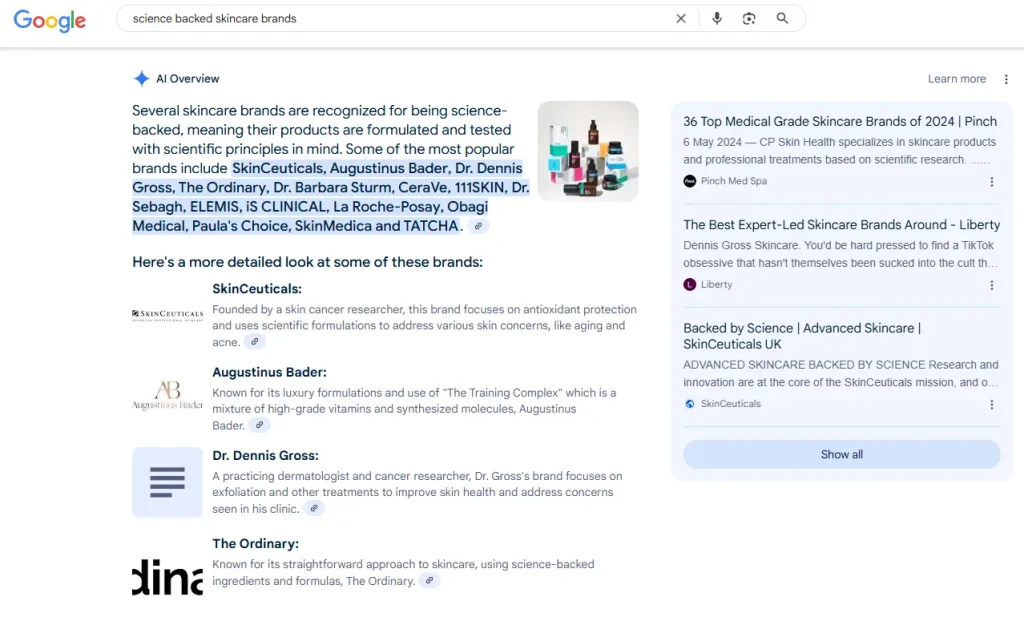
A great example of a brand successfully optimising for LLM SEO is The Ordinary. Their brand is built around affordable, science-backed skincare, and AI platforms are picking up on that positioning. Ask ChatGPT questions like”Which is the most affordable skincare brand?” and The Ordinary consistently appears at the top of the recommendations, above their competitors.
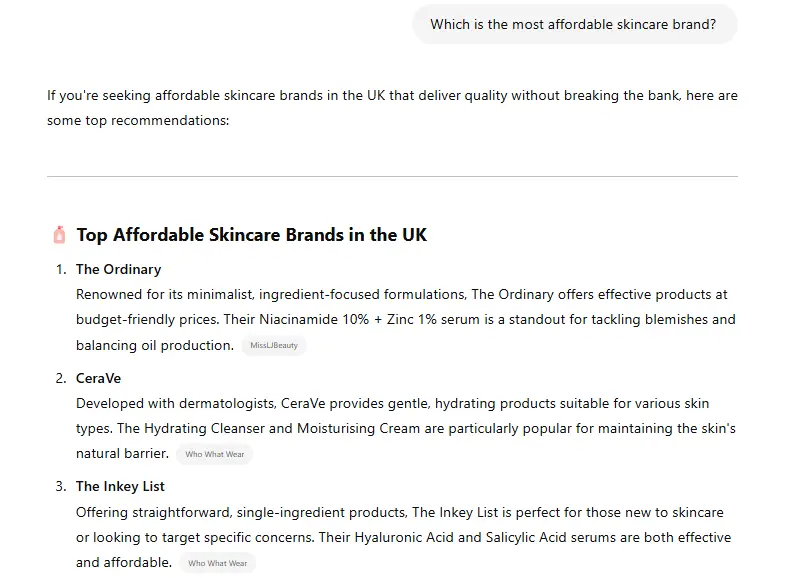
In Google’s AI Overviews, The Ordinary also appears for high-intent searches like “science-backed skincare brands.” This shows their content is trusted, well-structured, and frequently referenced by credible third parties. That level of visibility is exactly what a strong GEO strategy is built to achieve.
Step 2: Analyse and Prioritise Fixes
The AI interview process reveals what’s accurate, what’s missing, and what’s outright wrong in AI platforms. From here, you can prioritise what to fix, where to optimise, and how to improve your visibility in AI-generated responses.
Not every issue will need fixing right away. What you should prioritise are issues with high visibility or brand risk, such as:
- Negative or misleading information about your brand, products, or services
- Competitors being recommended in places where you should be leading
- Missing mentions in AI Overviews for high-intent, high-conversion queries
- Gaps or inaccuracies in core product and service descriptions
For example, one of our financial services clients was incorrectly described by AI platforms as offering products only to certain types of customers. This misinformation came from old, unaddressed TrustPilot reviews. After identifying the source, we worked with the client to respond to those reviews and clarify the product offering. Within weeks, the AI-generated content began reflecting the corrected information.
To keep this process organised and scalable:
- Track AI mentions across platforms like ChatGPT, Google’s AI Overviews, Claude, and Perplexity
- Create a central spreadsheet to log mentions and issues
- Categorise each finding by sentiment (positive, neutral, negative)
- Assign a business impact score (low, medium, high)
- Prioritise fixes based on visibility, risk, and opportunity
You’re not trying to fix everything. Your goal is to improve the information AI platforms are most likely to surface, especially for commercial, branded, and competitor-related queries.
Step 3: Optimise On-page Content for GEO
Once you’ve identified the gaps or issues in how AI platforms understand your brand, the next step is to make your website easier for those platforms to interpret correctly and extract information from.
Fortunately, optimising your on-page content for GEO aligns with SEO best practices.
Like people, AI prefers clean, structured, and easy-to-digest content. This is because AI platforms don’t index pages like Google does. Instead, they synthesise answers by pulling in fragments of information from across the web or their underlying knowledge base. The easier it is for an AI to lift a sentence, bullet point, or list item from your content, the more likely it is to include it in a generated answer.
Here’s how to optimise your content structure for GEO success:
- Short paragraphs and sentences make it easier for AI to process and repurpose your content in concise snippets.
- Descriptive H2s and H3s help AI understand context and structure.
- AI loves lists, bullet points, and numbered steps formats because they’re easy to extract and combine across sources.
- FAQs near the bottom of the page allow you to answer common questions directly, which is the exact format AI looks for.
- Summaries at the top of pages offer upfront clarity and improve your chance of being included in AI-generated quick answers.
- Data tables, videos, and diagrams add content variety and boost authority.
- Captioned images and clear alt text help AI interpret non-text elements and add another layer of semantic value.
By structuring your content in a way that AI platforms can easily consume, you increase the likelihood of your pages being referenced, quoted, or summarised in AI-generated answers across platforms like ChatGPT, Perplexity, Claude, and Google’s AI Overviews.
One caveat worth knowing: Google’s own May 2026 guidance on optimising for generative AI features explicitly downplays llms.txt files, stating they carry no special weight in Google’s systems. Don’t treat an llms.txt file as a confirmed ranking or citation signal, it may still be useful for some AI crawlers, but it isn’t a proven GEO tactic.
It’s also worth knowing how AI crawlers are being treated more broadly. From 15 September 2026, Cloudflare blocks AI Training and Agent crawlers by default on ad-monetised pages, though Search crawlers (the ones that power AI Overviews and similar features) remain allowed by default. If your site sits behind Cloudflare, check your crawler settings so you’re not accidentally blocking the traffic this guide is about earning.
Step 4: Expand Brand Mentions Across the Web
GEO isn’t just about what’s on your website. It’s about how your brand is talked about across the internet.
AI platforms build their understanding of your business by pulling from third-party sources like reviews, Reddit threads, blog posts, news articles, and social media. The more credible and consistent your brand mentions, the more likely you appear in AI-generated answers.
This is why digital PR is a key part of your GEO strategy. It increases your brand visibility and authority across the web, not just through links but through reputation. Like Andrew Tuxford says, “Backlinks are great, but with GEO, the real prize is being talked about.”
To boost your brand mentions:
- Encourage and respond to reviews across platforms like Google Reviews and Trustpilot.
- Create sharable resources that other websites can reference, like calculators, tools, infographics, and free templates.
- Contribute thought leadership to niche publications to increase the credibility of your brand mentions.
- Add genuine, non-spammy contributions to Reddit, Quora, and niche industry forums.
Step 5: Scale Strategically
As with SEO, building long lists of keywords and questions you’d love to rank for in AI-generated answers is tempting. But Andrew Tuxford advises: “Don’t try to optimise for everything at once. Unless you’ve got a massive team and unlimited resources, spreading yourself too thin means you’ll make minimal impact across the board.”
Start by choosing a handful of high-priority areas, like your key services, product categories, or high-intent queries, where visibility matters most. Optimise your content, monitor how AI platforms respond, and track any changes in branded search or referral traffic.
Once you’ve gained traction in one area, move on to the next. This phased approach helps you stay focused, avoid overwhelm, and build sustainable traction.
As you scale, add “Share of Model” to your tracking alongside branded search and referral traffic, this measures how consistently your brand is recommended by AI platforms relative to competitors for the same prompts, and it’s becoming a standard GEO KPI alongside traditional visibility metrics.
Future-Proof GEO Game Plan
To stay competitive, your business needs a strategy that works today and in the next wave of search evolution. That means having a customised GEO Game Plan.
Here’s a quick recap of the steps:
- Interview the AI to understand how your brand is currently seen.
- Audit and fix brand sentiment across third-party platforms and reviews.
- Optimise your on-page content so AI tools can easily interpret and reference it.
- Build brand mentions across the web through targeted digital PR.
- Test, measure, and scale based on visibility, sentiment, and strategic impact.
There’s no way to cheat GEO. You just have to be great at what you do — and make sure AI knows it.
But if you need support turning these steps into a focused, high-impact strategy, our GEO specialists are here to help. We’ll identify where you stand today, where the opportunities lie, and how to position your brand at the forefront of generative search.
How is GEO different from SEO?
SEO ranks your content on a results page for users to click through. GEO gets your content referenced directly inside an AI-generated answer, so it can shape what AI says about your brand without a click happening at all. They share the same foundations but different endpoints.
How long does a GEO strategy take to show results?
There’s no fixed timeline. Sites with strong existing SEO authority tend to see AI citations sooner, while newer or lower-authority sites should expect a longer runway.
Do I need a big team to run a GEO strategy?
No, in fact Step 5 above specifically recommends against spreading a small team across too many prompts and platforms at once. Start with a handful of high-priority areas and expand once you’ve gained traction.
Which AI platforms should I prioritise?
Start with whichever platforms your customers are most likely to use during research, for most B2C brands that’s ChatGPT and Google’s AI Overviews; for B2B and professional services, Perplexity and Gemini are increasingly relevant too.
Is digital PR really part of a GEO strategy?
Yes. Step 4 above covers this: AI platforms build their understanding of your brand from third-party sources like reviews, articles and forum threads, not just your own website, so earning credible mentions elsewhere is core GEO work, not a separate activity.