Everything Marketing Leaders Should Know About Google’s NEW AI Mode

Google is once again reshaping the search landscape, and this time the changes are profound.
While marketing leaders have been adapting to AI overviews appearing in roughly 10% of search results, Google has now introduced something far more transformative: AI Mode.
This new search experience, currently being tested in the US, could fundamentally alter how your customers discover and interact with your brand online.
As a marketing leader, you’re likely already juggling countless priorities — from campaign performance and budget allocation to team management and strategic planning. The last thing you need is another seismic shift in search.
Yet Google’s AI Mode represents exactly that — a potential reinvention of the search experience that could dramatically impact your traffic, visibility, and ultimately, your bottom line.
Executive Summary
Google’s AI Mode is an experimental search interface currently in labs testing in the US market. Unlike traditional search results with their familiar “10 blue links,” AI Mode delivers personalised, conversational, and AI-generated answers directly in the search interface.
Key points marketing leaders need to understand:
- AI Mode differs from existing AI Overviews by being fully AI-generated rather than partially generated
- Google accidentally revealed 47 different types of AI search modes being tested, suggesting highly specialised search experiences for different query types
- Publishers and brands may see decreased click-through rates as more information is presented directly in search results
- Marketing strategies need to evolve beyond traditional SEO to focus on brand positioning and creating high-quality, authoritative content that AI systems will reference
For marketing leaders, this represents both a threat to existing traffic patterns and an opportunity to position your brand as an authoritative source that AI systems will reference and recommend.
What Is Google’s AI Mode?
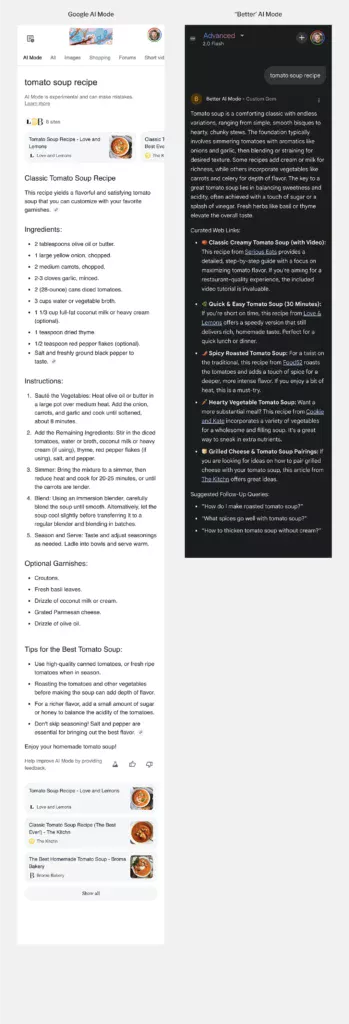
Google’s AI Mode represents a fundamental shift in how search results are presented. While traditional search results display a list of relevant websites, AI Mode generates a comprehensive, conversational answer directly in the search interface.
As Charlie Marchant, CEO here at Exposure Ninja, explains: “Google’s AI mode… is essentially an AI version, probably not dissimilar looking to what Google’s Gemini looks like of search results. So you can search and then you actually get an AI set of search results instead of your usual Google search engine results page.“
This differs significantly from AI Overviews, which have been appearing in approximately 10% of search results globally. AI Overviews are partial AI integrations that appear alongside traditional search results, similar to Featured Snippets but with generative content and citation links.
AI Mode, by contrast, is a complete reinvention of the search results page, focusing on delivering a direct answer rather than directing users to external websites.
Why AI Mode Matters to Marketing Leaders
For marketing leaders, AI Mode represents a significant shift in how potential customers will discover and evaluate your products and services.
The most immediate concern is traffic reduction.
When search engines deliver comprehensive answers directly in the results, users have less incentive to click through to websites. This threatens the traditional SEO model that many B2B and B2C companies rely on for lead generation.
However, AI Mode also creates new opportunities for brand positioning. As I mentioned during the podcast: “I want to applaud all those people who are promoting brand as the big thing to focus on over the last couple of years because they were completely right.“
AI systems like Google’s AI Mode pull information from sources they consider authoritative. This means that building your brand authority and establishing subject matter expertise becomes even more critical in an AI-first search landscape.
The 47 Different AI Search Modes
In a revealing slip, Google briefly showed what appeared to be 47 different specialised AI search modes being tested. As I mentioned in the podcast: “There was a post that’s been covered in a couple of different search marketing platforms by Tom Critchlow talking about how he accidentally saw there were 47 different types of AI search mode.“
These specialised modes included intriguing options like:
- Home Energy Assistant
- Fantasy Football Researcher
- LSI (Latent Semantic Indexing)
This suggests Google is experimenting with highly tailored search experiences for different query types, potentially creating distinct AI interfaces optimized for specific industries or search intents.
For marketing leaders, this fragmentation of search experiences means you’ll need to understand not just how your brand appears in traditional search, but how it’s represented across potentially dozens of specialised AI search interfaces.
Publishers vs. Searchers: The Content Dilemma
AI Mode creates a fundamental tension between publisher interests and searcher convenience. When AI Mode generates comprehensive answers, it potentially reduces traffic to the very publishers whose content feeds these systems.
Tom Critchlow proposed a more publisher-friendly approach that would provide links to multiple sources rather than generating complete answers. However, as I pointed out during the podcast, many users prefer the convenience of direct answers: “If I’m a mother of three and I’ve got half an hour to get some food ready… I don’t want to look through your recipe blog and hear about your grandmother. I just want a recipe.“
This tension highlights a key challenge for marketing leaders: creating content that serves both algorithmic systems and human readers. Your content strategy must balance depth and comprehensiveness with clarity and accessibility.
How AI Mode Will Impact B2B Marketing
For marketers leaders specifically, AI Mode’s impact will vary depending on your target keywords and customer journey:
1. Bottom-of-funnel searches may see less disruption initially, as Google will likely be cautious about interfering with commercial queries that drive their ad revenue.
2. Top-of-funnel informational searches are likely to be most affected, with AI Mode potentially answering questions directly that previously drove traffic to educational content.
3. Brand positioning becomes even more critical, as AI systems will need to understand not just what your company offers, but why it’s distinctive in the marketplace.
This trend reinforces the importance of an integrated approach that combines traditional SEO with brand building, authority development, and customer experience optimisation.
Protecting Your Traffic: Strategic Recommendations for Marketing Leaders
While there’s no single solution to the challenges posed by AI Mode, there are several strategic approaches that can help protect and even enhance your search visibility:
1. Focus on Commercial Intent Keywords
As Charlie advises: “I think it’s a legitimate thing for businesses to be worried about, and I think the focus has to be on which keywords are gonna drive commercial traffic to start with.“
Bottom-of-funnel keywords with clear commercial intent should remain your priority, as these are less likely to be fully answered by AI systems and more likely to continue driving valuable traffic.
2. Build Brand Authority Through Digital PR
AI systems will increasingly reference brands they consider authoritative in their generated responses. This makes digital PR, industry recognition, and third-party validation more important than ever.
“I think there’s probably a lot of businesses now wishing that they’d really invested more in digital PR and sort of worried a little less about specifically getting a backlink on a certain keyword over the past five years,” notes Charlie.
3. Create Multi-Format, Structured Content
AI systems prefer content that is well-structured and easy to parse. This means:
- Clear FAQ sections
- Statistical data points (which increase citation probability)
- Concise, factual snippets
- Well-structured headings and lists
4. Develop Clear Brand Positioning
Define 2-3 key positioning statements or USPs about your business and ensure these are consistently communicated across all channels. This consistency helps AI systems understand what makes your brand distinctive and when to recommend it.
5. Balance Depth with Accessibility
As search becomes more AI-driven, content needs to serve both algorithms and humans. This means providing comprehensive information while maintaining clarity and accessibility.
Next Steps
As a marketing leader navigating this evolving landscape, your immediate action items should include:
1. Audit your current search traffic to identify which keywords and pages might be most vulnerable to AI Mode disruption
2. Review your brand positioning to ensure it’s clear, consistent, and differentiated
3. Evaluate your content strategy to ensure it balances comprehensive information with clear structure and accessibility
4. Consider expanding your digital PR efforts to build third-party validation and authority signals
5. Monitor AI search results in your industry to understand how your brand and competitors are being represented
Remember that while AI Mode is currently in testing, the direction of travel is clear. Search is becoming more AI-driven, and preparing now will position your brand for success regardless of exactly how and when these changes roll out more broadly.
Resources Mentioned
- Google’s AI Mode (currently in labs testing in the US)
- Google’s AI Overviews
- Tom Critchlow’s analysis of AI Mode and the accidentally revealed 47 different AI search modes
- Perplexity AI
- Our Marketing Strategies for 2025 podcast series
In Conclusion
While Google’s AI Mode represents a significant shift in the search landscape, it’s important not to panic. As Charlie advises: “Not to panic and not to despair. I feel like there’s a lot of like, ‘Oh, I don’t know what’s happening. It’s all over.’ SEO’s died… Google’s still the dominant player. SEO still works. It still matters.“
The fundamental principles of creating valuable content, building brand authority, and focusing on user experience remain as important as ever. By understanding how AI is changing search and adapting your strategy accordingly, marketing leaders can turn this potential threat into a competitive advantage.
The businesses that thrive in this new era will be those that embrace these changes while remaining focused on delivering exceptional value to their customers, regardless of how they discover your brand.
Watch This Next
Google’s AI mode is just the start. You need to learn how to rank in ChatGPT. Watch this video and learn three proven strategies for appearing in generative AI search results, like ChatGPT and Perplexity.