What Is Generative Engine Optimisation (GEO)? The Complete 2026 Guide


What is GEO and how do marketers use it? Learn to optimise for AI-driven search tools like ChatGPT, Google's Gemini and Perplexity.
When someone asks ChatGPT which agency, software or supplier to use, the answer is a short paragraph with a handful of names in it. Generative engine optimisation (GEO) is the work of making sure your brand is one of those names, and that what the AI says about you is accurate.
This guide covers what GEO is, how AI tools decide what to cite, how GEO differs from SEO, and the tactics we use to get brands mentioned and recommended in AI search.
TL;DR
- GEO is optimising your website and wider online presence so AI tools like ChatGPT, Gemini, Claude, Perplexity and Google’s AI Overviews reference your brand in their answers.
- SEO is about ranking in a list of results. GEO is about being quoted inside the answer, which is closer to being mentioned in a conversation than listed in a directory.
- AI tools build answers from sources they trust, so authority, accuracy and what other sites say about you all count.
- Good SEO is still the foundation. Most AI tools search the web in the background, so if search engines can’t find you, AI tools usually can’t either.
- Start by asking the AI tools what they know about your brand. The gaps in their answers are your to-do list.
What Is Generative Engine Optimisation (GEO)?
Generative engine optimisation is the practice of optimising your content, and your brand’s wider presence online, so that AI tools reference and recommend you when they answer questions.
The “generative engines” are tools that write a fresh answer instead of showing a list of links: ChatGPT, Google Gemini, Claude, Perplexity, Microsoft Copilot, and Google’s AI Overviews and AI Mode.
Think of it this way. When someone asks ChatGPT a question about your industry, you want your content to be one of the sources it uses to write the answer, and you want your brand named in that answer for the right reasons.
Where the Term Came From
The name comes from a 2023 research paper, GEO: Generative Engine Optimization, by Pranjal Aggarwal and colleagues. It’s a bit jargony, and “geo” is easy to confuse with geographic or local search, but it has stuck.
You’ll also see the same work called answer engine optimisation (AEO), AI search optimisation, AI SEO and LLM optimisation (LLMO). The labels overlap so much that we treat them as one discipline.
Why You Need a GEO Strategy
People are using AI tools to research and shortlist suppliers, and many of those conversations never reach a traditional search results page. If your brand isn’t in the answer, you’re not on the shortlist.
In 2024, Gartner estimated that by 2028, many brands will see their site traffic from organic search fall by 50% or more as customers embrace AI-powered search. That’s a forecast, not a certainty, but the direction is clear enough to plan for.
This doesn’t mean SEO is dead. Most of what makes a brand visible in AI answers is built on good SEO, and Google still handles most searches. It means you need both working together.
How Generative Engines Decide What to Cite
AI tools learn from huge amounts of training data, then many of them search the web live when you ask a question. The answer you see is built in three stages:
- Query fan-out. The tool breaks your question into several smaller searches. “Best coffee maker for a small office” might become searches about bean-to-cup machines, running costs, capacity and reviews.
- Retrieval (RAG). Retrieval-augmented generation means the tool fetches pages that answer those smaller searches, usually from a search index such as Google’s or Bing’s.
- Synthesis. The model reads what it retrieved, weighs which sources it trusts, and writes one answer, sometimes with links to the pages it used.
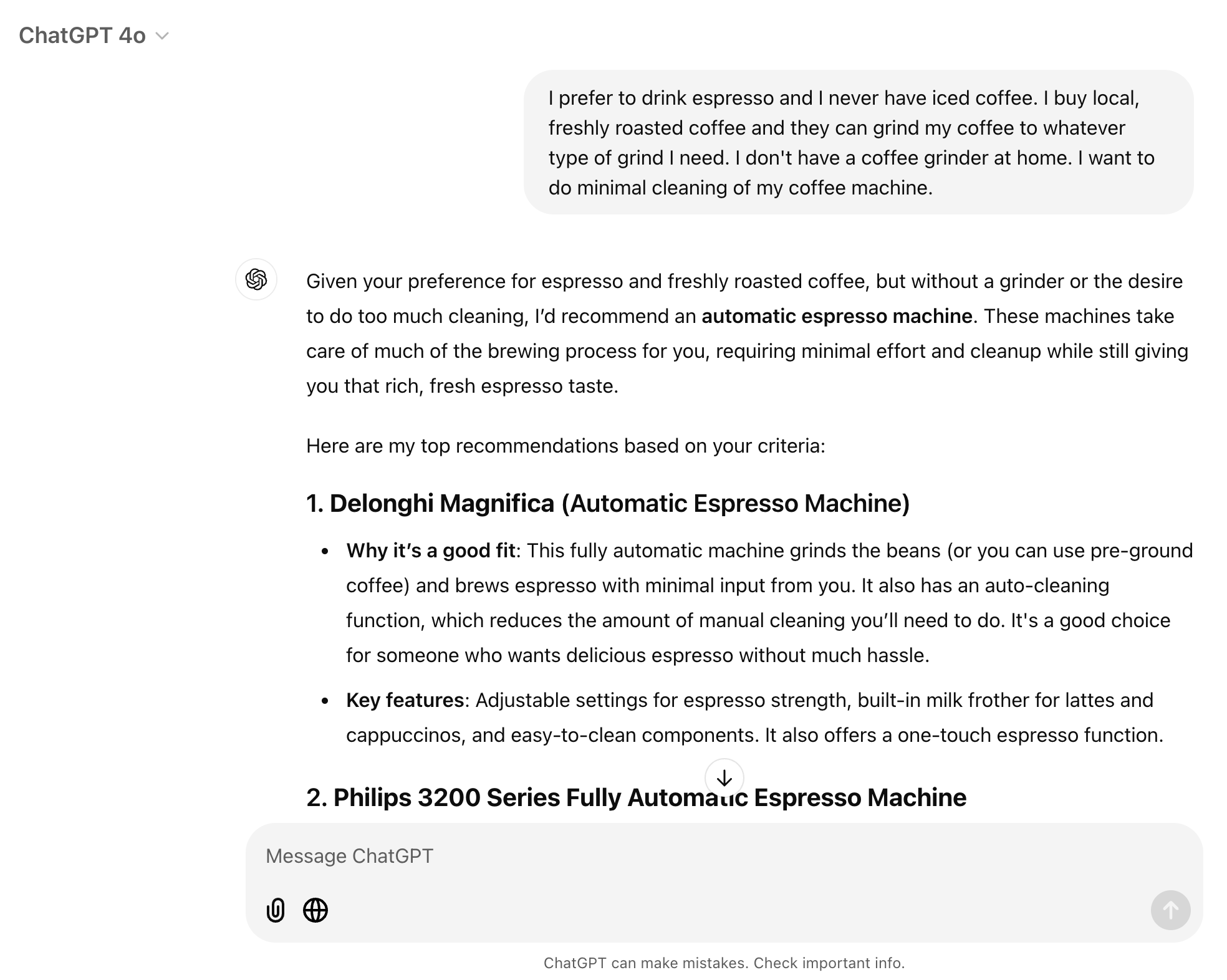
Two things follow from this. First, the tool is matching your content to the intent behind each sub-question, so pages that answer specific questions clearly get used more than pages that repeat a keyword. Second, it leans on sources it considers reliable, which is why authority, accuracy and what other sites say about you matter so much.
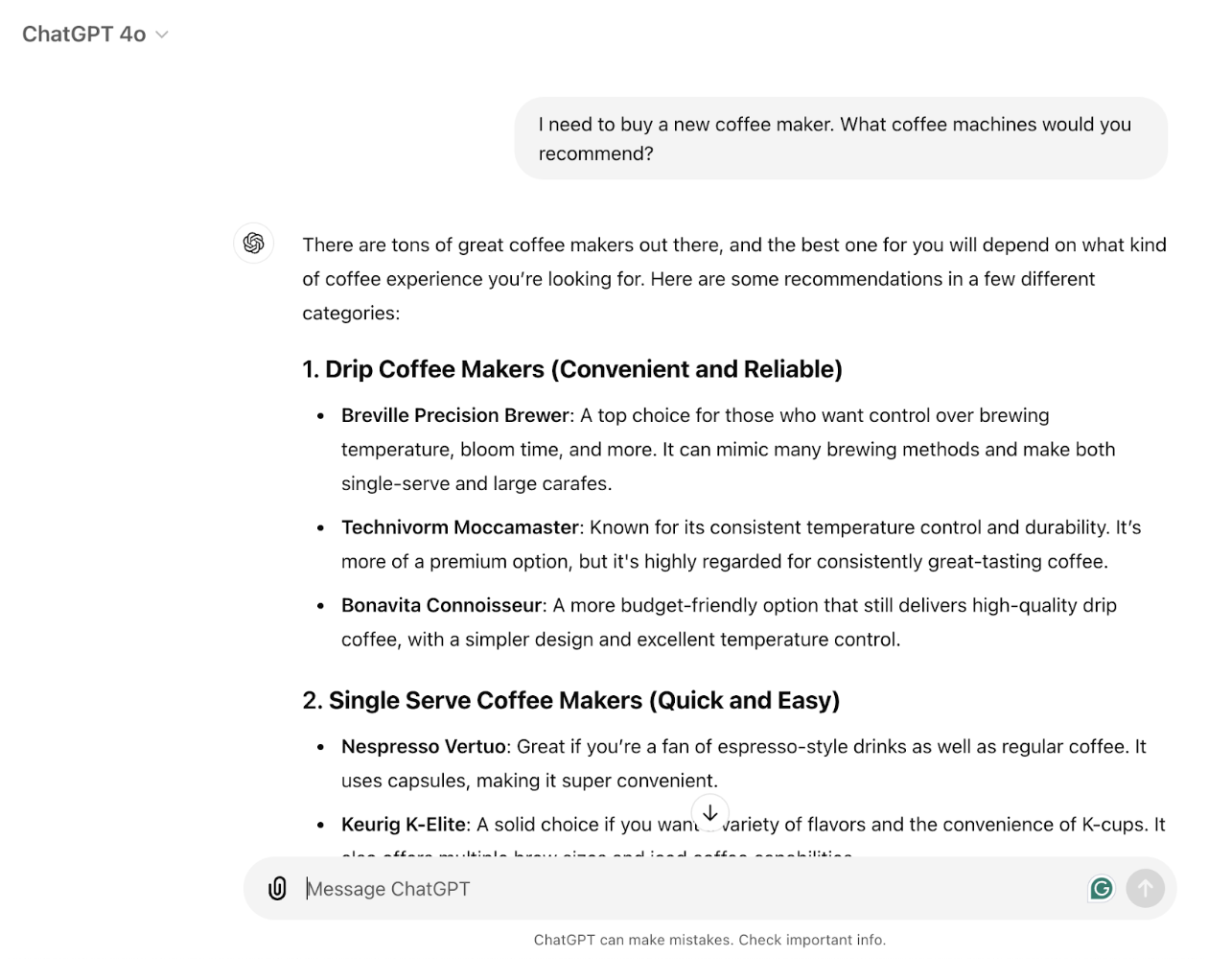
Answers also change with context. Add “for a team of 20 on a £500 budget” to a prompt and you’ll get different recommendations, because the fan-out searches change.
GEO vs SEO: What’s the Difference?
SEO is about ranking in a list of results: position 1, position 2, or (hopefully not) page 2. GEO is about being quoted inside the answer itself. It’s closer to being recommended in a conversation than listed in a directory.
Google’s own view, in its guide to optimising for generative AI features, is that “optimizing for generative AI search is optimizing for the search experience, and thus still SEO.” For Google’s AI features, that’s right. Across ChatGPT, Perplexity and the rest, a few things carry more weight than they do in classic SEO.
| SEO | AI Overviews and AI Mode | GEO across AI tools | |
| What you’re aiming for | A high position in the organic results | A cited link or mention in Google’s AI answer | A mention, citation or recommendation in the answer |
| Where the sources come from | Google’s index | Google’s index | The tool’s training data plus live search (often Bing or Google) |
| What counts most | Relevance, links, technical health, helpful content | The same as SEO, plus clear answers to specific questions | Authority, clear positioning, and mentions on sites the tool trusts, such as reviews, directories, press and forums |
| How you measure it | Rankings, clicks, conversions | AI Overview tracking, clicks | Mention rate, share of voice, sentiment, AI referral traffic |
What GEO and SEO Share
Content quality, keyword and intent research, technical SEO, and links from trusted sites all help in both. Andrew Tuxford, our Head of SEO, explains why SEO has to come first:
“SEO and GEO share a lot of similarities and they pretty much both use all the same building blocks but they put them together in a slightly different way, improving one almost always improves the other as well. You do need to start with a solid foundation of SEO though. SEO is about getting your website found by people, and bots. If the AI bots can’t find and, accurately, index your website, then they can’t evaluate it properly to use in its answers, and that’s where the SEO comes in.”
 Andrew Tuxford
Head of SEO
Where GEO Is Different
- Brand mentions count, even without a link. AI tools form a view of your brand from everything written about it: reviews, Reddit threads, directories, press coverage and comparison articles.
- Third-party lists matter. “Best X for Y” articles and trusted directories are some of the most cited pages in AI answers.
- It’s closer to winner-takes-most. An AI answer might name three to five brands. There’s no page 2 to fall back on.
- Accuracy is your problem too. If AI tools describe your brand wrongly, that’s what thousands of people hear.
How to Optimise for Generative Engines
Start by Interviewing the AI Tools
Before you change anything, ask ChatGPT, Gemini, Claude and Perplexity what they know about your business. Then ask the questions your customers ask: “Who are the best [your service] providers for [your audience]?” and “What does [your brand] specialise in?”
If they’ve never heard of you, or they describe you wrongly, you’ve found your starting point. We once found an AI tool telling people that one of our clients only served one type of customer. It was wrong, but a few old reviews suggested it and nobody had corrected them.
1. Get Your SEO Foundations Right
Most AI tools search the web in the background, and Google’s AI features draw on Google’s index. If search engines can’t crawl and understand your site, AI tools are unlikely to cite it.
- Make sure your important pages can be crawled and indexed, and keep your XML sitemap up to date.
- Use clear, descriptive URLs, and keep the site fast and mobile-friendly.
- Add structured data that matches what’s visible on the page. Google says there’s no special schema you need for its AI features, but accurate markup helps machines understand who you are and what you offer.
- Don’t block the AI crawlers you want to be found by.
Our technical SEO guide covers this in detail.
2. Position Your Brand Clearly
If you’re vague about what you do, AI tools will be too, and they won’t recommend you. Be specific and consistent, on your site and everywhere else, about:
- What you do and what you’re expert in
- Who you serve
- Where you operate
- What problems you solve
- What makes you different
Use the same wording on your About page, service pages, Google Business Profile, LinkedIn and directory listings, so every source tells the same story.
3. Write Content That Answers Real Questions
Remember query fan-out: AI tools search for specific sub-questions. Pages that answer those questions directly are more likely to be used.
- Use clear, descriptive headings, not clever ones.
- Put a short summary or direct answer near the top.
- Keep paragraphs short and use lists where they help.
- Add FAQs that answer questions your customers ask, in their words.
- Write proper image captions and alt text.
- Cover related terms and subtopics naturally. Keyword stuffing doesn’t help here any more than it does in SEO.
You don’t need to chop your content into tiny fragments for AI. Google says plainly that there’s no requirement to break content into tiny pieces. Write for people first and make it easy to scan.
4. Publish Expert-Led Content With Original Evidence
AI tools are getting better at spotting content that says nothing new. Show experience and expertise (Google’s E-E-A-T):
- Stick to what you know, and name the expert behind each piece.
- Back up claims with data, and publish your own research and the numbers behind it, not just the conclusions.
- Cite other experts where it helps the reader, even competitors.
- Update content when things change, not just its date.
5. Get Mentioned Across the Web
AI tools judge your brand by what others say about it. This is where GEO goes furthest beyond on-site SEO.
- Digital PR: earn coverage and links in industry publications and the press. Our digital PR team does this every day.
- Thought leadership: write for trade publications, speak at events, appear on podcasts and get quoted.
- Lists and directories: get included in the “best X” articles and directories that AI tools cite in your sector.
- Reviews: collect reviews on Google and platforms such as Trustpilot, Feefo and Reviews.io, and reply to them, good and bad.
- Communities: keep an eye on Reddit, Quora and industry forums, and take part where you can genuinely help.
- Listings: keep business listings accurate everywhere.
Avoid shortcuts. Google warns that pages made mainly to manipulate AI answers break its scaled content abuse spam policy.
6. Make Short, Useful Videos
YouTube is one of the sources AI tools cite, especially Google’s. Short videos that answer specific questions, embedded in the relevant blog posts and service pages, give you another way into the answer.
7. Optimise for AI Overviews and AI Mode
Google’s AI answers draw on pages that already rank well and answer the question clearly. Our guide to ranking in AI Overviews goes into the detail.
Where to Start
You don’t need to rewrite your whole website. Start small:
- Pick three to five key pages, usually your main service pages.
- Ask the AI tools about those topics and see who they mention.
- Note the gaps between what you offer and what the AI says.
- Fix those gaps on your site, then work on the third-party sources the AI tools are citing.
- Check again every month.
What’s Changed in 2026
- Google published official guidance. Its guide to optimising for generative AI features confirms that SEO best practice still applies to its AI features.
- llms.txt isn’t needed for Google. Google says creating llms.txt files will “neither harm nor help” your visibility in Google Search, as it ignores them. Other AI tools may use them, so treat them as optional.
- AI agents are arriving. Tools such as ChatGPT agent can browse, compare and act for users, so clear, crawlable pages with accurate prices and details matter even more.
- Tracking has improved. There are now dedicated AI visibility tools, which we cover below.
How to Measure GEO
There’s still no single number for GEO, so track a few signals together:
- Mention rate and share of voice. How often AI tools mention your brand for the prompts that matter to you, compared with competitors. AI visibility tools such as Peec AI, Semrush’s AI Visibility Toolkit and SE Ranking run a fixed set of prompts every day and track the answers.
- Citations. Which of your pages the AI tools link to, and which third-party sites they cite instead of you. That second list is your digital PR target list.
- Accuracy and sentiment. Whether AI tools describe you correctly and positively. Read the answers yourself, not just the scores.
- AI Overview appearances. Rank trackers such as Semrush Position Tracking show which of your keywords trigger an AI Overview and whether you’re cited in it.
- AI referral traffic. In GA4, build a report or segment for traffic from chatgpt.com, perplexity.ai, gemini.google.com, copilot.microsoft.com and similar sources, and look at sessions, conversions and landing pages.
- Branded search. People often check an AI recommendation by searching your name on Google, so a rise in branded searches can be a sign your GEO is working.
AI answers vary from one run to the next, so judge trends over weeks and months, not single answers.
Does GEO Work?
The research is still young. The original GEO paper found that methods such as adding citations, quotations and statistics could boost a source’s visibility by up to 40% in generative engine responses. That was on the authors’ own test set, not live search, so take the exact number with a pinch of salt. The direction matches what we see in practice: clear, well-evidenced content from brands that others talk about gets cited more.
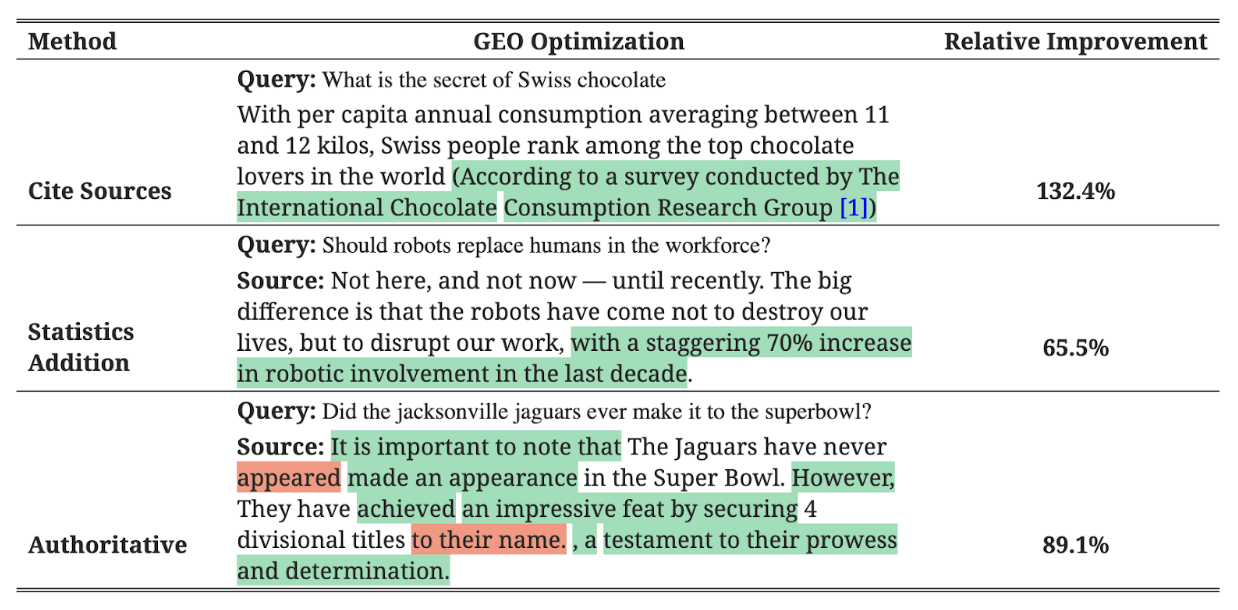
Table from GEO: Generative Engine Optimization by Aggarwal et al.
The Challenges of GEO
- Answers change constantly. Models are updated often, and the same prompt can return different brands on different days.
- Bias in training data. AI tools can repeat outdated or one-sided views of your brand, and fixing them takes time.
- Misinformation. AI tools sometimes get things wrong with total confidence, which is why monitoring accuracy matters.
- Over-optimisation. Content written to game AI tools tends to read badly for people, and Google treats it as spam.
- Fewer slots. An answer that names three brands leaves little room, so competition for those places is tough.
GEO Across Industries
GEO matters most where buyers research carefully before they get in touch. B2B brands are increasingly shortlisted by AI tools when buyers ask for supplier recommendations. Financial services brands see people asking AI tools about mortgages, investments and insurance before they speak to anyone. Regulated sectors need extra care, because AI tools may repeat claims you’d never be allowed to make yourself.
Want to hear more? Listen to our podcast episode on GEO.
GEO FAQs
What is GEO in marketing?
GEO (generative engine optimisation) is optimising your website and wider online presence so that AI tools such as ChatGPT, Gemini, Claude, Perplexity and Google’s AI Overviews mention, cite and recommend your brand in their answers.
How is GEO different from SEO?
SEO aims for a high position in a list of search results. GEO aims for a mention or citation inside an AI-written answer. They share the same foundations, but GEO puts more weight on brand mentions, clear positioning and what third-party sites say about you.
Which platforms does GEO cover?
ChatGPT, Google Gemini, Google AI Overviews and AI Mode, Perplexity, Claude and Microsoft Copilot, plus any other tool that writes answers from web sources.
Is GEO the same as AEO?
Very nearly. Answer engine optimisation (AEO) and GEO describe the same goal, being the answer AI tools give, and the tactics overlap almost completely.
How long does GEO take to work?
There’s no fixed timeline. On-site changes can show up in AI tools that search live within weeks, while changing how AI tools see your brand through mentions and reviews takes months.
Do I need an llms.txt file?
Not for Google. Google says it ignores llms.txt files, so they won’t help or harm your visibility in Google Search. Some other AI tools may read them, so they’re optional.
Speak to Our Consultants
Want to know how AI tools talk about your brand, and what to do about it? Our generative engine optimisation team can show you where you stand and what to do first.